
Telephone traffic data association and integration method
A traffic and data technology, applied in the field of association and integration of traffic data, can solve the problem of destroying the integrity of traffic data, unfavorable call center management and monitoring traffic data query and analysis, and inability to effectively trace traffic data link traces, etc. question
Patent Information
- Authority / Receiving Office
- CN · China
- Current Assignee / Owner
- Publication Date
- 2019-12-03
Smart Images
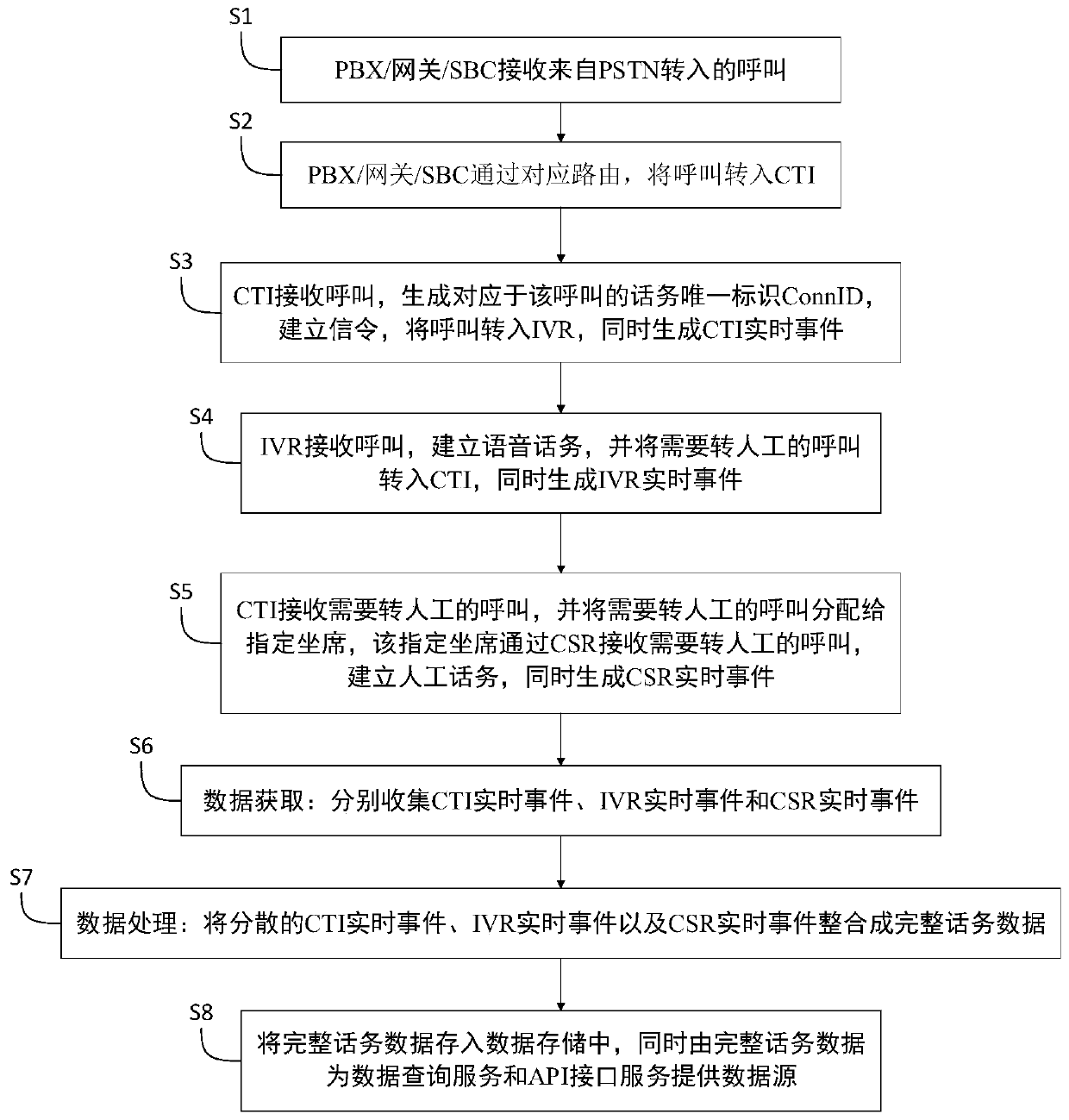
Figure 1 
Figure 2
Abstract
Description
technical field
[0001] The invention relates to the technical field of traffic data processing in a call center, in particular to a method for associating and integrating traffic data. Background technique
[0002] With more and more intelligent service and IVR (Interactive Voice Response, Interactive Voice Response) service nodes, PBX (Private Branch Exchange, private branch exchange) / gateway / SBC (Session Border Controller, session border controller) and CTI of the call center (Computer Telecommunication Integration, computer telecommunications integration), IVR, and CSR (Customer Service Representative, customer service representative) are becoming more and more scattered. It is impossible to trace the link track of customer traffic data, and it also destroys the traffic The integrity of the data is not conducive to the management and monitoring of the call center and the query and analysis of the traffic data.
[0003] Chinese patent CN105592236B proposes a traffic data ...
Examples
Embodiment Construction
[0041] The present invention will be described in detail below in conjunction with the accompanying drawings and specific embodiments.
[0042] like figure 1 As shown, a method for associating and integrating traffic data includes the following steps:
[0043] S1. The PBX / gateway / SBC receives incoming calls from the PSTN;
[0044] S2. The PBX / gateway / SBC transfers the call to the CTI through the corresponding route;
[0045] S3, CTI receives the call, generates the traffic unique identifier ConnID corresponding to the call, establishes signaling, transfers the call to the IVR, and generates a CTI real-time event at the same time;
[0046] S4. The IVR receives the call, establishes voice traffic, and transfers the call that needs to be transferred to the CTI, and generates an IVR real-time event at the same time;
[0047] S5, CTI receives the call that needs to be transferred to manual, and assigns the call that needs to be transferred to a designated agent, and the designat...