

Checking method and system for password-free payment transaction
A password-free payment and transaction technology, which is applied in the field of verification methods and systems for password-free payment transactions, can solve the problems that bank cards are easily stolen and swiped, hidden in pockets, and the function of password-free payment is noticed, thereby improving security. sexual effect
Patent Information
- Authority / Receiving Office
- CN · China
- Current Assignee / Owner
- Publication Date
- 2019-12-13
- Estimated Expiration
- Not applicable · inactive patent
Smart Images
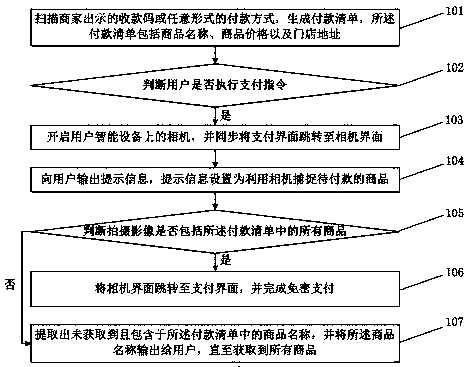
Figure 1 
Figure 2 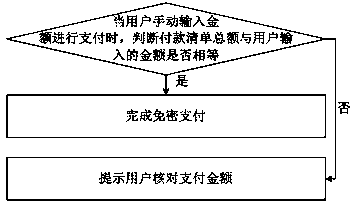
Figure 3
Abstract
Description
technical field
[0001] The invention relates to the field of financial transactions, in particular to a checking method and system for secret-free payment transactions. Background technique
[0002] Nowadays, when people apply for a bank card, the password-free payment function will be enabled by default. Users need to apply to turn off this function through online banking or bank counters. However, most users have not noticed the password-free payment function in the card application agreement. , or users feel that the password-free payment function has played a positive role in payment, so most users' bank cards retain the password-free payment function, but the password-free payment function also has certain defects.
[0003] For example, if the bank card that is not commonly used by the user is lost or stolen, it is difficult for the user to find out in time, and there is a great risk of being stolen. In addition, when the bank card is close to the POS machine, it can be...
Examples
Embodiment 1
[0068] Such as figure 1 As shown, this embodiment provides a verification method for password-free payment transactions, which is applied to the user's smart device and associated with a bank card, including the following steps:
[0069] S101: Scan the payment code presented by the merchant or any form of payment method to generate a payment list, the payment list includes the name of the product, the price of the product and the address of the store.
[0070] S102: Determine whether the user executes the payment instruction.
[0071] S103: If yes, turn on the camera on the user's smart device, and synchronously jump the payment interface to the camera interface.
[0072] S104: Output prompt information to the user, where the prompt information is set to use a camera to capture commodities to be paid.
[0073] S105: Extract the photographed image acquired by the camera, and determine whether the photographed image includes all commodities in the payment list.
[0074] S106: I...
Embodiment 2
[0094] Such as image 3 As shown, this embodiment provides a checking method. When the user manually enters the amount for payment, it is judged whether the total amount of the payment list is equal to the amount entered by the user before completing the confidentiality-free payment.
[0095] If yes, the password-free payment is completed.
[0096] If not, the user is prompted to check the payment amount.
[0097] Such as Figure 4 As shown, if the total amount of the payment list is not equal to the amount input by the user, it is judged whether there is a voucher or a red envelope in this payment.
[0098] If so, then compare the total amount of the payment list minus the voucher or red envelope with the amount input by the user to determine whether they are equal.
[0099] If yes, the password-free payment is completed.
[0100] If not, the user is prompted to check the payment amount.
[0101] Specifically, there are two situations in which the merchant shows the paym...
Embodiment 3
[0105] Such as Figure 5 As shown, this embodiment provides a collection account checking method, which extracts the collection account information, and judges whether the collection account information is a legal collection account of the store through the method of big data analysis according to the store address.
[0106] If yes, continue to execute S102.
[0107] If not, close the transaction.
[0108] Specifically, when the user scans the collection code presented by the merchant, the processor will conduct big data analysis based on the name of the store the user consumes, and sort out the collection account number used by the store. If the store does not have a special collection account number, Then allow the user to confirm the payment. If the big data analysis shows that the store has several collection accounts, it is judged whether the collection account is located in it. If so, the user is allowed to confirm the payment. If not, the transaction is closed to preve...