
Pulse current generation method for battery testing
A pulse current and battery testing technology, which is applied to the parts of electrical measuring instruments, the improvement of basic electrical components, and the measurement of electricity. state accuracy, precise amplitude control, and precise pulse time control
Patent Information
- Authority / Receiving Office
- CN · China
- Patent Type
- Applications(China)
- Current Assignee / Owner
- Publication Date
- 2020-11-17
Smart Images
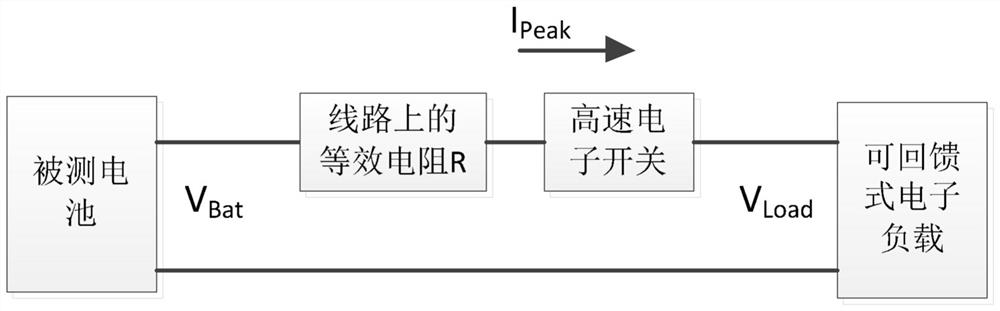
Figure 1 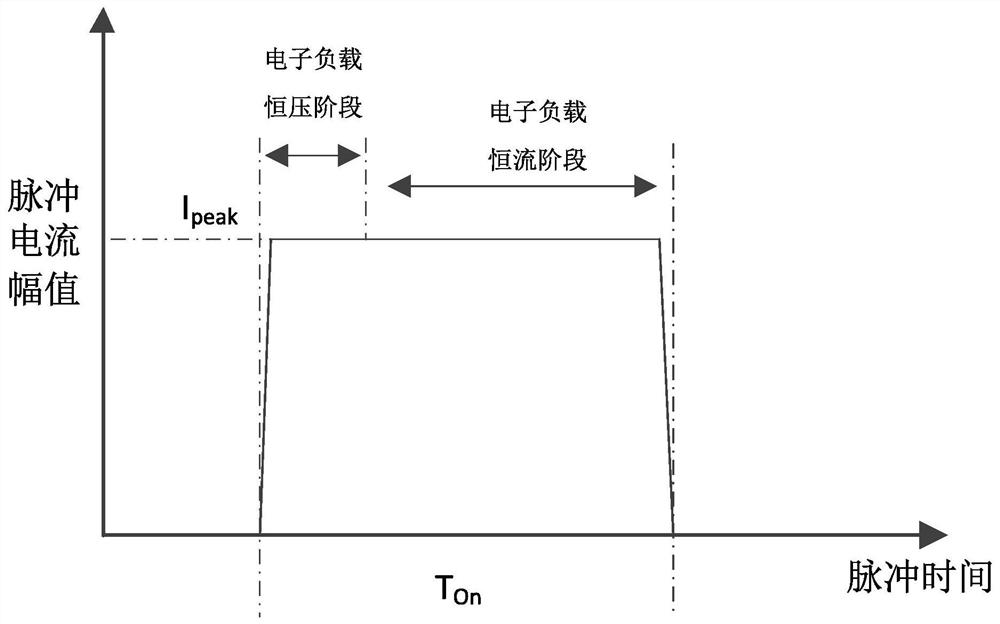
Figure 2 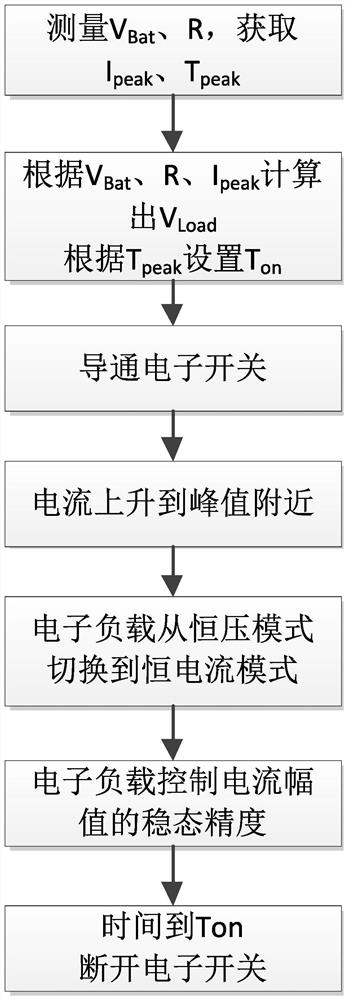
Figure 3
Abstract
Description
technical field
[0001] The invention relates to the field of pulse current generation, in particular to a pulse current generation method for battery testing. Background technique
[0002] Various lithium batteries, lead-acid batteries, hydrogen fuel cells, etc. are widely used in production and life. In the process of battery research and development and factory inspection, it is necessary to conduct a pulse current discharge test on the battery, that is, let the battery output a pulse current in a short time;
[0003] However, there are certain deficiencies in the existing ones that need to be improved. First of all, the existing battery pulse current test topology can be seen in Figure 4 , the electronic load is directly connected to the battery. If you want to generate a pulse current, you need to control the voltage VLoad of the electronic load, so that VLoad quickly drops and rises to form a voltage difference with VBat, thereby generating current. The rising and falli...
Examples
Embodiment Construction
[0035] In order to make the technical means, creative features, goals and effects achieved by the present invention easy to understand, the present invention will be further described below in conjunction with specific embodiments.
[0036] Such as Figure 1-4 As shown, a pulse current generation method for battery testing, the method specifically includes the following steps:
[0037] Step 1: Measure VBat, R, obtain Ipeak, Tpeak;
[0038] Step 2: Calculate Vload according to VBat, R, and Ipeak, and set Ton according to Tpeak;
[0039] Step 3: turn on the high-speed electronic switch;
[0040] Step 4: The current rises to near the peak value;
[0041] Step 5: The electronic load switches from constant voltage mode to constant current mode;
[0042] Step 6: The electronic load controls the steady-state accuracy of the current amplitude;
[0043] Step 7: Turn off the electronic switch when the time is up to Ton;
[0044] The measured battery voltage is VBat, the regenerati...