
Rock core tensile strength testing device and method under confining pressure based on Brazilian splitting
A Brazilian splitting and testing device technology, which is applied to measuring devices, using stable tension/pressure to test material strength, strength characteristics, etc., can solve the problem of inability to simulate confining pressure applied to rock cores, insufficient accuracy of experimental results, and difficult to meet Accurate positioning of small-volume rock cores and other issues, to achieve the effect of reducing the experimental deviation rate, improving accuracy and stability, and compact device structure
Patent Information
- Authority / Receiving Office
- CN · China
- Patent Type
- Patents(China)
- Current Assignee / Owner
- Publication Date
- 2021-08-27
Smart Images
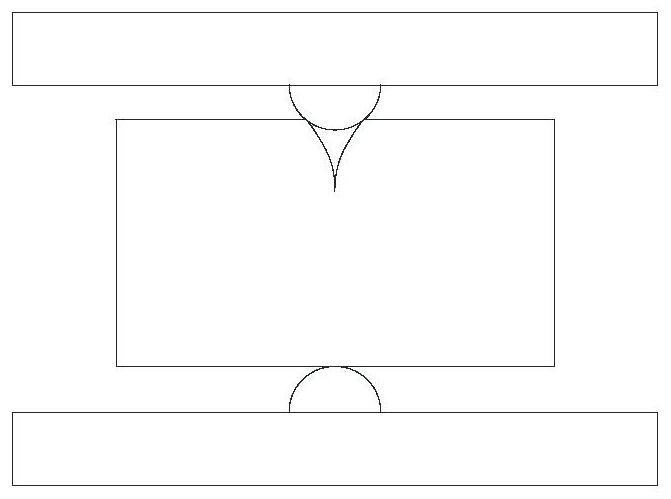
Figure 1 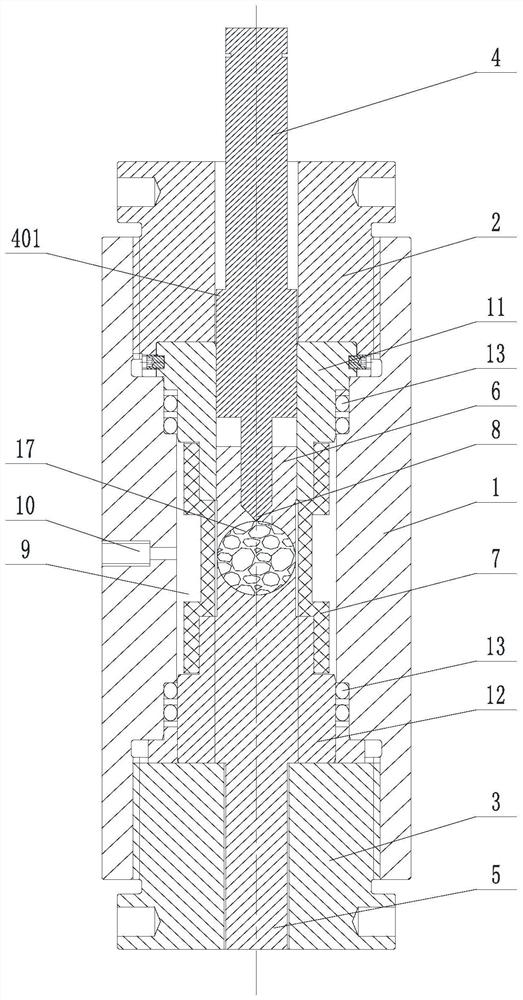
Figure 2 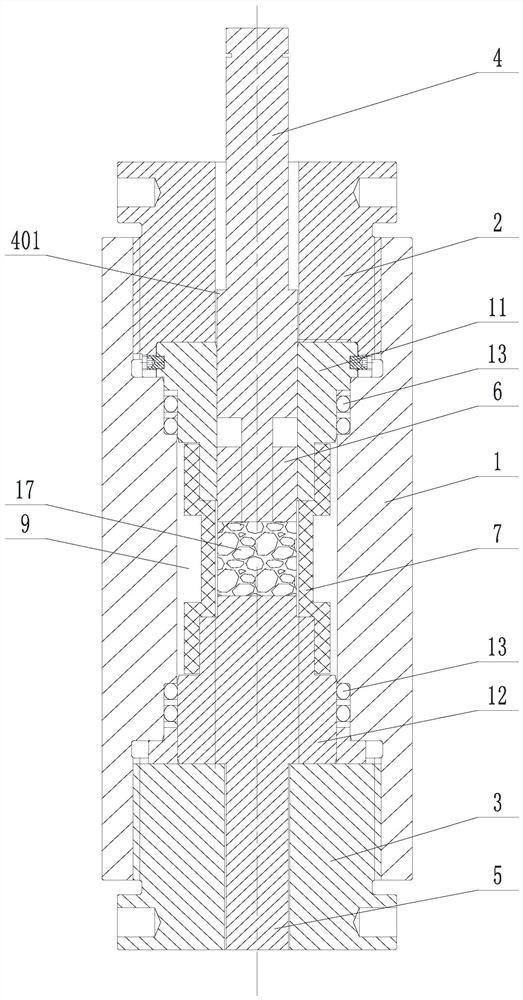
Figure 3
Abstract
Description
technical field
[0001] The invention relates to the field of petroleum and natural gas, in particular to a device and method for testing rock core tensile strength under confining pressure conditions based on Brazilian splitting. Background technique
[0002] In the field of oil and gas, the tensile strength of formation rock is an important geological parameter, which is closely related to the wellbore stability during drilling and hydraulic fracturing during stimulation. Tensile strength is a basic concept in rock mechanics courses, an important mechanical property of rocks, and an important parameter in the stability analysis of rock structures. As a typical brittle material, the tensile strength of rock is much smaller than its compressive strength. When the tensile stress on the rock is higher than the tensile strength of the rock, the rock will undergo tensile failure, and its failure is usually controlled by the tensile strength. Therefore, the rock Accurate measurem...
Examples
Embodiment 1
[0053] Such as Figure 2 to Figure 3 , Figure 6 to Figure 7 The shown rock core tensile strength test device under the confining pressure condition based on Brazil splitting, wherein figure 2 and image 3 It is a schematic diagram of the same structure in different sections; it includes a cylinder body 1, and the upper and lower ends of the cylinder body 1 are respectively detachably connected to the upper pressure head 2 and the lower pressure head 3; the cylinder body 1 is provided with a guide cylinder 6 and a rubber sleeve 7, It also includes a pressing rod 4 passing through the upper pressing head 2 and the guide cylinder 6 in the axial direction, and a support rod 5 passing through the lower pressing head 3 in the axial direction. The pressing rod 4 is slidingly fitted with the upper pressing head 2 and the guiding cylinder 6, The supporting rod 5 is detachably fixedly connected with the lower pressing head 3, and the bottom end of the pressing rod 4 and the top end ...
Embodiment 2
[0069] Such as Figure 4 to Figure 7 The shown rock core tensile strength test device under the confining pressure condition based on Brazil splitting, wherein Figure 4 and Figure 5 It is a schematic diagram of the same structure in different sections; the difference between this embodiment and Embodiment 1 is that it also includes an annular piston 14 outside the pressure rod 4, the outer wall of the annular piston 14 is in contact with the inner wall of the upper pressing head 2, and the annular piston 14 is in contact with the pressure rod. 4 is relatively fixed in the axial direction; it also includes a piston fluid inlet 15 provided on the barrel 1 and / or the upper pressure head 2, and the fluid applied to the piston fluid inlet 15 pushes the annular piston 14 downward. The top of the pressure rod 4 is sleeved with a hollow tightening bolt 16. The pressure rod 4 includes a diameter-expanding portion 401. The tightening bolt 16 is located above the diameter-expanding po...