
Periodic gap constrained negative sequence pattern mining method
A pattern mining and negative sequence technology, applied in special data processing applications, instruments, knowledge expression, etc., can solve problems such as inability to take into account negative sequences
Patent Information
- Authority / Receiving Office
- CN · China
- Patent Type
- Applications(China)
- Current Assignee / Owner
- Publication Date
- 2021-07-06
- Estimated Expiration
- Not applicable · inactive patent
Smart Images
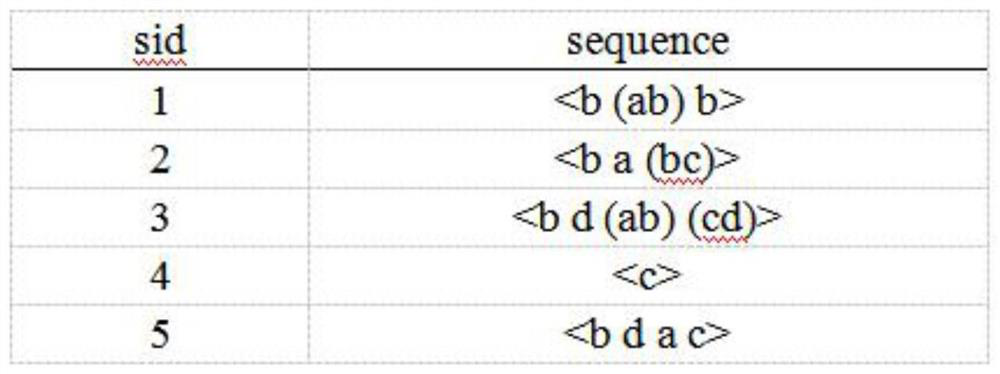
Figure 1 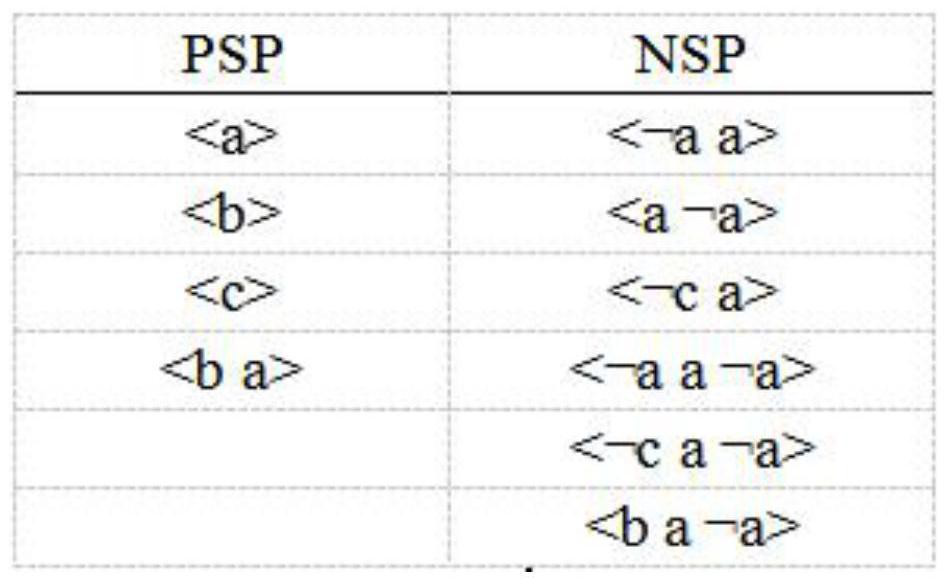
Figure 2 
Figure 3
Abstract
Description
technical field
[0001] The technical solution of the invention relates to the field of sequence pattern analysis, in particular to a negative sequence pattern mining method with periodic gap constraints. Background technique
[0002] With the rapid development of artificial intelligence, data is playing an increasingly important role in our lives, and countless sequence data have emerged in many fields, such as biometric information mining, group behavior analysis, malicious network attack investigation, customer Purchase information analysis, etc. These data are huge in size and have multi-category and multi-dimensionality. How to quickly and effectively extract valuable information from these data has become a hot spot in current scientific research. In order to discover these valuable information, sequential pattern mining came into being, and as an important branch of data mining, it has been widely used. However, sequential pattern mining only focuses on appearing ele...
Examples
Embodiment 1
[0117] Given a sequence database D={s 1 = d 1 d 2 d 3 d 4 d 5 d 6 d 7 d 8 d 9 d 10 =ttcctccgcg,s 2 = d 1 d 2 d 3 d 4 d 5 =tggct}, given the density threshold ρ=0.1, the minimum gap constraint M=0, and the maximum gap constraint N=2.
[0118] The first step is to read the sequence database D given by the user, the threshold ρ and the period gap constraint [M,N]:
[0119] Read into the sequence database D, it can be seen that D has a total of g sequences, and each sequence is recorded as sequence s 1 , sequence s 2 , ..., sequence s g , where the sequence s i The elements contained in (1≤i≤g) are respectively denoted as element d 1 , element d 2 , ..., element d l , that is, the length is l, read in D to get h different elements, and get the element set E={e 1 、e 2 ...e h }. Read in the threshold ρ, and read in the periodic gap constraint [M,N].
[0120] The specific processing method is as follows:
[0121] Read int...