
A PTZ Attitude Estimation Method Based on Extended Kalman Filtering
An extended Kalman and attitude estimation technology, applied in the field of Kalman filtering, can solve problems such as lack of accuracy and unsatisfactory results, and achieve the effects of improving accuracy, avoiding mutual interference, and reducing influence
Patent Information
- Authority / Receiving Office
- CN · China
- Patent Type
- Patents(China)
- Current Assignee / Owner
- Publication Date
- 2022-07-01
Smart Images
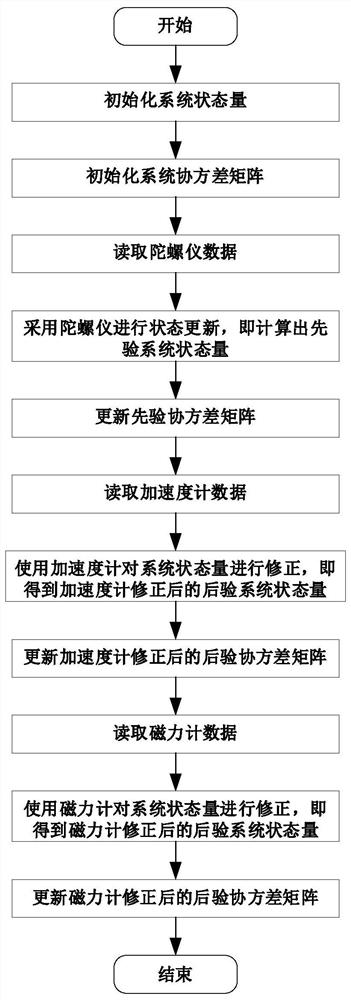
Figure 1 
Figure 2 
Figure 3
Abstract
Description
technical field
[0001] The invention relates to Kalman filtering technology, in particular to a pan-tilt attitude estimation algorithm based on quaternion extended Kalman filtering. Background technique
[0002] In recent years, with the wide application of smart devices such as handheld PTZs, people have put forward higher requirements for their stability and accuracy. It is particularly important to make these devices work more stably and obtain more accurate attitude estimation information. important. In most attitude estimation algorithms, the gyroscope is used to update the attitude information, and the accelerometer and the magnetometer are used to correct the attitude information. At present, the widely used attitude estimation algorithms include Kalman filter algorithm and complementary filter algorithm, both of which can reduce the influence of Gaussian noise on attitude estimation, and can also reduce the cumulative error caused by gyroscope drift.
[0003] Howev...
Examples
Embodiment Construction
[0087] The present invention will be described in detail below with reference to the accompanying drawings and embodiments.
[0088] like figure 1 As shown, the present invention is based on a pan-tilt attitude estimation method based on extended Kalman filtering, including:
[0089] 1. The heading and attitude reference system (AHRS) is used to provide the gimbal controller with more accurate attitude information. The attitude information is represented by Euler angles, which include pitch angle, roll angle and yaw angle. The pitch angle is the rotation angle Φ of the gimbal around the Y axis; the roll angle is the rotation angle θ of the gimbal around the X axis; the yaw angle is the rotation angle ψ of the gimbal around the Z axis. AHRS provides the navigation coordinate system and the body coordinate system. The direction cosine matrix (DCM) represents the relationship between the two coordinate systems, and includes the relevant attitude information of the gimbal. Due to...