
Resource allocation method for industrial wireless network based on multi-agent deep reinforcement learning
An industrial wireless network and resource allocation technology, applied in the field of industrial wireless network resource allocation and resource allocation based on multi-agent deep reinforcement learning, can solve the problems of difficult to track dynamic changes of system information, increase delay, energy consumption, etc. Real-time efficient processing, strong versatility and practicability, and the effect of improving system security and stability
Patent Information
- Authority / Receiving Office
- CN · China
- Patent Type
- Patents(China)
- Current Assignee / Owner
- Publication Date
- 2022-05-06
Smart Images
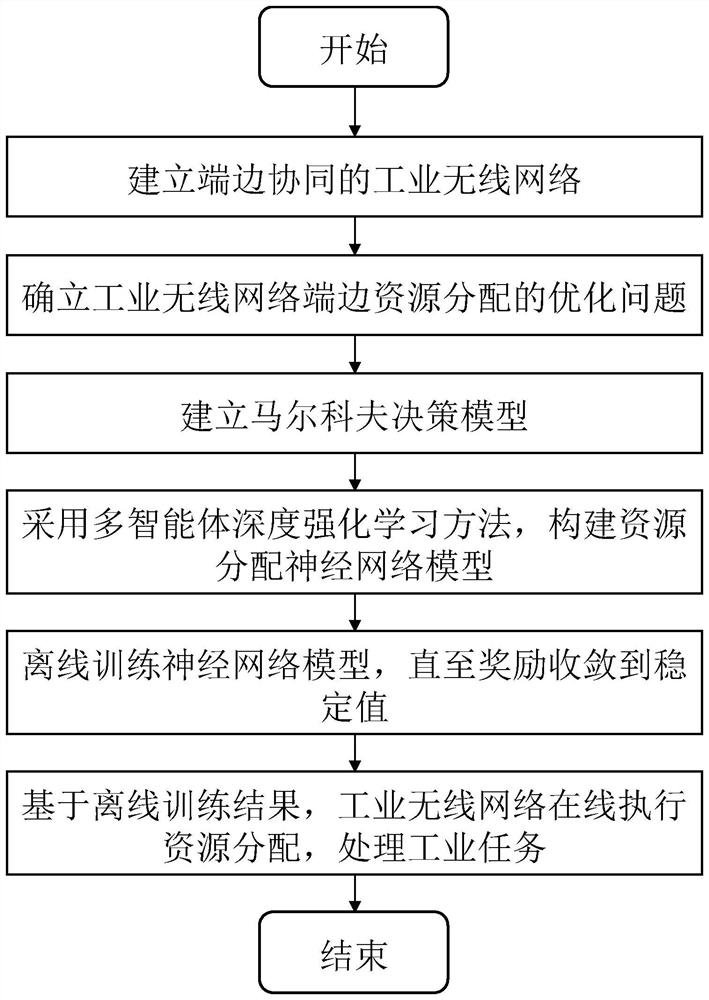
Figure 1 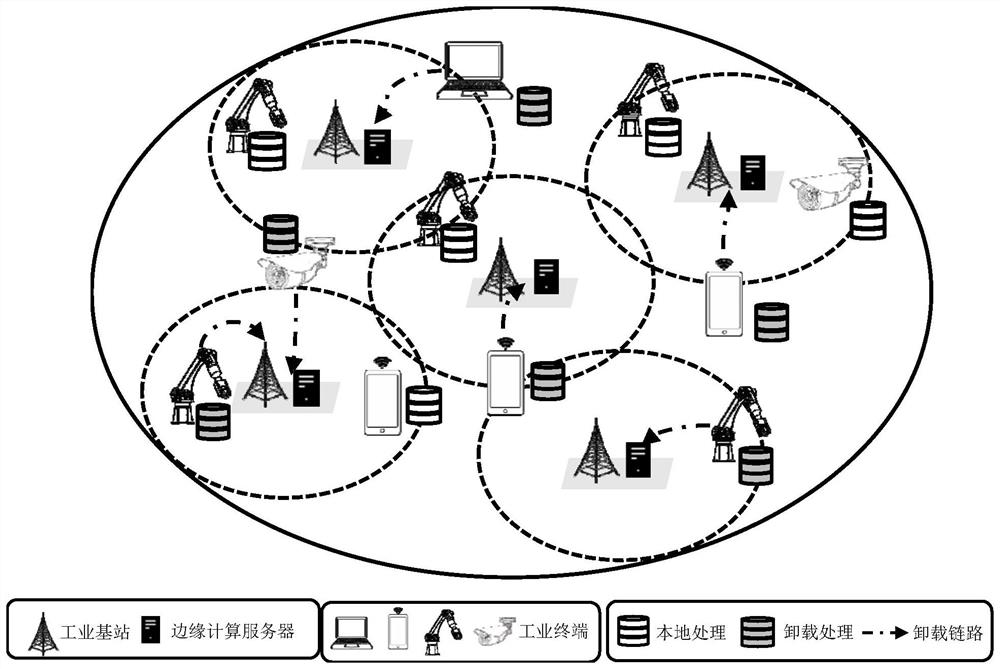
Figure 2 
Figure 3
Abstract
Description
technical field
[0001] The invention relates to resource allocation under the constraints of limited energy and computing resources, belongs to the technical field of industrial wireless networks, and specifically relates to an industrial wireless network resource allocation method based on multi-agent deep reinforcement learning. Background technique
[0002] With the development of Industry 4.0, a large number of distributed industrial terminals are interconnected through industrial wireless networks, resulting in massive calculation-intensive and delay-sensitive industrial tasks. However, the local energy and computing resources of industrial terminals are limited, and it is difficult to meet the quality of service requirements of industrial tasks.
[0003] The edge computing server deployed on the edge of the network can provide nearby computing resource support for industrial terminals, but the large-scale concurrent offloading of industrial terminals will cause full lo...
Examples
Embodiment Construction
[0070] The present invention will be further described in detail below in conjunction with the accompanying drawings and embodiments.
[0071] The invention relates to industrial wireless network technology, comprising the following steps: establishing an industrial wireless network with terminal-side collaboration; establishing an optimization problem for resource allocation between industrial wireless network terminals; establishing a Markov decision model; adopting a multi-agent deep reinforcement learning method to construct Resource allocation neural network model; train the neural network model offline until the reward converges to a stable value; based on the offline training results, the industrial wireless network performs resource allocation online to process industrial tasks. Aiming at the service quality requirements of computing-intensive and delay-sensitive industrial tasks generated by industrial terminals in industrial wireless networks, the present invention es...