
Photoelectric type semiconductor safety unit
A security unit and semiconductor technology, applied in electrical components, circuit devices, emergency protection circuit devices for limiting overcurrent/overvoltage, etc., can solve problems such as chronic air leakage, slow alarm speed, and endangering equipment and personal safety. Achieve the effects of improving response speed, increasing functions, and saving maintenance costs
Patent Information
- Authority / Receiving Office
- CN · China
- Patent Type
- Patents(China)
- Current Assignee / Owner
- Publication Date
- 2006-10-18
- Estimated Expiration
- Not applicable · inactive patent
Smart Images
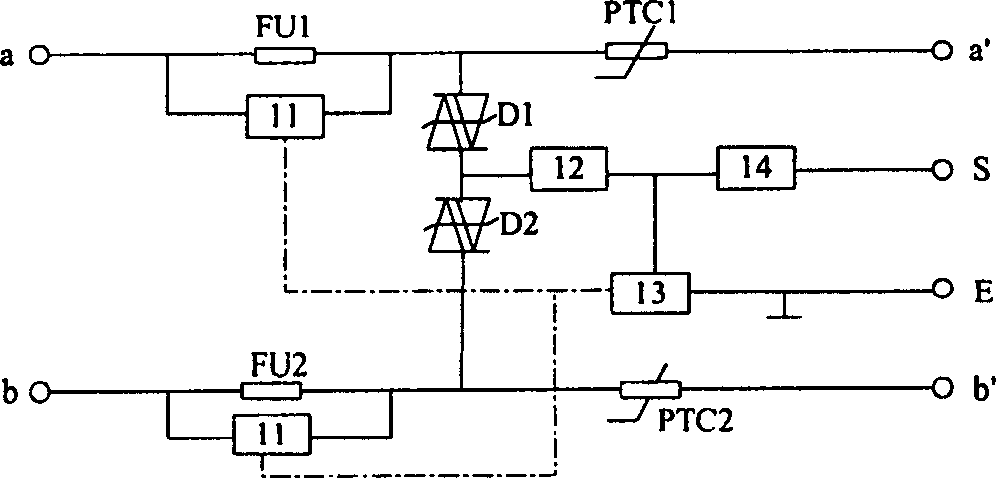
Figure 1 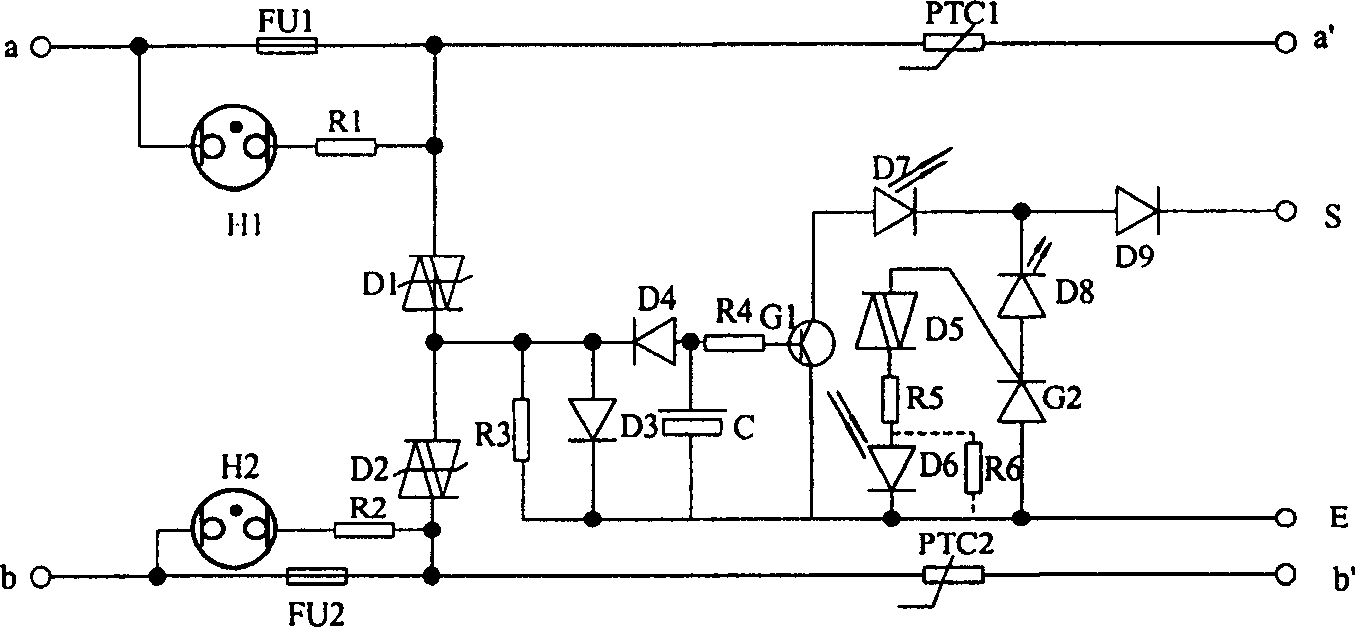
Figure 2 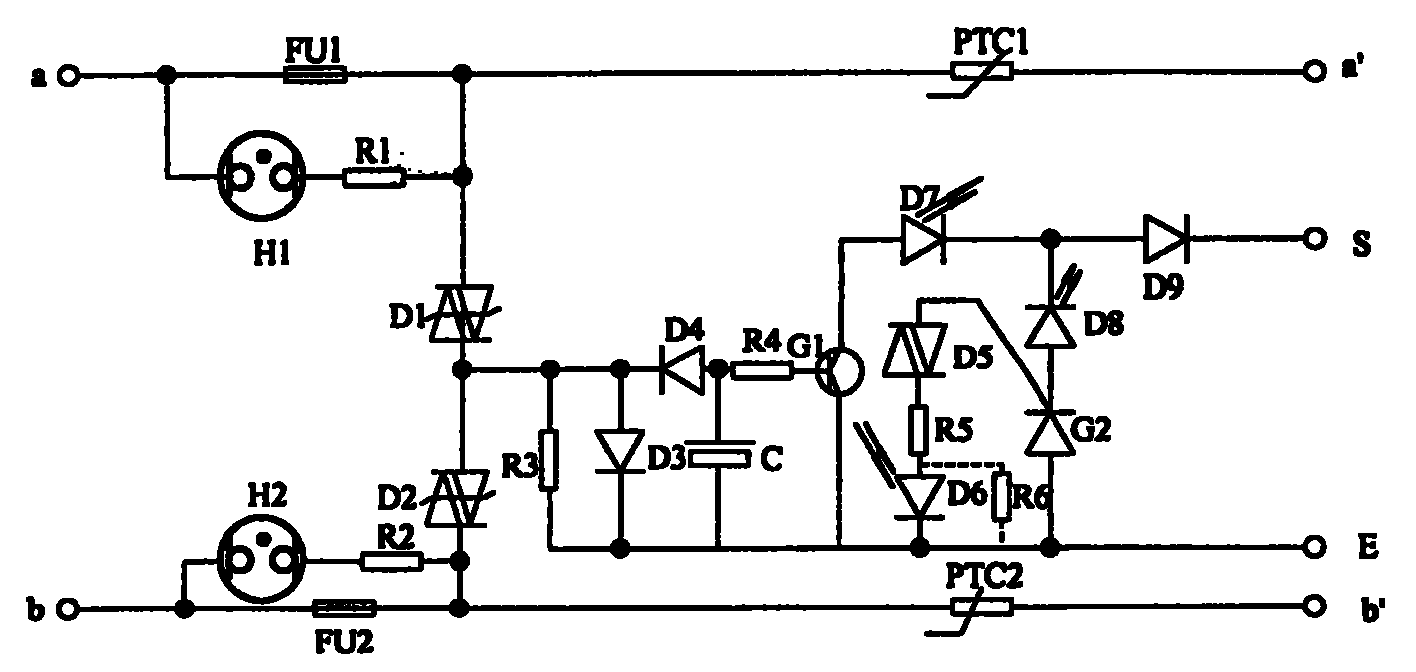
Figure 3
Abstract
Description
technical field
[0001] The present invention relates to a security technology for communication equipment, more specifically to a semiconductor security unit, which is applied to the main distribution frame of a telephone exchange and connected between the incoming cable and the telephone exchange equipment. Provide protection and alarm for overvoltage, overcurrent protection and lightning strike protection. Background technique
[0002] The security unit is a protective device for overvoltage and overcurrent in telecommunications equipment such as distribution frames. Most of the security units currently in use use gas discharge tubes for overvoltage and overcurrent protection components. In addition to the gas discharge tube, the security unit using the gas discharge tube also includes a compression spring, a metal jacket of the discharge tube, a short circuit, a low-temperature tin block (or a hot coil), a propulsion shaft, an alarm signal moving piece, and an alarm sign...
Examples
Embodiment Construction
[0019] see figure 1 , The photoelectric semiconductor security unit is connected between the incoming terminals a, b of the telephone cable, the incoming terminals a', b' of the telecommunication switching equipment and the terminals S, E of the alarm system, mainly including two parts of the protective device and the alarm circuit. The protective device includes fuses FU1 and FU2 respectively connected in series in a, a' and b, b' lines, positive temperature coefficient thermistors PTC1 and PTC2, and two series-connected semiconductor tubes connected in parallel on lines a and b. D1, D2, when there is overvoltage at terminal a or overvoltage at terminal b or overvoltage at both terminals a and b, and the current exceeds the rated value of the fuse, fuse FU1 will blow or FU2 will blow or FU1 and FU2 will blow at the same time; When the current does not exceed the rated value of the fuse, the semiconductor tube D1 or D2 is broken down, and the overvoltage is "short-circuited" t...