
Method and apparatus for unifying light beams
Patent Information
- Authority / Receiving Office
- US · United States
- Current Assignee / Owner
- Publication Date
- 2002-05-02
- Estimated Expiration
- Not applicable · inactive patent
Smart Images
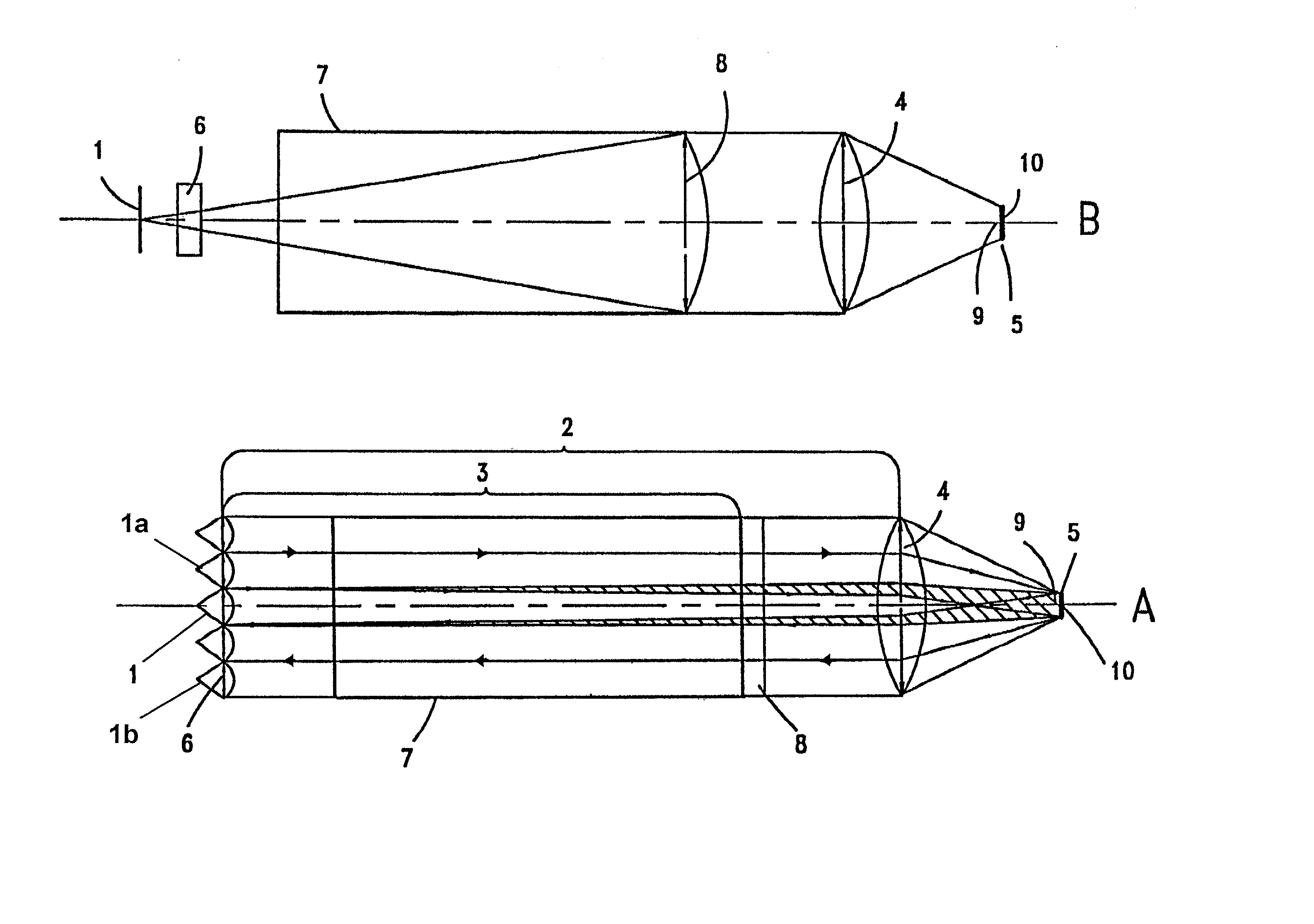
Figure 1 
Figure 2 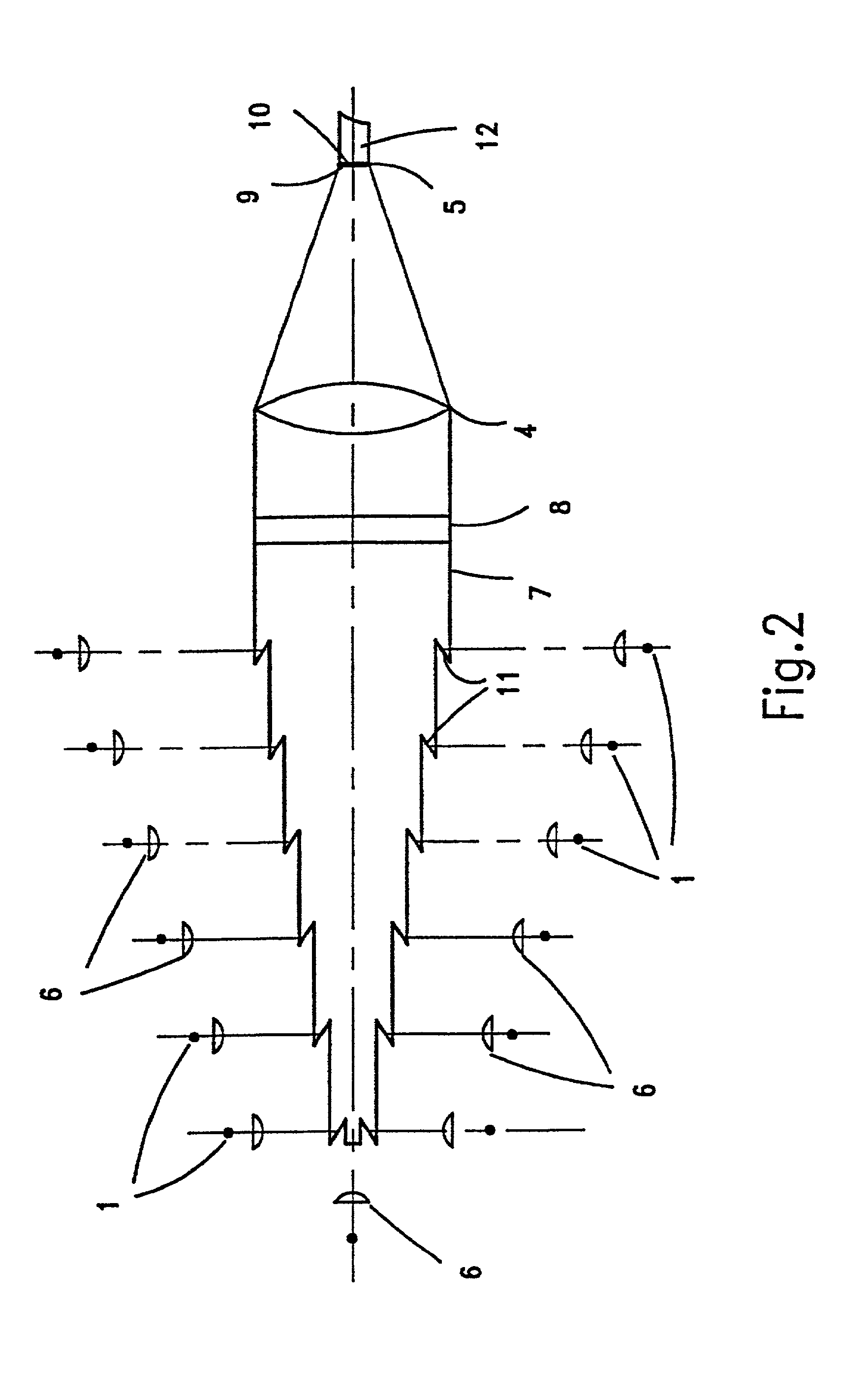
Figure 3
Abstract
Description
SPECIFICATION
[0001] This application is a continuation-in-part of application Ser. No. 09 / 783,475 filed Feb. 14, 2001. This application is also a continuation-in-part of PCT / RU / 00363 filed Nov. 4, 1998 designating the U.S. and published in Russian on May 11, 2000 as WO 00 / 27002. This application additionally claims priority from Israeli Patent Application No. 140,386 filed Dec. 18, 2000
[0002] The present invention relates to a method and a device for unifying the beams produced by light sources, particularly laser diodes, so as to obtain a unified beam having high power, high brightness and high output density, adapted to be focused especially on optical fiber cross-sections.DESCRIPTION OF THE PRIOR ART
[0003] One of the problems of great importance in laser engineering consists in providing coherent light sources having high brightness and high power output density wherein such light could be coupled e.g. into an optical fiber of 50 .mu.m diameter.
[0004] Known are various structures...
Examples
Embodiment Construction
[0018] The invention aims to provide a light-emitting adder or light unifier, which comprises a plurality of light sources, particularly laser sources, each of which emits a beam having a rectangular cross-section in a plane perpendicular to the source optical axis, viz. perpendicular to the direction of propagation of the emitted beam. Said cross-section has a long side and a short side. The long side will be called herein the longitudinal side and the short side will be called the transverse side. In a system of Cartesian coordinates, the X axis will be considered to be parallel to the longitudinal direction, the Y axis to the transverse direction, and the Z axis to the direction of propagation of the beam. In rectangular laser beams, the ratio of the long side of the rectangular cross-section to the short side is high, e.g., 20 / 1 or 120 / 1. Beams of such cross-section are produced by laser sources well known in the art, for instance SDL-6370-A, SDL-6380-A, SDL-6380-L-2, S-915-500C...