
Device for supporting chromophore elements
a technology of chromophore elements and devices, applied in the direction of optical elements, fluorescence/phosphorescence, instruments, etc., can solve the problems of considerable difficulties in coupling excitation light into the guiding layer of the substrate, and achieve the effect of improving the signal-to-noise ratio
Patent Information
- Authority / Receiving Office
- US · United States
- Current Assignee / Owner
- Publication Date
- 2005-09-15
Smart Images
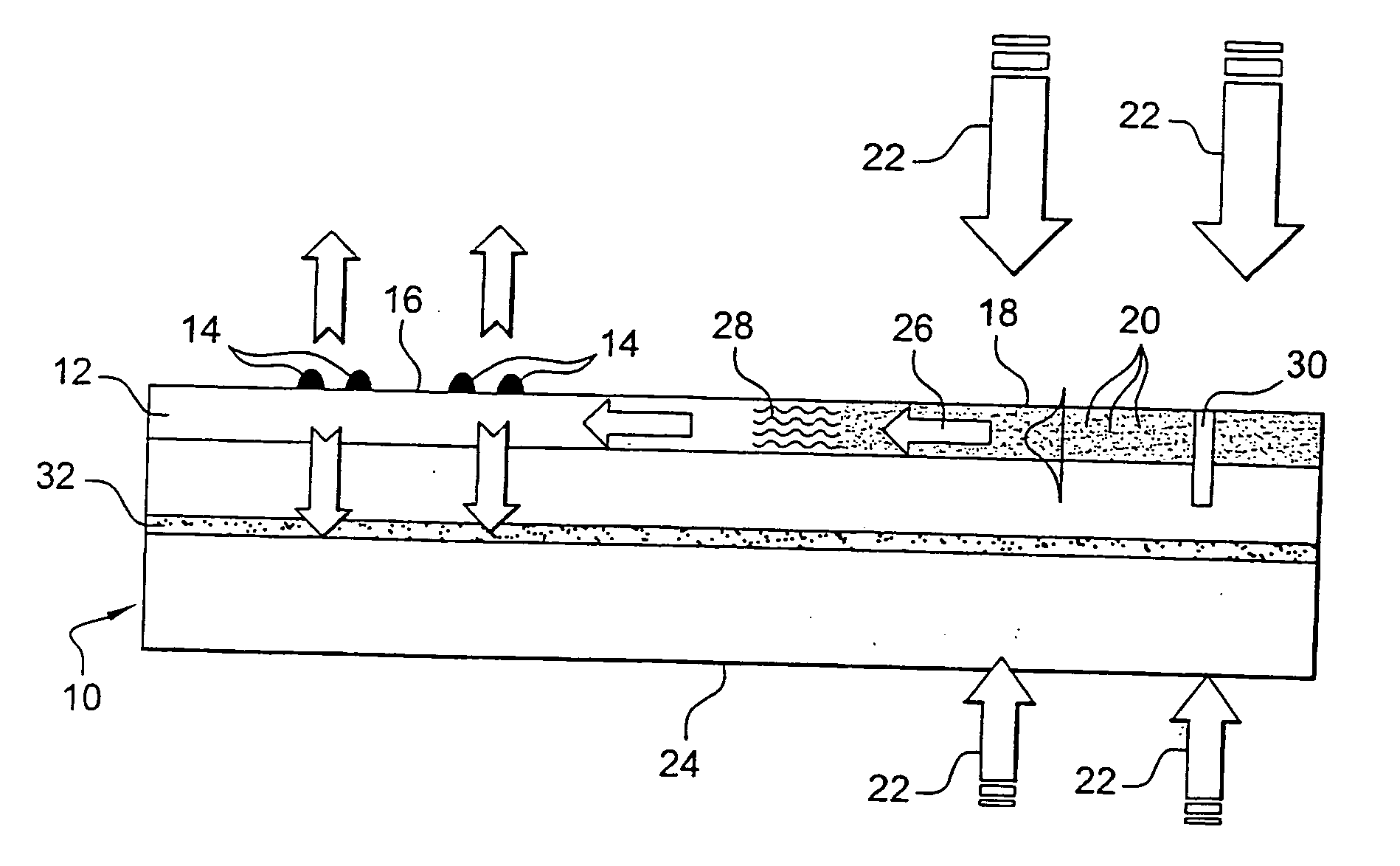
Figure 1 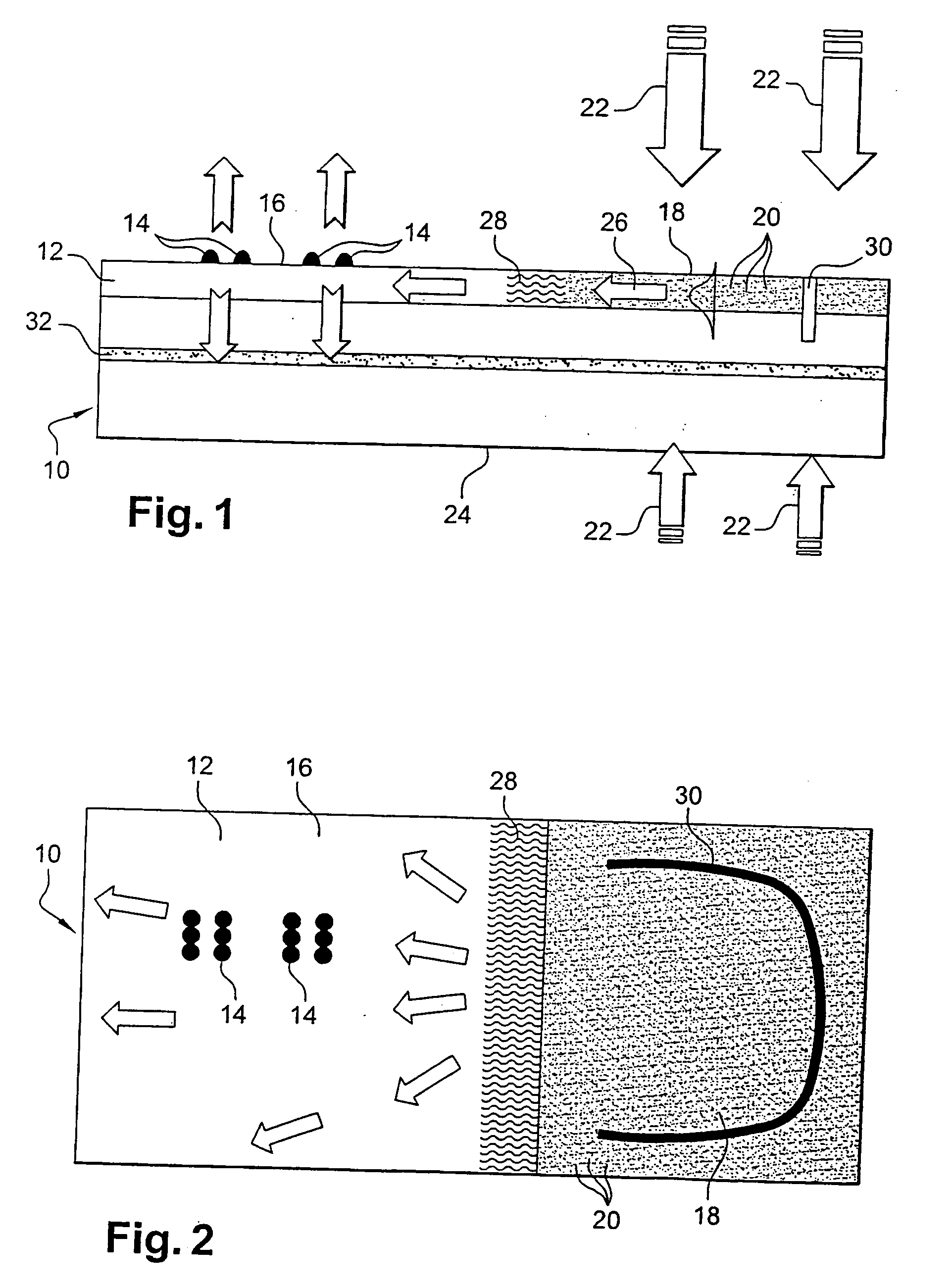
Figure 2 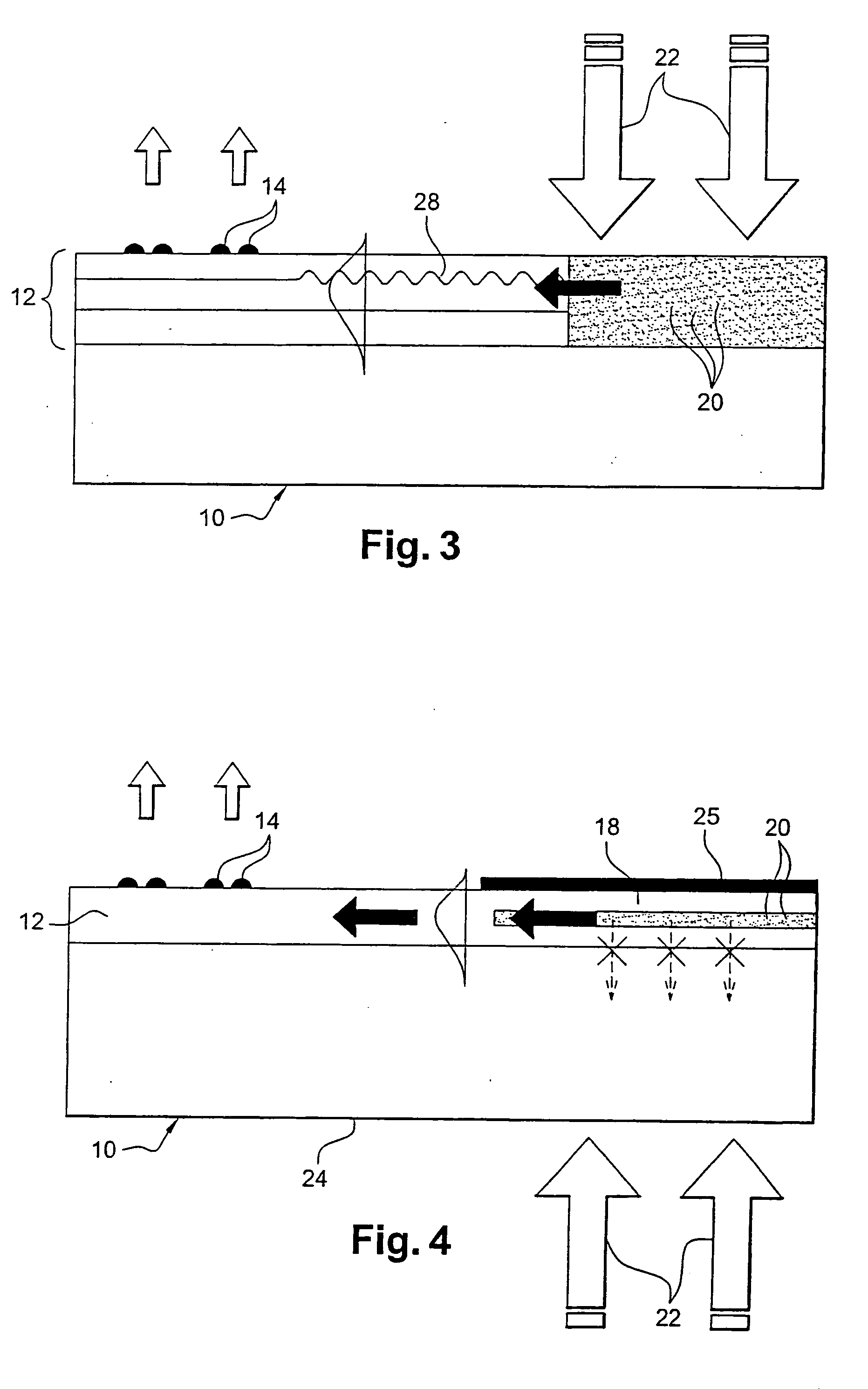
Figure 3
Abstract
Description
[0001] The invention relates to a device for supporting chromophore elements, in particular devices such as those commonly called “biochips”. BACKGROUND OF THE INVENTION
[0002] In such devices, a generally multi-layer substrate carries chromophore elements that are chemical molecules or biological molecules, dye elements added or grafted to the chemical biological molecules, or semiconductor nanostructures such as quantum boxes or wires that respond to excitation by appropriate light by emitting fluorescence at a wavelength that depends on their nature. This fluorescence makes it possible in particular to identify and find on the substrate molecules that have responded to given treatments.
[0003] Proposals have already been made in patent applications WO-A-02 / 16912, FR 01 / 15140, and FR 02 / 10285 in the names of the same inventors, for means enabling the excitation intensity of chromophore elements to be reinforced, and thus to reinforce the fluorescence emitted by said elements. In p...
Examples
Embodiment Construction
[0047] The device shown in FIGS. 1 and 2 comprises a substrate 10 of conventional type having a top layer 12 for carrying chromophore elements 14 on a portion 16 of its surface, which layer is made of a material having a high refractive index, e.g. greater than about 1.6, and forms a planar waveguide.
[0048] A portion 18 of this layer 12, adjacent to the portion 16 for carrying the chromophore elements 14, contains photoluminescent constituents 20 which emit luminescence in guided mode in the layer 12 on being excited by primary excitation light 22 directly illuminating either the portion 18 of the layer 12 containing the photoluminescent constituents 20, or the opposite face 24 of the substrate 10, as shown diagrammatically in FIG. 1.
[0049] The photoluminescent components 20 are selected, on being excited by the light 22, to emit luminescence at the excitation wavelengths for the chromophore elements 14. The chromophore elements are then excited by the evanescent portion of the gu...