
Method for deriving standard 12-lead electrocardiogram, and electrocardiograph using the same
a technology of electrocardiogram and lead waveform, which is applied in the field of deriving standard 12-lead electrocardiogram and electrocardiograph using the same, can solve the problems of inability to meet the requirements of time, difficulty in transmitting a large number of lead waveforms in the form of multi-channel signals, and variation in the detection accuracy of electrocardiogram, so as to achieve easy judgment of reliability with respect to the waveform of each lead
Patent Information
- Authority / Receiving Office
- US · United States
- Current Assignee / Owner
- Publication Date
- 2006-02-02
Smart Images
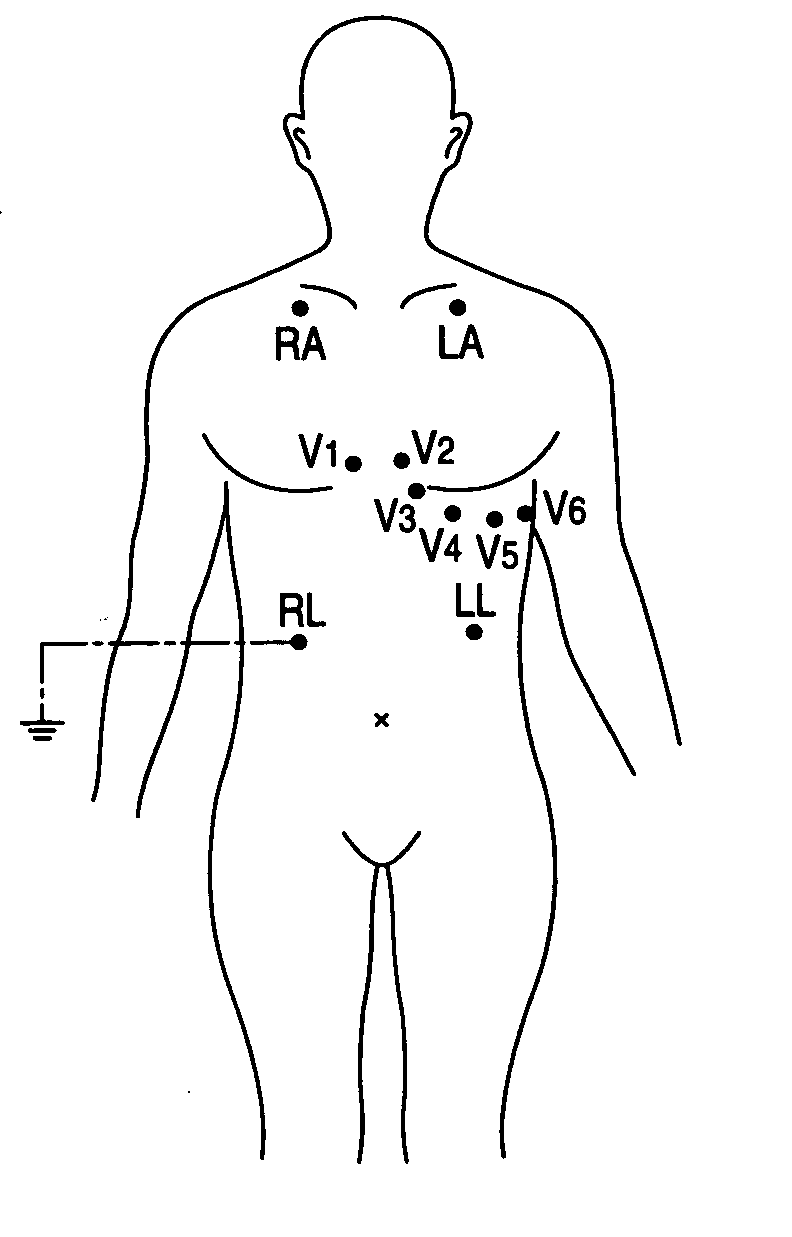
Figure 1 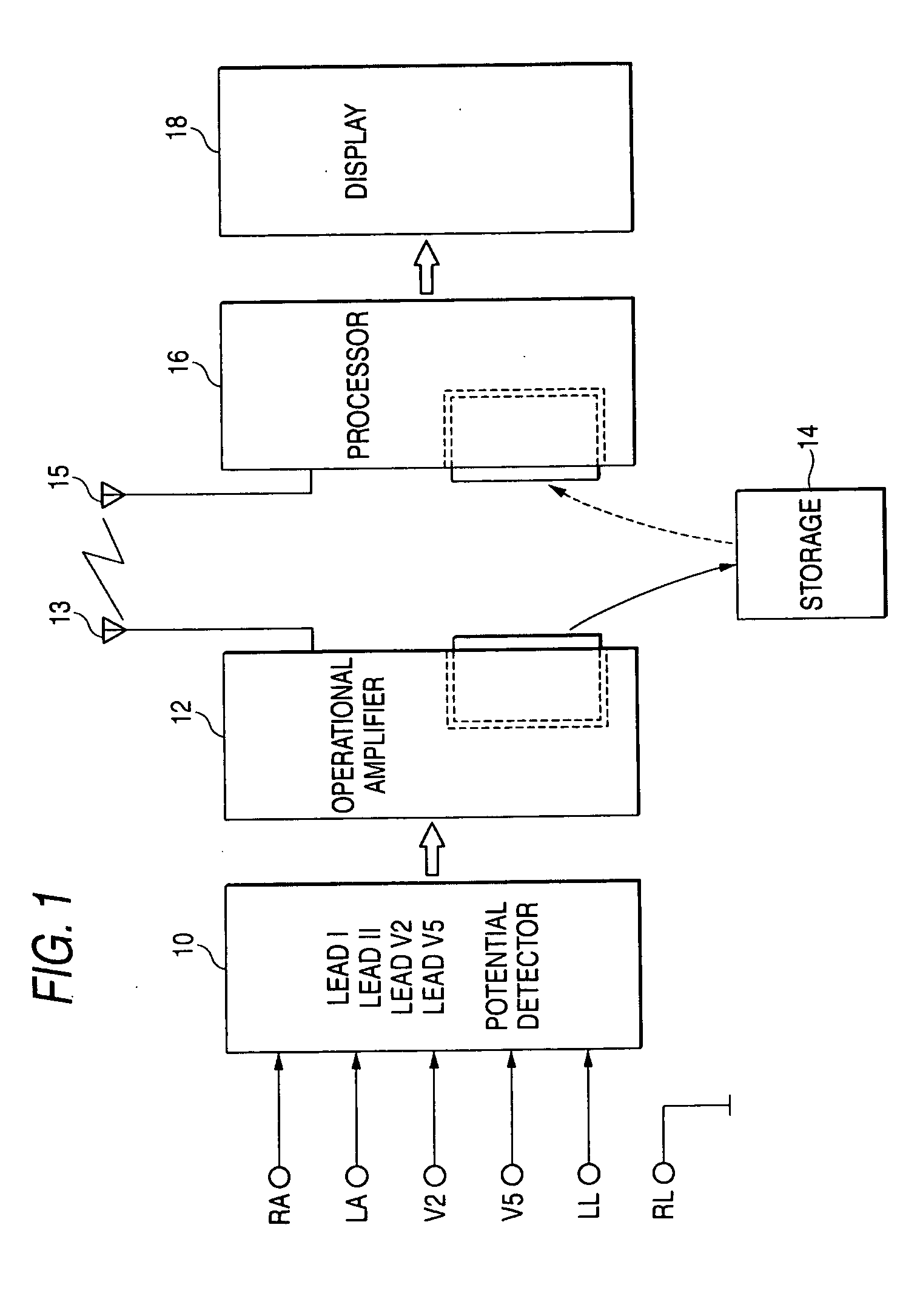
Figure 2 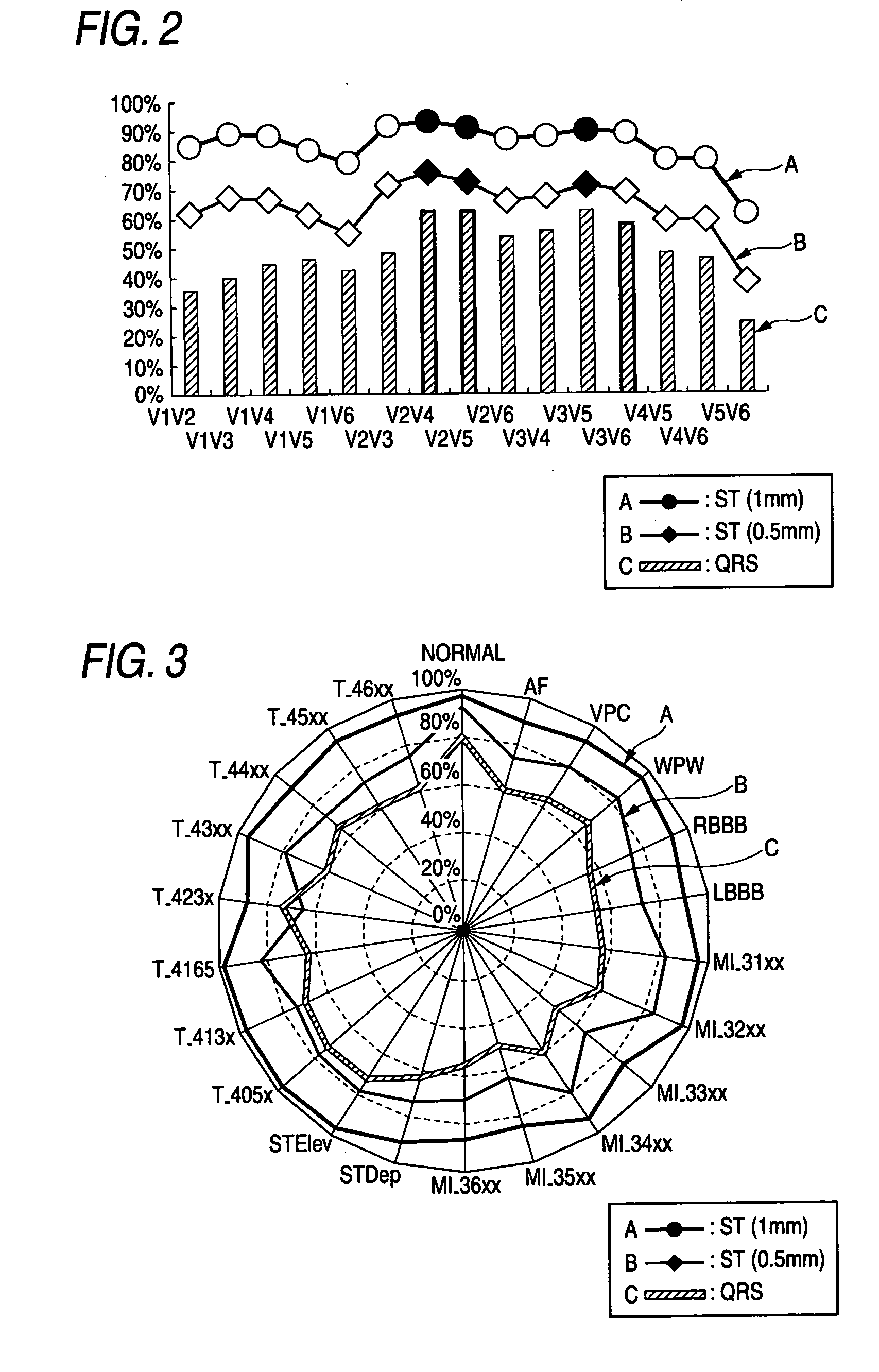
Figure 3
Abstract
Description
BACKGROUND OF THE INVENTION
[0001] The present invention relates to a method for deriving a standard 12-lead electrocardiogram effective for diagnosing ischemic heart disease, acute myocardial infarction, or the like, in which a minimum number of electrodes are attached to predetermined areas on the body surface of a living body to thus obtain an electrocardiographic waveform, and focus is placed on an ST segment of the electrocardiographic waveform which will serve as an important index of, in particular, ischemic heart disease. The present invention also relates to an electrocardiograph using such a method.
[0002] Conventionally, when an electrocardiogram of a patient is detected, measured, and recorded in a hospital or a like facility, a total of ten electrodes are attached to the body surface of the patient; namely, six positions for chest leads, and four positions for limb leads. Six limb-lead waveforms (I, II, III, aVR, aVL, and aVF) of standard 12-lead waveforms and six chest...
Examples
Embodiment Construction
[0036] Embodiments of the invention will be described below in detail with reference to the accompanying drawings.
[0037] A rationale for deriving a standard 12-lead electrocardiogram according to the invention is as follows. A total of six electrodes are attached to a body surface of a living body for obtaining lead waveforms from a lead system subset which is constituted of two leads from limb leads (e.g., leads I and II) and two leads from chest leads (e.g., leads V2, V5). On the basis of electrocardiographic data detected and measured by these electrodes, the remaining four chest leads (e.g., leads V1, V3, V4, and V6), which are not measured by electrodes, can be calculated by subjecting data on the above-mentioned four leads to a transformation matrix constituted of a derivation matrix of the following equation (1). [V1V3V4V6]=[αI-1αII-1α2-1α5-1αI-3αII-3α2-3α5-3αJ-4αII-4α2-4α5-4αI-6αII-6α2-6α5-6][IIIV2V5](1)
[0038] In this case, as is apparent from Equation (1), when a...