
Method of and apparatus for image serving
a technology of image file and image, applied in the field of image file transfer, can solve the problems of insufficient image market optimization, almost certainly wrong appearance, and inability to effectively use small amounts of pistol in the hands of actors, so as to avoid data split up and effective use
Patent Information
- Authority / Receiving Office
- US · United States
- Current Assignee / Owner
- Publication Date
- 2007-11-01
- Estimated Expiration
- Not applicable · inactive patent
Smart Images
Figure 1 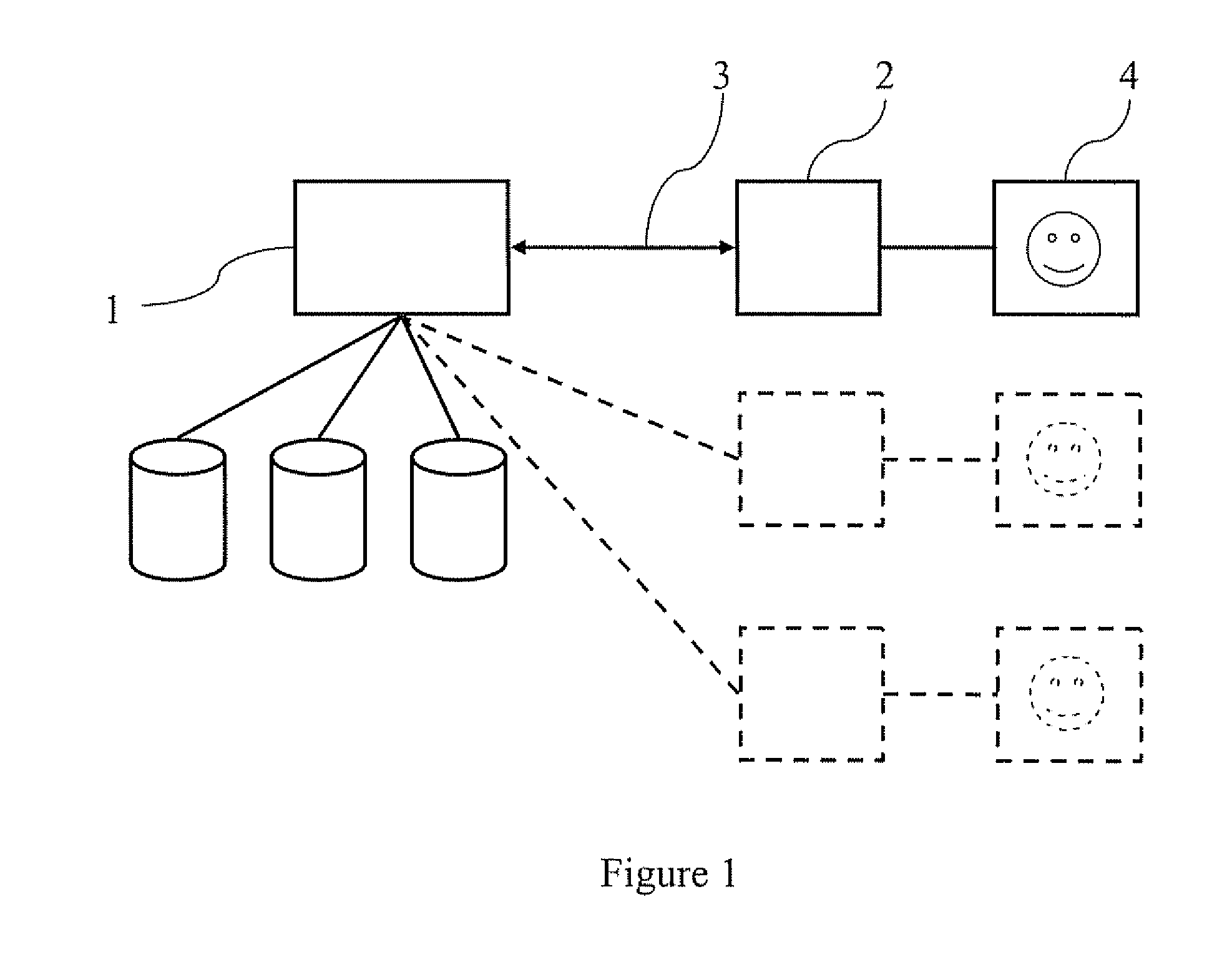
Figure 2 
Figure 3
Abstract
Description
FIELD OF THE INVENTION
[0001] The present invention relates to a method and apparatus for image file transfer from a server to a client. BACKGROUND TO THE INVENTION
[0002] Client-server architectures for computing purposes have been known for at least thirty years. Such architectures commonly feature a large computer, known as a ‘server’ with significant amounts of storage ‘feeding’ many terminals or ‘clients’ with data. One common usage may be in a financial institution or bank, where all the customer records are contained within the server and when an employee of the bank wishes to inspect a customer's records, the employees' computer (a ‘terminal’ or ‘client’) requests over a data link of some form that a given customers' records are recalled by the server computer, and passed back over the link to the client computer, where the employee can view such data. The importance of such architectures are that only one set of customer data is needed—it is not necessary for every employee...
Examples
Embodiment Construction
[0046]FIG. 1 shows a typical client-server architecture. A server 1 is connected to a client 2 by a link 3. The client 2 has a display screen 4 upon which the image is shown. Further clients could be connected to the server 1 as indicated by the dashed lines. In image serving, the requirement in terms of data transfer per second is generally much higher than with commercial clerical systems. A typical architecture has multiple channels or ‘pipes’ between points as the client-server links 3. Each of these ‘pipes’ has a maximum data transfer capacity.
[0047] One architecture we have found suitable to build such systems is manufactured by Picolight Incorporated of 1480 Arthur Ave Louisville, CO 80027 USA (www.picolight.com). The model used transmits data at a rate of 3.125 Gbits per second on each channel or pipe and we have used twelve of these pipes together, giving a total data capacity of 37.5 Gbits per second. It is necessary to utilise substantial buffering at each transceiver, a...