
Signature-reduced muzzle brake
a technology of muzzle brake and signature, applied in the field of muzzle brake, can solve the problems of action being taken against and skilled in the art would see this as questionable, and achieve the effect of reducing the intrinsic signatur
Patent Information
- Authority / Receiving Office
- US · United States
- Current Assignee / Owner
- Publication Date
- 2013-09-12
Smart Images
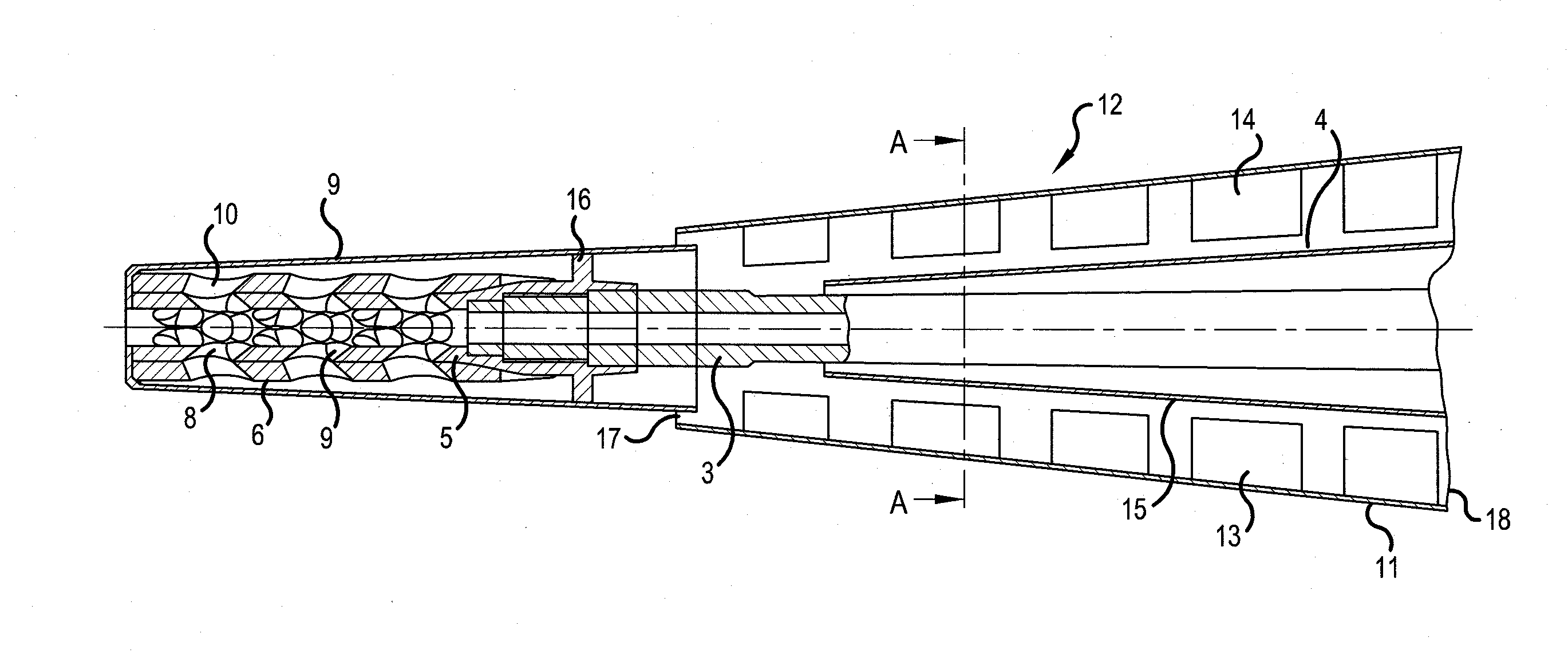
Figure 1 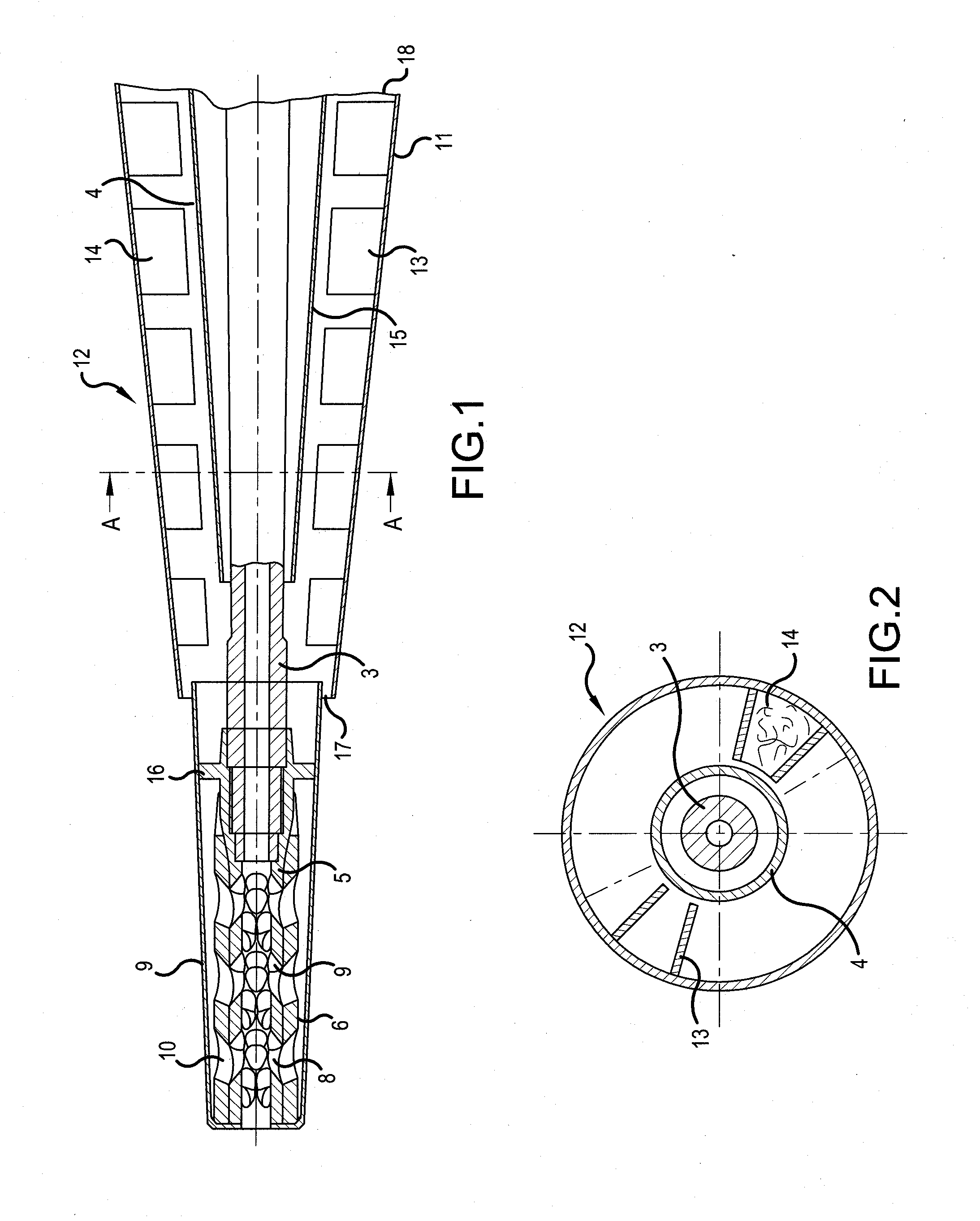
Figure 2 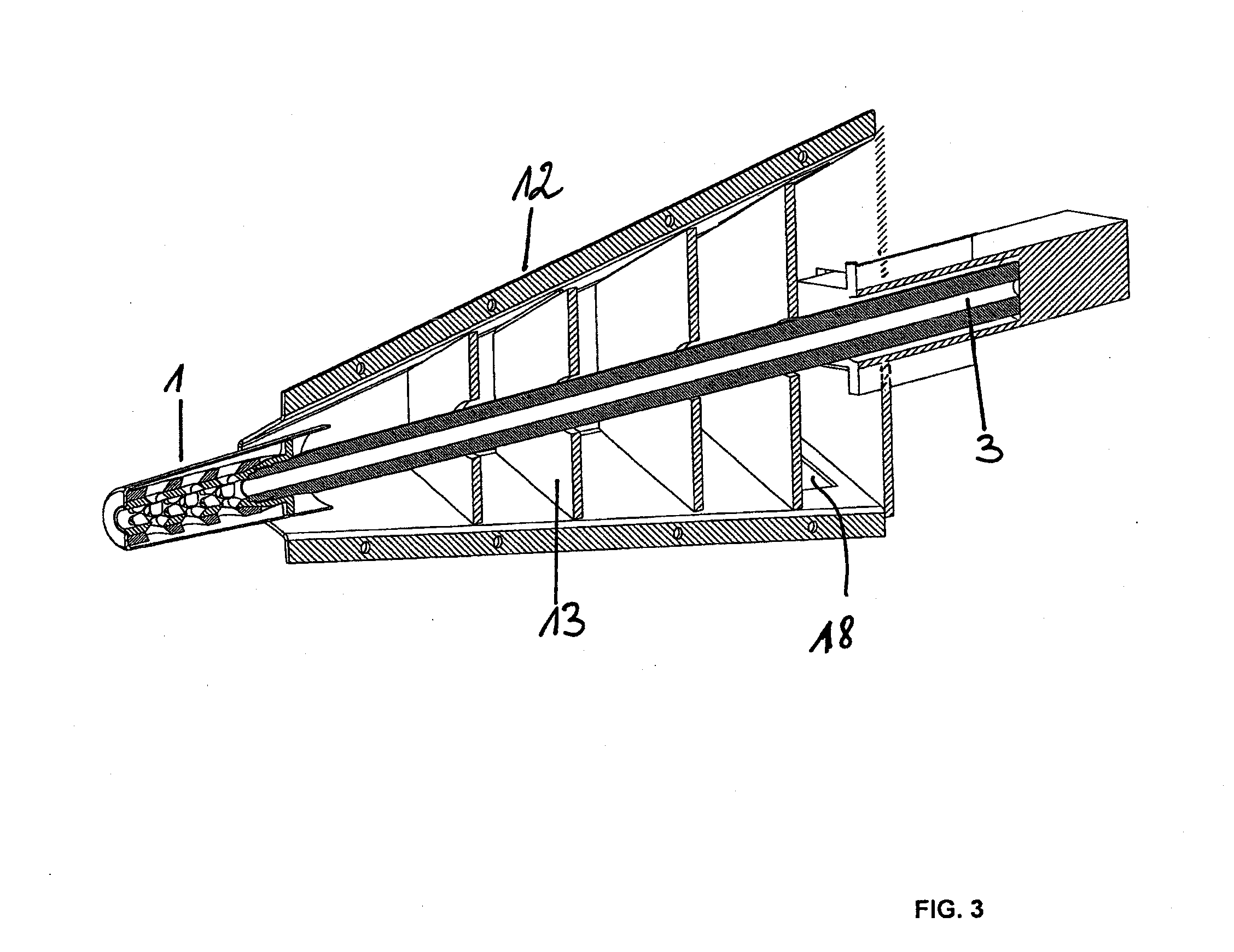
Figure 3
Abstract
Description
[0001] This nonprovisional application is a continuation of International Application No. PCT / EP2011 / 001996, which was filed on Apr. 19, 2011, and which claims priority to German Patent Application No. DE 10 2010 019 358.5, which was filed in Germany on May 6, 2010, and which are both herein incorporated by reference.BACKGROUND OF THE INVENTION
[0002] 1. Field of the Invention
[0003] The invention relates to a muzzle brake of a weapon or weapon system, in particular for small-caliber and medium-caliber weapons, that has a reduced external signature with regard to heat and / or propellant gas emissions. To this end, the propellant gas emerging from the gun barrel is directed in a conventional manner onto the gas outlet openings of the muzzle brake in order to impinge thereon—to absorb the recoil—and then be guided further toward the rear and cooled in the process.
[0004] 2. Description of the Background Art
[0005] Muzzle brakes have the task of deflecting to the side or the rear the powder gase...
Examples
Embodiment Construction
[0029]In a cross-sectional representation, FIG. 1 shows a muzzle brake 1 with a jacket 2, which can be attached to a gun barrel 3, for example by means of a screw fitting. In this exemplary embodiment, the gun barrel 3 is enclosed by a barrel mount 4.
[0030]The muzzle brake 1 is composed of a base sleeve 5, a deflecting sleeve 6, and a jacket tube 7. Taper bores 8 in the base sleeve 5 have bevels 9 so that the propellant gases can exit better. Taper bores 10 in the deflecting sleeve 6 provide for better expansion in the jacket tube 7. The bores 8, 10 have an oblique shape—becoming larger toward the outside in each case, similar to a taper bore—since this shape can depressurize the gas, so that a first cooling already takes place at this point. The two bores 8, 10 are matched to one another.
[0031]Adjoining the jacket tube 7 is a gas-reducing device 12, which in the simplest form can be a simple outer tube (not shown in detail). According to the concept of the invention, an additional ...