
Novel compound and electroluminescent device including same
a technology of organic electroluminescent devices and compound, which is applied in the direction of luminescent compositions, thermoelectric devices, organic chemistry, etc., can solve the problems of poor thermal stability and failure to reach a satisfactory lifespan, and achieve excellent heat resistance, enhanced hole transport layer, and/or light-emitting layer. large
Patent Information
- Authority / Receiving Office
- US · United States
- Patent Type
- Applications(United States)
- Current Assignee / Owner
- Publication Date
- 2015-06-18
Smart Images
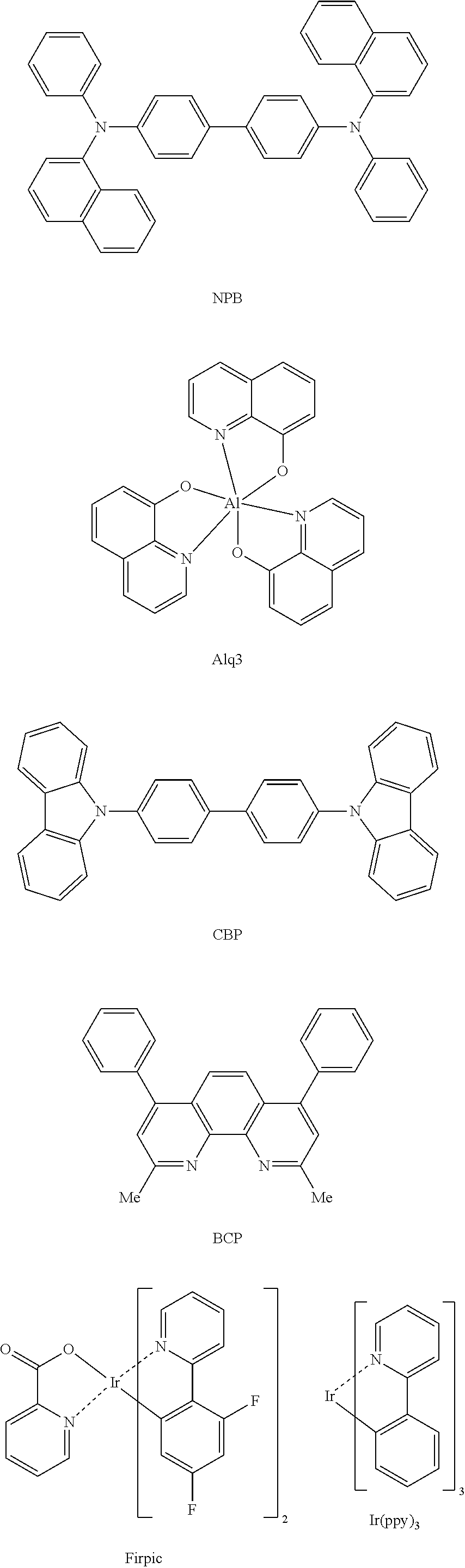
Figure 1 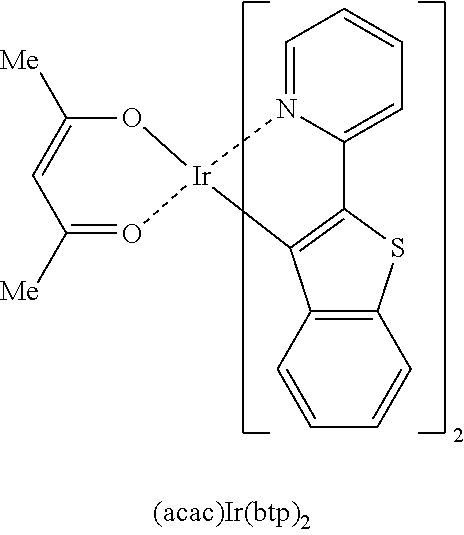
Figure 2 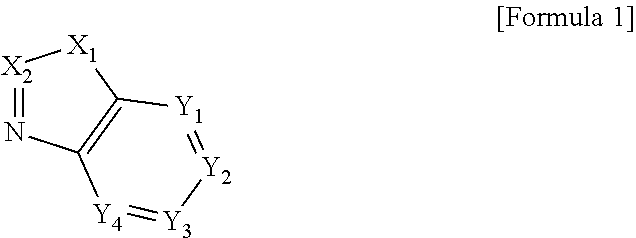
Figure 3
Abstract
Description
TECHNICAL FIELD
[0001] The present invention relates to a novel compound and an organic electroluminescent device including the same, and more particularly, to a novel compound having excellent hole injection and transport capabilities, light-emitting capabilities, and the like, and an organic electroluminescent device which comprises the compound as a material for an organic material layer to improve characteristics, such as light-emitting efficiency, driving voltage, and lifespan.BACKGROUND ART
[0002] Studies on an organic electroluminescent (EL) device (hereinafter, simply referred to as ‘organic EL device’) have continued from the start point of observing an organic thin film light emission by Bernanose in the 1950s to blue electroluminescence using an anthracene single crystal in 1965, and then an organic EL device having a laminated structure including functional layers of a hole layer and a light emitting layer was proposed by Tang in 1987. Since then, the organic EL device has b...
Examples
preparation example 2
Synthesis of Compounds Core2A and Core2B
Synthesis of 5-(2-nitrophenyl)-1H-benzo[d][1,2,3]triazole
[0091]
[0092]6.3 g (yield: 51%) of 5-(2-nitrophenyl)-1H-benzo[d][1,2,3]triazole was obtained by performing the same procedure as in of Preparation Example 1, except that 7.9 g of 5-chloro-1H-benzo[d][1,2,3]triazole was used instead of 5-bromo-1H-benzo[d]imidazole used in of Preparation Example 1.
[0093]1H-NMR: δ 7.68 (m, 2H), 7.92 (t, 1H), 8.03 (m, 3H), 8.20 (s, 1H)
Synthesis of Compounds Core2A and Core2B
[0094]
[0095]2.3 g (yield: 42%) of Compound Core2A and 0.8 g (yield: 14%) of Compound Core2B were obtained by performing the same procedure as in of Preparation Example 1, except that 6.3 g of 5-(2-nitrophenyl)-1H-benzo[d][1,2,3]triazole obtained in of Preparation Example 2 was used instead of 5-(2-nitrophenyl)-1H-benzo[d]imidazole used in of Preparation Example 1.
[0096]1H-NMR for Compound Core2A: δ 7.28 (t, 1H), 7.48 (m, 2H), 7.65 (d, 1H), 7.98 (d, 1H), 8.13 (d, 1H), 10.33 (s, 1H)
[0...
preparation example 3
Synthesis of Compounds Core3A and Core3B
Synthesis of 5-(2-nitrophenyl)benzo[d]oxazole
[0098]
[0099]4.1 g (yield: 46%) of 5-(2-nitrophenyl)benzo[d]oxazole was obtained by performing the same procedure as in of Preparation Example 1, except that 5.7 g of 5-chlorobenzo[d]oxazole was used instead of 5-bromo-1H-benzo[d]imidazole used in of Preparation Example 1.
[0100]1H-NMR: δ 7.65 (t, 1H), 7.88 (m, 4H), 8.12 (m, 3H)
Synthesis of Compounds Core3A and Core3B
[0101]
[0102]1.6 g (yield: 45%) of Compound Core3A and 0.4 g (yield: 14%) of Compound Core3B were obtained by performing the same procedure as in of Preparation Example 1, except that 4.1 g of 5-(2-nitrophenyl)benzo[d]oxazole obtained in of Preparation Example 3 was used instead of 5-(2-nitrophenyl)-1H-benzo[d]imidazole used in of Preparation Example 1.
[0103]1H-NMR for Compound Core3A: δ 7.02 (d, 1H), 7.28 (t, 1H), 7.53 (t, 1H), 7.72 (d, 1H), 7.98 (s, 1H), 8.15 (m, 2H), 10.38 (s, 1H)
[0104]1H-NMR for Compound Core3B: δ 7.30 (t, 1H), ...
preparation example 4
Synthesis of Compounds Core4A and Core4B
Synthesis of 6-(2-nitrophenyl)benzo[d]thiazole
[0105]
[0106]4.7 g (yield: 62%) of 6-(2-nitrophenyl)benzo[d]thiazole was obtained by performing the same procedure as in of Preparation Example 1, except that 6.3 g of 6-bromobenzo[d]thiazole was used instead of 5-bromo-1H-benzo[d]imidazole used in of Preparation Example 1.
[0107]1H-NMR: δ 7.72 (m, 2H), 7.92 (m, 3H), 8.35 (s, 1H), 9.28 (s, 1H)
Synthesis of Compounds Core4A and Core4B
[0108]
[0109]2.2 g (yield: 53%) of Compound Core4A and 0.9 g (yield: 21%) of Compound Core4B were obtained by performing the same procedure as in of Preparation Example 1, except that 4.7 g of 6-(2-nitrophenyl)benzo[d]thiazole obtained in of Preparation Example 4 was used instead of 5-(2-nitrophenyl)-1H-benzo[d]imidazole used in of Preparation Example 1.
[0110]1H-NMR for Compound Core4A: δ 7.25 (t, 1H), 7.55 (m, 3H), 7.78 (d, 1H), 8.15 (d, 1H), 9.26 (s, 1H), 10.27 (s, 1H)
[0111]1H-NMR for Compound Core4B: ≡ 7.26 (t, 1H...