
Method for determining a variable of a sample
Patent Information
- Authority / Receiving Office
- US · United States
- Current Assignee / Owner
- Publication Date
- 2016-06-09
Smart Images
Figure 1 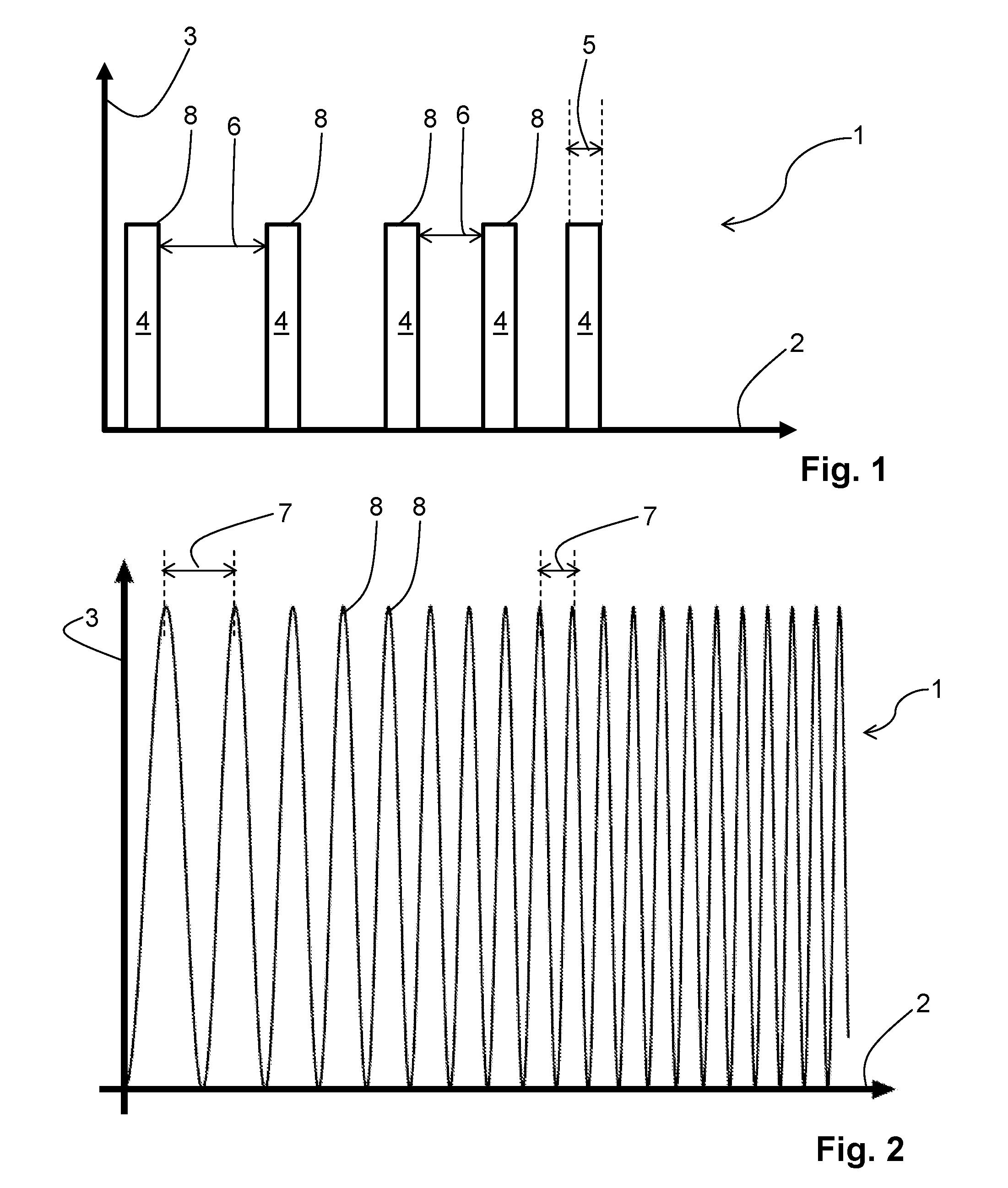
Figure 2 
Figure 3
Abstract
Description
[0001] This is a Continuation of International Patent Application No. PCT / IB2014 / 063765, filed Aug. 7, 2014 which claims the benefit of German Patent Application DE 10 2013 109 010.9, filed Aug. 21, 2013, both of which are hereby incorporated by reference herein.
[0002] The present invention relates to a method for determining a variable of a sample, more specifically to a method in which the variable of the sample is determined from the luminescence behavior of a sensor substance.BACKGROUND
[0003] The German published patent application DE 196 34 873 A1 describes an apparatus and a method for discriminating, by a time-resolved fluorescence measurement, at least two differently fluorescing types of molecule groups bound to analyte molecules. Therein a light source for illuminating a sample volume is activated for a time-interval T1, then, after a time-interval T2, a detector is activated for a time T3. Which of the at least two molecule groups are contained in the sample volume is determ...
Examples
Embodiment Construction
[0054]FIG. 1 shows an excitation signal 1, which is a sequence of pulses, as may be used for exciting a luminescence of a sensor substance in the method according to the invention. Time is shown on the abscissa 2, the ordinate 3 shows a measure for the strength of the excitation signal 1, for example the intensity of the excitation signal 1. The excitation signal 1 comprises a sequence of pulses 4, and is characterized by pulse durations 5 and distances 6 between pulses. In the sequence of pulses shown, the pulse durations 5 are constant over the duration of the sequence of pulses, the distances 6 between pulses, however, decrease from pulse 4 to pulse 4. The sum of pulse duration 5 and distance 6 between pulses for the rectangular pulses shown here corresponds to the temporal distance of consecutive signal maxima 8. The decreasing distances 6 between pulses therefore imply that the distances between consecutive signal maxima 8 of the excitation signal 1 decrease over the duration o...