
Novel antifungal oxodihydropyridinecarbohydrazide derivative
Patent Information
- Authority / Receiving Office
- US · United States
- Current Assignee / Owner
- Publication Date
- 2016-10-20
Smart Images
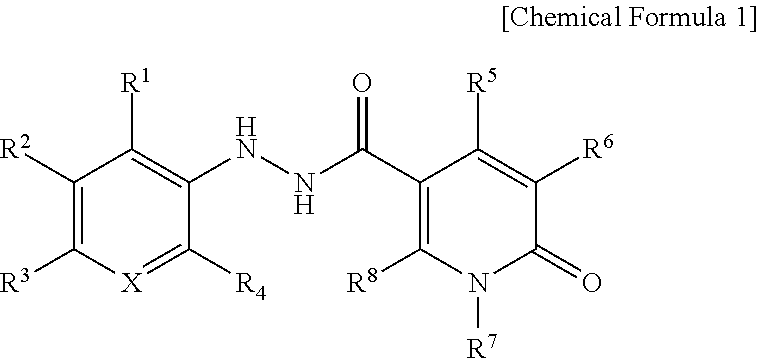
Figure 1 
Figure 2 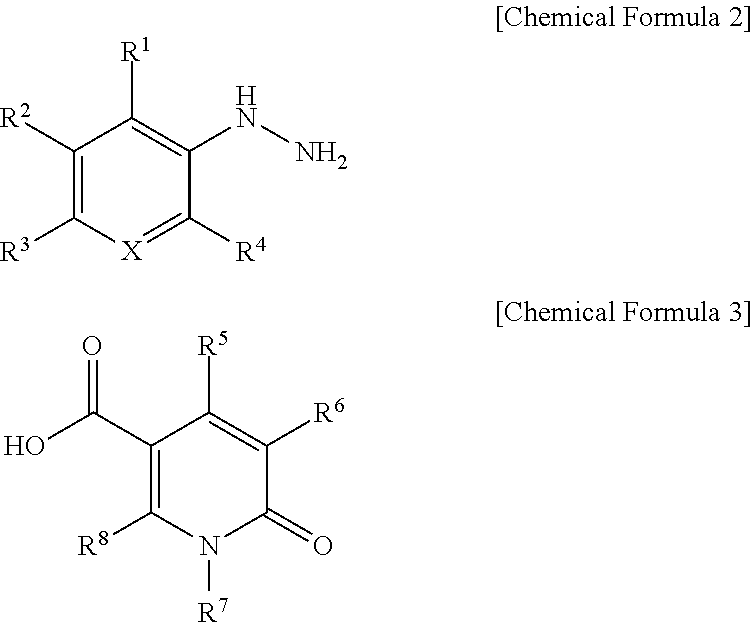
Figure 3
Abstract
Description
TECHNICAL FIELD
[0001] The present invention relates, in general, to a novel oxodihydropyridinecarbohydrazide derivative with excellent antifungal activities, an antifungal composition containing the same, and its use for the prevention and treatment of fungal infectious diseases.BACKGROUND ART
[0002] Recently, there have been a growing number of reports on serious fungal infections in immunocompromised cancer patients undergoing chemotherapies, organ transplant recipients, AIDS patients, etc. Most of the fungal infections are known to be caused by opportunistic pathogens such as Candida spp., Aspergillus spp. and Cryptococcus neoformans. Accordingly, for the future elderly society, development of medical countermeasures against emerging infectious diseases caused by pathogens including resistant bacteria will become an important issue.
[0003] The number of antifungal agents available at present is much less than that of antibiotics used for the treatment of bacterial infections. Examples...
Examples
example 2
Preparation of N′-(3-fluorophenyl)-1-methyl-6-oxo-1,6-dihydropyridine-3-carbohydrazide
[0150]A title compound (18.0 mg, yield 69%) was obtained in the same manner as in Example 1 except that (3-fluorophenyl)hydrazine was used instead of (2-fluorophenyl)hydrazine.
[0151]1H NMR (MeOH-d4): δ 8.37 (d, 2H), 8.36-7.94 (m, 1H), 7.17-7.61 (m, 1H), 6.57-6.47 (m, 4H), 3.63 (s, 3H)
example 3
Preparation of N′-(4-fluorophenyl)-1-methyl-6-oxo-1,6-dihydropyridine-3-carbohydrazide
[0152]A title compound (14.9 mg, yield 57%) was obtained in the same manner as in Example 1 except that (4-fluorophenyl)hydrazine was used instead of (2-fluorophenyl)hydrazine.
[0153]1H NMR (DMSO-d6): δ 10.10 (s, 1H), 8.40 (s, 1H), 7.86 (d, 1H), 7.82 (s, 1H), 6.96 (t, 2H), 6.79 (m, 2H), 6.41 (d, 1H), 3.48 (s, 3H)
example 4
Preparation of N′-(3-chlorophenyl)-1-methyl-6-oxo-1,6-dihydropyridine-3-carbohydrazide
[0154]A title compound (17.8 mg, yield 64%) was obtained in the same manner as in Example 1 except that (3-chlorophenyl)hydrazine was used instead of (2-fluorophenyl)hydrazine.
[0155]1H NMR (CDCl3-d): δ 8.18 (s, 1H), 7.69 (d, 1H), 7.16 (t, 1H), 6.90-6.87 (m, 2H), 6.78-6.76 (m, 1H), 6.59 (d, 1H), 3.63 (s, 3H)