
Infrastructure to vehicle communication protocol
a technology of infrastructure and communication protocol, applied in the field of secure communication, can solve the problems of localized disturbance of traffic flow, which may ripple throughout the system, and not all disruptions of traffic flow, so as to reduce congestion, avoid data loss or minimize, and improve travel times
Patent Information
- Authority / Receiving Office
- US · United States
- Patent Type
- Applications(United States)
- Current Assignee / Owner
- Publication Date
- 2018-06-07
Smart Images
Figure 1 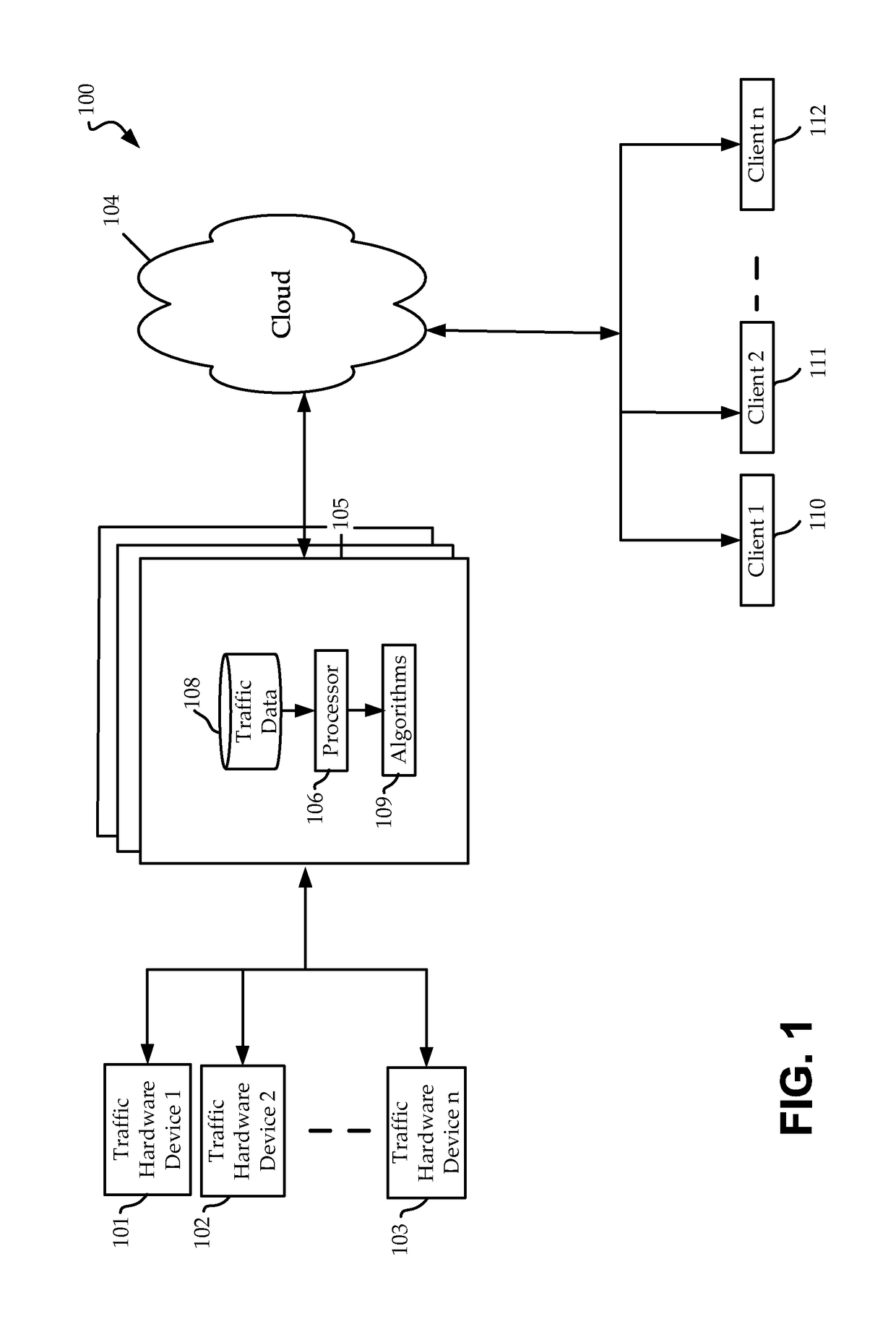
Figure 2 
Figure 3
Abstract
Description
RELATED U.S. APPLICATION DATA
[0001] This application claims the benefit of U.S. Provisional Application No. 62 / 430,724, filed on Dec. 6, 2016, the entire contents of which are incorporated herein by reference.FIELD OF THE INVENTION
[0002] The present invention relates generally to securing communications that may be transmitted from infrastructure associated with a roadway network. The technology may be implemented with existing systems and hardware or may be incorporated with proprietary systems. The invention has particular advantages for improving traffic safety by preventing spoofed signals.BACKGROUND
[0003] Existing traffic signals at intersections and along roadways utilize various traffic hardware devices to affect or monitor signalization. Generally, these devices are positioned adjacent to the intersection they impact and are frequently disposed upon traffic signal poles or arms (e.g., cameras), within a traffic control cabinet (e.g., conflict monitor unit), or in / on the roadway...
Examples
Embodiment Construction
[0055]FIG. 1 illustrates a system 100 operable to collect and transmit traffic data to a remote location. In the illustrated system 100, traffic signal information is obtained by a network of traffic hardware devices 101-103. Traffic hardware devices may be, for example, a traffic controller, traffic camera, intersection controller, inductive loop detector, microwave detector, magnetometer, traffic radar, thermal sensor, conflict monitor, general hardware I / O, road weather information system, battery backup system, etc. The traffic hardware devices 101-103 may be disposed within, on, under, adjacent, above, or otherwise relative to a roadway. Traffic hardware devices may be stored, for example, within a traffic control cabinet or upon a support mast. The traffic hardware devices may provide raw or preprocessed data to an LDCM 105. The LDCM 105 may be embodied as a single device or may be distributed across multiple devices in operative communication with one another. The traffic har...