
Communications system providing automatic text-to-speech conversion features and related methods
a technology of automatic text-to-speech and communication system, which is applied in the field of communication system, can solve the problems of many accidents, low and can be difficult to achieve, and achieve the effect of improving text-to-speech conversion and delivery features
Patent Information
- Authority / Receiving Office
- US · United States
- Patent Type
- Applications(United States)
- Current Assignee / Owner
- Publication Date
- 2021-04-22
Smart Images
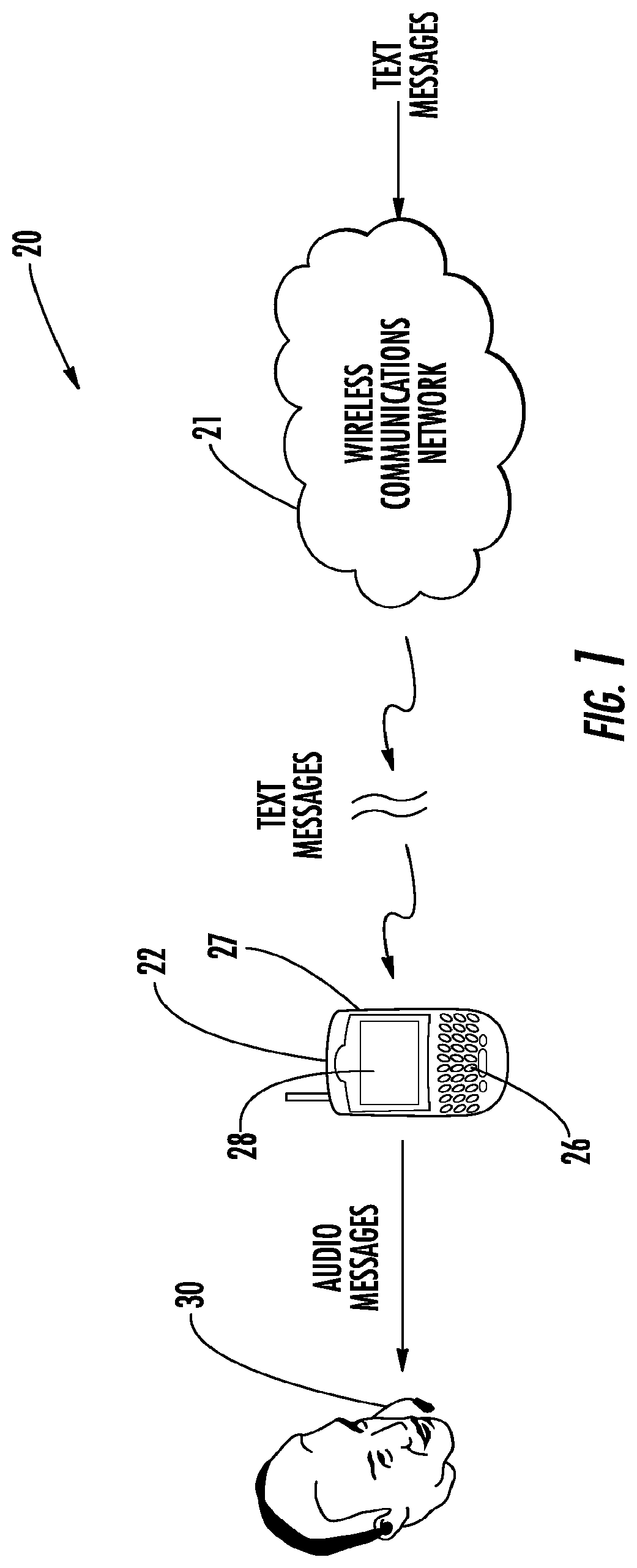
Figure 1 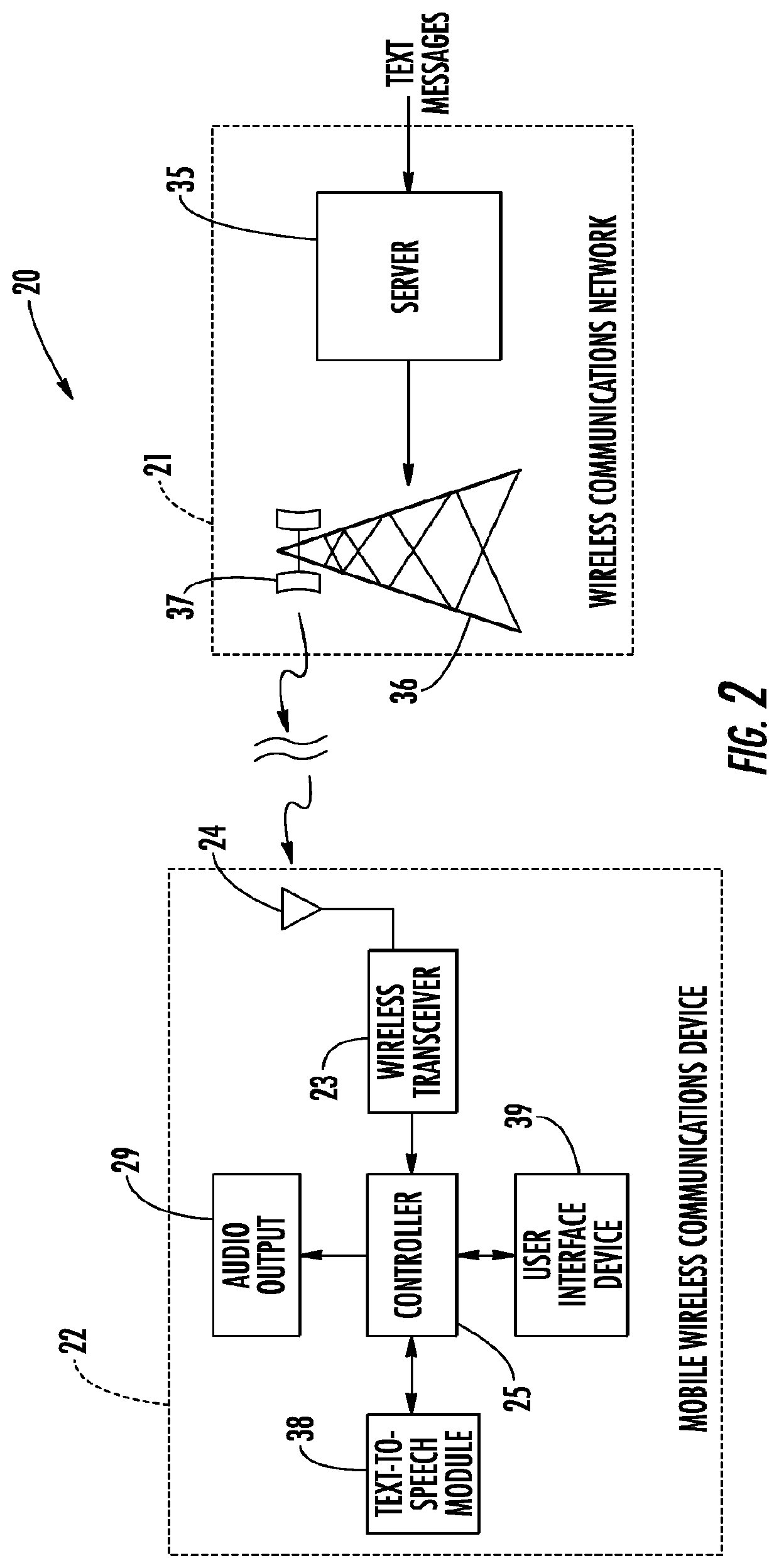
Figure 2 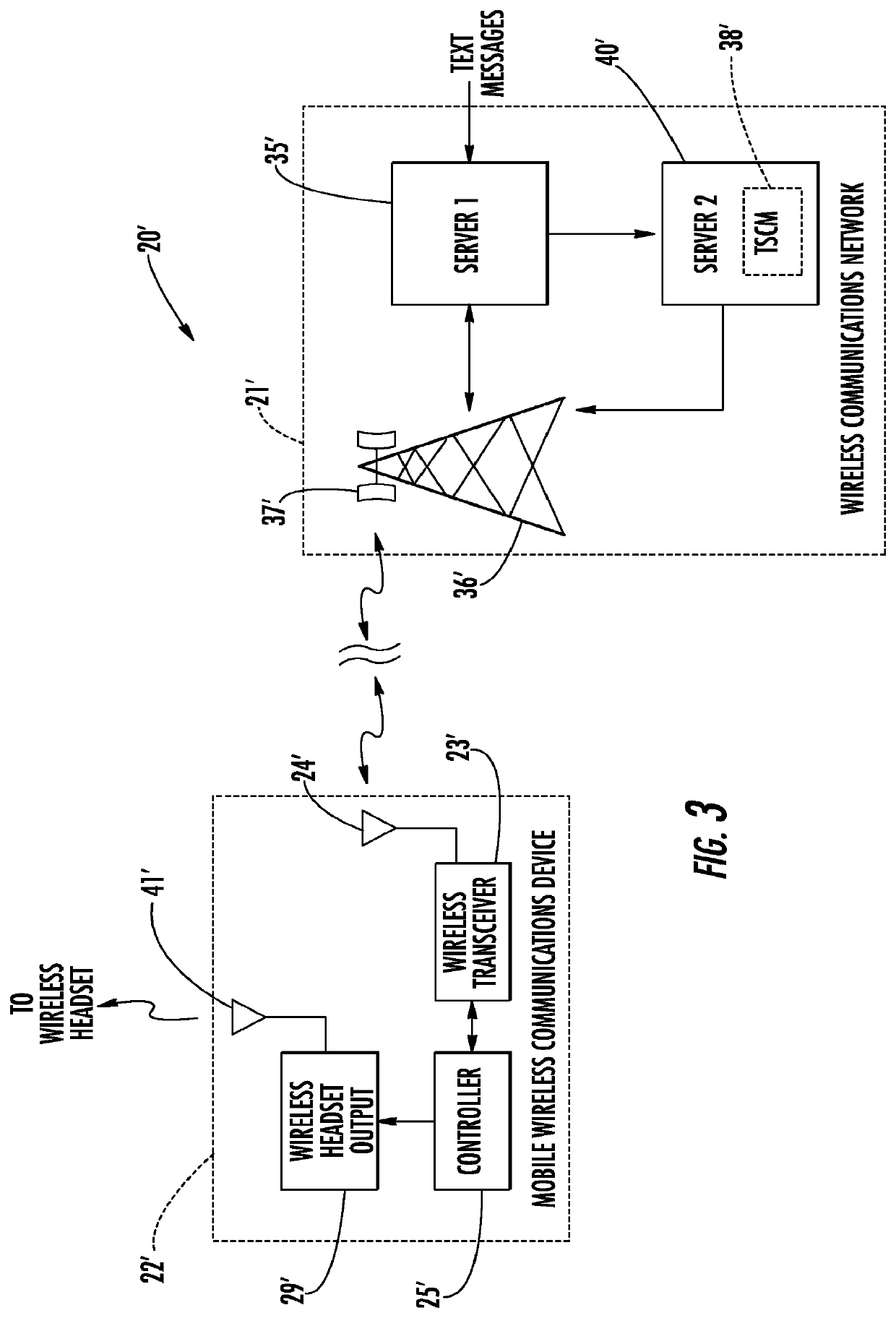
Figure 3
Abstract
Description
CROSS REFERENCE TO RELATED APPLICATIONS
[0001] This application is a continuation of U.S. patent application Ser. No. 15 / 457,927, filed on Mar. 13, 2017, which is a continuation of U.S. patent application Ser. No. 14 / 960,867, now U.S. Pat. No. 9,596,339, filed on Dec. 7, 2015, which is a continuation of U.S. patent application Ser. No. 14 / 255,345, now U.S. Pat. No. 9,237,219, filed on April 17,2014, which is a continuation of U.S. patent application Ser. No. 14 / 047,482, now U.S. Pat. No. 8,731,531, filed on Oct. 7, 2013, which is a continuation of U.S. patent application Ser. No. 13 / 493,538, now U.S. Pat. No. 8,554,254, filed on Jun. 11, 2012, which is a continuation of U.S. patent application Ser. No. 13 / 304,788, now U.S. Pat. No. 8,200,295, filed on Nov. 28, 2011, which is a continuation of U.S. patent application Ser. No. 13 / 081,753, now U.S. Pat. No. 8,086,289, filed on Apr. 7, 2011, which is a continuation of U.S. patent application Ser. No. 12 / 632,359, now U.S. Pat. No. 7,937,12...
Examples
example 1
[0048]An executive is awaiting an email regarding an important issue from the CEO of his company. He sets an audio message filter parameter indicating that all emails from the CEO joe@somecompany.com will need to be provided via audio (i.e., speech). He commutes one hour to work every day. Before he starts his commute, he sets the device to be in the audio message mode, or the device automatically switches to this mode when he connects a headset (e.g., a Bluetooth enabled headset) Thirty minutes into the commute he receives an email from the CEO. The Blackberry Enterprise Server checks the device filters and sees that this email is subject to audio (i.e., speech) conversion and sends the request to a text-to-speech server.
[0049]This server looks up the phone number for the device and converts the text of the email to speech in a .wav file. It then places a call to the device and plays the .wav file. The device can be set to have unique ring tones when an incoming call is from the te...
example 2
[0050]Turning now additionally to FIG. 7, an exemplary hand-held mobile wireless communications device 1000 (i.e., a Blackberry device) that can be used in accordance with the present invention is now described. The device 1000 illustratively includes a housing 1200, a keyboard 1400 and an output device 1600. The output device shown is a display 1600, which is preferably a full graphic LCD. Other types of output devices may alternatively be utilized. A processing device 1800 is contained within the housing 1200 and is coupled between the keyboard 1400 and the display 1600. The processing device 1800 controls the operation of the display 1600, as well as the overall operation of the mobile device 1000, in response to actuation of keys on the keyboard 1400 by the user.
[0051]The housing 1200 may be elongated vertically, or may take on other sizes and shapes (including clamshell housing structures). The keyboard may include a mode selection key, or other hardware or software for switchi...