
Treatment apparatus, method of controlling same and the treatment method
a treatment apparatus and control method technology, applied in the field of treatment apparatus and control method, can solve the problems of unnecessary damage to the touched tissue, unnecessary damage, etc., and achieve the effect of preventing problems
Patent Information
- Authority / Receiving Office
- US · United States
- Current Assignee / Owner
- Publication Date
- 2021-07-01
Smart Images
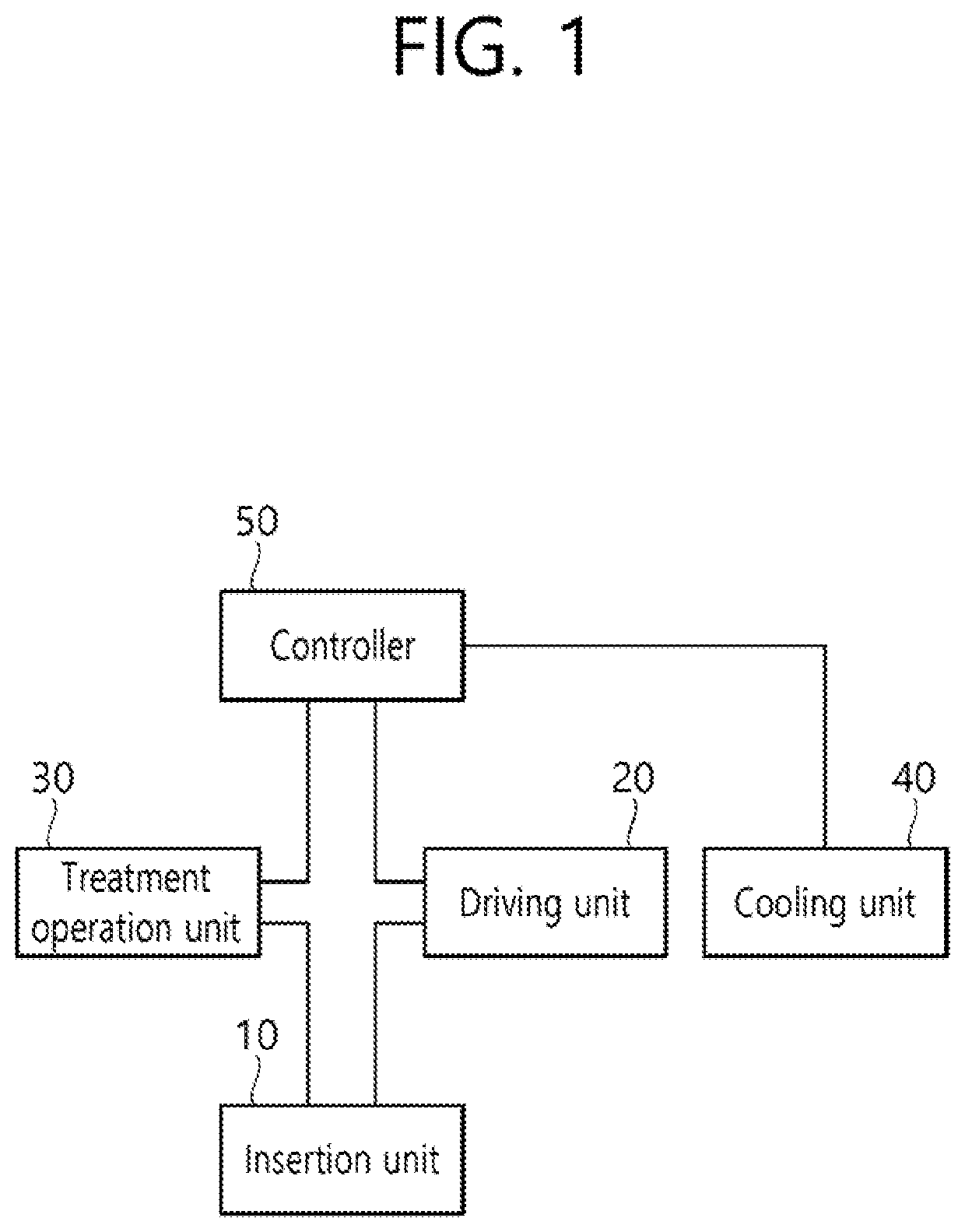
Figure 1 
Figure 2 
Figure 3
Abstract
Description
CROSS-REFERENCE TO RELATED APPLICATIONS
[0001] The present specification is a U.S. National Stage of International Patent Application No. PCT / KR2018 / 000098, filed Jan. 3, 2018, which claims priority to and the benefit of Korean Patent Application No. 10-2017-0002535, filed in the Korean Intellectual Property Office on Jan. 6, 2017, the entire contents of which are incorporated herein by reference.TECHNICAL FIELD
[0002] The present invention relates to a treatment apparatus and a method of controlling the same and the treatment method, more particularly, to a treatment apparatus into a tissue of the human body to perform treatment in an invasion manner and a method of controlling the same and a treatment method.BACKGROUND ART
[0003] A method of treating a tissue may be divided into a method of treating a tissue outside the tissue and an invasive treatment method of treating a tissue by inserting some of or the entire treatment apparatus into the tissue. The invasive treatment method basica...
Examples
first embodiment
[0043]FIG. 1 is a block diagram showing the configuration of a treatment apparatus according to the present invention.
[0044]FIG. 1 is a block diagram showing the configuration of a treatment apparatus according to a first embodiment of the present invention. As shown in FIG. 1, the treatment apparatus according to the present invention is configured to include an insertion unit 10 formed to be inserted into a tissue, a driving unit 20 driving the insertion unit 10, a treatment operation unit 30 for performing treatment on the inside of a tissue through the insertion unit 10, a cooling unit 40, and a controller 50 controlling the operations of various elements including the driving unit and the treatment unit.
[0045]The insertion unit 10 is an element inserted up to the inside of a tissue through a tissue surface as described above. The insertion unit 10 has a lengthy structure having a sharp end and a small diameter so that it can be easily inserted into a tissue. In the present embo...
second embodiment
[0053]Hereinafter, a treatment apparatus of a second embodiment is described with reference to FIGS. 4 to 7.
[0054]FIG. 4 is a perspective view of the second embodiment, and FIG. 5 is an enlarged diagram of a handpiece of FIG. 3. The treatment apparatus 1 according to the present invention is an apparatus in which the insertion unit 10 is inserted into a skin tissue of the human body and transfers energy to the inside of the skin tissue. The insertion unit 10 of the present embodiment includes a plurality of needles, and may transfer energy to the inside of a skin tissue through the ends of the needles. Referring to FIGS. 5 and 6, the treatment apparatus according to the present invention includes a main body 100, a handpiece 200 enabling a user to perform treatment while the user graphs the handpiece, and a connection unit 400 connecting the main body and the handpiece.
[0055]An RF generator (not shown) may be provided within the main body 100. The RF generator is an element correspo...
third embodiment
[0071]FIGS. 9a, 9b and 9c show the state in which a third embodiment operates. As shown, in the present embodiment, the cooling unit 40 may be configured to include a heat sink and a cooling driving unit. The cooling unit 40 is configured to selectively come into contact with the protruded part of the electrode 11 so that heat energy from the electrode 11 is conducted. A cooling fin is configured on one side of the heat sink so that the heat sink continues to discharge heat energy. The other side of the heat sink is configured to selectively come into contact with the protruded part of the electrode 11 and to absorb heat energy.
[0072]An operation is described. As in the previous embodiment, in the present embodiment, the handpiece is positioned in a tissue surface (FIG. 9a). After the electrode 11 is inserted by driving the driving unit, treatment is performed on the tissue by supplying energy (FIG. 9b). When the application of the energy to the electrode 11 is stopped, the cooling ...