
Method for determining poses of sensors
a technology for sensors and poses, applied in direction finders, direction finders using radio waves, instruments, etc., can solve the problems of insufficient constrained problems, decomposition and other problems, and achieve the effect of simple and fast implementation, stable number of results
Patent Information
- Authority / Receiving Office
- US · United States
- Patent Type
- Patents(United States)
- Current Assignee / Owner
- Publication Date
- 2006-02-28
Smart Images
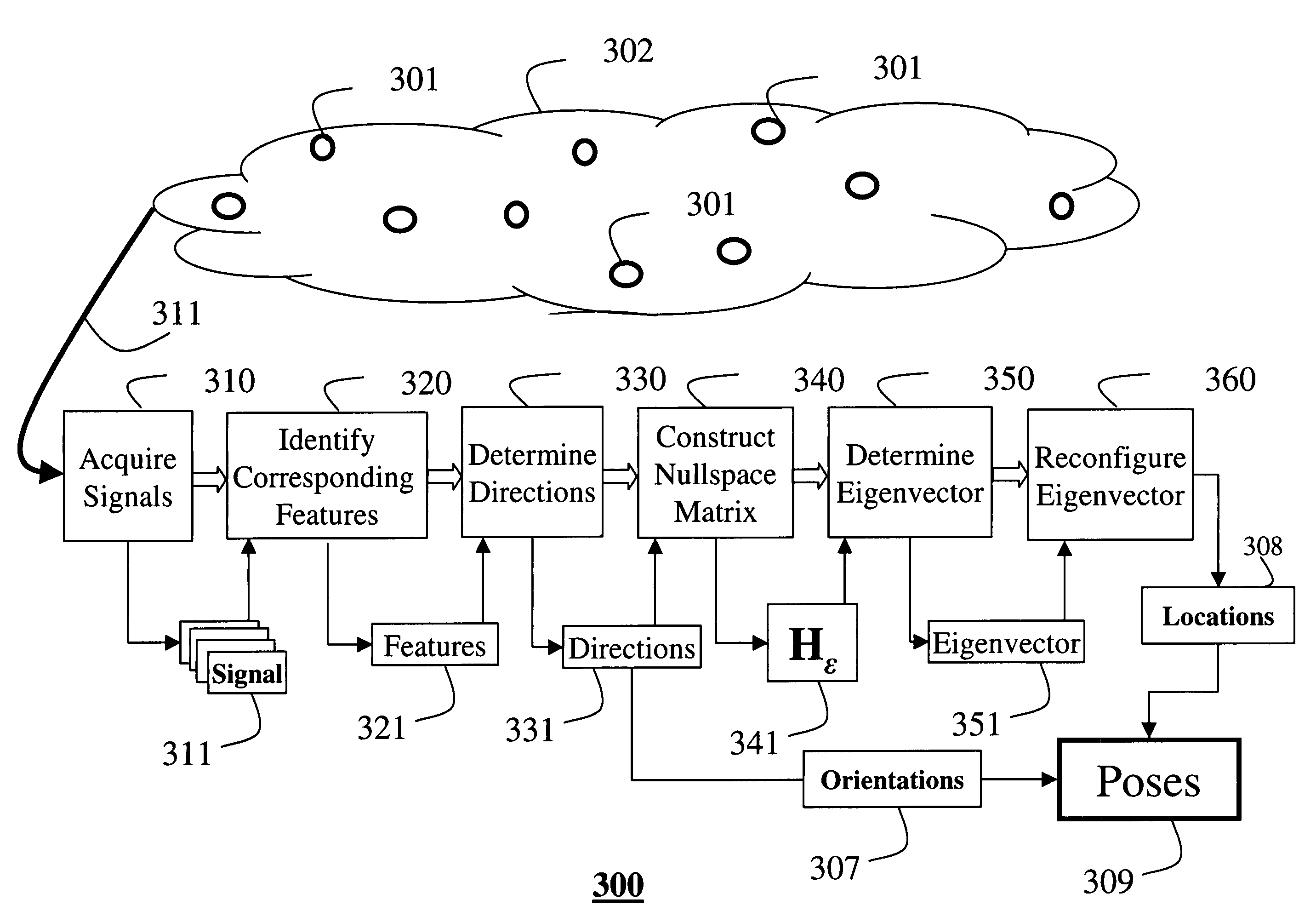
Figure 1 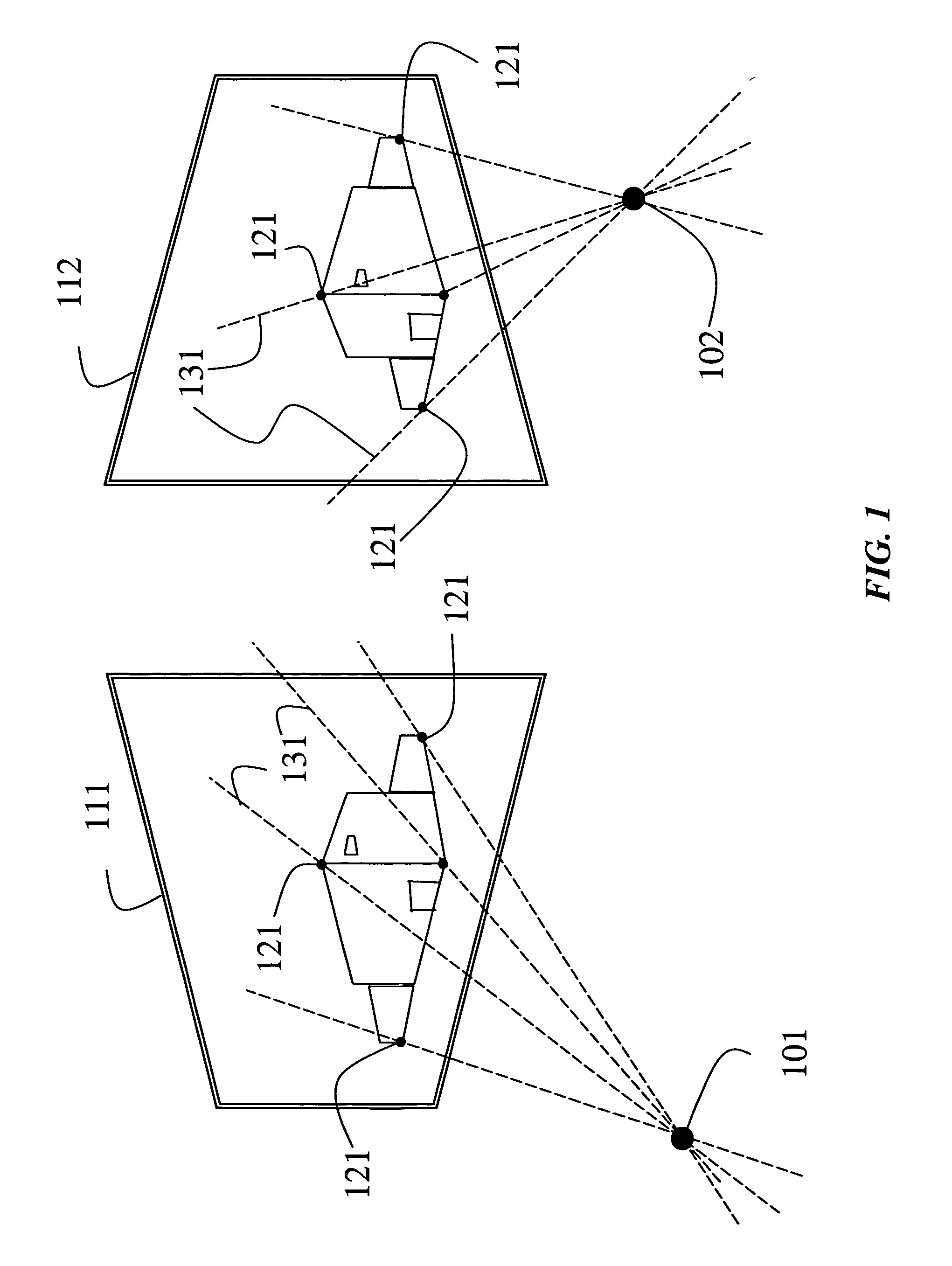
Figure 2 
Figure 3
Abstract
Description
FIELD OF THE INVENTION
[0001] This invention relates generally to sensors, and more particularly to determining poses of the sensors.BACKGROUND OF THE INVENTION
[0002] In many computer applications it is necessary to determine poses of sensors relative to sensed features in the environment in which the sensors are located. The pose of a sensor gives both the location and the orientation of the sensor. In three-dimensions, the location is usually specified by a three-dimensional Cartesian coordinate system (x,y,z), and the orientation is specified by a three-dimensional polar coordinate system (u,v,w).
[0003] For example, many computer vision and graphics applications require that the poses of cameras are known. These applications include three-dimensional reconstructions, modeling by structure-from-motion, photo-realistic rendering, image based environment augmentation, simulation, and image registration, to name but a few.
[0004] In a simple application, signals in the form of stereo image...
Examples
Embodiment Construction
System Structure
[0023]FIG. 1 shows sensors or ‘nodes’101–102, e.g., cameras. A method according to my invention determines the poses of the sensors by analyzing signals 111–112, e.g., images, acquired by sensors. As a characteristic, the signals are acquired of a large environment, for example, an urban area, or a portion of the universe. Each signal has only a small number of features 121 in common with another signal. Consequently, the signals are said to be sparse.
[0024]The method according to my invention treats this problem as a graph embedding problem. Prior art solutions typically constrain a pose of a node by linear mixtures of directions to neighboring nodes, with a known mixture weights, see Roweis et al., “Nonlinear dimensionality reduction by locally linear embedding,” Science 290, pp. 2323–2326, 2000.
[0025]Similarly, my method constrains node poses to be linear mixtures of directions 131 between nodes and features 121, however, with an unknown mixture weights. The direc...