
Variation of neural-stimulation parameters
a neural stimulation and parameter technology, applied in the field of dynamically changing various neural stimulation treatment parameters, can solve the problems of high artificial activity and non-physiologic pattern, 422 patent, and large drain on the battery of the implanted stimulator, so as to minimize the loss of therapeutic effect.
Patent Information
- Authority / Receiving Office
- US · United States
- Patent Type
- Patents(United States)
- Current Assignee / Owner
- Publication Date
- 2006-05-23
- Estimated Expiration
- Not applicable · inactive patent
Smart Images
Figure 1 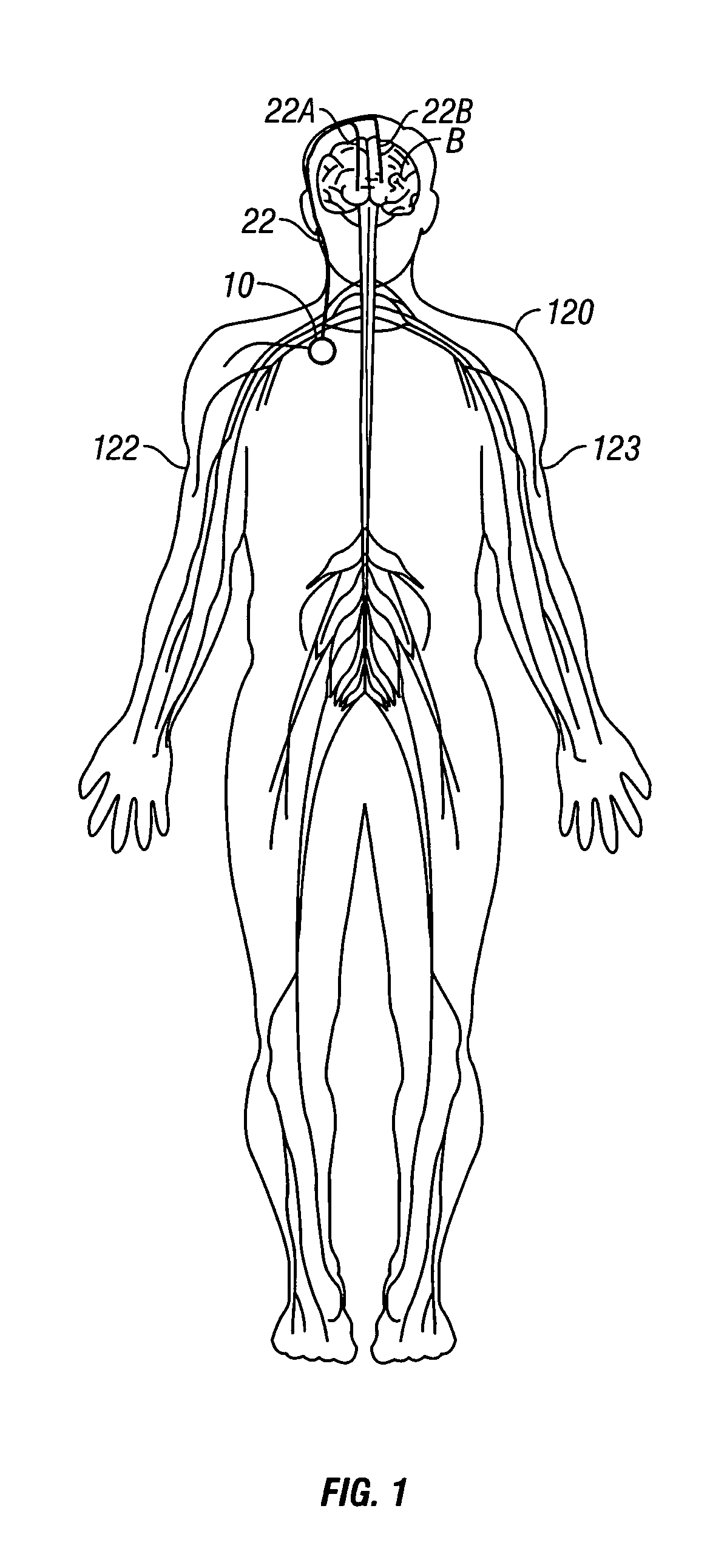
Figure 2 
Figure 3
Abstract
Description
FIELD OF THE INVENTION
[0001] The invention relates to dynamically changing various neural-stimulation-treatment parameters to improve therapy efficacy, minimize energy consumption, minimize undesired side effects, and to minimize any loss of therapeutic efficacy due to a patient developing physiologic tolerance to therapeutic stimulation. More particularly, the invention relates to pseudo-randomly changing stimulation-parameter values such as frequency, amplitude, pulse width, electrode-firing pattern, and electrode-firing-polarity conditions while therapeutically treating a patient with neural stimulation.BACKGROUND OF THE INVENTION
[0002] Neural stimulation devices are capable of treating various disorders and symptoms of disorders. In the context of neural stimulators, an electrical lead having one or more electrodes is typically implanted near a specific site in the brain of a patient. The lead is coupled to a signal generator that delivers electrical energy through the electrodes ...
Examples
Embodiment Construction
[0027]FIG. 1 depicts a microprocessor-controlled neural stimulation device 10 in accordance with an illustrative embodiment of the invention. Device 10 is preferably implanted below the skin of a patient, or alternatively, may be an external device. A lead 22A is positioned to stimulate a specific site in the brain (B). Device 10 may take the form of a modified signal generator Model 7424 manufactured by Medtronic, Inc. under the trademark Itrel II. Lead 22A may be any lead suitable for stimulation. The distal end of lead 22A terminates in one or more stimulation electrodes generally implanted into a portion of the brain such as the thalamus, the internal capsule, the globus pallidus, the subthalamic nucleus or other neural structure by conventional stereotactic surgical techniques. Any number of electrodes may be used for various applications. Each of the electrodes is individually connected to device 10 through lead 22A and conductor 22. Lead 22A is surgically implanted through a ...