
Portable light
a technology of leds and light bulbs, applied in the field of portable lights, can solve the problems of difficult to adequately dissipate heat in a high power, and still generate a substantial amount of heat in high-power leds, and achieve the effects of adequate heat dissipation, reliable operation and high-power leds
Patent Information
- Authority / Receiving Office
- US · United States
- Patent Type
- Patents(United States)
- Current Assignee / Owner
- Publication Date
- 2007-11-13
Smart Images
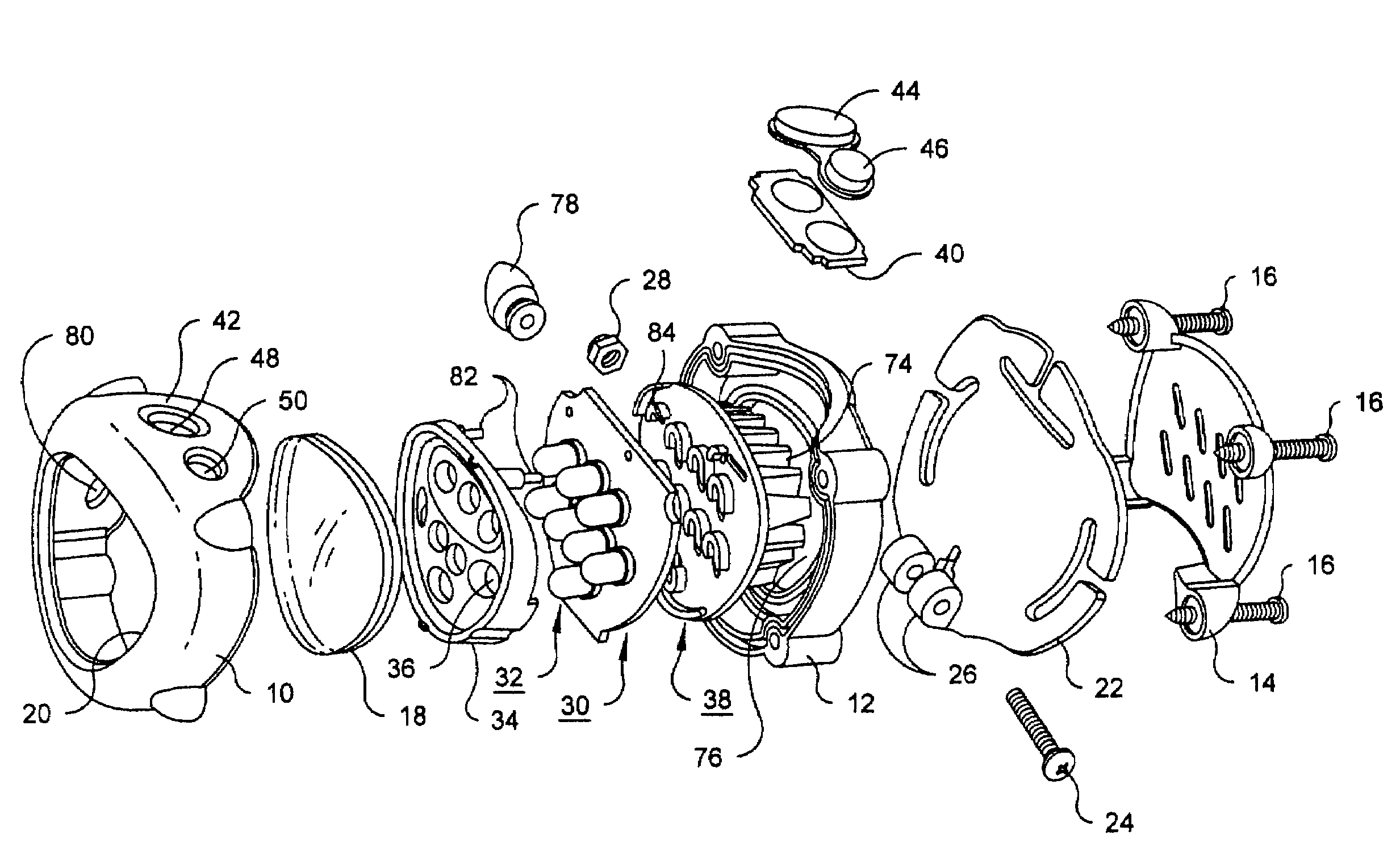
Figure 1 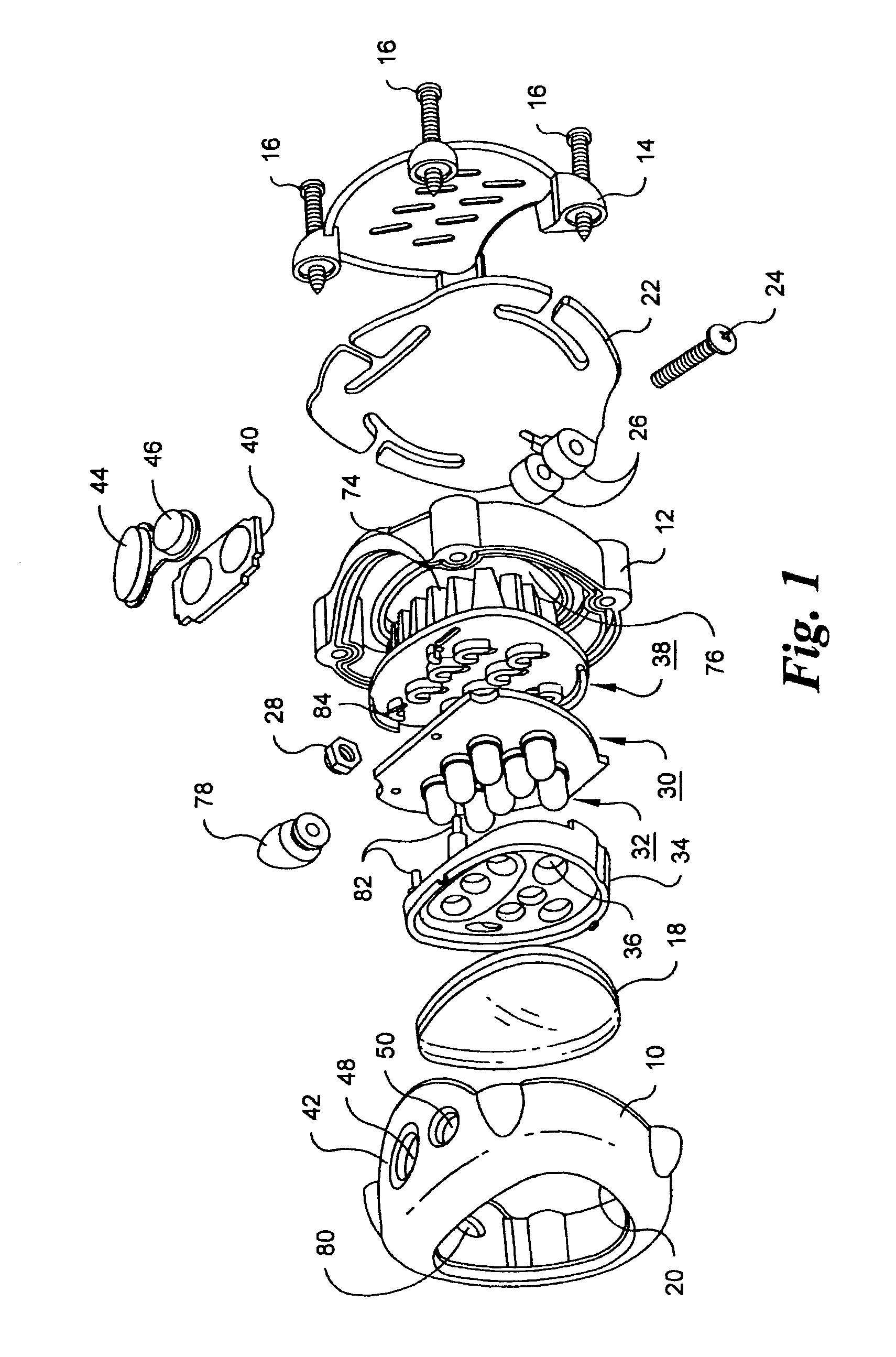
Figure 2 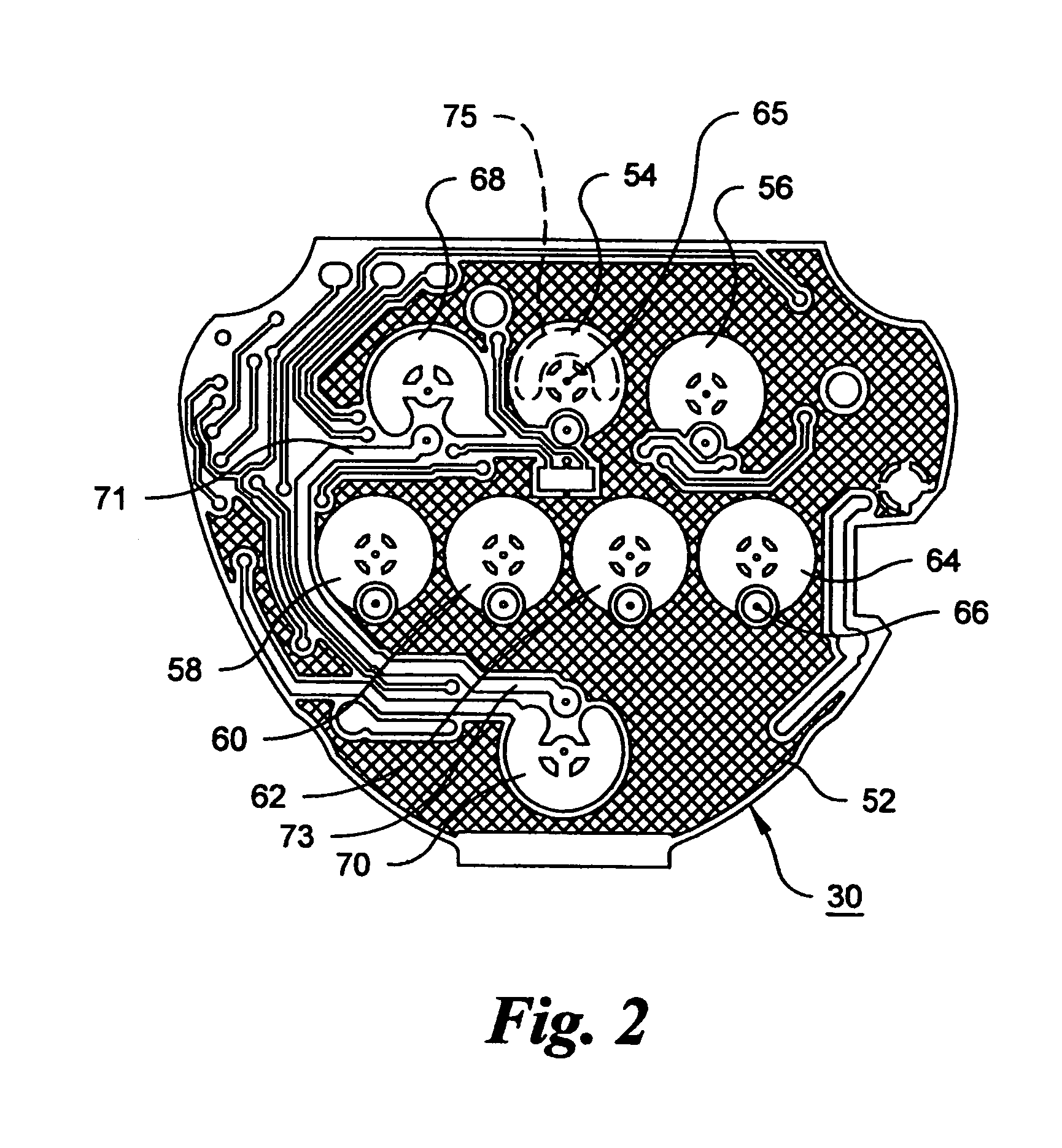
Figure 3
Abstract
Description
CROSS-REFERENCE TO RELATED APPLICATION
[0001] This application claims priority, under 35 U.S.C. §119(e)(1), on the basis of provisional patent application 60 / 592,646, filed Jul. 29, 2004.FIELD OF THE INVENTION
[0002] This invention relates to portable lights, and more particularly to a portable light in which illumination is produced by a plurality of light-emitting diodes.BACKGROUND OF THE INVENTION
[0003] With the development, beginning around 1996, of light-emitting diodes (LEDs) capable of emitting white light, LEDs have come into use in flashlights, and in portable headlights for use in activities such as diving, cave exploration, hiking, camping, etc. Moreover, in recent years, with the development of more powerful LEDs, these devices have even displaced incandescent bulbs in some flashlights and personal headlamps. For illumination comparable to that of an incandescent flashlight or personal headlamp, manufacturers have incorporated multiple LEDs into a single lamp. In some cases, ...
Examples
Embodiment Construction
[0015]The invention will be described as embodied in a personal headlamp designed to be worn on an individual's head with the aid of a flexible headband (not shown). As shown in FIG. 1, the housing of the portable light in accordance with the invention comprises a front part 10, a back part 12, and a back cover 14, all molded of a suitable synthetic resin. These three parts are secured together by screws 16.
[0016]A transparent lens 18 is secured by a suitable adhesive to the front part 10 of the housing, covering the front opening 20 therein, the adhesive providing a seal.
[0017]A bracket 22 is connected in pivoting relationship to the back housing part 12 by a pin 24, which extends through a pair of knuckles 26 formed on the bracket and a knuckle (not shown) formed on the housing part 12, which extends into a slot between knuckles 26. The pin is threaded into a lock nut 28. The knuckles and pin 24 cooperate to form a hinge, which allows the housing to be tilted relative to the brack...