
System and method for inductively charging a battery
a battery and inductive charging technology, applied in the field of system and method for inductive charging of batteries, can solve the problems of not all batteries are easily charged inductively, li-ion batteries are unable to absorb an overcharge, and li-ion batteries are not as straightforward as other batteries, so as to achieve the effect of increasing current through the primary coil
Patent Information
- Authority / Receiving Office
- US · United States
- Patent Type
- Patents(United States)
- Current Assignee / Owner
- Publication Date
- 2011-08-23
Smart Images
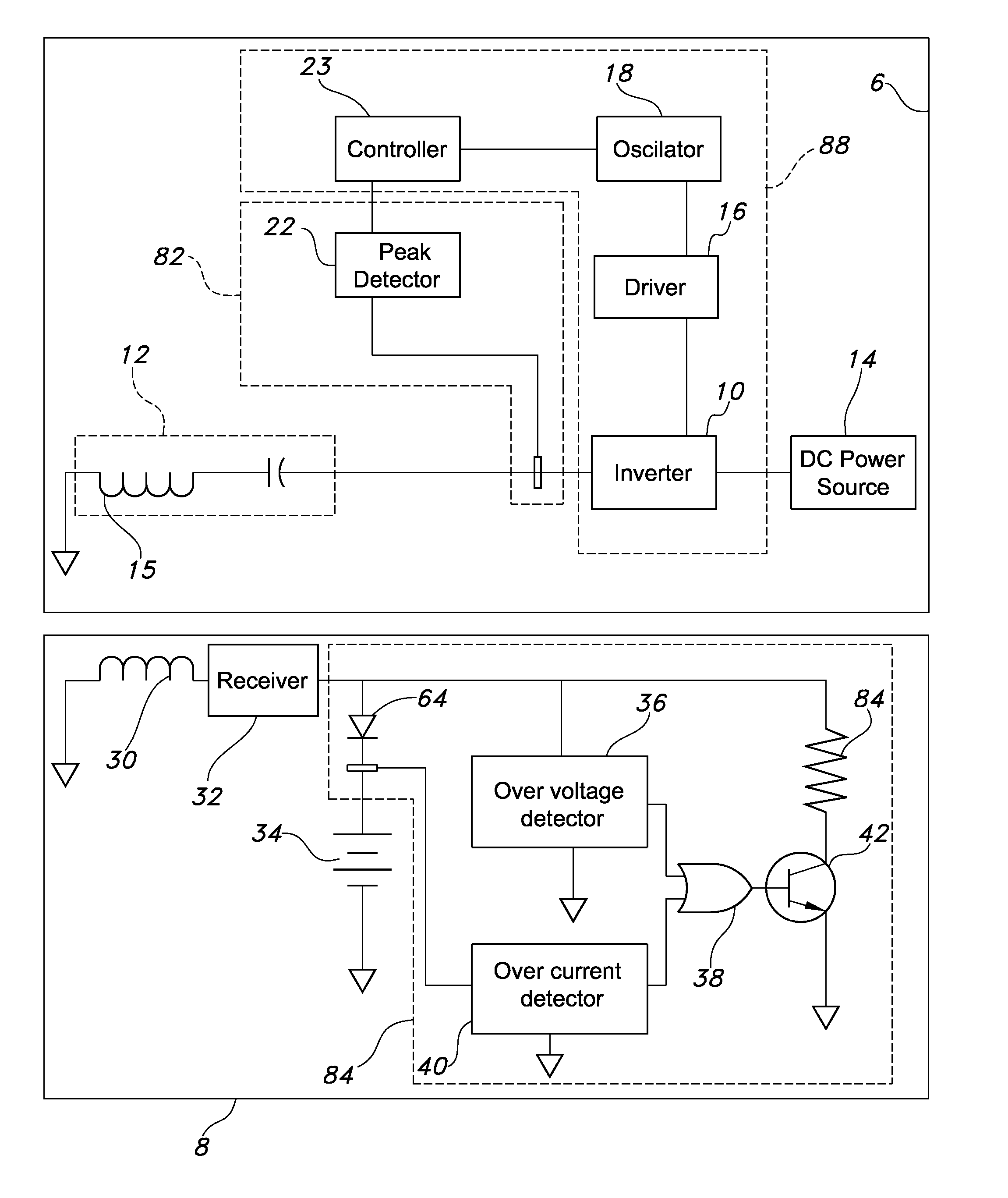
Figure 1 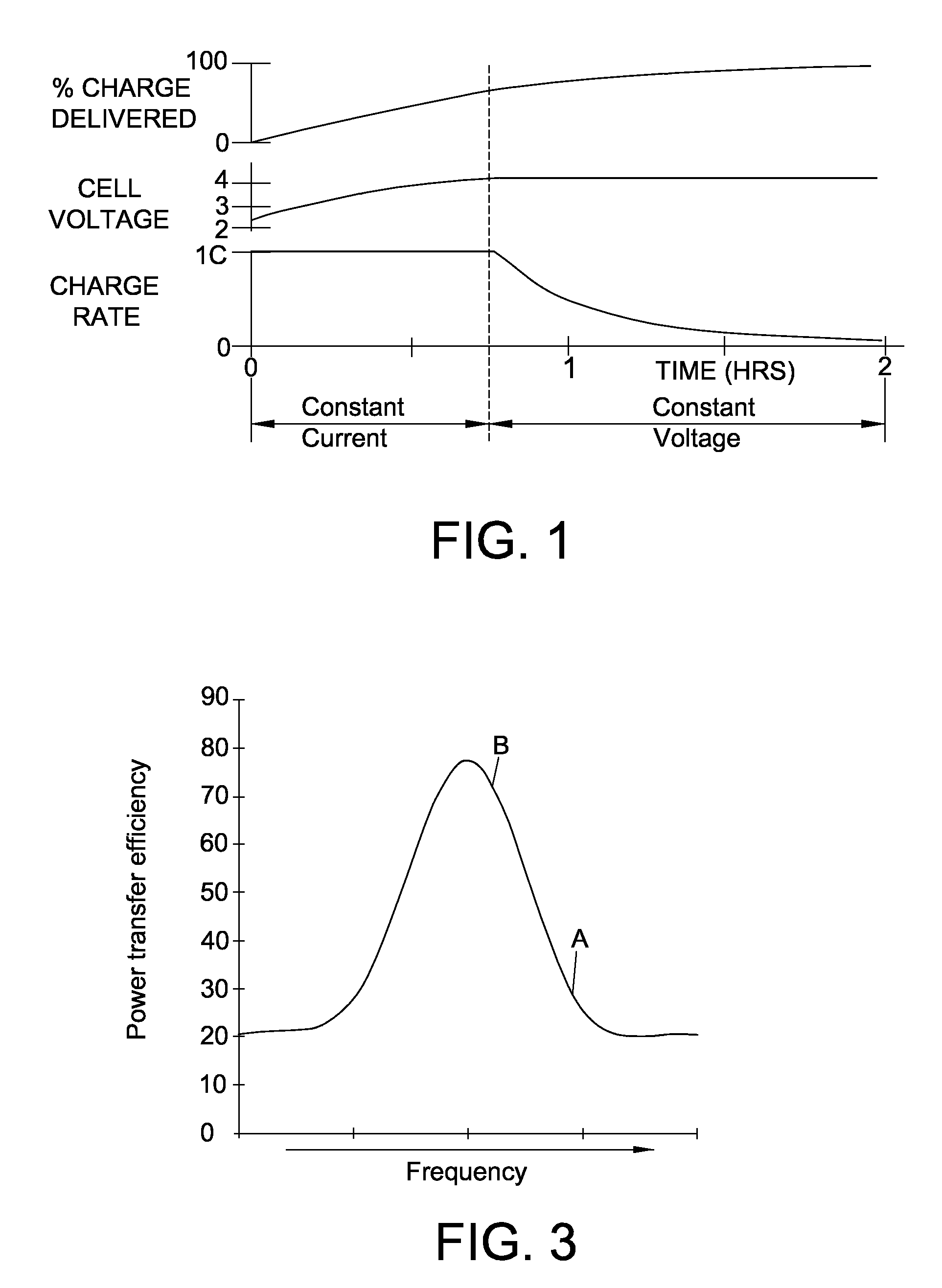
Figure 2 
Figure 3
Abstract
Description
BACKGROUND OF THE INVENTION
[0001] Charging of batteries with an inductive power supply is well-known. Inductive charging of batteries for electric automobiles as well as the charging of small electric appliance batteries such as those for toothbrushes has met some amount of success. Because inductive charging does not require a physical connection between the battery and the charger, the charging is considerably more convenient. However, not all batteries are easily charged inductively. Lithium-ion batteries (Li-Ion) are one such type of battery.
[0002] Recharging Li-Ion batteries is not as straightforward as that of other batteries. Li-Ion batteries are unable to absorb an overcharge. If a constant current is applied to a fully charged Li-Ion battery, metallic lithium plating may develop which could lead to failure of the battery. Thus, care should be taken not to overcharge the battery.
[0003] Conversely, charging a Li-Ion battery to full capacity presents some difficulty. The maximum ...
Examples
Embodiment Construction
[0033]An inductive charging system in accordance with an embodiment of the present invention in shown in FIG. 2. The inductive charging system 4 is configured to inductively charge a battery having a nonlinear charging profile, such as a Li-Ion battery. The system 4 generally includes a charger circuit 6 and secondary circuit 8. The charger circuit 6 generally includes a primary coil 15, a frequency controller 80 for applying power to the primary coil at a desired frequency and a feedback detector 82 for receiving feedback from the secondary circuit 8. The secondary circuit 8 generally includes a secondary coil 30 for receiving inductive power from the charger circuit 6 and a feedback mechanism 84 for providing feedback to the charger circuit 6 indicative of the voltage or current in the secondary circuit 8. The frequency controller 80 varies the frequency of the power applied to the primary coil 15 as a function of the feedback from the secondary circuit 8. Although described in co...