
Method of widely linear turbo-equalization in a multi-user context and for a multi-channel multi-antenna receiver
a multi-user context and multi-antenna receiver technology, applied in the field of digital radio communication systems, can solve the problem that the known equalization methods do not make it possible, and achieve the effect of reducing interference between multiple users and improving the equalization filter
Patent Information
- Authority / Receiving Office
- US · United States
- Patent Type
- Patents(United States)
- Current Assignee / Owner
- Publication Date
- 2016-08-30
- Estimated Expiration
- Not applicable · inactive patent
Smart Images
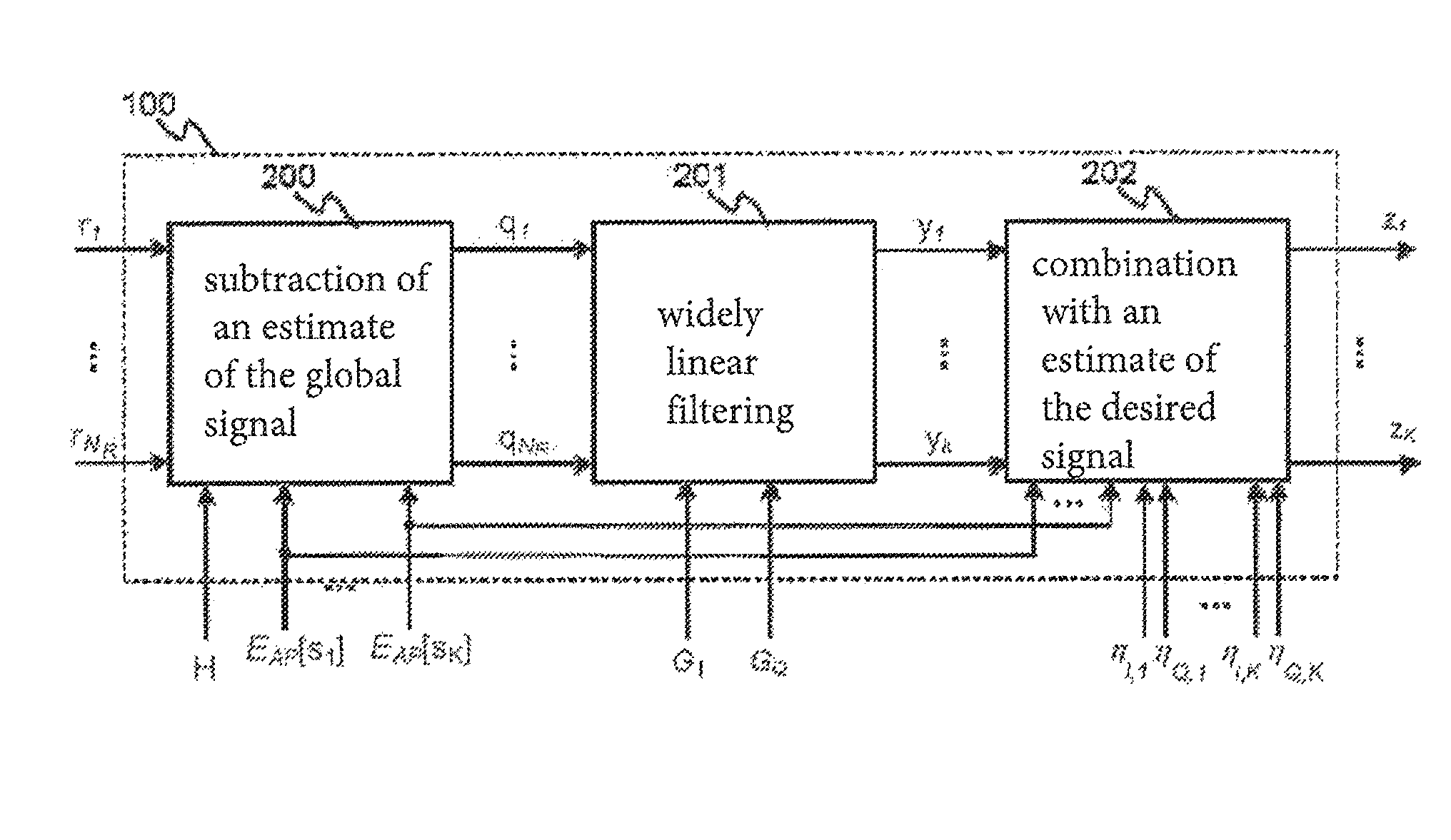
Figure 1 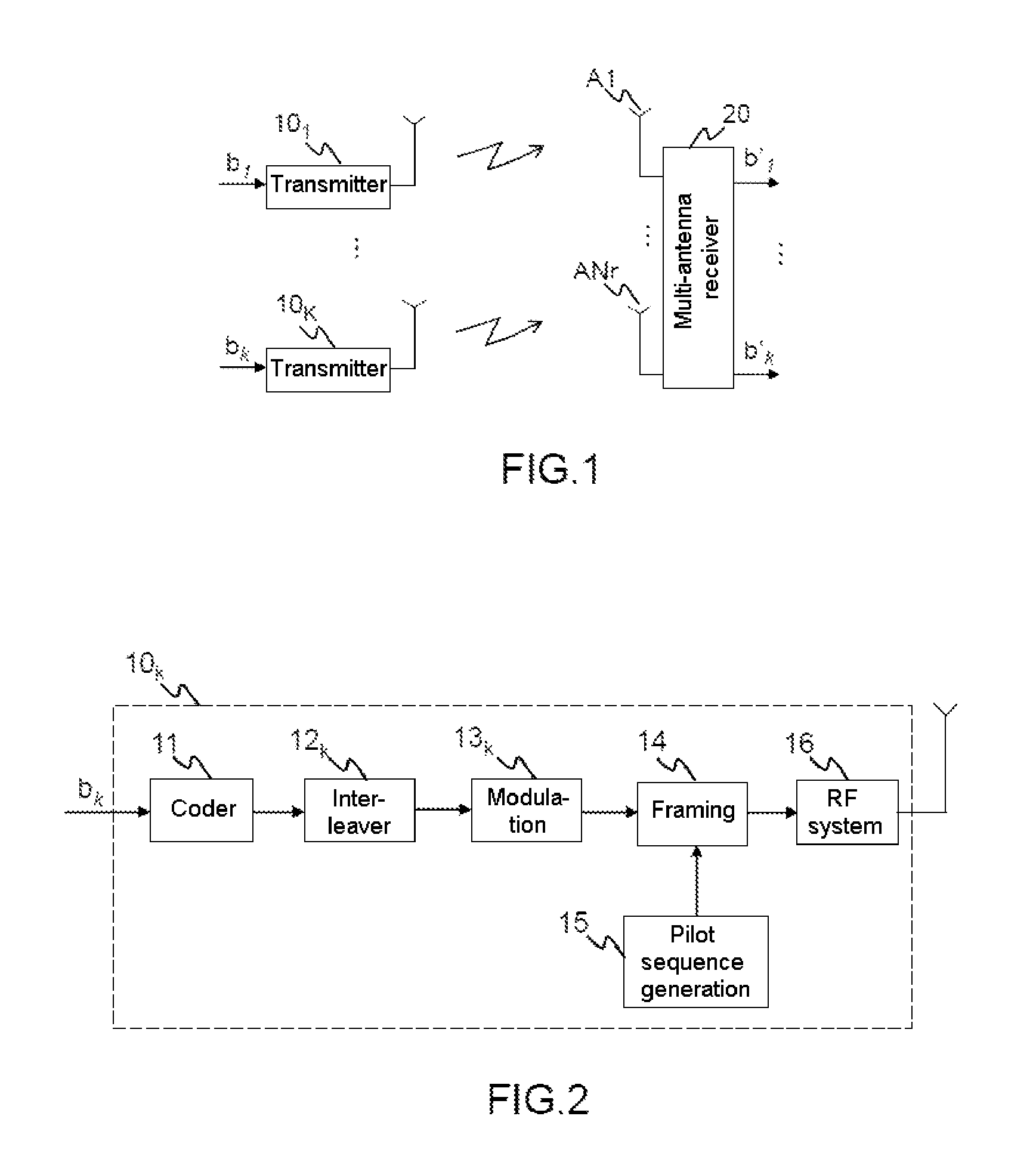
Figure 2 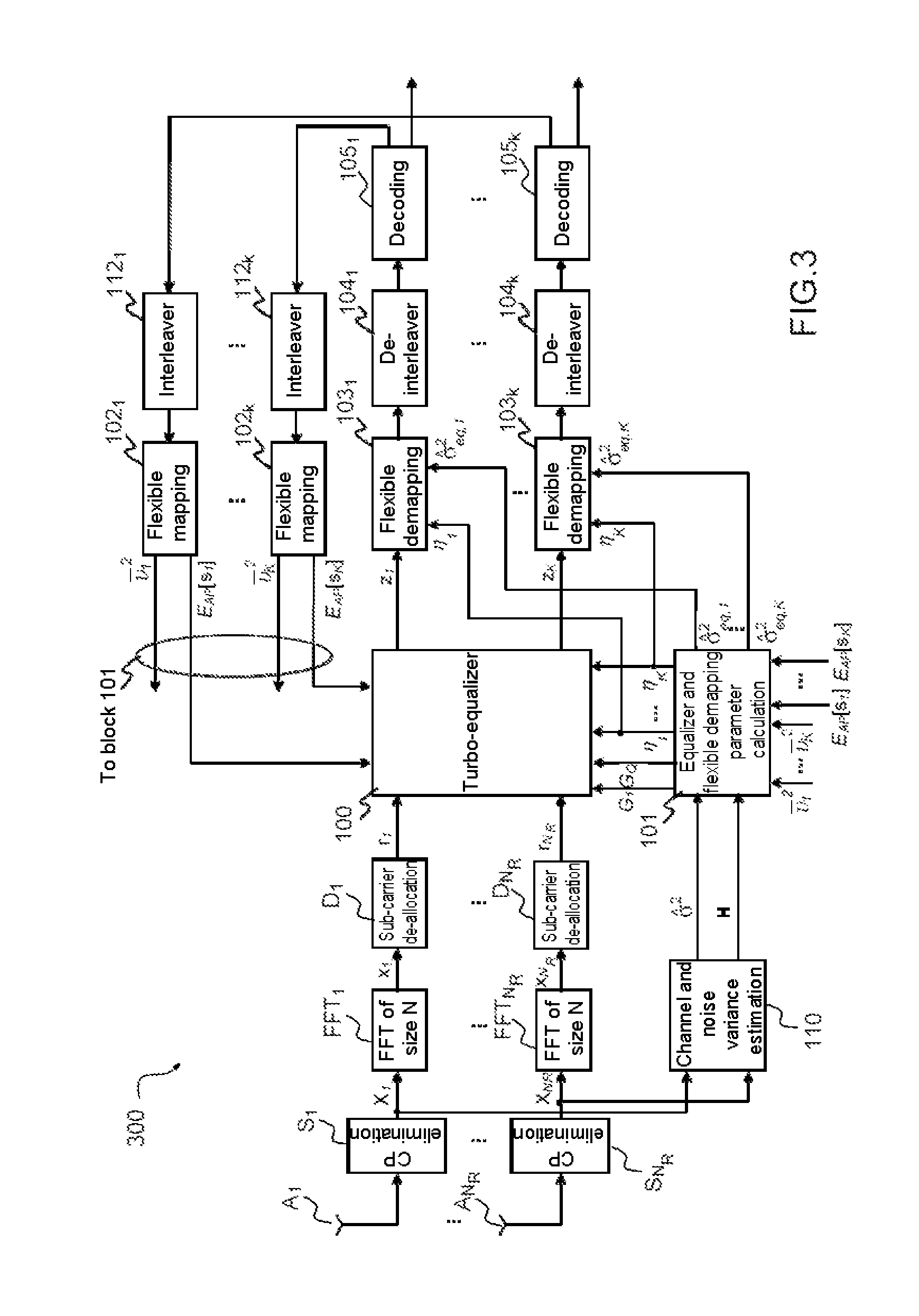
Figure 3
Abstract
Description
CROSS-REFERENCE TO RELATED APPLICATION
[0001] This application claims priority to foreign French patent application No. FR 1401178, filed on May 23, 2014, the disclosure of which is incorporated by reference in its entirety.FIELD OF THE INVENTION
[0002] The field of the invention is that of digital radio communication systems and more particularly multi-antenna communication receivers, i.e. receivers with a plurality of receiving antennas.
[0003] The invention also concerns multi-user systems in which communication resources are shared between a plurality of users who can communicate simultaneously by sharing frequency bands or timeslots.
[0004] The invention is more generally concerned with all multi-user communication systems in which high levels of interference are generated both between transmitters associated with different users and also between the symbols conveyed by a signal transmitted by one user because of interference inherent to the propagation channel.
[0005] It is known to emp...
Examples
first embodiment
[0113]The equalization method in accordance with the invention executed by the turbo-equalization module 100 of the receiver 300 is described in more detail next.
[0114]FIG. 4 shows this first embodiment of the turbo-equalization module 100.
[0115]In accordance with the invention, the turbo-equalization module 100 implements the method of widely linear turbo-equalization in the frequency domain on the signals coming from the NR antennas of the receiver.
[0116]From the functional point of view, the objective of the turbo-equalization block 100 is to cancel MUI interference and ISI interference and to equalize the signals in the space-frequency domain.
[0117]A first implementation of the block 100 consists in applying an equalizer 1001,1 . . . 100K,M to each signal symbol received on each of the M wanted sub-carriers from K transmitters simultaneously transmitting a signal to the receiver as represented in FIG. 4.
[0118]Each equalizer 100k,m comprises two main functions, a first function 2...
second embodiment
[0139]Described next is the equalization method in accordance with the invention in which the processing, although functionally equivalent to that described above for the first implementation, has reduced implementation complexity.
[0140]Equation (4) may be rewritten with the following equivalent formulation:
[0141]rk,m=r-H(IK⊗FM)EAP[s]+H(IK⊗FM)em+(k-1)MEAP[sk,m]=r-EAP[s]+k,mEAP[sk,m](5)where=H(IK⊗FM)k,m=H(IK⊗FM)em+(k-1)M
[0142]Equation (5) shows that the signal rk,m can be obtained from an estimate of the wanted symbol transmitted via the propagation channel H(IKFM)em+(k−1)MEAP[Sk,m] and corrected by the corrective term q=r−H(IKFM)EAP[s] in which the quantity H(IKFM)EAP[s] is an estimate of the global signal reconstructed from soft information coming from the decoders in the preceding iteration.
[0143]After filtering, the output of the equalizer filter may be expressed as the sum of the estimate of the wanted signal weighted by the coefficient gI,k,mHk,m and its conju...