
Polypropylene composition with improved mechanical properties
The polypropylene composition combining heterophasic propylene copolymer and ivory-colored recycled polypropylene addresses the issue of mechanical property deterioration in recycled polypropylene formulations, achieving enhanced mechanical properties and sustainable material usage.
Patent Information
- Application Number
- PCT/EP2024/083483
- Authority / Receiving Office
- WO · WO
- Patent Type
- Applications
- Current Assignee / Owner
- Priority Date
- 2023-12-05
- Filing Date
- 2024-11-25
- Publication Date
- 2025-06-12
AI Technical Summary
The development of polypropylene formulations incorporating recycled polyolefins often results in a deterioration of mechanical properties, which is undesirable for applications requiring adequate melt fluidity and mechanical strength.
A polypropylene composition comprising a heterophasic propylene copolymer and ivory-colored recycled polypropylene, with the heterophasic propylene copolymer present in a range of 30 wt% to 80 wt% and the recycled polypropylene present in a range of 20 wt% to 70 wt% based on the total weight of the composition.
The polypropylene composition exhibits excellent mechanical properties, including high elongation at break and a low ductile-brittle transition temperature, thereby maintaining the mechanical integrity while incorporating recycled materials.
Smart Images
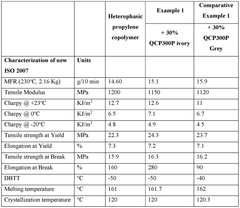
Figure IMGF000015_0001
Abstract
Description
POLYPROPYLENE COMPOSITION WITH IMPROVED MECHANICALPROPERTIESFIELD OF THE INVENTION
[0001] The present disclosure relates to recyclate polymer materials. In particular, the present disclosure relates to a polypropylene composition comprising a heterophasic propylene copolymer and ivory-colored recycled polypropylene.BACKGROUND OF THE INVENTION
[0002] Thermoplastic polyolefins, including polypropylenes, find extensive use in various applications, particularly in molded articles. The use of tailored heterophasic propylene copolymers can enhance the physical properties of molded articles, such as packaging for food and other products, fibers, automotive components, bottles, boxes, and a wide range of other items.
[0003] The extensive use of polypropylene and other polymers has generated millions of metric tons of plastic waste annually. Plastic recycling has long been acknowledged as a viable approach to mitigate the hazards associated with the extensive use of plastics, their disposal, and their potential release into the environment. In recent times, there has been a notable surge in plastic recycling rates due to increased awareness among consumers, businesses, and industrial manufacturing processes.
[0004] In some applications, polypropylene polymers are requested to show adequate melt fluidity together with excellent balance of mechanical properties.
[0005] Heterophasic polypropylenes have been generally found meeting said requirements. However, in the attempt to develop formulations including recycled polyolefins, it has been observed that a deterioration of the mechanical properties often occurs. It would be therefore advisable to find proper combinations of recycled polymers and heterophasic polypropylene not showing deterioration of mechanical properties.BRIEF SUMMARY OF THE INVENTION
[0006] The present disclosure provides a polypropylene composition comprising (a) a heterophasic propylene copolymer and (b) ivory-colored recycled polypropylene.
[0007] The heterophasic propylene copolymer is present in an amount in the range from 30 wt% to 80 wt%, preferably from 35%wt to 75%wt, more preferably from 40% wt to 80% wt based on the weight of the polypropylene composition. The ivory-colored recycled polypropylene is present in an amount in the range from 20 wt% to 70 wt%, preferably 25 wt% to 65 wt%, most preferably 30 wt% to 60 wt%, based on the total weight of the polypropylene composition.
[0008] The present disclosure also shows that a polypropylene composition comprising a heterophasic propylene copolymer and ivory-colored recycled polypropylene has excellent mechanical properties, especially high elongation at break and a low ductile brittle transition temperature.DETAILED DESCRIPTION OF THE INVENTION
[0009] The words and phrases used herein should be understood and interpreted to have a meaning consistent with the understanding of those words and phrases by those skilled in the relevant art. No special definition of a term or phrase, i.e., a definition that is different from the ordinary and customary meaning as understood by those skilled in the art, is intended to be implied by consistent usage of the term or phrase herein. To the extent that a term or phrase is intended to have a special meaning, i.e., a meaning other than the broadest meaning understood by skilled artisans, such a special or clarifying definition will be expressly outlined in the specification in a definitional manner that provides the special or clarifying definition for the term or phrase. It must also be noted that, as used in the specification and the appended claims, the singular forms "a," "an," and "the" include plural references unless otherwise specified.
[0010] For example, the following discussion contains a non-exhaustive list of definitions of several specific terms used in this disclosure (other terms may be defined or clarified in a definitional manner elsewhere herein). These definitions are intended to clarify the meanings of the terms used herein. It is believed that the terms are used in a manner consistent with their ordinary meaning, but the definitions are nonetheless specified here for clarity.
[0011] As used in this specification and the claims, the terms “comprising,” “containing,” or “including” mean that at least the named compound, element, material, particle, or method step is present in the composition, the article, or the method, but does not exclude the presence ofother compounds, elements, materials, particles, or method steps even if the other such compounds, elements, materials, particles, or method steps have the same function as that which is named, unless expressly excluded in the claims. It is also to be understood that the mention of one or more method steps does not preclude the presence of additional method steps before or after the combined recited steps or intervening method steps between those steps expressly identified.
[0012] Moreover, it is also to be understood that the lettering of process steps or ingredients is for identifying discrete activities or ingredients and the recited lettering can be arranged in any sequence, unless expressly indicated.
[0013] For the present description and of the claims which follow, except where otherwise indicated, numbers expressing amounts, quantities, percentages, and so forth, are to be understood as being modified by the term “about”. Also, ranges include any combination of the maximum and minimum points disclosed and include any intermediate ranges therein, which may or may not be specifically enumerated herein.
[0014] Definitions:
[0015] “PP,” as used herein, means propylene homopolymers or copolymers produced in a suspension, solution, bulk, or gas-phase polymerization process.
[0016] “HPP.” as used herein, means heterophasic propylene copolymer obtained by sequential polymerization by using Ziegler Natta catalysts.
[0017] “Recycled polymer,” as used herein, means post-consumer recycled (“PCR”) polyolefin and / or post- industrial recycled (“PIR”) polyolefin. Polyolefin recyclate is derived from an end product that has completed its life cycle as a consumer item and would otherwise be disposed of as waste (e.g., a polyethylene water bottle) or from plastic scrap that is generated as waste from an industrial process.
[0018] “Copolymer,” as used herein refers to both polymers with two different recurring units and polymers with more than two different recurring units, such as terpolymers, in the chain. “Ambient temperature” and “room temperature” mean a temperature of 25 °C
[0019] In the present invention, the terms “monomer” and “comonomer” are used interchangeably. The terms mean any compound with a polymerizable moiety that is added to a reactor to produce a polymer. In those instances in which a polymer is described as comprising one or more monomers, e.g., a polymer comprising propylene and ethylene, the polymer, ofcourse, comprises units derived from the monomers, e.g., — CH2 — CH2 — , and not the monomer itself, e.g., CH2=CH2.
[0020] The following abbreviations are used herein:ABBREVIATION TERMPP Polypropylene homopolymer or copolymerHPP Heterophasic propylene copolymerRpp Recycled polypropylene wt% weight percent
[0021] Heterophasic propylene copolymerThe heterophasic propylene copolymer comprises a propylene polymer continuous (matrix) phase (al) with a dispersed copolymer phase (a2). The propylene polymer matrix (al) of the heterophasic propylene copolymer is selected from propylene homopolymer or random copolymer of propylene containing up to 8 wt%, preferably 0.2 to 5 wt% of ethylene, or a random copolymer of propylene containing up to 8 wt%, preferably 1 to 8 wt%, of at least one C4-C10 a- olefin which conforms to the formula CH2=CHR, wherein R is a linear or branched alkyl C2-C8 radical or an aryl radical such as phenyl. Illustrative examples of C4-C10 alpha-olefin include 1 - butene, 1 -pentene, 1 -hexene, 4-methyl-l- pentene, and 1 -octene, with 1 -butene being particularly preferred.
[0022] The dispersed copolymer phase (a2) of the heterophasic propylene copolymer is selected from the copolymer of ethylene and at least one C3-C10 alpha-olefin having the formula CH2=CHR where R is a linear or branched Ci-Cs alkyl radical or an aryl radical such as phenyl, and optionally a minor amount of a diene. The ethylene content of the a2) component preferably ranges from 15 wt% to 60 wt%, most preferably from 18 wt% to 55 wt%. Illustrative examples of C3-C10 alpha-olefins include propylene, 1 -butene, 1 -pentene, 1 -hexene, 4- methyl- 1- pentene, and 1 -octene, with propylene and 1 -butene being particularly preferred. Suitable dienes include butadiene, 1,4-hexadiene, 1,5 -hexadiene, and ethylidene-norbornene- 1. When present, the diene is typically in an amount of 0.5 to 10% by weight concerning the weight of the dispersed copolymer a2).
[0023] The polymer matrix (al) is present in an amount ranging from 15 wt% to 85 wt%, preferably 20%wt to 80%wt, most preferably 25%wt to 70%wt and especially from 50%wt to 80%wt of the total weight of the heterophasic propylene copolymer. The dispersed copolymerphase (a2) is present in an amount from 15%wt to 85%wt, preferably 20% wt to 80%wt, most preferably 25%wt to 75%wt and especially from 20%wt to 50%wt of the total weight of the heterophasic propylene copolymer with the sum of the percentage of the individual components being equal to 100 percent.
[0024] The heterophasic propylene copolymer is at least partially soluble in xylene at room temperature, and the soluble fraction preferably has an intrinsic viscosity in tetraline [n] at 135°C ranging from 2 to 6 dl / g, preferably 2.5 to 5.5dl / g, more preferably from 2.5 to 5 dl / g, and most preferably 3 to 4.5 dl / g.
[0025] The heterophasic propylene copolymer has preferably a melt flow rate ranging from 2 to 50 g / 10 min., more preferably from 3 to 45 g / 10 min., and most preferably from 5 to 40 g / 10 min.
[0026] The heterophasic propylene copolymer can be prepared according to well-known polymerization processes. Specifically, the process for preparing the heterophasic composition can be a sequential polymerization carried out in the presence of stereospecific Ziegler Natta catalysts, comprising at least two sequential steps, wherein components al) and a2) are prepared in separate subsequent steps, operating in each step, except the first step, in the presence of the polymer formed and the catalyst used in the preceding step. The catalyst is preferably added only in the first step because its activity is usually such that it is still active for all the subsequent steps. Component al) is preferably prepared in a single polymerization stage. The order of the polymerization stages is not a critical process feature, however, component al) is preferably prepared before component a2).
[0027] The polymerization steps can occur in liquid phase, gas phase, or liquid-gas phase. Examples of suitable reactors are continuously stirred tank reactors, loop reactors, fluidized-bed reactors, or horizontally or vertically stirred powder bed reactors. Of course, the reaction can also be carried out in a plurality of reactors connected in series.
[0028] In an embodiment, each stage can be in gas-phase, operating in one or more fluidized or mechanically agitated bed reactors, or bulk polymerization using the liquid monomer (for example propylene) as a reaction medium. Particularly preferred are hybrid processes in which one stage, preferably that in which component (al) is prepared, is carried out in liquid monomer and another stage, preferably that in which the component (a2) is prepared, is carried out in gasphase.
[0029] The polymerization is generally carried out at temperature of from 20 to 120°C, preferably of from 40 to 80°C. When the polymerization is carried out in gas-phase the operating pressure is generally between 0.5 and 5 MPa, preferably between 1 and 4 MPa. In the bulk polymerization the operating pressure may range between 1 and 8 MPa, preferably between 1.5 and 5 MPa. Hydrogen can be used as a molecular weight regulator.
[0030] The process is carried out in the presence of a catalyst which preferably comprises the product of the reaction between: i) a solid catalyst component comprising Ti, Mg, Cl, and at least an internal electron donor compound; ii) an alkylaluminum compound and, iii) an external electron-donor compound having the general formula (R7)a(R8)bSi(OR9)c, where a and b are integers from 0 to 2, c is an integer from 1 to 4 and the sum (a+b+c) is 4; R7, R8, and R9, are alkyl, cycloalkyl or aryl radicals with 1-18 carbon atoms optionally containing heteroatoms.
[0031] The internal donor is preferably selected from the esters of mono or dicarboxylic organic acids such as benzoates, malonates, phthalates and succinates. It is also possible to use, alone or in combination with diesters, 1,3-diethers such as those disclosed in EP0361494 Bl. Examples of internal donors are described in US 4522930A, EP 045977A2 and international patent applications WO 00 / 63261 and WO 01 / 57099. Particularly suited are the phthalic acid esters and succinate acids esters. Alkylphthalates are preferred, such as diisobutyl, dioctyl and diethyl phthalate and benzyl-butyl phthalate.
[0032] The particles of solid component (i) may have substantially spherical morphology and average diameter ranging between 5 and 150 pm, preferably from 20 to 100 pm and more preferably from 30 to 90 pm. As particles having substantially spherical morphology, those are meant wherein the ratio between the greater axis and the smaller axis is equal to or lower than 1.5 and preferably lower than 1.3.
[0033] The amount of Mg may preferably range from 8 to 30% more preferably from 10 to 25wt. % with respect to the total weight of the catalyst.
[0034] The amount of Ti may range from 0.5 to 7% and more preferably from 0.7 to 5wt. % with respect to the total weight of the catalyst.
[0035] According to one method, the solid catalyst component (i) can be prepared by reacting a titanium compound of formula Ti(OR)q-yXy, where q is the valence of titanium and y is a number between 1 and q, preferably TiCh, with a magnesium chloride deriving from an adduct of formula MgCk’pROH, where p is a number between 0.1 and 6, preferably from 2 to 3.5, and R is a hydrocarbon radical having 1-18 carbon atoms. The adduct can be suitably prepared in spherical form by mixing alcohol and magnesium chloride, operating under stirring conditions at the melting temperature of the adduct (100-130°C). Then, the adduct is mixed with an inert hydrocarbon immiscible with the adduct thereby creating an emulsion which is quickly quenched causing the solidification of the adduct in form of spherical particles. Examples of spherical adducts prepared according to this procedure are described in USP 4,399,054 and USP 4,469,648. The so obtained adduct can be directly reacted with Ti compound or it can be previously subjected to thermal controlled dealcoholation (80-130°C) so as to obtain an adduct in which the number of moles of alcohol is of lower than 3, preferably between 0.1 and 2.5. The reaction with the Ti compound can be carried out by suspending the adduct (dealcoholated or as such) in cold TiCh; the mixture is heated up to 80-130°C and kept at this temperature for 0.5-2 hours. The treatment with TiCh can be carried out one or more times. The electron donor compound can be added in the desired ratios during the treatment with TiCh.
[0036] The alkyl-Al compound (ii) is preferably chosen among the trialkyl aluminum compounds such as for example triethylaluminum, triisobutylaluminum, tri-n-butylaluminum, tri-n-hexylaluminum, tri-n-octylaluminum. It is also possible to use alkylaluminum halides, alkylaluminum hydrides or alkylaluminum sesquichlorides, such as AlEt2Cl and AhEtsCh, possibly in mixture with the above cited trialkylaluminums. The Al / Ti ratio is higher than 1 and may preferably range between 50 and 2000.
[0037] Particularly preferred are the silicon compounds (iii) in which a is 1, b is 1, c is 2, at least one of R7and R8is selected from branched alkyl, cycloalkyl or aryl groups with 3-10 carbon atoms optionally containing heteroatoms and R9is a Ci-Cio alkyl group, in particular methyl. Examples of such preferred silicon compounds are methylcyclohexyldimethoxysilane (C donor), diphenyldimethoxysilane, methyl-t-butyldimethoxysilane, dicyclopentyldimethoxysilane (D donor), diisopropyldimethoxysilane, (2-ethylpiperidinyl)t-butyldimethoxysilane, (2- ethylpiperidinyl)thexyldimethoxysilane, (3,3,3-trifluoro-n-propyl)(2- ethylpiperidinyl)dimethoxysilane, methyl(3,3,3-trifluoro-n-propyl)dimethoxysilane. Moreover,are also preferred the silicon compounds in which a is 0, c is 3, R8is a branched alkyl or cycloalkyl group, optionally containing heteroatoms, and R9is methyl. Examples of such preferred silicon compounds are cyclohexyltrimethoxysilane, t-butyltrimethoxysilane and thexyltrimethoxysilane.
[0038] The external electron donor compound (iii) is used in such an amount to give a molar ratio between the organoaluminum compound and said external electron donor compound (iii) of from 0.1 to 200, preferably from 1 to 100 and more preferably from 3 to 50.
[0039] Ivory-colored recycled polypropylene.The ivory-colored recycled polypropylene (b) is present in an amount ranging from 20 to 70% wt, preferably 25-65%wt, most preferably 30 wt% to 60 wt%, of the total weight of the polypropylene composition.The ivory-colored recycled polypropylene comprises one or more propylene homopolymers, propylene copolymers, heterophasic propylene copolymers, or mixtures thereof.
[0040] The polypropylene content in the ivory-colored recycled polypropylene ranges from 40 wt% to 95 wt%, preferably 60 wt% to 95 wt%, more preferably 75 wt% to 95 wt%, and especially from 85 to 95% wherein the remaining weight percentage is made from or containing other polymers, paper, cardboard, carton, aluminized plastic, and textile. In a preferred embodiment, the ivory-colored recycled polypropylene contains polypropylene and other polymeric components for 99%wt or more.
[0041] The ivory-colored recycled polypropylene has a melt flow rate (ISO 1133 230° C. / 2.16 kg) preferably ranging between 2 to 30 g / 10 min, preferably from 3 to 25 g / 10 min, more preferably from 5 to 20 g / 10 min.
[0042] The ivory-colored recycled polypropylene may comprise plastic waste of postindustrial or post-consumer origin. Preferably, it originates from the cleaning, color sorting and optionally further treatment of post-consumer waste (PCW) PP packaging waste, such as detergent and shampoo bottles, dairy pots, and meat trays, etc. Ivory colored recycled polypropylene is commercially available.
[0043] As mentioned above, the ivory-colored recycled polypropylene may comprise propylene homopolymers and copolymers, including elastomers, having units derived from propylene and units derived from one or more of ethylene and C4-C20 alpha-olefins or mixtures thereof. Preferably, the units derived from one or more ethylene and C4-C10 alpha-olefincomonomers are present in amounts up to 15 wt. %, based upon the total weight of the ivorycolored recycled polypropylene.
[0044] AdditivesThe polypropylene composition may further include an additive package comprising one or more additives selected from antioxidants, fillers, nucleating agents, acid scavengers, and the like. The additive package can further enhance the properties and performance of the polypropylene composition.
[0045] The additives disclosed herein, are present in the range of 0.1-10 wt%, based on the total weight of the polypropylene composition.
[0046] The preferred antioxidants are selected from phenolic antioxidants, particularly Tetrakis[methylene-3-(3',5'-di-t-4-hydroxyphenyl)propionate] methane and Octadecyl 3-(3 ,5-di- tert-butyl-4-hydroxyphenyl)propionate are preferred as phenolic antioxidants. The preferred nucleating agents are selected from aromatic carboxylic salts, salts of monocarboxylic or poly carboxylic acids, e.g. sodium benzoate, aluminum tert-butylbenzoate or di cetyl peroxy di carbonate, or the mixtures thereof. The inorganic fillers can be flame-retardant inorganic fillers and inorganic oxides or salts. The preferred inorganic fillers are selected from hydroxides, hydrated oxides, salts, or hydrated salts of metals, in particular of Ca, Al or Mg, such as, for example magnesium hydroxide Mg(OH)2, aluminum hydroxide Al(0H)3, alumina trihydrate AI2O3 • 3H2O, magnesium carbonate hydrate, magnesium carbonate MgCCh, magnesium calcium carbonate hydrate, magnesium calcium carbonate, or mixtures thereof. The preferred inorganic oxides or salts are selected from CaO, TiCh, Sb20, ZnO, Fe2O3, CaCCh, BaSC , and mixtures thereof. The preferred acid scavengers are selected from sodium stearate, calcium stearate, hydrotalcite, or the mixtures thereof.
[0047] Compounding processThe heterophasic propylene copolymer and the ivory-colored recycled polypropylene are subjected to compounding conditions sufficient to form the disclosed propylene polymer composition. In a preferred embodiment, compounding conditions are implemented in the compounding zone of an extruder or mixer and are tailored for mixtures of specific polypropylenes, and optionally additives. Temperature, pressure, and shear force conditions are implemented in the extruder or mixer sufficient to provide intimate mixing of the heterophasicpropylene copolymer and the ivory-colored recycled polypropylene to produce a substantially homogeneous polymer blend. The preferred compounding process is melt blending.As used herein, the term "melt blending" involves the use of shear force, extensional force, compressive force, ultrasonic energy, electromagnetic energy, thermal energy, or combinations comprising at least one of the foregoing forces or forms of energy and is conducted in processing equipment wherein the aforementioned forces are exerted by a single screw, multiple screws, intermeshing co-rotating or counter-rotating screws, non-intermeshing co-rotating or counterrotating screws, reciprocating screws, screws with pins, barrels with pins, rolls, rams, helical rotors, or combinations comprising at least one of the foregoing. Melt blending may be conducted in machines such as single or multiple screw extruders, Buss kneaders, Eirich mixers, Henschel, helicones, Ross mixers, Banbury, roll mills, molding machines such as injection molding machines, vacuum forming machines, blow molding machines, or the like, or combinations comprising at least one of the foregoing machines. It is generally desirable during melt or solution blending of the composition to impart a specific energy of about 0.01 to about 10 kilowatt- hours / kilogram (kW h / kg) of the composition.In a preferred embodiment, melt blending is performed in a twin-screw extruder, such as a Brabender corotating twin-screw extruder.
[0048] In a preferred embodiment, the polypropylene composition is obtained by melt blending of heterophasic propylene copolymer and ivory-colored polypropylene and optionally the additives. The process of making polypropylene composition may use a co-rotating twin screw tandem extruder to which the heterophasic propylene copolymer and ivory-colored polypropylene and optionally additives are added. Additives can be added in a reclaim extruder (first extruder) and a compounding extruder (second extruder) of a tandem extruder.
[0049] The final polypropylene composition of the present disclosure has preferably a melt flow rate, measured according to ISO 1133 at 230°C with a load of 2.16 kg, ranging from 2 to 70 g / 10 min., more preferably 4 to 65g / 10 min, more preferably from 6 to 65 g / 10 min and especially from 8 to 40 g / 10 min..
[0050] The desired final melt flow rate can be obtained by properly selecting the melt flow rate of components a) and b). In the alternative, as known in the art, the desired melt flow rate can be reached by peroxide visbreaking of a polypropylene composition comprising components a) and b) but having a melt flow rate lower than 2 g / 10 min.
[0051] Moreover, said polypropylene composition is preferably characterized by one or more of the following features:DBTT ranging from -50°C to -10°C, preferably -40°C to -20°CElongation at yield ranging from 3% to 14%, preferably from 5% to 13% measured according to ISO 527;Tensile strength at yield equal to, or higher than 15 MPa, preferably equal to, or higher than 18 MPa, most preferably equal to, or higher than 20 MPa measured according to according to ISO 527-2;Elongation at break from 50% to 800%, preferably 100% to 600% measured according to ISO 527;Tensile modulus equal to, or higher than 1000 MPa, preferably equal to higher than 1100 MPa measured according to ISO 527-2;The polypropylene composition has a tensile strength at break equal to, or higher than 10 MPa, preferably equal to, or higher than 12 MPa, most preferably equal to, or higher than 13 MPa measured according to ISO 527-2.
[0052] Applications
[0053] The polypropylene composition of the present disclosure can be presented in granule or flake form to be used for manufacturing articles. In particular, it is suitable for manufacturing products for long-term use, such as films, pipes, bottles, sheets, profiles, boxes, suitcases, trays, fibers, and containers. The articles made from the polypropylene composition are preferably formed by injection molding, blow-molding, extrusion molding, and thermoforming. Parti culalry interesting are the applications where good elongation at break is requested. It has been in fact observed that, contrary to the expectations, elongation at break for the compositions of the present disclosure has also improved over the heterophasic propylene copolymer alone. These data indicate that the composition of the present disclosure is also able to improve properties of a virgin heterophasic copolymer.
[0054] Test Methods:Melt Flow Rate: measured according to ISO 1133 at 230°C with a load of 2.16 kg,
[0055] Samples for the following tests have been obtained according to ISO 1873-2:2007
[0056] DBTT (ductile to brittle transition temperature): measured via a biaxial impact test using an impact tester equipped with the following features:Load cell with a natural frequency equal to or greater than 15,000 Hz- Capability to impact with a nominal energy of 16J approx (5.3Kg mass * 30cm falling height)- Hemispheric impactor 1 / 2" diameter- Specimen support 38mm diameter- Capability to integrate Force / Time curve DBTTTest description:
[0057] Ten (10) 1.55* 38mm injection molded specimens are impacted at several different temperatures to find the 3 temperatures at which a ratio of 20-80%, 40-60%, and 80- 20%, respectively, of Brittle / Ductile failures occurs. As Brittle failure is intended a failure absorbing a total energy equal to or lower than 2 Joules. The best interpolation curve is then traced between those 3 temperatures. The temperature where the event of 50% Brittle and 50% Ductile failures occurs is intended to represent the DBTT.
[0058] The melting temperature and the crystallization temperature have been measured by using a DSC instrument according to ISO 11357-3, at a scanning rate of 20°C / min both in cooling and heating, on a sample of weight between 5 and 7 mg., under inert N2 flow. Instrument calibration made with Indium.
[0059] Tensile modulus is measured according to ISO 527-2.
[0060] Charpy notched impact is measured according to ISO 179 / leA at +23°C, 0°C, -20°C and -30°C using a specimen 80 x 10 x 4 mm, which is prepared from an injection molded multipurpose bars with special geometry molded at 23°C in line with EN ISO 20753 Type Al.
[0061] Elongation at yield: measured according to ISO 527.
[0062] Elongation at break: measured according To ISO 527
[0063] Stress at break: measured according to ISO 527.
[0064] Extrusion products and injection-molded articles are produced and assessed following ISO 19069-2: 2016, ISO294-E2017, and ISO294-3:2002.
[0065] Polymer compositions comprising heterophasic propylene copolymer and ivorycolored recycled polypropylene were prepared by melt blending and pelletizing. The results using ivory-colored recycled polypropylene and grey-colored recycled polypropylene are shown in TABLE 1 below.
[0066] The heterophasic propylene copolymer of Table 1 was produced in the following way.About 30-40 mg of the solid catalyst precursor described in Ex. 5 of EP728769 were reacted with 0.76 g of TEA and 380 mg of dicyclopentyldimethoxy silane (Al / ED = 4 mol / mol) in about 10 mL of iso-hexane. The activated catalyst was transferred into a 4.5 L stainless steel autoclave at room temperature and, after closing the reactor, 700 g of propane, 38 g of propylene and the desired amount of H2 (tuned to reach MIL = 25 g / 10 min) were added. The autoclave was warmed up to 70°C in about 10 minutes and 500 mL of propylene were quickly added to the reactor. The polymerization was carried out at 70 °C for 1 hour. At the end of this time the monomer and propane were vented off and the temperature decreased, without control, to about 35-40°C. After the complete venting of liquid phase, the procedure for the gas phase reaction was started: hydrogen was added and, at the same time as the autoclave was warmed to 60°C, 16 g of ethylene and 124 g of propylene were fed. The conditions were chosen in order to reach simultaneously the internal autoclave temperature of 60°C and the end of monomer feeding. This moment was defined as the starting time of gas phase copolymerization. The copolymerization was conducted by feeding ethylene and propylene mixture in a 30 / 70 wt / wt ratio to keep the pressure constant and equal to 18 barg. The polymerization was stopped when an estimated 18%wt of split of copopolymer was reached.
[0067] At the end the monomers were vented off. After the complete venting of monomers, the polymer was recovered and dried under vacuum in an oven at 80 °C. Further features of said heterophasic copolymers are the following:Xylene soluble content: 17%wt Amount of component a2): 18%wt Amount of ethylene in component a2): 49.4% The ivory and grey recycled PP were commercially available from Lyondellbasell.TABLE 1
[0068] Table 1 clearly shows that the composition prepared with the heterophasic copolymers and ivory-colored recycled polypropylene disclosed herein is endowed with improved values of Charpy and elongation at break over the comparative composition in which QCP300P grey replaced the ivory colored grade. Notably, elongation at break for example 1 has also improved over the reference heterophasic propylene copolymer alone. This demonstrate that composition of example 1, is also able to improve properties of a virgin heterophasic copolymer.
Claims
CLAIMSWhat is claimed is:
1. A polypropylene composition comprising: a) 30%wt to 80% wt of a heterophasic propylene copolymer, b) 20%wt to 70%wt of a ivory-colored recycled polypropylene, said percentages being based on the total weight of a)+b).
2. The polypropylene composition according to claim 1 , wherein the heterophasic propylene copolymer a) comprises a propylene polymer matrix phase (al) with a dispersed copolymer phase (a2).
3. The polypropylene composition according to claim 2, wherein in heterophasic propylene copolymer the propylene polymer matrix phase (al) is selected from propylene homopolymer or propylene / ethylene random copolymer.
4. The polypropylene composition according to claim 2, wherein in the heterophasic propylene copolymer the dispersed copolymer (a2) phase is selected from propyleneethylene copolymer or butene- 1 -ethylene copolymer or ethylene-hexene-1 copolymer or ethylene-octene-1 copolymer.
5. The polypropylene composition according to claim 1, wherein the heterophasic propylene copolymer is present in an amount ranging from 35%wt to 75%wt, based on the total weight of a)+b).
6. The polypropylene composition according to claim 1, wherein the ivory-colored recycled polypropylene is present in an amount in the range from 25 wt% to 65 wt%, based on the total weight of a)+b).
7. The polypropylene composition according to claim 1 , wherein the heterophasic propylene copolymer comprises: al) from 15 wt% to 85 wt% of a propylene homopolymer matrix phase; a2) from 15 wt% to 85 wt% of a propylene-ethylene copolymer / butene- 1 -ethylene copolymer / ethylene-hexene-1 copolymer / ethylene-octene-1 copolymer.
8. The polypropylene composition according to claim 1, wherein the heterophasic propylene copolymer is at least partially soluble in xylene at room temperature and the soluble fraction has an intrinsic viscosity in tetraline [n] at 135°C ranging from 2 to 6 dl / g.
9. The polypropylene composition according to claim 7 wherein the ethylene content of the component a2) ranges from 15 wt% to 60 wt% with respect to the weight of a2).
10. The polypropylene composition according to claim 1, wherein the ivory-colored recycled polypropylene is preferably present in an amount ranging from 20%wt to 70% wt based on the total weight of a)+b).
11. The polypropylene composition according to claim 1, wherein the ivory-colored recycled polypropylene comprises one or more propylene homopolymer, propylene copolymer, heterophasic propylene copolymer, or mixtures thereof.
12. The polypropylene composition according to claim 1, wherein the polypropylene content in the ivory-colored recycled polypropylene ranges from 40 wt% to 95 wt%, preferably 60 wt% to 95 wt%, more preferably 75 wt% to 90 wt%.
13. The polypropylene composition according to claim 1, wherein heterophasic propylene copolymer has preferably a melt flow rate, measured according to ISO 1133 at 230°C with a load of 2.16 kg, ranging from 2 to 50 g / 10 min., more preferably from 3 to 45 g / 10 min., and most preferably from 5 to 40 g / 10 min.
14. The polypropylene composition according to claim 1 characterized by a melt flow rate, measured according to ISO 1133 at 230°C with a load of 2.16 kg, ranging from 2 to 70 g / 10 min., preferably from 4 to 65 g / 10 min, more preferably from 6 to 65 g / 10 min and especially from 8 to 40 g / 10’.
15. The polypropylene composition according to claim 1, wherein the composition further comprises an additive package.
Citation Information
Patent Citations
Components and catalysts for the polymerization of olefins
EP0045977A2
Components and catalysts for the polymerization of olefins
EP0361494B1
Components and catalysts for the polymerization of olefins
EP0728769A1
Catalyst components and catalysts for the polymerization of alpha-olefins
US4399054A
Process for preparing spheroidally shaped products, solid at room temperature
US4469648A