Case Study: Certification Timeline For A CMC Turbine Part
SEP 3, 202510 MIN READ
Generate Your Research Report Instantly with AI Agent
PatSnap Eureka helps you evaluate technical feasibility & market potential.
CMC Turbine Part Certification Background and Objectives
Ceramic Matrix Composites (CMC) represent a revolutionary advancement in turbine engine technology, offering significant improvements in performance, efficiency, and durability compared to traditional metallic components. The development of CMC turbine parts began in the 1970s with fundamental research into ceramic materials capable of withstanding extreme temperatures and stresses. Over subsequent decades, this technology has evolved from laboratory curiosity to commercial reality, driven by aerospace and power generation industries seeking higher operating temperatures and reduced cooling requirements.
The evolution of CMC technology has followed a clear trajectory from basic material science to sophisticated manufacturing processes. Early challenges in brittleness and reliability have gradually been overcome through innovations in fiber coatings, matrix compositions, and processing techniques. Recent advancements in computational modeling and non-destructive evaluation methods have further accelerated development, enabling more precise prediction of component behavior under operational conditions.
The primary objective of CMC turbine part certification is to establish a standardized, reliable process for validating these components for commercial use in critical applications. This certification must verify that CMC parts can consistently meet or exceed performance requirements while maintaining safety margins equivalent to or better than conventional materials. Additionally, certification aims to create a framework that balances rigorous testing with practical timelines to prevent excessive delays in technology implementation.
Current certification processes for CMC turbine parts face unique challenges due to the relatively limited in-service experience compared to traditional materials. The certification timeline must account for extensive material characterization, component testing, and validation of long-term durability. Understanding these timelines is crucial for manufacturers and end-users to effectively plan product development cycles and market introduction strategies.
The global landscape of CMC technology development shows concentration in several key regions, with the United States, Japan, and Europe leading research efforts. Each region has developed slightly different approaches to certification, influenced by local regulatory frameworks and industrial priorities. These regional variations create both challenges and opportunities for international standardization efforts.
The certification timeline for CMC turbine parts must address several critical factors: material property database development, design allowable establishment, manufacturing process validation, quality control procedures, and demonstration of damage tolerance. Each of these elements requires significant time investment but is essential for ensuring component reliability in service.
This technical research report aims to comprehensively analyze the certification timeline for CMC turbine parts, identifying key milestones, potential bottlenecks, and opportunities for optimization. By understanding the technical and regulatory factors that influence certification duration, stakeholders can develop more effective strategies for bringing these advanced components to market.
The evolution of CMC technology has followed a clear trajectory from basic material science to sophisticated manufacturing processes. Early challenges in brittleness and reliability have gradually been overcome through innovations in fiber coatings, matrix compositions, and processing techniques. Recent advancements in computational modeling and non-destructive evaluation methods have further accelerated development, enabling more precise prediction of component behavior under operational conditions.
The primary objective of CMC turbine part certification is to establish a standardized, reliable process for validating these components for commercial use in critical applications. This certification must verify that CMC parts can consistently meet or exceed performance requirements while maintaining safety margins equivalent to or better than conventional materials. Additionally, certification aims to create a framework that balances rigorous testing with practical timelines to prevent excessive delays in technology implementation.
Current certification processes for CMC turbine parts face unique challenges due to the relatively limited in-service experience compared to traditional materials. The certification timeline must account for extensive material characterization, component testing, and validation of long-term durability. Understanding these timelines is crucial for manufacturers and end-users to effectively plan product development cycles and market introduction strategies.
The global landscape of CMC technology development shows concentration in several key regions, with the United States, Japan, and Europe leading research efforts. Each region has developed slightly different approaches to certification, influenced by local regulatory frameworks and industrial priorities. These regional variations create both challenges and opportunities for international standardization efforts.
The certification timeline for CMC turbine parts must address several critical factors: material property database development, design allowable establishment, manufacturing process validation, quality control procedures, and demonstration of damage tolerance. Each of these elements requires significant time investment but is essential for ensuring component reliability in service.
This technical research report aims to comprehensively analyze the certification timeline for CMC turbine parts, identifying key milestones, potential bottlenecks, and opportunities for optimization. By understanding the technical and regulatory factors that influence certification duration, stakeholders can develop more effective strategies for bringing these advanced components to market.
Market Demand Analysis for Certified CMC Turbine Components
The global market for Ceramic Matrix Composite (CMC) turbine components has been experiencing significant growth, driven primarily by the aerospace and power generation sectors. The demand for certified CMC turbine parts stems from their exceptional properties, including high-temperature resistance, reduced weight, and improved efficiency compared to traditional metal alloys. These advantages translate directly into fuel savings, extended component life, and reduced maintenance costs for end users.
In the aerospace sector, major aircraft engine manufacturers have been increasingly incorporating CMC components into their latest generation engines. The market value for CMC components in aerospace applications alone is projected to grow at a compound annual growth rate of 12% through 2030, reaching several billion dollars. This growth is fueled by the continuous pressure on airlines to reduce operating costs and meet stricter environmental regulations regarding emissions.
The power generation industry represents another substantial market for certified CMC turbine components. Gas turbine manufacturers are adopting CMC technology to achieve higher operating temperatures and improved thermal efficiency. This sector's demand is expected to grow steadily as aging power infrastructure is replaced with more efficient systems globally.
Defense applications constitute a premium segment of the market, where performance requirements often outweigh cost considerations. Military aircraft engines and specialized turbine applications require components that can withstand extreme conditions, making CMCs particularly valuable despite their higher initial cost.
Market analysis indicates that certification timelines significantly impact market penetration rates for new CMC components. The lengthy certification process, often taking 3-5 years for critical aerospace components, creates a substantial barrier to entry for new market participants and delays the widespread adoption of innovative designs. Companies that can navigate the certification process more efficiently gain considerable competitive advantage.
Customer surveys reveal that while the superior performance of CMC components is widely recognized, concerns about certification reliability, supply chain stability, and long-term maintenance requirements remain significant factors influencing purchasing decisions. End users consistently express willingness to pay premium prices for certified components that offer demonstrated reliability and performance benefits.
Regional market analysis shows North America and Europe currently leading in CMC component adoption, with Asia-Pacific markets showing the fastest growth rate as their aerospace and energy sectors expand. The certification standards and processes established in these leading markets are increasingly becoming global benchmarks, influencing certification requirements worldwide.
In the aerospace sector, major aircraft engine manufacturers have been increasingly incorporating CMC components into their latest generation engines. The market value for CMC components in aerospace applications alone is projected to grow at a compound annual growth rate of 12% through 2030, reaching several billion dollars. This growth is fueled by the continuous pressure on airlines to reduce operating costs and meet stricter environmental regulations regarding emissions.
The power generation industry represents another substantial market for certified CMC turbine components. Gas turbine manufacturers are adopting CMC technology to achieve higher operating temperatures and improved thermal efficiency. This sector's demand is expected to grow steadily as aging power infrastructure is replaced with more efficient systems globally.
Defense applications constitute a premium segment of the market, where performance requirements often outweigh cost considerations. Military aircraft engines and specialized turbine applications require components that can withstand extreme conditions, making CMCs particularly valuable despite their higher initial cost.
Market analysis indicates that certification timelines significantly impact market penetration rates for new CMC components. The lengthy certification process, often taking 3-5 years for critical aerospace components, creates a substantial barrier to entry for new market participants and delays the widespread adoption of innovative designs. Companies that can navigate the certification process more efficiently gain considerable competitive advantage.
Customer surveys reveal that while the superior performance of CMC components is widely recognized, concerns about certification reliability, supply chain stability, and long-term maintenance requirements remain significant factors influencing purchasing decisions. End users consistently express willingness to pay premium prices for certified components that offer demonstrated reliability and performance benefits.
Regional market analysis shows North America and Europe currently leading in CMC component adoption, with Asia-Pacific markets showing the fastest growth rate as their aerospace and energy sectors expand. The certification standards and processes established in these leading markets are increasingly becoming global benchmarks, influencing certification requirements worldwide.
Current Certification Challenges and Global Standards
The certification landscape for CMC (Ceramic Matrix Composite) turbine parts presents significant challenges across the global aerospace and energy industries. Current certification processes are characterized by lengthy timelines, often extending 5-7 years from initial material development to final part approval. This extended timeline creates substantial barriers to market entry and technological innovation, particularly affecting smaller manufacturers with limited resources.
Global certification standards for CMC turbine components vary considerably across regions, creating a complex regulatory environment. In the United States, the Federal Aviation Administration (FAA) requires extensive testing under AC 33.28-1, while the European Union Aviation Safety Agency (EASA) implements parallel but not identical requirements through CS-E regulations. This regulatory divergence forces manufacturers to navigate multiple certification pathways simultaneously, significantly increasing development costs and time-to-market.
Material qualification represents a critical bottleneck in the certification process. CMC materials must demonstrate consistent performance across thousands of test cycles under extreme temperature conditions (often exceeding 1200°C) and high mechanical stress. The statistical validation requirements demand large sample sizes, with some certification authorities requiring data from multiple production batches to establish material property allowables, further extending the timeline.
Test standardization issues compound these challenges. Unlike traditional metallic components, CMC parts lack universally accepted test methodologies for critical properties such as interlaminar shear strength, thermal cycling resistance, and environmental durability. The ASTM Committee C28 on Advanced Ceramics has developed some standards, but significant gaps remain in test protocols specifically designed for turbine applications.
International harmonization efforts through organizations like the International Organization for Standardization (ISO) and the Aerospace Material Specifications (AMS) committee have made progress in standardizing certain aspects of CMC certification. However, implementation remains inconsistent across different regulatory jurisdictions, creating uncertainty for global manufacturers.
Digital certification approaches, including simulation-based certification and digital twin methodologies, offer promising pathways to accelerate the process. However, regulatory acceptance of these computational methods varies significantly, with most authorities still requiring extensive physical testing to validate simulation results. The FAA's Advanced Materials Program has begun exploring frameworks for incorporating modeling and simulation into certification processes, but widespread implementation remains years away.
Cost considerations further complicate certification efforts. The extensive testing required for CMC turbine parts can cost manufacturers between $5-15 million per part family, creating significant barriers to entry for new market participants and limiting innovation in this critical technology area.
Global certification standards for CMC turbine components vary considerably across regions, creating a complex regulatory environment. In the United States, the Federal Aviation Administration (FAA) requires extensive testing under AC 33.28-1, while the European Union Aviation Safety Agency (EASA) implements parallel but not identical requirements through CS-E regulations. This regulatory divergence forces manufacturers to navigate multiple certification pathways simultaneously, significantly increasing development costs and time-to-market.
Material qualification represents a critical bottleneck in the certification process. CMC materials must demonstrate consistent performance across thousands of test cycles under extreme temperature conditions (often exceeding 1200°C) and high mechanical stress. The statistical validation requirements demand large sample sizes, with some certification authorities requiring data from multiple production batches to establish material property allowables, further extending the timeline.
Test standardization issues compound these challenges. Unlike traditional metallic components, CMC parts lack universally accepted test methodologies for critical properties such as interlaminar shear strength, thermal cycling resistance, and environmental durability. The ASTM Committee C28 on Advanced Ceramics has developed some standards, but significant gaps remain in test protocols specifically designed for turbine applications.
International harmonization efforts through organizations like the International Organization for Standardization (ISO) and the Aerospace Material Specifications (AMS) committee have made progress in standardizing certain aspects of CMC certification. However, implementation remains inconsistent across different regulatory jurisdictions, creating uncertainty for global manufacturers.
Digital certification approaches, including simulation-based certification and digital twin methodologies, offer promising pathways to accelerate the process. However, regulatory acceptance of these computational methods varies significantly, with most authorities still requiring extensive physical testing to validate simulation results. The FAA's Advanced Materials Program has begun exploring frameworks for incorporating modeling and simulation into certification processes, but widespread implementation remains years away.
Cost considerations further complicate certification efforts. The extensive testing required for CMC turbine parts can cost manufacturers between $5-15 million per part family, creating significant barriers to entry for new market participants and limiting innovation in this critical technology area.
Current Certification Methodologies and Testing Protocols
01 Certification processes for CMC turbine components
Ceramic Matrix Composite (CMC) turbine parts undergo specific certification processes to ensure they meet regulatory requirements. These processes include material qualification, component testing, and performance validation under simulated operating conditions. The certification timeline involves multiple stages of testing and documentation to verify the durability, reliability, and safety of CMC components before they can be approved for use in turbine applications.- Certification processes for CMC turbine components: Ceramic Matrix Composite (CMC) turbine parts undergo specific certification processes to ensure they meet regulatory requirements. These processes include material qualification, component testing, and performance validation under various operating conditions. The certification timeline involves multiple stages of testing and documentation to verify the durability, reliability, and safety of CMC components before they can be approved for use in turbine applications.
- Testing methodologies for CMC turbine parts: Various testing methodologies are employed to certify CMC turbine parts, including thermal cycling tests, mechanical strength assessments, and environmental exposure evaluations. These tests simulate the extreme conditions that turbine components experience during operation, such as high temperatures, pressure variations, and mechanical stress. The testing timeline typically includes initial material characterization, prototype testing, and final qualification testing to ensure the components meet all performance specifications.
- Regulatory compliance and documentation requirements: The certification timeline for CMC turbine parts involves extensive documentation to demonstrate compliance with industry standards and regulatory requirements. This includes material property data, manufacturing process controls, quality assurance protocols, and test results. The documentation process typically follows a predetermined timeline with specific milestones for submission and review by regulatory authorities before final certification can be granted.
- Manufacturing considerations affecting certification timeline: The manufacturing processes for CMC turbine parts significantly impact the certification timeline. Factors such as material consistency, production scalability, and quality control measures must be thoroughly documented and validated. Advanced manufacturing techniques, including specialized forming methods and precise curing cycles, require extensive validation to ensure repeatability and reliability, which can extend the overall certification timeline for these complex components.
- Performance validation and service life prediction: A critical aspect of the CMC turbine part certification timeline involves performance validation and service life prediction. This includes accelerated aging tests, fatigue testing, and computational modeling to predict long-term behavior under operating conditions. The certification process requires demonstration of adequate performance margins and reliable service life predictions based on both empirical data and analytical models, which can be time-intensive but essential for ensuring the safety and reliability of these advanced components.
02 Manufacturing and quality control timelines
The manufacturing of CMC turbine parts follows strict quality control protocols that impact certification timelines. This includes specialized fabrication techniques, non-destructive testing methods, and quality assurance procedures. The manufacturing process timeline must account for material preparation, forming, curing, machining, and inspection stages, all of which must be documented and validated as part of the certification process.Expand Specific Solutions03 Testing and validation requirements
CMC turbine parts must undergo extensive testing and validation to achieve certification. This includes thermal cycling tests, mechanical property evaluations, environmental exposure testing, and performance assessments under various operating conditions. The testing timeline typically includes baseline testing, accelerated life testing, and field testing phases, with each phase requiring specific documentation and analysis before proceeding to the next certification stage.Expand Specific Solutions04 Regulatory compliance and documentation
Achieving certification for CMC turbine parts requires comprehensive documentation and compliance with industry standards and regulatory requirements. This includes material property databases, process control documentation, test reports, and risk assessments. The timeline for regulatory approval involves submission of technical data packages, review periods by regulatory bodies, addressing any concerns or requests for additional information, and final approval processes.Expand Specific Solutions05 Integration and system-level certification
Beyond component-level certification, CMC turbine parts must also undergo system-level integration testing and certification. This involves evaluating how the CMC components interact with other turbine parts, assessing overall system performance, and validating reliability in the complete engine assembly. The timeline includes integration testing, system-level performance validation, and final certification of the turbine system with the CMC components installed.Expand Specific Solutions
Key Industry Players in CMC Turbine Part Development
The certification timeline for CMC turbine parts operates within a competitive landscape characterized by a maturing industry with significant growth potential. The market is expanding as aerospace and power generation sectors increasingly adopt ceramic matrix composites for their superior high-temperature performance. Technologically, the field shows varied maturity levels across key players. Industry leaders like GE, Rolls-Royce, and Safran have established advanced CMC capabilities through significant R&D investments. RTX (formerly United Technologies) and Siemens Energy are rapidly advancing their technologies, while specialized entities like Rolls-Royce High Temperature Composites provide niche expertise. Chinese institutions including Nanjing University of Aeronautics & Astronautics are emerging as important contributors, indicating the global competitive nature of this technology domain.
General Electric Company
Technical Solution: GE has developed a comprehensive certification timeline framework for CMC turbine parts that integrates design, manufacturing, and testing phases. Their approach includes preliminary design review (PDR), critical design review (CDR), and final design review (FDR) stages with specific milestones for CMC material qualification. GE's certification process typically spans 3-5 years, beginning with material system development and characterization, followed by component design and testing, then engine testing, and culminating in FAA certification. Their CMC turbine shrouds and combustor liners have successfully completed this certification process for the LEAP engine, demonstrating temperature capabilities up to 2400°F (1316°C), which is significantly higher than traditional nickel-based superalloys. GE's certification timeline incorporates extensive testing including thermal cycling, foreign object damage resistance, and accelerated life testing to validate the 30,000+ hour service life requirement for commercial aviation applications.
Strengths: GE possesses extensive experience with CMC implementation in commercial engines (LEAP), with established relationships with certification authorities. Their integrated supply chain for CMC production enables better quality control throughout the certification process. Weaknesses: Their certification timeline is relatively lengthy compared to conventional materials, and the high cost of CMC development and certification creates significant financial barriers.
Safran Aircraft Engines SAS
Technical Solution: Safran Aircraft Engines has implemented a certification timeline for CMC turbine parts that emphasizes early engagement with certification authorities. Their process begins with a pre-certification phase (6-8 months) involving regulatory discussions, followed by material qualification (12-18 months), design verification (8-10 months), manufacturing process validation (10-12 months), component testing (12-16 months), and final certification (4-6 months). Safran's approach incorporates "certification by similarity" strategies where possible, leveraging data from previously certified components to streamline new certifications. Their timeline includes specific provisions for addressing the unique aspects of CMC certification, including fiber architecture consistency, matrix uniformity, and coating durability. Safran has successfully certified CMC turbine blades for the LEAP engine program in partnership with GE, demonstrating a 500°F (260°C) temperature capability improvement over metallic alternatives while reducing weight by approximately 30%. Their certification process includes specialized testing for bird strike resistance and volcanic ash exposure, addressing specific aviation safety requirements.
Strengths: Their early engagement with certification authorities helps identify and address regulatory concerns early in the development process. Safran's vertical integration in CMC manufacturing provides greater control over material quality and consistency during certification. Weaknesses: Their certification timeline can be extended by the need to develop specialized test methods for novel CMC applications. The company's joint venture structure for some CMC programs adds complexity to certification documentation and approval processes.
Critical Technical Requirements and Material Properties
Turbine section assembly with ceramic matrix composite vane
PatentActiveUS11149559B2
Innovation
- A vane-stage support system comprising a metallic torsion box and spar, which transfers loads from the ceramic matrix composite vane to the turbine case, utilizing threaded fasteners and a compliant seal to minimize stress and deflection, and allowing for cooling air distribution.
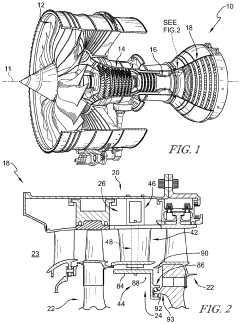
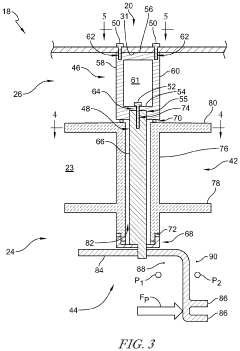
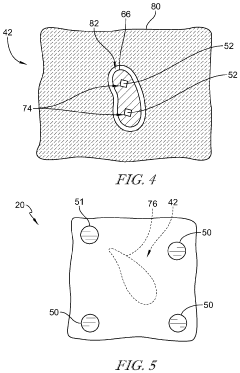
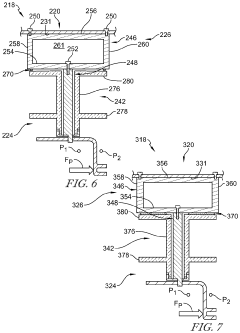
Ceramic matrix composite turbine exhaust case for a gas turbine engine
PatentActiveUS20180230909A1
Innovation
- The use of Ceramic Matrix Composites (CMC) materials for the turbine exhaust case, including struts, tail cone, and core nacelle aft portion, which are integrated as a single structure, reducing the need for bulk flanges and fasteners and enhancing structural rigidity through ring-strut-ring construction.


Regulatory Framework and Compliance Requirements
The certification process for Ceramic Matrix Composite (CMC) turbine parts operates within a complex regulatory framework that varies significantly across global aviation authorities. The Federal Aviation Administration (FAA) in the United States and the European Union Aviation Safety Agency (EASA) maintain the most comprehensive certification standards for advanced materials in aerospace applications. These authorities have established specific airworthiness directives (ADs) and technical standard orders (TSOs) that govern the certification of CMC components, with particular emphasis on high-temperature applications in turbine engines.
For CMC turbine parts, manufacturers must navigate multiple regulatory tiers, beginning with material qualification under standards such as the Aerospace Material Specification (AMS) and ASTM International guidelines. These standards establish baseline requirements for material properties, manufacturing processes, and quality control measures. The certification pathway then progresses through component-level testing, system integration validation, and finally full engine certification under regulations like 14 CFR Part 33 (FAA) or CS-E (EASA).
Compliance requirements for CMC turbine parts are particularly stringent due to their critical role in engine safety and performance. Manufacturers must demonstrate material consistency through extensive testing regimes that evaluate thermal stability, mechanical properties, and environmental durability. Statistical process control methodologies must be implemented throughout the manufacturing process, with documentation of all material batches, processing parameters, and quality assurance measures.
The timeline implications of these regulatory requirements are substantial. Material qualification alone typically requires 2-3 years of testing and data collection before a CMC system can be considered for component certification. The subsequent component certification process generally adds another 1-2 years, with system-level certification potentially extending the timeline by an additional 1-3 years depending on the complexity of the application and the extent of existing certification data.
Recent regulatory developments have introduced risk-based certification approaches that may accelerate the timeline for certain CMC applications. These approaches allow manufacturers to leverage existing data and experience with similar materials or components to streamline the certification process. However, these pathways still require comprehensive validation testing and are generally only available to manufacturers with established track records in advanced materials implementation.
International harmonization efforts between regulatory bodies have also impacted certification timelines. Bilateral agreements between the FAA and EASA have reduced redundant testing requirements, potentially shortening the global certification timeline by 6-12 months for manufacturers seeking multi-market approval. However, emerging aviation markets in Asia and the Middle East often maintain separate certification requirements that must be addressed independently.
For CMC turbine parts, manufacturers must navigate multiple regulatory tiers, beginning with material qualification under standards such as the Aerospace Material Specification (AMS) and ASTM International guidelines. These standards establish baseline requirements for material properties, manufacturing processes, and quality control measures. The certification pathway then progresses through component-level testing, system integration validation, and finally full engine certification under regulations like 14 CFR Part 33 (FAA) or CS-E (EASA).
Compliance requirements for CMC turbine parts are particularly stringent due to their critical role in engine safety and performance. Manufacturers must demonstrate material consistency through extensive testing regimes that evaluate thermal stability, mechanical properties, and environmental durability. Statistical process control methodologies must be implemented throughout the manufacturing process, with documentation of all material batches, processing parameters, and quality assurance measures.
The timeline implications of these regulatory requirements are substantial. Material qualification alone typically requires 2-3 years of testing and data collection before a CMC system can be considered for component certification. The subsequent component certification process generally adds another 1-2 years, with system-level certification potentially extending the timeline by an additional 1-3 years depending on the complexity of the application and the extent of existing certification data.
Recent regulatory developments have introduced risk-based certification approaches that may accelerate the timeline for certain CMC applications. These approaches allow manufacturers to leverage existing data and experience with similar materials or components to streamline the certification process. However, these pathways still require comprehensive validation testing and are generally only available to manufacturers with established track records in advanced materials implementation.
International harmonization efforts between regulatory bodies have also impacted certification timelines. Bilateral agreements between the FAA and EASA have reduced redundant testing requirements, potentially shortening the global certification timeline by 6-12 months for manufacturers seeking multi-market approval. However, emerging aviation markets in Asia and the Middle East often maintain separate certification requirements that must be addressed independently.
Risk Assessment and Mitigation Strategies
The certification process for CMC turbine parts involves significant risks that must be systematically identified and managed. Material property variability represents a primary risk factor, as ceramic matrix composites exhibit inherent inconsistencies in mechanical properties across production batches. These variations can lead to unpredictable performance characteristics, potentially compromising the certification timeline if not properly accounted for in testing protocols.
Manufacturing process stability poses another substantial risk, with complex fabrication techniques for CMC components requiring precise control over numerous parameters. Any deviation in processing conditions can result in defects that may only become apparent during later certification stages, causing costly delays and rework. Statistical process control methods must be implemented to monitor critical manufacturing variables and establish acceptable tolerance ranges.
Regulatory uncertainty compounds these challenges, particularly as certification standards for CMC applications in turbine environments continue to evolve. Changes in certification requirements during the development cycle can necessitate additional testing or design modifications, extending the timeline significantly. Maintaining regular communication with certification authorities and participating in industry standards development can help mitigate this risk.
Test facility availability represents a logistical risk that is often underestimated. The specialized equipment required for high-temperature mechanical testing of CMC components frequently has limited availability, with scheduling conflicts potentially adding months to certification timelines. Early reservation of test facilities and development of contingency testing plans are essential mitigation strategies.
Supply chain vulnerabilities must also be addressed, as CMC production relies on specialized raw materials with limited supplier options. Disruptions in material availability can halt the certification process entirely. Developing relationships with multiple qualified suppliers and maintaining strategic material reserves can provide necessary redundancy.
A comprehensive risk mitigation framework should include phased testing approaches that identify potential issues early in the certification process. Non-destructive evaluation techniques should be employed throughout manufacturing to detect defects before components reach critical certification stages. Additionally, digital twin modeling can simulate component performance under various conditions, helping to predict certification outcomes and focus physical testing on critical areas.
Cross-functional review boards should be established to regularly assess certification progress against identified risks, with authority to implement corrective actions when necessary. Documentation protocols must ensure traceability of all materials, processes, and test results to facilitate rapid problem resolution and maintain certification integrity throughout the timeline.
Manufacturing process stability poses another substantial risk, with complex fabrication techniques for CMC components requiring precise control over numerous parameters. Any deviation in processing conditions can result in defects that may only become apparent during later certification stages, causing costly delays and rework. Statistical process control methods must be implemented to monitor critical manufacturing variables and establish acceptable tolerance ranges.
Regulatory uncertainty compounds these challenges, particularly as certification standards for CMC applications in turbine environments continue to evolve. Changes in certification requirements during the development cycle can necessitate additional testing or design modifications, extending the timeline significantly. Maintaining regular communication with certification authorities and participating in industry standards development can help mitigate this risk.
Test facility availability represents a logistical risk that is often underestimated. The specialized equipment required for high-temperature mechanical testing of CMC components frequently has limited availability, with scheduling conflicts potentially adding months to certification timelines. Early reservation of test facilities and development of contingency testing plans are essential mitigation strategies.
Supply chain vulnerabilities must also be addressed, as CMC production relies on specialized raw materials with limited supplier options. Disruptions in material availability can halt the certification process entirely. Developing relationships with multiple qualified suppliers and maintaining strategic material reserves can provide necessary redundancy.
A comprehensive risk mitigation framework should include phased testing approaches that identify potential issues early in the certification process. Non-destructive evaluation techniques should be employed throughout manufacturing to detect defects before components reach critical certification stages. Additionally, digital twin modeling can simulate component performance under various conditions, helping to predict certification outcomes and focus physical testing on critical areas.
Cross-functional review boards should be established to regularly assess certification progress against identified risks, with authority to implement corrective actions when necessary. Documentation protocols must ensure traceability of all materials, processes, and test results to facilitate rapid problem resolution and maintain certification integrity throughout the timeline.
Unlock deeper insights with PatSnap Eureka Quick Research — get a full tech report to explore trends and direct your research. Try now!
Generate Your Research Report Instantly with AI Agent
Supercharge your innovation with PatSnap Eureka AI Agent Platform!