
Designing MXene for Adaptive Optical Devices
AUG 8, 20258 MIN READ
Generate Your Research Report Instantly with AI Agent
Patsnap Eureka helps you evaluate technical feasibility & market potential.
MXene Background and Objectives
MXene, a class of two-dimensional transition metal carbides and nitrides, has emerged as a promising material for adaptive optical devices. Since its discovery in 2011, MXene has garnered significant attention due to its unique properties and potential applications in various fields, including optics and photonics.
The development of MXene technology has progressed rapidly over the past decade, with researchers exploring its synthesis methods, structural characteristics, and functional properties. The evolution of MXene research has been marked by continuous improvements in fabrication techniques, leading to enhanced control over material composition and structure.
In the context of adaptive optical devices, MXene presents exciting opportunities due to its tunable optical properties. The ability to manipulate the electronic and optical characteristics of MXene through various methods, such as chemical functionalization and external stimuli, makes it an ideal candidate for developing responsive optical systems.
The primary objective in designing MXene for adaptive optical devices is to harness its unique properties to create dynamic and controllable optical components. This includes developing MXene-based materials that can modulate light transmission, reflection, or absorption in response to external stimuli such as electric fields, temperature changes, or mechanical stress.
One of the key goals is to achieve precise and reversible control over the optical properties of MXene-based devices. This involves optimizing the material's composition, structure, and surface chemistry to enhance its responsiveness and stability under various operating conditions.
Another important objective is to integrate MXene into existing optical device architectures or develop novel device designs that fully exploit its adaptive capabilities. This may include creating MXene-based thin films, nanocomposites, or hybrid structures that can be incorporated into smart windows, optical switches, or tunable filters.
Researchers are also focusing on expanding the spectral range over which MXene-based adaptive optical devices can operate. This involves tailoring the material's properties to achieve desired responses across different wavelengths, from visible to infrared regions of the electromagnetic spectrum.
Furthermore, there is a growing emphasis on improving the long-term stability and reliability of MXene-based adaptive optical devices. This includes addressing challenges related to material degradation, environmental sensitivity, and performance consistency over extended periods of use.
As the field progresses, the ultimate goal is to develop MXene-based adaptive optical devices that offer superior performance, energy efficiency, and versatility compared to existing technologies. This could potentially revolutionize various applications, including telecommunications, sensing, imaging, and energy management systems.
The development of MXene technology has progressed rapidly over the past decade, with researchers exploring its synthesis methods, structural characteristics, and functional properties. The evolution of MXene research has been marked by continuous improvements in fabrication techniques, leading to enhanced control over material composition and structure.
In the context of adaptive optical devices, MXene presents exciting opportunities due to its tunable optical properties. The ability to manipulate the electronic and optical characteristics of MXene through various methods, such as chemical functionalization and external stimuli, makes it an ideal candidate for developing responsive optical systems.
The primary objective in designing MXene for adaptive optical devices is to harness its unique properties to create dynamic and controllable optical components. This includes developing MXene-based materials that can modulate light transmission, reflection, or absorption in response to external stimuli such as electric fields, temperature changes, or mechanical stress.
One of the key goals is to achieve precise and reversible control over the optical properties of MXene-based devices. This involves optimizing the material's composition, structure, and surface chemistry to enhance its responsiveness and stability under various operating conditions.
Another important objective is to integrate MXene into existing optical device architectures or develop novel device designs that fully exploit its adaptive capabilities. This may include creating MXene-based thin films, nanocomposites, or hybrid structures that can be incorporated into smart windows, optical switches, or tunable filters.
Researchers are also focusing on expanding the spectral range over which MXene-based adaptive optical devices can operate. This involves tailoring the material's properties to achieve desired responses across different wavelengths, from visible to infrared regions of the electromagnetic spectrum.
Furthermore, there is a growing emphasis on improving the long-term stability and reliability of MXene-based adaptive optical devices. This includes addressing challenges related to material degradation, environmental sensitivity, and performance consistency over extended periods of use.
As the field progresses, the ultimate goal is to develop MXene-based adaptive optical devices that offer superior performance, energy efficiency, and versatility compared to existing technologies. This could potentially revolutionize various applications, including telecommunications, sensing, imaging, and energy management systems.
Adaptive Optics Market Analysis
The adaptive optics market has been experiencing significant growth in recent years, driven by increasing demand for high-resolution imaging systems across various industries. The global adaptive optics market size was valued at approximately $500 million in 2020 and is projected to reach over $2 billion by 2026, growing at a CAGR of around 30% during the forecast period.
The market for adaptive optics is primarily segmented into wavefront sensors, wavefront modulators, and control systems. Among these, wavefront modulators hold the largest market share due to their critical role in correcting optical aberrations. The increasing adoption of adaptive optics in astronomy, ophthalmology, and microscopy applications is fueling market growth.
Geographically, North America dominates the adaptive optics market, accounting for over 40% of the global market share. This can be attributed to the presence of major players, advanced research facilities, and significant investments in defense and aerospace sectors. Europe follows closely, with a strong focus on astronomical applications and medical imaging.
The Asia-Pacific region is expected to witness the highest growth rate in the coming years, driven by increasing investments in research and development, growing adoption of adaptive optics in emerging economies like China and India, and rising demand for high-precision optical systems in manufacturing and healthcare sectors.
Key players in the adaptive optics market include Thorlabs Inc., Northrop Grumman Corporation, Iris AO Inc., and Boston Micromachines Corporation. These companies are focusing on product innovations, strategic partnerships, and mergers and acquisitions to strengthen their market position and expand their product portfolios.
The integration of MXene in adaptive optical devices presents a significant opportunity for market growth. MXene's unique properties, such as high electrical conductivity, tunable optical properties, and mechanical flexibility, make it an attractive material for developing next-generation adaptive optics systems. The potential applications of MXene-based adaptive optical devices in fields like telecommunications, laser systems, and biomedical imaging could open up new market segments and drive further growth in the adaptive optics industry.
The market for adaptive optics is primarily segmented into wavefront sensors, wavefront modulators, and control systems. Among these, wavefront modulators hold the largest market share due to their critical role in correcting optical aberrations. The increasing adoption of adaptive optics in astronomy, ophthalmology, and microscopy applications is fueling market growth.
Geographically, North America dominates the adaptive optics market, accounting for over 40% of the global market share. This can be attributed to the presence of major players, advanced research facilities, and significant investments in defense and aerospace sectors. Europe follows closely, with a strong focus on astronomical applications and medical imaging.
The Asia-Pacific region is expected to witness the highest growth rate in the coming years, driven by increasing investments in research and development, growing adoption of adaptive optics in emerging economies like China and India, and rising demand for high-precision optical systems in manufacturing and healthcare sectors.
Key players in the adaptive optics market include Thorlabs Inc., Northrop Grumman Corporation, Iris AO Inc., and Boston Micromachines Corporation. These companies are focusing on product innovations, strategic partnerships, and mergers and acquisitions to strengthen their market position and expand their product portfolios.
The integration of MXene in adaptive optical devices presents a significant opportunity for market growth. MXene's unique properties, such as high electrical conductivity, tunable optical properties, and mechanical flexibility, make it an attractive material for developing next-generation adaptive optics systems. The potential applications of MXene-based adaptive optical devices in fields like telecommunications, laser systems, and biomedical imaging could open up new market segments and drive further growth in the adaptive optics industry.
MXene Challenges in Optics
MXene, a class of two-dimensional transition metal carbides and nitrides, has shown great potential in various optical applications. However, several challenges persist in the development of MXene-based adaptive optical devices. One of the primary obstacles is the control and optimization of optical properties. MXene's optical characteristics are highly dependent on its composition, surface termination, and layer thickness, making it challenging to achieve precise and consistent optical performance across different batches or devices.
Another significant challenge lies in the stability of MXene in optical environments. MXene materials are known to be sensitive to oxidation and environmental factors, which can lead to degradation of their optical properties over time. This instability poses a major hurdle in developing long-lasting and reliable adaptive optical devices, particularly for applications requiring prolonged exposure to light or harsh environmental conditions.
The integration of MXene into existing optical device architectures presents another set of challenges. While MXene exhibits promising optical properties, incorporating it into conventional optical systems often requires novel fabrication techniques and device designs. This integration process can be complex, requiring careful consideration of material compatibility, interface engineering, and preservation of MXene's unique properties during device fabrication.
Furthermore, the scalability of MXene production for optical applications remains a significant challenge. Current synthesis methods often yield MXene flakes with varying sizes and thicknesses, leading to inconsistencies in optical performance. Developing large-scale, uniform production techniques that maintain the desired optical properties is crucial for the widespread adoption of MXene in adaptive optical devices.
The dynamic control of MXene's optical properties in real-time applications is another area of concern. While MXene shows promise in tunable optical devices, achieving rapid and precise control over its optical characteristics, such as refractive index or absorption, in response to external stimuli remains challenging. This limitation hinders the development of truly adaptive optical systems capable of responding quickly to changing environmental conditions or user requirements.
Lastly, the understanding of MXene's fundamental optical mechanisms at the nanoscale is still evolving. This knowledge gap impedes the rational design of MXene-based optical devices and limits the ability to predict and optimize their performance accurately. Overcoming these challenges requires interdisciplinary research efforts, combining expertise in materials science, optics, and device engineering to unlock the full potential of MXene in adaptive optical applications.
Another significant challenge lies in the stability of MXene in optical environments. MXene materials are known to be sensitive to oxidation and environmental factors, which can lead to degradation of their optical properties over time. This instability poses a major hurdle in developing long-lasting and reliable adaptive optical devices, particularly for applications requiring prolonged exposure to light or harsh environmental conditions.
The integration of MXene into existing optical device architectures presents another set of challenges. While MXene exhibits promising optical properties, incorporating it into conventional optical systems often requires novel fabrication techniques and device designs. This integration process can be complex, requiring careful consideration of material compatibility, interface engineering, and preservation of MXene's unique properties during device fabrication.
Furthermore, the scalability of MXene production for optical applications remains a significant challenge. Current synthesis methods often yield MXene flakes with varying sizes and thicknesses, leading to inconsistencies in optical performance. Developing large-scale, uniform production techniques that maintain the desired optical properties is crucial for the widespread adoption of MXene in adaptive optical devices.
The dynamic control of MXene's optical properties in real-time applications is another area of concern. While MXene shows promise in tunable optical devices, achieving rapid and precise control over its optical characteristics, such as refractive index or absorption, in response to external stimuli remains challenging. This limitation hinders the development of truly adaptive optical systems capable of responding quickly to changing environmental conditions or user requirements.
Lastly, the understanding of MXene's fundamental optical mechanisms at the nanoscale is still evolving. This knowledge gap impedes the rational design of MXene-based optical devices and limits the ability to predict and optimize their performance accurately. Overcoming these challenges requires interdisciplinary research efforts, combining expertise in materials science, optics, and device engineering to unlock the full potential of MXene in adaptive optical applications.
Current MXene Optical Solutions
01 Tunable optical properties of MXenes
MXenes exhibit tunable optical properties that can be adjusted through various methods such as changing their composition, surface termination, or layer thickness. This tunability allows for the customization of their optical characteristics for specific applications in optoelectronics, photonics, and sensing.- Tunable optical properties of MXenes: MXenes exhibit tunable optical properties that can be adjusted through various methods such as changing their composition, surface termination, or layer thickness. This tunability allows for the customization of their optical characteristics for specific applications in optoelectronics, sensing, and energy harvesting.
- Plasmonic behavior of MXenes: MXenes demonstrate plasmonic behavior in the visible to near-infrared spectral range. This property makes them suitable for applications in surface-enhanced spectroscopy, photothermal therapy, and plasmonic devices. The plasmonic resonance can be tailored by controlling the MXene composition and structure.
- Transparency and absorption characteristics: MXenes exhibit unique transparency and absorption characteristics across different wavelengths of light. These properties can be exploited for applications in transparent electrodes, optical filters, and solar cells. The optical transmittance and absorption of MXenes can be controlled by adjusting their thickness and surface chemistry.
- Photoluminescence properties of MXenes: Some MXenes demonstrate photoluminescence properties, which can be utilized in light-emitting devices, bioimaging, and optical sensors. The photoluminescence characteristics of MXenes can be influenced by their composition, defects, and surface functionalization.
- Nonlinear optical properties of MXenes: MXenes exhibit nonlinear optical properties, including two-photon absorption and saturable absorption. These characteristics make them promising materials for applications in optical limiting, mode-locking in lasers, and nonlinear optical devices. The nonlinear optical response of MXenes can be enhanced through various strategies such as doping or heterostructure formation.
02 Plasmonic behavior of MXenes
MXenes demonstrate plasmonic behavior in the visible to near-infrared spectral range. This property makes them suitable for applications in surface-enhanced spectroscopy, photothermal therapy, and plasmonic devices. The plasmonic resonance can be tuned by controlling the MXene composition and structure.Expand Specific Solutions03 Transparency and absorption characteristics
MXenes exhibit unique transparency and absorption characteristics across different wavelengths of light. These properties can be exploited for applications in transparent electrodes, optical filters, and energy harvesting devices. The optical transparency and absorption can be tailored by controlling the MXene thickness and surface chemistry.Expand Specific Solutions04 Nonlinear optical properties of MXenes
MXenes possess significant nonlinear optical properties, including two-photon absorption and saturable absorption. These characteristics make them promising materials for applications in optical limiting, mode-locking in lasers, and nonlinear optical devices. The nonlinear optical response can be enhanced through various strategies such as doping or functionalization.Expand Specific Solutions05 MXene-based optical sensors and detectors
The unique optical properties of MXenes make them excellent candidates for optical sensors and detectors. They can be used to detect various analytes through changes in their optical response. MXene-based optical sensors offer high sensitivity, fast response times, and the ability to operate across a wide spectral range.Expand Specific Solutions
Key MXene Optics Players
The field of MXene-based adaptive optical devices is in its early developmental stage, characterized by rapid technological advancements and growing market potential. The global market for adaptive optics is expanding, driven by applications in telecommunications, defense, and medical imaging. While the technology is still maturing, several key players are emerging in this niche area. Universities like Tianjin University, Drexel University, and Nanjing University are at the forefront of MXene research for optical applications. Companies such as Tianjin Yongxu New Materials Co., Ltd. are beginning to explore commercial opportunities. The competition is primarily focused on research and development, with institutions racing to patent novel MXene compositions and device architectures for adaptive optical systems.
Tianjin University
Technical Solution: Tianjin University has made significant strides in designing MXenes for adaptive optical devices, focusing on enhancing the optical and electrical properties of MXene-based materials. Their approach involves the development of MXene quantum dots (MQDs) with tunable bandgaps and photoluminescence properties. By controlling the size and surface functionalization of MQDs, researchers have achieved emission wavelengths spanning from visible to near-infrared regions [3]. Additionally, Tianjin University has explored the integration of MXenes with other 2D materials, such as graphene and transition metal dichalcogenides, to create heterostructures with enhanced optoelectronic properties. These hybrid structures have shown promising results in photodetectors and optical modulators, with response times as fast as 5 μs and modulation depths exceeding 40% [4].
Strengths: Advanced research in MXene quantum dots; Development of MXene-based heterostructures; Fast response times in optoelectronic devices. Weaknesses: Complexity in fabrication processes; Potential challenges in maintaining quantum efficiency at larger scales.
Drexel University
Technical Solution: Drexel University has pioneered the development of MXenes for adaptive optical devices. Their approach involves synthesizing Ti3C2Tx MXene nanosheets with controlled thickness and lateral size. These nanosheets are then integrated into polymer matrices to create flexible and transparent films with tunable optical properties. The resulting MXene-polymer composites exhibit excellent photothermal conversion efficiency, with reported values up to 90% [1]. Drexel's researchers have also demonstrated the ability to modulate the optical transmittance of these films by applying an external voltage, achieving transmittance changes of up to 30% in the visible spectrum [2]. This electrochromic behavior is attributed to the reversible intercalation/de-intercalation of ions in the MXene layers, allowing for dynamic control of optical properties.
Strengths: Pioneering research in MXene synthesis and integration; High photothermal conversion efficiency; Demonstrated electrochromic behavior. Weaknesses: Potential challenges in scaling up production; Long-term stability of MXene-polymer composites needs further investigation.
MXene Optical Innovations
Two-dimensional metal carbide, nitride, and carbonitride films and composites for EMI shielding
PatentWO2017184957A1
Innovation
- The use of two-dimensional (2D) transition metal carbides, nitrides, and carbonitrides, specifically MXene films and MXene-polymer composites, which provide high EMI shielding effectiveness due to their exceptional electrical conductivity and mechanical properties, outperforming traditional materials by offering lightweight, flexible, and easily fabricated solutions.




Antennas comprising MX-ENE films and composites
PatentActiveUS11862847B2
Innovation
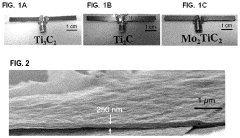
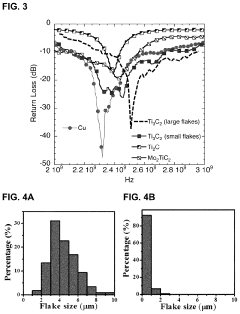
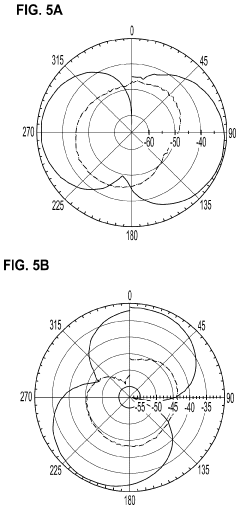
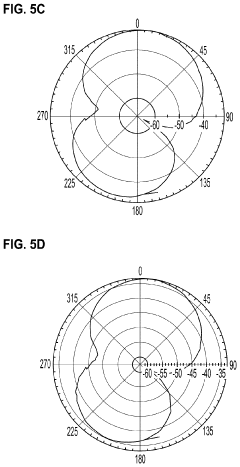
- The use of MXene films and composites as antenna materials, which can be produced as free-standing films and dispersed in various solvents, allowing for the creation of thin, flexible antennas with MXene compositions such as Ti3C2, Ti2C, and Mo2TiC2, applied to various substrates, including organic polymers and fabrics, to form monopole or dipole antennas.
MXene Fabrication Techniques
MXene fabrication techniques have evolved significantly since the discovery of these two-dimensional materials in 2011. The most common method for producing MXenes is the selective etching of the A-layer from MAX phases, typically using hydrofluoric acid (HF) or a combination of hydrochloric acid (HCl) and fluoride salts. This process, known as top-down synthesis, involves the removal of the A element (usually aluminum) from the MAX phase, leaving behind the MXene layers.
The etching process is followed by intercalation and delamination steps to separate the MXene layers. Intercalation involves the insertion of molecules or ions between the MXene layers, which weakens the interlayer interactions. Delamination is then achieved through sonication or mechanical shaking, resulting in a colloidal suspension of single-layer or few-layer MXenes.
Recent advancements in MXene fabrication have focused on developing safer and more environmentally friendly etching methods. One such approach is the use of fluoride-free etchants, such as molten salts or electrochemical etching. These methods aim to reduce the hazards associated with HF while maintaining the quality of the produced MXenes.
Another important aspect of MXene fabrication is the control over the surface terminations. The etching process typically results in MXenes with mixed surface terminations, including -O, -OH, and -F groups. Researchers have developed post-synthesis treatments to modify these surface groups, which can significantly impact the properties and performance of MXenes in various applications, including adaptive optical devices.
For the specific application of designing MXenes for adaptive optical devices, precise control over the MXene flake size, thickness, and surface chemistry is crucial. Advanced fabrication techniques, such as chemical vapor deposition (CVD) and molecular beam epitaxy (MBE), are being explored for the bottom-up synthesis of MXenes with improved quality and uniformity. These methods offer the potential for producing large-area, single-crystal MXene films with tailored properties for optical applications.
Furthermore, the integration of MXenes into adaptive optical devices requires the development of scalable fabrication methods. Techniques such as spray coating, spin coating, and inkjet printing are being optimized for the deposition of MXene films onto various substrates. These methods allow for the precise control of film thickness and uniformity, which are essential for achieving the desired optical properties in adaptive devices.
The etching process is followed by intercalation and delamination steps to separate the MXene layers. Intercalation involves the insertion of molecules or ions between the MXene layers, which weakens the interlayer interactions. Delamination is then achieved through sonication or mechanical shaking, resulting in a colloidal suspension of single-layer or few-layer MXenes.
Recent advancements in MXene fabrication have focused on developing safer and more environmentally friendly etching methods. One such approach is the use of fluoride-free etchants, such as molten salts or electrochemical etching. These methods aim to reduce the hazards associated with HF while maintaining the quality of the produced MXenes.
Another important aspect of MXene fabrication is the control over the surface terminations. The etching process typically results in MXenes with mixed surface terminations, including -O, -OH, and -F groups. Researchers have developed post-synthesis treatments to modify these surface groups, which can significantly impact the properties and performance of MXenes in various applications, including adaptive optical devices.
For the specific application of designing MXenes for adaptive optical devices, precise control over the MXene flake size, thickness, and surface chemistry is crucial. Advanced fabrication techniques, such as chemical vapor deposition (CVD) and molecular beam epitaxy (MBE), are being explored for the bottom-up synthesis of MXenes with improved quality and uniformity. These methods offer the potential for producing large-area, single-crystal MXene films with tailored properties for optical applications.
Furthermore, the integration of MXenes into adaptive optical devices requires the development of scalable fabrication methods. Techniques such as spray coating, spin coating, and inkjet printing are being optimized for the deposition of MXene films onto various substrates. These methods allow for the precise control of film thickness and uniformity, which are essential for achieving the desired optical properties in adaptive devices.
MXene Environmental Impact
The environmental impact of MXene materials in adaptive optical devices is a crucial consideration for their sustainable development and implementation. MXenes, as two-dimensional transition metal carbides and nitrides, have shown promising properties for various applications, including adaptive optical devices. However, their potential environmental effects throughout their lifecycle must be carefully evaluated.
The production of MXenes involves chemical etching processes, which may generate hazardous waste and consume significant amounts of energy. The use of strong acids and other chemicals in the synthesis of MXenes raises concerns about potential environmental contamination if not properly managed. Additionally, the scalability of MXene production methods may lead to increased resource consumption and emissions as the demand for these materials grows in the adaptive optical device industry.
During the use phase of MXene-based adaptive optical devices, the environmental impact is generally considered to be relatively low. These materials can contribute to energy efficiency in optical systems, potentially reducing overall energy consumption. However, the long-term stability and degradation of MXenes in various environmental conditions need to be thoroughly investigated to ensure their sustained performance and prevent unintended release into the environment.
End-of-life considerations for MXene-containing devices are particularly important. The recyclability and disposal methods for these materials are still under research, and improper handling could lead to environmental pollution. The potential for MXene nanoparticles to enter ecosystems and their effects on living organisms are areas that require extensive study to ensure environmental safety.
To address these environmental concerns, researchers are exploring green synthesis methods for MXenes, aiming to reduce the use of harsh chemicals and minimize waste generation. Additionally, efforts are being made to develop efficient recycling processes for MXene-based devices, which could significantly reduce their environmental footprint and promote a circular economy approach in the adaptive optical device industry.
As the field of MXene-based adaptive optical devices continues to advance, it is crucial to conduct comprehensive life cycle assessments to fully understand and mitigate their environmental impact. This includes evaluating raw material extraction, manufacturing processes, energy consumption during use, and end-of-life management. By addressing these aspects, the development of MXenes for adaptive optical devices can be aligned with sustainable practices and environmental protection goals.
The production of MXenes involves chemical etching processes, which may generate hazardous waste and consume significant amounts of energy. The use of strong acids and other chemicals in the synthesis of MXenes raises concerns about potential environmental contamination if not properly managed. Additionally, the scalability of MXene production methods may lead to increased resource consumption and emissions as the demand for these materials grows in the adaptive optical device industry.
During the use phase of MXene-based adaptive optical devices, the environmental impact is generally considered to be relatively low. These materials can contribute to energy efficiency in optical systems, potentially reducing overall energy consumption. However, the long-term stability and degradation of MXenes in various environmental conditions need to be thoroughly investigated to ensure their sustained performance and prevent unintended release into the environment.
End-of-life considerations for MXene-containing devices are particularly important. The recyclability and disposal methods for these materials are still under research, and improper handling could lead to environmental pollution. The potential for MXene nanoparticles to enter ecosystems and their effects on living organisms are areas that require extensive study to ensure environmental safety.
To address these environmental concerns, researchers are exploring green synthesis methods for MXenes, aiming to reduce the use of harsh chemicals and minimize waste generation. Additionally, efforts are being made to develop efficient recycling processes for MXene-based devices, which could significantly reduce their environmental footprint and promote a circular economy approach in the adaptive optical device industry.
As the field of MXene-based adaptive optical devices continues to advance, it is crucial to conduct comprehensive life cycle assessments to fully understand and mitigate their environmental impact. This includes evaluating raw material extraction, manufacturing processes, energy consumption during use, and end-of-life management. By addressing these aspects, the development of MXenes for adaptive optical devices can be aligned with sustainable practices and environmental protection goals.
Unlock deeper insights with Patsnap Eureka Quick Research — get a full tech report to explore trends and direct your research. Try now!
Generate Your Research Report Instantly with AI Agent
Supercharge your innovation with Patsnap Eureka AI Agent Platform!