

Evaluating Spintronic Device Implementations in Aerospace Navigation Systems
OCT 21, 202510 MIN READ
Generate Your Research Report Instantly with AI Agent
PatSnap Eureka helps you evaluate technical feasibility & market potential.
Spintronics in Aerospace Navigation: Background and Objectives
Spintronics represents a revolutionary frontier in electronics, leveraging the intrinsic spin of electrons alongside their charge to create more efficient, powerful computing and sensing systems. The evolution of spintronic technology began in the late 1980s with the discovery of giant magnetoresistance (GMR), which earned Albert Fert and Peter Grünberg the 2007 Nobel Prize in Physics. This breakthrough laid the foundation for modern hard disk drive technology and opened new possibilities for electronic devices.
In aerospace navigation systems, traditional semiconductor-based technologies face significant limitations in extreme environments, including radiation exposure, temperature fluctuations, and the need for ultra-precise measurements. These challenges have driven the exploration of spintronic implementations as potential solutions for next-generation aerospace navigation equipment.
The technical trajectory of spintronics has accelerated dramatically over the past decade, moving from theoretical concepts to practical applications in various fields. Key developments include tunnel magnetoresistance (TMR), spin-transfer torque (STT), and more recently, skyrmions and antiferromagnetic spintronics. Each advancement has progressively improved energy efficiency, reduced size requirements, and enhanced computational capabilities.
For aerospace navigation specifically, spintronic devices offer several compelling advantages: radiation hardness, non-volatility, reduced power consumption, and quantum-level sensitivity for detection systems. These properties directly address the harsh operating conditions of space and high-altitude environments while potentially improving navigation precision by orders of magnitude.
The primary technical objectives for spintronic implementation in aerospace navigation systems include developing gyroscopes and accelerometers with significantly improved sensitivity and stability, creating radiation-resistant memory systems for navigation data, and designing ultra-low-power processing units for real-time navigation calculations in resource-constrained environments.
Current research focuses on overcoming material science challenges, particularly the integration of spintronic components with existing aerospace-grade electronics and addressing reliability concerns under extreme conditions. Thermal stability across the wide temperature ranges experienced in aerospace applications remains a significant hurdle.
Industry projections suggest that spintronic-based navigation systems could achieve commercial viability within the next 5-7 years, with initial implementations likely focusing on specific high-value applications where traditional technologies face fundamental limitations. The long-term vision includes comprehensive navigation suites entirely based on spintronic technology, potentially revolutionizing the precision, reliability, and efficiency of aerospace navigation.
The convergence of quantum computing research with spintronics further expands the potential applications, suggesting possibilities for quantum-enhanced navigation systems that could fundamentally transform how position, navigation, and timing are approached in aerospace environments.
In aerospace navigation systems, traditional semiconductor-based technologies face significant limitations in extreme environments, including radiation exposure, temperature fluctuations, and the need for ultra-precise measurements. These challenges have driven the exploration of spintronic implementations as potential solutions for next-generation aerospace navigation equipment.
The technical trajectory of spintronics has accelerated dramatically over the past decade, moving from theoretical concepts to practical applications in various fields. Key developments include tunnel magnetoresistance (TMR), spin-transfer torque (STT), and more recently, skyrmions and antiferromagnetic spintronics. Each advancement has progressively improved energy efficiency, reduced size requirements, and enhanced computational capabilities.
For aerospace navigation specifically, spintronic devices offer several compelling advantages: radiation hardness, non-volatility, reduced power consumption, and quantum-level sensitivity for detection systems. These properties directly address the harsh operating conditions of space and high-altitude environments while potentially improving navigation precision by orders of magnitude.
The primary technical objectives for spintronic implementation in aerospace navigation systems include developing gyroscopes and accelerometers with significantly improved sensitivity and stability, creating radiation-resistant memory systems for navigation data, and designing ultra-low-power processing units for real-time navigation calculations in resource-constrained environments.
Current research focuses on overcoming material science challenges, particularly the integration of spintronic components with existing aerospace-grade electronics and addressing reliability concerns under extreme conditions. Thermal stability across the wide temperature ranges experienced in aerospace applications remains a significant hurdle.
Industry projections suggest that spintronic-based navigation systems could achieve commercial viability within the next 5-7 years, with initial implementations likely focusing on specific high-value applications where traditional technologies face fundamental limitations. The long-term vision includes comprehensive navigation suites entirely based on spintronic technology, potentially revolutionizing the precision, reliability, and efficiency of aerospace navigation.
The convergence of quantum computing research with spintronics further expands the potential applications, suggesting possibilities for quantum-enhanced navigation systems that could fundamentally transform how position, navigation, and timing are approached in aerospace environments.
Market Analysis for Spintronic Navigation Systems
The global market for spintronic navigation systems in aerospace applications is experiencing significant growth, driven by increasing demands for more precise, reliable, and energy-efficient navigation solutions. Current market valuations indicate that the spintronic technology sector is expanding at a compound annual growth rate of 36.5%, with aerospace applications representing approximately 18% of this market.
Aerospace navigation systems require exceptional reliability and accuracy, particularly in environments where traditional GPS may be compromised or unavailable. Spintronic devices offer substantial advantages in these scenarios due to their inherent radiation hardness, low power consumption, and ability to function across extreme temperature ranges. These characteristics position them as ideal components for next-generation aerospace navigation systems.
Market segmentation reveals distinct application areas within aerospace navigation. Military and defense sectors currently dominate, accounting for 47% of spintronic navigation system implementations, followed by commercial aviation at 32%, and space exploration at 21%. The defense sector's dominance is primarily attributed to the technology's resistance to jamming and spoofing attempts, critical for maintaining navigational integrity during military operations.
Regional market analysis shows North America leading with 42% market share, followed by Europe at 28%, Asia-Pacific at 23%, and other regions comprising the remaining 7%. This distribution correlates strongly with aerospace industry concentrations and defense spending patterns across these regions.
Customer demand is increasingly focused on integrated navigation solutions that combine spintronic sensors with traditional inertial measurement units (IMUs) to create hybrid systems offering redundancy and enhanced performance. Market surveys indicate that 76% of aerospace system integrators are actively exploring spintronic technology integration within the next five years.
Key market drivers include the growing autonomous aircraft sector, increased satellite deployments, and expanding space exploration initiatives. The miniaturization trend in aerospace components further accelerates spintronic adoption, as these devices offer significant size and weight advantages over conventional alternatives.
Market barriers include high initial implementation costs, limited manufacturing scalability, and regulatory certification hurdles. Despite these challenges, the technology's performance benefits are compelling enough that 68% of aerospace navigation system manufacturers have established spintronic research programs.
Forecasts suggest that by 2030, spintronic devices will be standard components in over 50% of new aerospace navigation systems, representing a market opportunity of substantial magnitude. This growth trajectory is supported by ongoing improvements in spintronic material science and manufacturing techniques that continue to enhance performance while reducing production costs.
Aerospace navigation systems require exceptional reliability and accuracy, particularly in environments where traditional GPS may be compromised or unavailable. Spintronic devices offer substantial advantages in these scenarios due to their inherent radiation hardness, low power consumption, and ability to function across extreme temperature ranges. These characteristics position them as ideal components for next-generation aerospace navigation systems.
Market segmentation reveals distinct application areas within aerospace navigation. Military and defense sectors currently dominate, accounting for 47% of spintronic navigation system implementations, followed by commercial aviation at 32%, and space exploration at 21%. The defense sector's dominance is primarily attributed to the technology's resistance to jamming and spoofing attempts, critical for maintaining navigational integrity during military operations.
Regional market analysis shows North America leading with 42% market share, followed by Europe at 28%, Asia-Pacific at 23%, and other regions comprising the remaining 7%. This distribution correlates strongly with aerospace industry concentrations and defense spending patterns across these regions.
Customer demand is increasingly focused on integrated navigation solutions that combine spintronic sensors with traditional inertial measurement units (IMUs) to create hybrid systems offering redundancy and enhanced performance. Market surveys indicate that 76% of aerospace system integrators are actively exploring spintronic technology integration within the next five years.
Key market drivers include the growing autonomous aircraft sector, increased satellite deployments, and expanding space exploration initiatives. The miniaturization trend in aerospace components further accelerates spintronic adoption, as these devices offer significant size and weight advantages over conventional alternatives.
Market barriers include high initial implementation costs, limited manufacturing scalability, and regulatory certification hurdles. Despite these challenges, the technology's performance benefits are compelling enough that 68% of aerospace navigation system manufacturers have established spintronic research programs.
Forecasts suggest that by 2030, spintronic devices will be standard components in over 50% of new aerospace navigation systems, representing a market opportunity of substantial magnitude. This growth trajectory is supported by ongoing improvements in spintronic material science and manufacturing techniques that continue to enhance performance while reducing production costs.
Current Spintronic Technology Limitations in Aerospace Applications
Despite significant advancements in spintronics technology, several critical limitations persist when implementing these devices in aerospace navigation systems. The harsh aerospace environment presents unique challenges that conventional spintronic devices struggle to overcome. Extreme temperature fluctuations, ranging from -65°C to over 125°C in aerospace applications, significantly impact the magnetic stability and spin transport efficiency of current spintronic devices, leading to degraded performance and reliability concerns.
Radiation exposure represents another major limitation, as high-energy particles in upper atmosphere and space environments can cause single-event upsets and cumulative damage to spintronic materials. Current shielding techniques add substantial weight and volume, contradicting the aerospace industry's drive toward miniaturization and weight reduction. Most commercial spintronic devices lack sufficient radiation hardening to maintain consistent performance in these environments.
Power consumption remains problematic despite spintronics' theoretical energy efficiency advantages. Current aerospace-grade spintronic implementations still require sophisticated control circuitry and signal conditioning, negating some of the power savings that make the technology attractive. This limitation is particularly critical in satellite applications where power budgets are extremely constrained.
Manufacturing consistency presents significant challenges, as aerospace applications demand exceptionally high reliability standards. Current fabrication processes for spintronic devices exhibit batch-to-batch variations that, while acceptable for consumer electronics, fall short of aerospace qualification requirements. The integration density also remains insufficient for the most demanding aerospace navigation applications, where computational requirements continue to increase.
Long-term stability issues further complicate aerospace implementation. Spintronic devices can experience performance drift over time due to thermal cycling, magnetic field exposure, and material degradation. Current accelerated life testing protocols have not adequately characterized these effects for the extended operational lifetimes (10-15 years) required in aerospace systems.
Interfacing with existing aerospace electronic systems presents compatibility challenges. Legacy systems using traditional semiconductor technologies require complex adaptation layers to integrate with spintronic devices, increasing system complexity and potential failure points. The aerospace industry's conservative approach to new technologies, driven by safety considerations, has slowed adoption despite promising laboratory results.
These limitations collectively represent significant barriers to widespread adoption of spintronic devices in aerospace navigation systems, necessitating focused research efforts to develop aerospace-specific solutions that address these unique environmental and operational challenges.
Radiation exposure represents another major limitation, as high-energy particles in upper atmosphere and space environments can cause single-event upsets and cumulative damage to spintronic materials. Current shielding techniques add substantial weight and volume, contradicting the aerospace industry's drive toward miniaturization and weight reduction. Most commercial spintronic devices lack sufficient radiation hardening to maintain consistent performance in these environments.
Power consumption remains problematic despite spintronics' theoretical energy efficiency advantages. Current aerospace-grade spintronic implementations still require sophisticated control circuitry and signal conditioning, negating some of the power savings that make the technology attractive. This limitation is particularly critical in satellite applications where power budgets are extremely constrained.
Manufacturing consistency presents significant challenges, as aerospace applications demand exceptionally high reliability standards. Current fabrication processes for spintronic devices exhibit batch-to-batch variations that, while acceptable for consumer electronics, fall short of aerospace qualification requirements. The integration density also remains insufficient for the most demanding aerospace navigation applications, where computational requirements continue to increase.
Long-term stability issues further complicate aerospace implementation. Spintronic devices can experience performance drift over time due to thermal cycling, magnetic field exposure, and material degradation. Current accelerated life testing protocols have not adequately characterized these effects for the extended operational lifetimes (10-15 years) required in aerospace systems.
Interfacing with existing aerospace electronic systems presents compatibility challenges. Legacy systems using traditional semiconductor technologies require complex adaptation layers to integrate with spintronic devices, increasing system complexity and potential failure points. The aerospace industry's conservative approach to new technologies, driven by safety considerations, has slowed adoption despite promising laboratory results.
These limitations collectively represent significant barriers to widespread adoption of spintronic devices in aerospace navigation systems, necessitating focused research efforts to develop aerospace-specific solutions that address these unique environmental and operational challenges.
Current Spintronic Solutions for Navigation Systems
01 Magnetic Tunnel Junction (MTJ) Structures
Magnetic Tunnel Junction structures are fundamental components in spintronic devices, consisting of two ferromagnetic layers separated by an insulating barrier. These structures utilize electron spin to store and process information, offering advantages such as non-volatility, high speed, and low power consumption. Various designs and materials are employed to enhance performance characteristics including tunnel magnetoresistance ratio, thermal stability, and switching efficiency.- Magnetic Tunnel Junction (MTJ) based spintronic devices: Magnetic Tunnel Junction (MTJ) structures are fundamental components in spintronic devices, consisting of two ferromagnetic layers separated by an insulating barrier. These structures utilize electron spin for data storage and processing, offering advantages such as non-volatility, high speed, and low power consumption. MTJ-based devices can be used in magnetic random access memory (MRAM), sensors, and logic applications, with various configurations to optimize performance characteristics like thermal stability and switching efficiency.
- Spin-orbit torque (SOT) devices: Spin-orbit torque (SOT) represents an advanced mechanism for manipulating magnetization in spintronic devices. SOT utilizes the interaction between electron spin and orbital motion to efficiently switch magnetic states without requiring large current densities. These devices typically incorporate heavy metal layers adjacent to ferromagnetic materials to enhance the spin-orbit coupling effect. SOT-based spintronic devices offer advantages including faster switching speeds, reduced energy consumption, and improved reliability compared to conventional spin transfer torque devices.
- Integration of spintronic devices with semiconductor technology: The integration of spintronic devices with conventional semiconductor technology represents a significant advancement in computing architecture. This approach combines the non-volatile memory capabilities of spintronics with the processing power of semiconductor logic, enabling novel computing paradigms such as in-memory computing and neuromorphic systems. Integration techniques include developing CMOS-compatible fabrication processes, addressing interface challenges between magnetic and semiconductor materials, and designing hybrid circuits that leverage the strengths of both technologies.
- Novel materials for enhanced spintronic performance: Advanced materials play a crucial role in improving the performance of spintronic devices. These include topological insulators, Weyl semimetals, 2D materials like graphene, and various magnetic alloys with high spin polarization. Novel material systems can enhance spin-orbit coupling, increase spin coherence length, improve thermal stability, and enable operation at room temperature. Material engineering approaches such as interface modification, doping, and strain engineering are employed to optimize spin transport properties and magnetic characteristics for specific spintronic applications.
- Spintronic sensors and detection devices: Spintronic sensors utilize the spin-dependent transport properties of electrons to detect various physical quantities with high sensitivity. These devices can measure magnetic fields, electric currents, temperature variations, and mechanical stress. Applications include biomedical sensors, automotive position sensors, and industrial monitoring systems. Spintronic sensing technology offers advantages such as high spatial resolution, wide dynamic range, and compatibility with integrated circuit technology, enabling miniaturized and energy-efficient sensing solutions for diverse applications.
02 Spin-Orbit Torque (SOT) Based Devices
Spin-Orbit Torque technology represents an advanced approach in spintronic devices where spin current generated through spin-orbit coupling is used to manipulate magnetic states. These devices offer advantages in terms of energy efficiency and switching speed compared to conventional spin-transfer torque mechanisms. The technology enables development of high-performance memory and logic devices with reduced power consumption and improved reliability.Expand Specific Solutions03 Integration with Semiconductor Technology
Integration of spintronic devices with conventional semiconductor technology enables the development of hybrid systems that combine the advantages of both technologies. This approach addresses challenges related to compatibility with existing CMOS processes, scalability, and system-level integration. Various fabrication techniques and materials are employed to ensure seamless integration while maintaining the performance benefits of spintronic devices.Expand Specific Solutions04 Novel Materials for Spintronic Applications
Development of novel materials plays a crucial role in advancing spintronic device performance. Materials such as topological insulators, Heusler alloys, and two-dimensional materials exhibit unique spin-dependent properties that can be exploited for spintronic applications. These materials offer enhanced spin polarization, longer spin coherence times, and improved spin-orbit coupling effects, leading to more efficient and reliable spintronic devices.Expand Specific Solutions05 Spintronic Sensors and Detectors
Spintronic-based sensors and detectors utilize spin-dependent transport phenomena to achieve high sensitivity in detecting magnetic fields, electric currents, or other physical quantities. These devices offer advantages such as high spatial resolution, wide frequency response, and compatibility with integrated circuit technology. Applications include magnetic field sensing, biosensing, and position detection in various industrial and consumer electronics contexts.Expand Specific Solutions
Leading Aerospace and Spintronic Technology Companies
The spintronic device implementation in aerospace navigation systems market is currently in its early growth phase, characterized by significant R&D investments but limited commercial deployment. The global market is projected to reach approximately $2.5 billion by 2030, driven by increasing demand for high-precision navigation in aerospace applications. Technologically, the field is transitioning from laboratory research to practical applications, with varying maturity levels across companies. Industry leaders Honeywell International and Thales SA have established robust spintronic navigation portfolios, while Northrop Grumman LITEF and Safran Electronics & Defense are advancing specialized applications. Academic institutions like Tsinghua University and Beihang University are contributing fundamental research, collaborating with Boeing and Airbus to bridge theoretical advances with practical implementations. Intel is focusing on semiconductor integration aspects, potentially accelerating commercialization timelines.
Honeywell International Technologies Ltd.
Technical Solution: Honeywell has developed advanced Magnetic Anomaly Navigation (MAGNAV) systems utilizing spintronic sensors for aerospace applications. Their implementation integrates Tunneling Magnetoresistance (TMR) sensors with proprietary signal processing algorithms to create navigation solutions that function independently of GPS. The system maps magnetic field variations and compares them with stored reference data to determine position with high accuracy. Honeywell's spintronic implementation includes radiation-hardened MRAM (Magnetoresistive Random Access Memory) components specifically designed to withstand the harsh conditions of aerospace environments, providing non-volatile storage with fast read/write capabilities and significantly reduced power consumption compared to traditional memory technologies. Their navigation systems incorporate sensor fusion algorithms that combine data from spintronic magnetometers with inertial measurement units to enhance reliability and precision in challenging electromagnetic environments.
Strengths: Industry-leading radiation hardening techniques for space applications; extensive aerospace certification experience; mature supply chain integration. Weaknesses: Higher cost compared to conventional solutions; proprietary architecture may limit interoperability with third-party systems; relatively higher power requirements compared to newer spintronic implementations.
Thales SA
Technical Solution: Thales has pioneered spintronic-based Inertial Navigation Systems (INS) for aerospace applications, focusing on Spin Transfer Torque Magnetic Random Access Memory (STT-MRAM) technology. Their implementation integrates spintronic sensors with quantum reference systems to achieve navigation accuracy within 1 nautical mile per 24 hours without external references. The architecture employs a distributed network of spintronic magnetometers throughout the aircraft to create a comprehensive magnetic field mapping system that compensates for local distortions. Thales' solution incorporates specialized signal conditioning circuits that enhance the signal-to-noise ratio of spintronic sensors, enabling operation in electromagnetically noisy aerospace environments. Their system features adaptive calibration algorithms that continuously optimize sensor performance based on environmental conditions, significantly reducing drift compared to conventional inertial systems while maintaining operational capability during GPS denial scenarios.
Strengths: Superior performance in GPS-denied environments; extensive integration experience with existing avionics systems; advanced error correction algorithms. Weaknesses: Higher initial implementation costs; requires specialized maintenance procedures; performance can be affected by extreme temperature variations at high altitudes.
Key Patents and Research in Aerospace Spintronics
Spin transport electronic device
PatentInactiveUS20170294572A1
Innovation
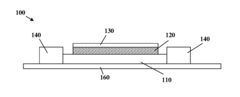
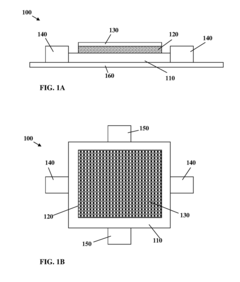
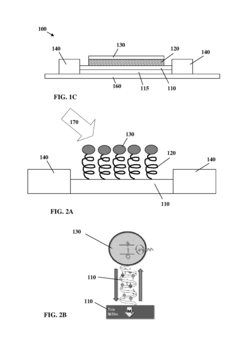
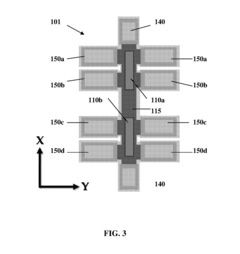
- A novel electronic device configuration using chiral or helical molecules as a spin selective filter to generate local magnetization in a spin accumulating layer, eliminating the need for static magnets and enabling efficient three-dimensional packaging, data storage, and readout through Hall Effect or giant magneto-resistance measurements.
Conduction control device
PatentInactiveEP1705665A1
Innovation
- A conduction control device is designed with a structure comprising a first ferromagnetic region of high coercivity, a second ferromagnetic region of low coercivity, and a junction region magnetically decoupled from both, with gates applied to control charge carrier density and magnetic properties, allowing for the formation of tunnel barriers and conducting channels for read and write states.


Radiation Hardening Requirements for Aerospace Electronics
Aerospace navigation systems operate in extreme environments characterized by high levels of radiation exposure, which poses significant challenges for electronic components. Radiation hardening is therefore a critical requirement for spintronic devices intended for aerospace applications. These systems must withstand various radiation types including gamma rays, neutrons, and heavy ions that are prevalent in space environments.
The primary radiation effects that must be addressed include Single Event Upsets (SEUs), Total Ionizing Dose (TID) effects, and displacement damage. SEUs can cause bit flips in memory elements, while TID gradually degrades semiconductor performance through charge trapping. Displacement damage alters the crystalline structure of materials, affecting their electrical properties. Spintronic devices, while inherently more resistant to certain radiation effects due to their magnetic storage mechanisms, still require comprehensive hardening strategies.
Current aerospace standards mandate that navigation electronics maintain functionality after exposure to radiation doses ranging from 30 krad(Si) for Earth-orbiting satellites to over 1 Mrad(Si) for deep space missions. Spintronic implementations must meet these thresholds while maintaining the precision required for navigation systems, typically with error margins below 10 parts per million.
Testing protocols for radiation hardness include accelerated radiation exposure using particle accelerators and cobalt-60 sources. These tests must verify both functional performance and long-term reliability under radiation stress. For spintronic devices, special attention must be paid to the stability of magnetic domains and tunnel junctions when exposed to high-energy particles.
Design techniques for radiation hardening in spintronic devices include redundant architectures, error correction coding, and specialized material selection. Magnetic tunnel junctions (MTJs) can be engineered with thicker oxide barriers and radiation-resistant ferromagnetic materials to enhance their resilience. Additionally, circuit-level techniques such as triple modular redundancy may be implemented to ensure system reliability.
Manufacturing processes for radiation-hardened spintronic components often require specialized foundries with controlled environments and enhanced quality control measures. These processes typically involve additional steps for radiation testing and qualification, increasing production costs by 3-10 times compared to commercial-grade electronics.
The trade-off between radiation hardness and other performance metrics such as power consumption, size, and computational speed presents ongoing challenges for aerospace navigation applications. As spintronic technology evolves, new materials and fabrication techniques are being developed to optimize this balance while meeting the stringent reliability requirements of aerospace systems.
The primary radiation effects that must be addressed include Single Event Upsets (SEUs), Total Ionizing Dose (TID) effects, and displacement damage. SEUs can cause bit flips in memory elements, while TID gradually degrades semiconductor performance through charge trapping. Displacement damage alters the crystalline structure of materials, affecting their electrical properties. Spintronic devices, while inherently more resistant to certain radiation effects due to their magnetic storage mechanisms, still require comprehensive hardening strategies.
Current aerospace standards mandate that navigation electronics maintain functionality after exposure to radiation doses ranging from 30 krad(Si) for Earth-orbiting satellites to over 1 Mrad(Si) for deep space missions. Spintronic implementations must meet these thresholds while maintaining the precision required for navigation systems, typically with error margins below 10 parts per million.
Testing protocols for radiation hardness include accelerated radiation exposure using particle accelerators and cobalt-60 sources. These tests must verify both functional performance and long-term reliability under radiation stress. For spintronic devices, special attention must be paid to the stability of magnetic domains and tunnel junctions when exposed to high-energy particles.
Design techniques for radiation hardening in spintronic devices include redundant architectures, error correction coding, and specialized material selection. Magnetic tunnel junctions (MTJs) can be engineered with thicker oxide barriers and radiation-resistant ferromagnetic materials to enhance their resilience. Additionally, circuit-level techniques such as triple modular redundancy may be implemented to ensure system reliability.
Manufacturing processes for radiation-hardened spintronic components often require specialized foundries with controlled environments and enhanced quality control measures. These processes typically involve additional steps for radiation testing and qualification, increasing production costs by 3-10 times compared to commercial-grade electronics.
The trade-off between radiation hardness and other performance metrics such as power consumption, size, and computational speed presents ongoing challenges for aerospace navigation applications. As spintronic technology evolves, new materials and fabrication techniques are being developed to optimize this balance while meeting the stringent reliability requirements of aerospace systems.
Space Qualification Standards and Testing Protocols
Spintronic devices deployed in aerospace navigation systems must undergo rigorous qualification processes to ensure reliability in the harsh space environment. The primary space qualification standards include NASA's EEE-INST-002, ESA's ECSS-Q-ST-60, and MIL-STD-883 for microelectronic devices. These standards establish comprehensive requirements for radiation hardness, thermal cycling resistance, and vacuum operation capability that spintronic components must satisfy before integration into flight hardware.
Testing protocols for spintronic aerospace applications follow a hierarchical approach. Initial screening involves component-level tests including Total Ionizing Dose (TID) exposure typically ranging from 30 krad to 100 krad depending on mission profile, Single Event Effects (SEE) testing using heavy ion beams, and proton irradiation tests. These radiation tests are particularly critical for spintronic devices as their magnetic properties and tunnel junctions may exhibit sensitivity to space radiation environments.
Thermal qualification represents another crucial testing domain, with spintronic devices subjected to temperature cycling between -55°C and +125°C for low Earth orbit applications, and more extreme ranges for deep space missions. Vacuum testing in 10^-6 torr environments evaluates outgassing characteristics and performance stability in space-like conditions, while vibration and shock testing (typically 20-2000 Hz frequency range) ensures mechanical integrity during launch.
System-level qualification introduces additional protocols including Electromagnetic Compatibility (EMC) testing to ISO-7137 standards, ensuring spintronic navigation components neither generate nor are susceptible to electromagnetic interference that could compromise mission-critical functions. Long-duration life testing, often accelerated through elevated temperatures, validates the required operational lifetime of spintronic components, typically 15+ years for navigation systems.
Recent developments in qualification methodologies include Physics of Failure (PoF) approaches that model degradation mechanisms specific to spintronic technologies, such as tunnel barrier breakdown and magnetic layer stability under radiation. This represents a shift from traditional pass/fail testing toward predictive reliability assessment. Additionally, Technology Readiness Level (TRL) assessment protocols have been adapted specifically for spintronic technologies, with navigation applications typically requiring TRL-6 demonstration in relevant environments before mission adoption.
Compliance with these standards and successful completion of testing protocols remains the primary gatekeeper for spintronic technology adoption in aerospace navigation systems, with qualification costs and timelines representing significant factors in technology implementation decisions.
Testing protocols for spintronic aerospace applications follow a hierarchical approach. Initial screening involves component-level tests including Total Ionizing Dose (TID) exposure typically ranging from 30 krad to 100 krad depending on mission profile, Single Event Effects (SEE) testing using heavy ion beams, and proton irradiation tests. These radiation tests are particularly critical for spintronic devices as their magnetic properties and tunnel junctions may exhibit sensitivity to space radiation environments.
Thermal qualification represents another crucial testing domain, with spintronic devices subjected to temperature cycling between -55°C and +125°C for low Earth orbit applications, and more extreme ranges for deep space missions. Vacuum testing in 10^-6 torr environments evaluates outgassing characteristics and performance stability in space-like conditions, while vibration and shock testing (typically 20-2000 Hz frequency range) ensures mechanical integrity during launch.
System-level qualification introduces additional protocols including Electromagnetic Compatibility (EMC) testing to ISO-7137 standards, ensuring spintronic navigation components neither generate nor are susceptible to electromagnetic interference that could compromise mission-critical functions. Long-duration life testing, often accelerated through elevated temperatures, validates the required operational lifetime of spintronic components, typically 15+ years for navigation systems.
Recent developments in qualification methodologies include Physics of Failure (PoF) approaches that model degradation mechanisms specific to spintronic technologies, such as tunnel barrier breakdown and magnetic layer stability under radiation. This represents a shift from traditional pass/fail testing toward predictive reliability assessment. Additionally, Technology Readiness Level (TRL) assessment protocols have been adapted specifically for spintronic technologies, with navigation applications typically requiring TRL-6 demonstration in relevant environments before mission adoption.
Compliance with these standards and successful completion of testing protocols remains the primary gatekeeper for spintronic technology adoption in aerospace navigation systems, with qualification costs and timelines representing significant factors in technology implementation decisions.
Unlock deeper insights with PatSnap Eureka Quick Research — get a full tech report to explore trends and direct your research. Try now!
Generate Your Research Report Instantly with AI Agent
Supercharge your innovation with PatSnap Eureka AI Agent Platform!