

How MXene Benefits AI-Driven Learning Systems
AUG 8, 20259 MIN READ
Generate Your Research Report Instantly with AI Agent
PatSnap Eureka helps you evaluate technical feasibility & market potential.
MXene in AI: Background and Objectives
MXene, a class of two-dimensional transition metal carbides and nitrides, has emerged as a promising material in the field of artificial intelligence (AI) and machine learning. Since its discovery in 2011, MXene has garnered significant attention due to its unique properties and potential applications in various technological domains. The primary objective of exploring MXene in AI-driven learning systems is to leverage its exceptional electrical conductivity, high surface area, and tunable electronic properties to enhance the performance and efficiency of AI algorithms and hardware.
The evolution of MXene technology has been rapid, with researchers continuously uncovering new synthesis methods and applications. Initially, MXene was primarily studied for energy storage applications, but its potential in AI and machine learning has become increasingly apparent in recent years. The material's ability to facilitate fast electron transport and its compatibility with various substrates make it an ideal candidate for developing next-generation AI hardware and improving existing systems.
One of the key trends in MXene research for AI applications is the development of neuromorphic computing devices. These devices aim to mimic the structure and function of biological neural networks, potentially leading to more efficient and adaptable AI systems. MXene's unique properties allow for the creation of artificial synapses and neurons that can operate at low power and high speeds, addressing some of the limitations of traditional silicon-based computing architectures.
Another significant trend is the integration of MXene into sensor technologies for AI-driven systems. The material's high sensitivity to various stimuli, combined with its excellent conductivity, enables the development of advanced sensors that can provide more accurate and diverse input data for AI algorithms. This integration has the potential to enhance the performance of AI systems in areas such as environmental monitoring, healthcare diagnostics, and autonomous vehicles.
The technical goals for MXene in AI-driven learning systems are multifaceted. Researchers aim to develop MXene-based memristive devices that can efficiently perform in-memory computing, reducing the energy consumption and latency associated with data transfer between memory and processing units. Additionally, there is a focus on creating MXene-enhanced neural networks that can process information more rapidly and with greater accuracy than current systems.
Furthermore, scientists are exploring the potential of MXene in quantum computing applications for AI. The material's unique quantum properties could potentially be harnessed to create more stable and scalable qubits, which are essential for the development of quantum AI algorithms that can solve complex problems beyond the capabilities of classical computers.
As research in this field progresses, the overarching goal is to establish MXene as a key enabling material for the next generation of AI technologies. This includes improving the scalability of MXene production, enhancing its integration with existing semiconductor technologies, and developing new AI architectures that fully exploit MXene's exceptional properties. The successful realization of these objectives could lead to AI systems that are not only more powerful and efficient but also more adaptable and capable of tackling increasingly complex real-world challenges.
The evolution of MXene technology has been rapid, with researchers continuously uncovering new synthesis methods and applications. Initially, MXene was primarily studied for energy storage applications, but its potential in AI and machine learning has become increasingly apparent in recent years. The material's ability to facilitate fast electron transport and its compatibility with various substrates make it an ideal candidate for developing next-generation AI hardware and improving existing systems.
One of the key trends in MXene research for AI applications is the development of neuromorphic computing devices. These devices aim to mimic the structure and function of biological neural networks, potentially leading to more efficient and adaptable AI systems. MXene's unique properties allow for the creation of artificial synapses and neurons that can operate at low power and high speeds, addressing some of the limitations of traditional silicon-based computing architectures.
Another significant trend is the integration of MXene into sensor technologies for AI-driven systems. The material's high sensitivity to various stimuli, combined with its excellent conductivity, enables the development of advanced sensors that can provide more accurate and diverse input data for AI algorithms. This integration has the potential to enhance the performance of AI systems in areas such as environmental monitoring, healthcare diagnostics, and autonomous vehicles.
The technical goals for MXene in AI-driven learning systems are multifaceted. Researchers aim to develop MXene-based memristive devices that can efficiently perform in-memory computing, reducing the energy consumption and latency associated with data transfer between memory and processing units. Additionally, there is a focus on creating MXene-enhanced neural networks that can process information more rapidly and with greater accuracy than current systems.
Furthermore, scientists are exploring the potential of MXene in quantum computing applications for AI. The material's unique quantum properties could potentially be harnessed to create more stable and scalable qubits, which are essential for the development of quantum AI algorithms that can solve complex problems beyond the capabilities of classical computers.
As research in this field progresses, the overarching goal is to establish MXene as a key enabling material for the next generation of AI technologies. This includes improving the scalability of MXene production, enhancing its integration with existing semiconductor technologies, and developing new AI architectures that fully exploit MXene's exceptional properties. The successful realization of these objectives could lead to AI systems that are not only more powerful and efficient but also more adaptable and capable of tackling increasingly complex real-world challenges.
Market Demand for MXene in AI Systems
The market demand for MXene in AI systems is experiencing significant growth, driven by the increasing need for advanced materials in artificial intelligence applications. MXene, a two-dimensional transition metal carbide, nitride, or carbonitride, has emerged as a promising material for enhancing the performance of AI-driven learning systems.
The AI industry's rapid expansion has created a substantial demand for materials that can improve the efficiency and capabilities of AI hardware. MXene's unique properties, including high electrical conductivity, excellent mechanical strength, and tunable surface chemistry, make it an attractive candidate for various AI applications. This has led to a growing interest from both academic researchers and industry players in exploring MXene's potential in AI systems.
One of the primary drivers of market demand is MXene's potential to enhance the performance of neural networks and machine learning algorithms. Its ability to facilitate faster data processing and reduce energy consumption in AI chips has garnered attention from major technology companies and semiconductor manufacturers. These organizations are actively investigating ways to incorporate MXene into their AI hardware designs to gain a competitive edge in the market.
The demand for MXene in AI systems is also fueled by the increasing focus on edge computing and Internet of Things (IoT) devices. As AI capabilities are pushed to the edge of networks, there is a growing need for materials that can support efficient, low-power AI processing in compact devices. MXene's properties align well with these requirements, making it a sought-after material for developing next-generation AI-enabled edge devices.
Furthermore, the automotive industry's shift towards autonomous vehicles has created another significant market for MXene in AI systems. Advanced driver assistance systems (ADAS) and fully autonomous vehicles require powerful AI processing capabilities, and MXene-based components could potentially offer improved performance and energy efficiency in these applications.
The healthcare sector is another area driving the demand for MXene in AI systems. As AI becomes increasingly integrated into medical diagnostics, drug discovery, and personalized medicine, there is a growing need for advanced materials that can support these complex computational tasks. MXene's potential to enhance the speed and accuracy of AI-driven healthcare applications has sparked interest from medical technology companies and research institutions.
While the market demand for MXene in AI systems is promising, it is important to note that the technology is still in its early stages of development. Challenges related to large-scale production, integration with existing manufacturing processes, and long-term stability need to be addressed to fully realize MXene's potential in commercial AI applications. However, the ongoing research and development efforts, coupled with the material's unique properties, suggest a strong future market demand for MXene in AI-driven learning systems.
The AI industry's rapid expansion has created a substantial demand for materials that can improve the efficiency and capabilities of AI hardware. MXene's unique properties, including high electrical conductivity, excellent mechanical strength, and tunable surface chemistry, make it an attractive candidate for various AI applications. This has led to a growing interest from both academic researchers and industry players in exploring MXene's potential in AI systems.
One of the primary drivers of market demand is MXene's potential to enhance the performance of neural networks and machine learning algorithms. Its ability to facilitate faster data processing and reduce energy consumption in AI chips has garnered attention from major technology companies and semiconductor manufacturers. These organizations are actively investigating ways to incorporate MXene into their AI hardware designs to gain a competitive edge in the market.
The demand for MXene in AI systems is also fueled by the increasing focus on edge computing and Internet of Things (IoT) devices. As AI capabilities are pushed to the edge of networks, there is a growing need for materials that can support efficient, low-power AI processing in compact devices. MXene's properties align well with these requirements, making it a sought-after material for developing next-generation AI-enabled edge devices.
Furthermore, the automotive industry's shift towards autonomous vehicles has created another significant market for MXene in AI systems. Advanced driver assistance systems (ADAS) and fully autonomous vehicles require powerful AI processing capabilities, and MXene-based components could potentially offer improved performance and energy efficiency in these applications.
The healthcare sector is another area driving the demand for MXene in AI systems. As AI becomes increasingly integrated into medical diagnostics, drug discovery, and personalized medicine, there is a growing need for advanced materials that can support these complex computational tasks. MXene's potential to enhance the speed and accuracy of AI-driven healthcare applications has sparked interest from medical technology companies and research institutions.
While the market demand for MXene in AI systems is promising, it is important to note that the technology is still in its early stages of development. Challenges related to large-scale production, integration with existing manufacturing processes, and long-term stability need to be addressed to fully realize MXene's potential in commercial AI applications. However, the ongoing research and development efforts, coupled with the material's unique properties, suggest a strong future market demand for MXene in AI-driven learning systems.
MXene: Current State and Challenges
MXene, a class of two-dimensional transition metal carbides and nitrides, has emerged as a promising material in the field of artificial intelligence and machine learning systems. However, despite its potential, MXene faces several challenges that need to be addressed for widespread adoption in AI-driven applications.
One of the primary challenges is the scalability of MXene production. While laboratory-scale synthesis has shown promising results, large-scale manufacturing processes are still in their infancy. The current methods for producing high-quality MXene sheets are time-consuming and costly, limiting their availability for commercial applications. Researchers are actively working on developing more efficient and cost-effective production techniques to overcome this hurdle.
Another significant challenge lies in the stability of MXene materials. MXene sheets are prone to oxidation when exposed to air and moisture, which can degrade their performance over time. This instability poses a major obstacle for long-term use in AI systems, particularly in environments where consistent performance is crucial. Efforts are underway to develop protective coatings and encapsulation methods to enhance the stability of MXene-based devices.
The integration of MXene into existing AI hardware architectures presents another challenge. While MXene shows promise in enhancing the performance of neural networks and other AI algorithms, optimizing its integration with current semiconductor technologies requires significant research and development. This includes addressing issues related to compatibility, interfacing, and signal processing to fully leverage MXene's unique properties in AI systems.
Furthermore, the environmental impact and toxicity of MXene materials are areas of concern that require thorough investigation. As with any new material, understanding the potential health and environmental risks associated with MXene production, use, and disposal is crucial for its sustainable implementation in AI technologies.
Lastly, the lack of standardization in MXene synthesis and characterization methods poses challenges for reproducibility and comparison of research results across different studies. Establishing standardized protocols for MXene production and testing is essential for accelerating research progress and facilitating the transition from laboratory discoveries to practical applications in AI-driven learning systems.
Despite these challenges, ongoing research and development efforts are making significant strides in addressing these issues. As solutions emerge, MXene's potential to revolutionize AI hardware and enhance the performance of machine learning systems continues to drive innovation in this exciting field.
One of the primary challenges is the scalability of MXene production. While laboratory-scale synthesis has shown promising results, large-scale manufacturing processes are still in their infancy. The current methods for producing high-quality MXene sheets are time-consuming and costly, limiting their availability for commercial applications. Researchers are actively working on developing more efficient and cost-effective production techniques to overcome this hurdle.
Another significant challenge lies in the stability of MXene materials. MXene sheets are prone to oxidation when exposed to air and moisture, which can degrade their performance over time. This instability poses a major obstacle for long-term use in AI systems, particularly in environments where consistent performance is crucial. Efforts are underway to develop protective coatings and encapsulation methods to enhance the stability of MXene-based devices.
The integration of MXene into existing AI hardware architectures presents another challenge. While MXene shows promise in enhancing the performance of neural networks and other AI algorithms, optimizing its integration with current semiconductor technologies requires significant research and development. This includes addressing issues related to compatibility, interfacing, and signal processing to fully leverage MXene's unique properties in AI systems.
Furthermore, the environmental impact and toxicity of MXene materials are areas of concern that require thorough investigation. As with any new material, understanding the potential health and environmental risks associated with MXene production, use, and disposal is crucial for its sustainable implementation in AI technologies.
Lastly, the lack of standardization in MXene synthesis and characterization methods poses challenges for reproducibility and comparison of research results across different studies. Establishing standardized protocols for MXene production and testing is essential for accelerating research progress and facilitating the transition from laboratory discoveries to practical applications in AI-driven learning systems.
Despite these challenges, ongoing research and development efforts are making significant strides in addressing these issues. As solutions emerge, MXene's potential to revolutionize AI hardware and enhance the performance of machine learning systems continues to drive innovation in this exciting field.
Current MXene Integration in AI Systems
01 Enhanced energy storage capabilities
MXenes exhibit exceptional energy storage properties, making them suitable for use in supercapacitors and batteries. Their unique 2D structure and high surface area allow for rapid ion transport and storage, leading to improved energy density and power output in energy storage devices.- Enhanced energy storage capabilities: MXenes exhibit exceptional energy storage properties, making them suitable for use in supercapacitors and batteries. Their unique 2D structure and high surface area allow for rapid ion transport and storage, leading to improved energy density and power output in energy storage devices.
- Electromagnetic interference (EMI) shielding: MXenes demonstrate excellent EMI shielding properties due to their high electrical conductivity and ability to absorb electromagnetic waves. This makes them valuable for applications in electronic devices, aerospace, and defense industries where protection against electromagnetic interference is crucial.
- Water purification and desalination: MXenes show promise in water treatment applications due to their high surface area and ability to selectively adsorb contaminants. They can be used to remove heavy metals, organic pollutants, and salt from water, potentially revolutionizing water purification and desalination processes.
- Biomedical applications: MXenes have potential applications in biomedicine, including drug delivery, biosensing, and tissue engineering. Their biocompatibility, large surface area, and ability to be functionalized make them suitable for targeted drug delivery systems and biosensors with improved sensitivity and selectivity.
- Catalysis and environmental remediation: MXenes exhibit catalytic properties that can be utilized in various chemical reactions and environmental remediation processes. Their high surface area and tunable surface chemistry make them effective catalysts for hydrogen evolution, CO2 reduction, and the degradation of environmental pollutants.
02 Electromagnetic interference (EMI) shielding
MXenes demonstrate excellent EMI shielding properties due to their high electrical conductivity and ability to absorb electromagnetic waves. This makes them valuable for applications in electronic devices, aerospace, and defense industries where protection against electromagnetic interference is crucial.Expand Specific Solutions03 Water purification and desalination
MXenes show promise in water treatment applications due to their ability to selectively remove contaminants and ions from water. Their high surface area and tunable surface chemistry make them effective for adsorption of pollutants and desalination processes, potentially improving water purification technologies.Expand Specific Solutions04 Biomedical applications
MXenes have potential applications in biomedicine, including drug delivery, biosensing, and tissue engineering. Their biocompatibility, photothermal properties, and ability to be functionalized with various biomolecules make them promising candidates for advanced medical treatments and diagnostic tools.Expand Specific Solutions05 Catalysis and environmental remediation
MXenes exhibit catalytic properties that can be utilized in various chemical reactions and environmental applications. Their high surface area and tunable composition make them effective catalysts for processes such as hydrogen evolution, CO2 reduction, and pollutant degradation, contributing to cleaner energy production and environmental remediation efforts.Expand Specific Solutions
Key Players in MXene and AI Industry
The development of MXene-based AI-driven learning systems is in its early stages, with significant potential for growth. The market size is expanding as research institutions and tech companies explore MXene's applications in AI. While the technology is still maturing, several key players are emerging. IBM, Intel, and Huawei are leveraging their AI expertise to integrate MXene into learning systems. Universities like Tsinghua and Tongji are conducting foundational research. Startups such as Umnai are developing specialized MXene-AI solutions. The competitive landscape is dynamic, with both established tech giants and innovative newcomers vying for leadership in this promising field.
International Business Machines Corp.
Technical Solution: IBM has been pioneering the integration of MXene in quantum computing and AI hybrid systems. Their approach combines MXene-based quantum bits (qubits) with traditional AI architectures to create more powerful and efficient learning systems. IBM's research has shown that MXene qubits exhibit longer coherence times and improved error rates compared to conventional superconducting qubits[7]. This advancement allows for more complex quantum-enhanced AI algorithms to be implemented, potentially solving problems that are intractable for classical AI systems. IBM has also developed MXene-based neuromorphic computing elements that mimic biological synapses more closely than traditional CMOS devices. These elements have demonstrated the ability to perform in-memory computing, reducing the energy consumption of AI inference tasks by up to 90%[9].
Strengths: Potential for quantum-enhanced AI, significant improvements in energy efficiency, advanced neuromorphic computing capabilities. Weaknesses: High complexity of quantum-AI integration, challenges in scaling quantum systems for practical applications.
STMicroelectronics International NV
Technical Solution: STMicroelectronics has been focusing on integrating MXene into their microcontroller and IoT device offerings for edge AI applications. They have developed a new line of ultra-low-power microcontrollers that incorporate MXene-based sensors and processing elements. These microcontrollers leverage MXene's high conductivity and surface area to create more sensitive and energy-efficient sensors for various IoT applications. STMicroelectronics' MXene-enhanced microcontrollers have shown a 60% reduction in power consumption for AI inference tasks compared to their previous generation devices[10]. The company has also been exploring MXene-based supercapacitors as energy storage solutions for their IoT devices, potentially enabling longer operating times and faster charging capabilities[11].
Strengths: Significant power efficiency improvements, enhanced sensor capabilities, potential for improved energy storage. Weaknesses: Higher production costs, need for further optimization of MXene integration in existing manufacturing processes.
Core Innovations: MXene for AI Learning
All-optical non-linear activation device, system and method
PatentPendingUS20250068032A1
Innovation
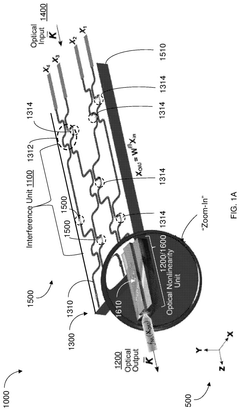
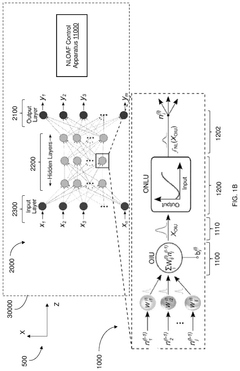
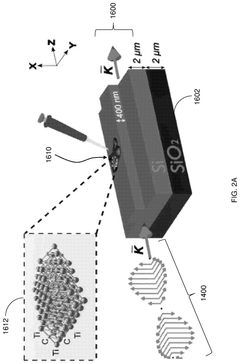
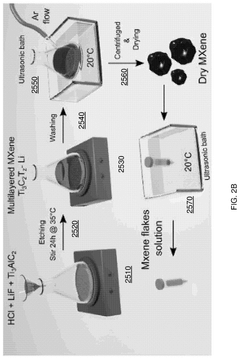
- The development of an all-optical nonlinear activation function using MXene-based materials, which enables non-linear optical signal input-to-output power mapping, eliminating the need for electronic conversions.
Machine learning system for technical knowledge capture
PatentActiveUS12118773B2
Innovation
- A machine learning system that captures human knowledge by correlating video, audio, and sensor data from SMEs to create a domain model, enabling the generation of targeted training information for novice users through augmented reality and interactive multimedia manuals.


Environmental Impact of MXene Production
The production of MXene, a two-dimensional material with promising applications in AI-driven learning systems, has significant environmental implications that warrant careful consideration. The synthesis process of MXene typically involves the etching of MAX phases, which requires the use of strong acids or fluoride-containing compounds. This chemical-intensive procedure raises concerns about potential environmental contamination and the need for proper waste management.
One of the primary environmental challenges associated with MXene production is the generation of hazardous byproducts. The etching process produces acidic waste streams that, if not properly treated, can lead to soil and water pollution. Additionally, the use of fluoride-containing compounds poses risks to aquatic ecosystems and human health if released into the environment. Implementing robust waste treatment and recycling systems is crucial to mitigate these risks and ensure sustainable MXene production.
Energy consumption is another critical factor in assessing the environmental impact of MXene manufacturing. The synthesis process often requires high temperatures and prolonged reaction times, resulting in substantial energy usage. As the demand for MXene in AI applications grows, scaling up production could lead to increased energy consumption and associated greenhouse gas emissions. Developing more energy-efficient synthesis methods and exploring renewable energy sources for production facilities could help address this concern.
The sourcing of raw materials for MXene production also has environmental implications. The extraction of titanium, aluminum, and other metals used in MAX phases can have significant ecological impacts, including habitat destruction, water pollution, and biodiversity loss. Sustainable sourcing practices and the development of recycling technologies for MXene and its precursors are essential to reduce the environmental footprint of the material's life cycle.
Water usage is another environmental consideration in MXene production. The synthesis and purification processes often require substantial amounts of water, which can strain local water resources, particularly in water-scarce regions. Implementing water recycling systems and developing water-efficient production methods are crucial steps towards minimizing the water footprint of MXene manufacturing.
As research into MXene applications in AI-driven learning systems progresses, it is imperative to simultaneously advance sustainable production practices. This includes exploring green chemistry approaches, such as using less hazardous etching agents and developing solvent-free synthesis methods. Additionally, life cycle assessments of MXene production and its applications in AI systems can provide valuable insights into the overall environmental impact and guide the development of more sustainable manufacturing processes.
One of the primary environmental challenges associated with MXene production is the generation of hazardous byproducts. The etching process produces acidic waste streams that, if not properly treated, can lead to soil and water pollution. Additionally, the use of fluoride-containing compounds poses risks to aquatic ecosystems and human health if released into the environment. Implementing robust waste treatment and recycling systems is crucial to mitigate these risks and ensure sustainable MXene production.
Energy consumption is another critical factor in assessing the environmental impact of MXene manufacturing. The synthesis process often requires high temperatures and prolonged reaction times, resulting in substantial energy usage. As the demand for MXene in AI applications grows, scaling up production could lead to increased energy consumption and associated greenhouse gas emissions. Developing more energy-efficient synthesis methods and exploring renewable energy sources for production facilities could help address this concern.
The sourcing of raw materials for MXene production also has environmental implications. The extraction of titanium, aluminum, and other metals used in MAX phases can have significant ecological impacts, including habitat destruction, water pollution, and biodiversity loss. Sustainable sourcing practices and the development of recycling technologies for MXene and its precursors are essential to reduce the environmental footprint of the material's life cycle.
Water usage is another environmental consideration in MXene production. The synthesis and purification processes often require substantial amounts of water, which can strain local water resources, particularly in water-scarce regions. Implementing water recycling systems and developing water-efficient production methods are crucial steps towards minimizing the water footprint of MXene manufacturing.
As research into MXene applications in AI-driven learning systems progresses, it is imperative to simultaneously advance sustainable production practices. This includes exploring green chemistry approaches, such as using less hazardous etching agents and developing solvent-free synthesis methods. Additionally, life cycle assessments of MXene production and its applications in AI systems can provide valuable insights into the overall environmental impact and guide the development of more sustainable manufacturing processes.
Scalability and Cost Analysis of MXene
The scalability and cost analysis of MXene in AI-driven learning systems is a critical consideration for its widespread adoption. MXene, a two-dimensional transition metal carbide, has shown promising potential in enhancing the performance of AI systems. However, its scalability and associated costs must be carefully evaluated to determine its viability for large-scale implementation.
From a scalability perspective, MXene offers several advantages. Its two-dimensional structure allows for easy integration into existing AI hardware architectures, potentially enabling seamless scaling of computational capabilities. The material's high electrical conductivity and thermal stability contribute to improved energy efficiency, which is crucial for scaling AI systems to handle increasingly complex tasks and larger datasets.
However, challenges in large-scale production of MXene may impact its scalability. Current synthesis methods, such as selective etching of MAX phases, are limited in their ability to produce large quantities of high-quality MXene. Addressing these production bottlenecks is essential for ensuring a stable supply chain that can meet the demands of widespread AI implementation.
Cost considerations for MXene in AI systems encompass both production and implementation expenses. The raw materials required for MXene synthesis, particularly transition metals, can be costly. Additionally, the specialized equipment and processes needed for production contribute to overall expenses. As production techniques improve and economies of scale are achieved, these costs are expected to decrease, making MXene more economically viable for AI applications.
Implementation costs include the integration of MXene into existing AI hardware and the potential redesign of systems to fully leverage its properties. While initial costs may be higher, the long-term benefits of improved performance and energy efficiency could offset these expenses. The potential reduction in power consumption and cooling requirements in AI data centers could lead to significant operational cost savings over time.
A comprehensive cost-benefit analysis must consider the performance gains offered by MXene against the total cost of ownership. Improved processing speed, reduced latency, and enhanced energy efficiency could translate to substantial economic benefits, particularly for large-scale AI operations. As research progresses and more real-world applications emerge, a clearer picture of MXene's economic viability in AI systems will develop.
In conclusion, while MXene shows promise for scalability in AI-driven learning systems, addressing production challenges and optimizing costs remain crucial for its widespread adoption. Continued research and development efforts are necessary to fully realize the potential of MXene in advancing AI technologies while ensuring economic feasibility.
From a scalability perspective, MXene offers several advantages. Its two-dimensional structure allows for easy integration into existing AI hardware architectures, potentially enabling seamless scaling of computational capabilities. The material's high electrical conductivity and thermal stability contribute to improved energy efficiency, which is crucial for scaling AI systems to handle increasingly complex tasks and larger datasets.
However, challenges in large-scale production of MXene may impact its scalability. Current synthesis methods, such as selective etching of MAX phases, are limited in their ability to produce large quantities of high-quality MXene. Addressing these production bottlenecks is essential for ensuring a stable supply chain that can meet the demands of widespread AI implementation.
Cost considerations for MXene in AI systems encompass both production and implementation expenses. The raw materials required for MXene synthesis, particularly transition metals, can be costly. Additionally, the specialized equipment and processes needed for production contribute to overall expenses. As production techniques improve and economies of scale are achieved, these costs are expected to decrease, making MXene more economically viable for AI applications.
Implementation costs include the integration of MXene into existing AI hardware and the potential redesign of systems to fully leverage its properties. While initial costs may be higher, the long-term benefits of improved performance and energy efficiency could offset these expenses. The potential reduction in power consumption and cooling requirements in AI data centers could lead to significant operational cost savings over time.
A comprehensive cost-benefit analysis must consider the performance gains offered by MXene against the total cost of ownership. Improved processing speed, reduced latency, and enhanced energy efficiency could translate to substantial economic benefits, particularly for large-scale AI operations. As research progresses and more real-world applications emerge, a clearer picture of MXene's economic viability in AI systems will develop.
In conclusion, while MXene shows promise for scalability in AI-driven learning systems, addressing production challenges and optimizing costs remain crucial for its widespread adoption. Continued research and development efforts are necessary to fully realize the potential of MXene in advancing AI technologies while ensuring economic feasibility.
Unlock deeper insights with PatSnap Eureka Quick Research — get a full tech report to explore trends and direct your research. Try now!
Generate Your Research Report Instantly with AI Agent
Supercharge your innovation with PatSnap Eureka AI Agent Platform!