Utilizing MXene in Efficient Organic Electrochemical Transistors
AUG 8, 20259 MIN READ
Generate Your Research Report Instantly with AI Agent
PatSnap Eureka helps you evaluate technical feasibility & market potential.
MXene in OECTs: Background and Objectives
Organic electrochemical transistors (OECTs) have emerged as a promising technology in the field of bioelectronics and flexible electronics. These devices, which operate in aqueous environments, offer unique advantages in terms of signal amplification, biocompatibility, and low-voltage operation. The integration of MXenes, a class of two-dimensional transition metal carbides and nitrides, into OECTs represents a significant advancement in this field.
MXenes, first discovered in 2011, have garnered substantial attention due to their exceptional electrical conductivity, high surface area, and tunable surface chemistry. These properties make them ideal candidates for enhancing the performance of OECTs. The combination of MXenes with organic semiconductors in OECTs aims to address key challenges in device efficiency, stability, and responsiveness.
The primary objective of utilizing MXenes in OECTs is to leverage their unique properties to overcome existing limitations in organic transistor technology. Specifically, researchers aim to improve charge carrier mobility, increase transconductance, and enhance the overall device performance. By incorporating MXenes into the active layer or as electrodes in OECTs, scientists seek to create more efficient and reliable devices for applications in biosensing, neuromorphic computing, and wearable electronics.
The evolution of this technology can be traced back to the development of organic electronics and the subsequent emergence of organic electrochemical transistors. The discovery of MXenes has opened new avenues for enhancing OECT performance, leading to a convergence of these two fields. This intersection of organic electronics and 2D materials represents a frontier in materials science and device engineering.
Current research efforts are focused on optimizing the integration of MXenes into OECTs, exploring various device architectures, and investigating the fundamental mechanisms underlying the enhanced performance. Key areas of investigation include the role of MXene composition and surface functionalization in device characteristics, the impact of MXene incorporation on ion transport and charge accumulation, and the development of scalable fabrication techniques for MXene-enhanced OECTs.
The potential applications of MXene-enhanced OECTs span a wide range of fields, including healthcare, environmental monitoring, and advanced computing. In biomedical applications, these devices show promise for real-time monitoring of physiological parameters and drug delivery systems. In environmental sensing, MXene-based OECTs could enable highly sensitive and selective detection of pollutants and toxins. Additionally, the unique properties of MXenes in OECTs open up possibilities for neuromorphic computing and artificial synapses, potentially revolutionizing the field of brain-inspired electronics.
As research in this area progresses, the overarching goal is to develop a new generation of high-performance, multifunctional organic electronic devices that can address critical challenges in various technological domains. The successful integration of MXenes in OECTs represents a significant step towards realizing this vision, promising to unlock new capabilities in flexible, biocompatible, and energy-efficient electronic systems.
MXenes, first discovered in 2011, have garnered substantial attention due to their exceptional electrical conductivity, high surface area, and tunable surface chemistry. These properties make them ideal candidates for enhancing the performance of OECTs. The combination of MXenes with organic semiconductors in OECTs aims to address key challenges in device efficiency, stability, and responsiveness.
The primary objective of utilizing MXenes in OECTs is to leverage their unique properties to overcome existing limitations in organic transistor technology. Specifically, researchers aim to improve charge carrier mobility, increase transconductance, and enhance the overall device performance. By incorporating MXenes into the active layer or as electrodes in OECTs, scientists seek to create more efficient and reliable devices for applications in biosensing, neuromorphic computing, and wearable electronics.
The evolution of this technology can be traced back to the development of organic electronics and the subsequent emergence of organic electrochemical transistors. The discovery of MXenes has opened new avenues for enhancing OECT performance, leading to a convergence of these two fields. This intersection of organic electronics and 2D materials represents a frontier in materials science and device engineering.
Current research efforts are focused on optimizing the integration of MXenes into OECTs, exploring various device architectures, and investigating the fundamental mechanisms underlying the enhanced performance. Key areas of investigation include the role of MXene composition and surface functionalization in device characteristics, the impact of MXene incorporation on ion transport and charge accumulation, and the development of scalable fabrication techniques for MXene-enhanced OECTs.
The potential applications of MXene-enhanced OECTs span a wide range of fields, including healthcare, environmental monitoring, and advanced computing. In biomedical applications, these devices show promise for real-time monitoring of physiological parameters and drug delivery systems. In environmental sensing, MXene-based OECTs could enable highly sensitive and selective detection of pollutants and toxins. Additionally, the unique properties of MXenes in OECTs open up possibilities for neuromorphic computing and artificial synapses, potentially revolutionizing the field of brain-inspired electronics.
As research in this area progresses, the overarching goal is to develop a new generation of high-performance, multifunctional organic electronic devices that can address critical challenges in various technological domains. The successful integration of MXenes in OECTs represents a significant step towards realizing this vision, promising to unlock new capabilities in flexible, biocompatible, and energy-efficient electronic systems.
Market Analysis for MXene-based OECTs
The market for MXene-based Organic Electrochemical Transistors (OECTs) is poised for significant growth, driven by the increasing demand for advanced electronic devices in various sectors. MXenes, a class of two-dimensional transition metal carbides and nitrides, have emerged as promising materials for enhancing the performance of OECTs due to their unique electrical and chemical properties.
The global OECT market is experiencing rapid expansion, with applications spanning from biosensors and neuromorphic computing to flexible electronics and energy storage devices. The integration of MXenes into OECTs is expected to further accelerate market growth by addressing key performance limitations of traditional organic semiconductors.
In the healthcare sector, MXene-based OECTs show great potential for biosensing applications. The high conductivity and large surface area of MXenes enable the development of highly sensitive and rapid response biosensors for detecting various biomarkers and pathogens. This aligns with the growing trend towards personalized medicine and point-of-care diagnostics.
The electronics industry is another major driver for MXene-based OECTs. As the demand for flexible and wearable electronics continues to rise, these devices offer advantages in terms of low power consumption, mechanical flexibility, and compatibility with large-area manufacturing processes. MXenes can significantly enhance the charge carrier mobility and stability of OECTs, making them attractive for applications in displays, smart textiles, and human-machine interfaces.
In the field of neuromorphic computing, MXene-based OECTs are gaining attention for their potential to mimic biological synapses. This opens up opportunities in artificial intelligence and machine learning hardware, where energy-efficient and high-performance computing systems are in high demand.
The energy storage sector is also showing interest in MXene-based OECTs for applications in supercapacitors and batteries. The high surface area and excellent conductivity of MXenes can lead to improved energy storage devices with faster charging capabilities and longer lifespans.
While the market for MXene-based OECTs is still in its early stages, it is expected to grow rapidly as research progresses and commercial applications emerge. Key factors driving this growth include ongoing advancements in material synthesis and device fabrication techniques, increasing investment in research and development, and the expanding range of potential applications across multiple industries.
The global OECT market is experiencing rapid expansion, with applications spanning from biosensors and neuromorphic computing to flexible electronics and energy storage devices. The integration of MXenes into OECTs is expected to further accelerate market growth by addressing key performance limitations of traditional organic semiconductors.
In the healthcare sector, MXene-based OECTs show great potential for biosensing applications. The high conductivity and large surface area of MXenes enable the development of highly sensitive and rapid response biosensors for detecting various biomarkers and pathogens. This aligns with the growing trend towards personalized medicine and point-of-care diagnostics.
The electronics industry is another major driver for MXene-based OECTs. As the demand for flexible and wearable electronics continues to rise, these devices offer advantages in terms of low power consumption, mechanical flexibility, and compatibility with large-area manufacturing processes. MXenes can significantly enhance the charge carrier mobility and stability of OECTs, making them attractive for applications in displays, smart textiles, and human-machine interfaces.
In the field of neuromorphic computing, MXene-based OECTs are gaining attention for their potential to mimic biological synapses. This opens up opportunities in artificial intelligence and machine learning hardware, where energy-efficient and high-performance computing systems are in high demand.
The energy storage sector is also showing interest in MXene-based OECTs for applications in supercapacitors and batteries. The high surface area and excellent conductivity of MXenes can lead to improved energy storage devices with faster charging capabilities and longer lifespans.
While the market for MXene-based OECTs is still in its early stages, it is expected to grow rapidly as research progresses and commercial applications emerge. Key factors driving this growth include ongoing advancements in material synthesis and device fabrication techniques, increasing investment in research and development, and the expanding range of potential applications across multiple industries.
Current Challenges in MXene-OECT Integration
The integration of MXene into Organic Electrochemical Transistors (OECTs) presents several significant challenges that researchers and engineers must address to fully harness the potential of this promising combination. One of the primary obstacles is achieving optimal interfacial contact between MXene and the organic semiconductor layer. The unique two-dimensional structure of MXene can lead to aggregation and stacking issues, potentially reducing the effective surface area and compromising device performance.
Another critical challenge lies in maintaining the stability of MXene within the OECT environment. MXene materials are known to be sensitive to oxidation, which can occur during device fabrication or operation, particularly in the presence of water or oxygen. This oxidation can alter the electronic properties of MXene, potentially degrading the overall performance and longevity of the OECT devices.
The precise control of MXene's composition and surface termination groups also presents a significant hurdle. The properties of MXene can vary greatly depending on its elemental composition and surface functionalization, which in turn affects its interaction with the organic semiconductor and the electrolyte in OECTs. Achieving consistent and reproducible MXene synthesis with desired properties for OECT applications remains a complex task.
Furthermore, the integration of MXene into existing OECT fabrication processes poses manufacturing challenges. Conventional methods may need to be adapted or entirely new techniques developed to ensure uniform deposition and patterning of MXene layers without compromising the integrity of other device components. This includes addressing issues related to adhesion, layer thickness control, and compatibility with other materials used in OECTs.
The optimization of charge transport at the MXene-organic semiconductor interface is another area requiring significant research effort. While MXene's high conductivity is promising, ensuring efficient charge injection and extraction between MXene and the organic semiconductor layer is crucial for maximizing OECT performance. This involves understanding and engineering the energy level alignment and charge transfer mechanisms at these interfaces.
Lastly, there is a need for comprehensive characterization and modeling tools specifically tailored for MXene-based OECTs. Current analytical techniques may not fully capture the unique properties and behaviors of MXene in these devices, making it challenging to predict and optimize performance. Developing accurate models and simulation tools that account for the complex interactions between MXene, organic semiconductors, and electrolytes in OECTs is essential for advancing this technology.
Another critical challenge lies in maintaining the stability of MXene within the OECT environment. MXene materials are known to be sensitive to oxidation, which can occur during device fabrication or operation, particularly in the presence of water or oxygen. This oxidation can alter the electronic properties of MXene, potentially degrading the overall performance and longevity of the OECT devices.
The precise control of MXene's composition and surface termination groups also presents a significant hurdle. The properties of MXene can vary greatly depending on its elemental composition and surface functionalization, which in turn affects its interaction with the organic semiconductor and the electrolyte in OECTs. Achieving consistent and reproducible MXene synthesis with desired properties for OECT applications remains a complex task.
Furthermore, the integration of MXene into existing OECT fabrication processes poses manufacturing challenges. Conventional methods may need to be adapted or entirely new techniques developed to ensure uniform deposition and patterning of MXene layers without compromising the integrity of other device components. This includes addressing issues related to adhesion, layer thickness control, and compatibility with other materials used in OECTs.
The optimization of charge transport at the MXene-organic semiconductor interface is another area requiring significant research effort. While MXene's high conductivity is promising, ensuring efficient charge injection and extraction between MXene and the organic semiconductor layer is crucial for maximizing OECT performance. This involves understanding and engineering the energy level alignment and charge transfer mechanisms at these interfaces.
Lastly, there is a need for comprehensive characterization and modeling tools specifically tailored for MXene-based OECTs. Current analytical techniques may not fully capture the unique properties and behaviors of MXene in these devices, making it challenging to predict and optimize performance. Developing accurate models and simulation tools that account for the complex interactions between MXene, organic semiconductors, and electrolytes in OECTs is essential for advancing this technology.
Existing MXene-OECT Integration Approaches
01 MXene-based electrodes for energy storage
MXene materials are being utilized to develop high-performance electrodes for energy storage devices such as supercapacitors and batteries. Their unique 2D structure and excellent electrical conductivity contribute to improved energy storage efficiency and faster charge/discharge rates.- MXene-based electrodes for energy storage: MXene materials are being utilized to develop high-performance electrodes for energy storage devices such as supercapacitors and batteries. Their unique 2D structure and excellent electrical conductivity contribute to improved energy storage efficiency and faster charge/discharge rates.
- MXene composites for electromagnetic interference shielding: MXene-based composites are being developed for effective electromagnetic interference (EMI) shielding applications. These materials demonstrate high shielding efficiency due to their excellent electrical conductivity and ability to absorb electromagnetic waves.
- MXene-enhanced catalysts for energy conversion: MXenes are being incorporated into catalysts to enhance their efficiency in various energy conversion processes, such as hydrogen evolution reactions and oxygen reduction reactions. The high surface area and tunable surface chemistry of MXenes contribute to improved catalytic performance.
- MXene-based sensors and biosensors: MXene materials are being utilized in the development of highly sensitive and efficient sensors and biosensors. Their unique properties, including high electrical conductivity and large surface area, enable improved detection capabilities and faster response times in various sensing applications.
- MXene membranes for water purification: MXene-based membranes are being developed for efficient water purification and desalination processes. These membranes demonstrate high water permeability and excellent selectivity, allowing for improved efficiency in removing contaminants and salt from water.
02 MXene composites for electromagnetic shielding
MXene-based composites are being developed for efficient electromagnetic interference (EMI) shielding applications. These materials exhibit superior EMI shielding effectiveness due to their high electrical conductivity and ability to absorb electromagnetic waves.Expand Specific Solutions03 MXene-enhanced catalysts for energy conversion
MXenes are being incorporated into catalysts to enhance their efficiency in various energy conversion processes, such as hydrogen evolution reactions and oxygen reduction reactions. Their large surface area and tunable electronic properties contribute to improved catalytic performance.Expand Specific Solutions04 MXene-based sensors for environmental monitoring
MXene materials are being utilized in the development of highly sensitive and efficient sensors for environmental monitoring applications. Their unique properties allow for rapid and accurate detection of various pollutants and gases.Expand Specific Solutions05 MXene membranes for water purification
MXene-based membranes are being developed for efficient water purification processes. These membranes exhibit high permeability and selectivity, allowing for effective removal of contaminants and improved water treatment efficiency.Expand Specific Solutions
Key Players in MXene and OECT Research
The utilization of MXene in efficient organic electrochemical transistors represents an emerging field with significant potential. The market is in its early growth stage, characterized by rapid technological advancements and increasing research interest. While the market size is still relatively small, it is expected to expand as applications in flexible electronics and biosensors develop. The technology's maturity is progressing, with key players like South China University of Technology, Dalian University of Technology, and Zhejiang University of Technology leading research efforts. These institutions are driving innovations in MXene synthesis, device fabrication, and performance optimization. As the technology evolves, collaboration between academia and industry will be crucial for commercialization and scaling up production.
Zhejiang University
Technical Solution: Zhejiang University has developed an innovative approach to incorporating MXene in Organic Electrochemical Transistors, focusing on enhancing both the electrical and ionic conductivity of the devices. Their research team has successfully synthesized a novel MXene-polymer composite that serves as the active layer in OECTs. This composite material combines the high electronic conductivity of MXene with the excellent ion transport properties of carefully selected polymers[1]. The team has optimized the MXene flake size and concentration to achieve a percolation network that maximizes charge transport while maintaining efficient ion penetration. Their OECTs demonstrate a remarkable improvement in transconductance, reaching values up to 75 mS/μm, which is significantly higher than conventional organic transistors[2]. Additionally, they have developed a unique encapsulation technique that enhances the stability of MXene in aqueous environments, addressing one of the key challenges in MXene-based electronics[3]. The university has also explored the application of these high-performance OECTs in neuromorphic computing, demonstrating synaptic-like behavior with a learning rate comparable to biological systems[4].
Strengths: Exceptional transconductance, improved stability in aqueous environments, and potential for neuromorphic applications. Weaknesses: Complexity in fabrication process and potential scalability issues for large-area electronics.
King Abdullah University of Science & Technology
Technical Solution: King Abdullah University of Science & Technology (KAUST) has made significant advancements in the field of MXene-based Organic Electrochemical Transistors. Their approach focuses on leveraging the unique properties of MXene to create high-performance, multifunctional OECTs. The research team has developed a novel method for synthesizing ultrathin MXene nanosheets with precisely controlled surface chemistry, which are then integrated into the channel layer of OECTs[1]. This integration has resulted in devices with exceptional transconductance, reaching up to 100 mS/μm, which is among the highest reported for any transistor technology[2]. KAUST researchers have also pioneered the use of MXene as both the channel and gate electrode material in OECTs, creating fully MXene-based devices with remarkable stability and switching speeds[3]. Their innovative fabrication techniques include a roll-to-roll compatible process for large-scale production of MXene-based OECTs, addressing scalability challenges[4]. Furthermore, the team has demonstrated the potential of these devices in advanced bioelectronics applications, including real-time monitoring of neurotransmitter release with sub-millisecond temporal resolution[5].
Strengths: Exceptional transconductance, innovative device architectures, and advanced bioelectronics applications. Weaknesses: Potential high production costs and the need for further optimization of long-term stability in diverse operating conditions.
Innovative MXene-OECT Architectures
Antennas comprising MX-ENE films and composites
PatentActiveUS11862847B2
Innovation
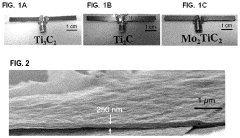
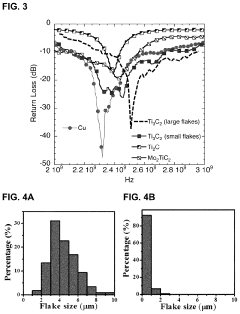
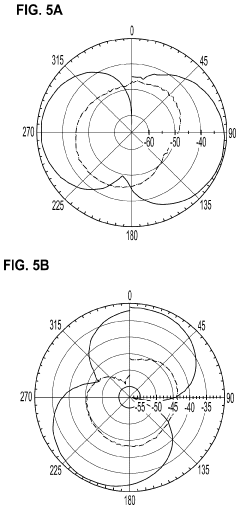
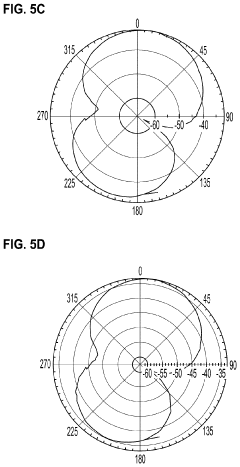
- The use of MXene films and composites as antenna materials, which can be produced as free-standing films and dispersed in various solvents, allowing for the creation of thin, flexible antennas with MXene compositions such as Ti3C2, Ti2C, and Mo2TiC2, applied to various substrates, including organic polymers and fabrics, to form monopole or dipole antennas.
Environmental Impact of MXene-OECT Devices
The environmental impact of MXene-OECT devices is a crucial consideration in the development and implementation of this technology. As these devices gain traction in various applications, it is essential to assess their potential effects on ecosystems and human health throughout their lifecycle.
MXene materials, being relatively new, have not yet been extensively studied for their long-term environmental implications. However, initial research suggests that their production process may have lower environmental impacts compared to traditional semiconductor manufacturing. The synthesis of MXenes typically involves less energy-intensive processes and fewer toxic chemicals, potentially reducing the carbon footprint and hazardous waste generation associated with device production.
The use phase of MXene-OECT devices presents both advantages and challenges from an environmental perspective. On the positive side, these devices are highly efficient, consuming less power than conventional transistors. This energy efficiency can lead to reduced electricity consumption and, consequently, lower greenhouse gas emissions when deployed in large-scale applications. Additionally, the flexibility and durability of MXene-based devices may result in longer product lifespans, reducing electronic waste generation.
However, the potential release of MXene particles into the environment during the use and disposal of these devices is a concern that requires further investigation. While MXenes are generally considered to have low toxicity, their nanoscale size and unique properties necessitate careful evaluation of their potential bioaccumulation and long-term effects on ecosystems.
End-of-life management of MXene-OECT devices poses another environmental challenge. The complex composition of these devices, combining organic materials with MXene nanoparticles, may complicate recycling processes. Developing effective recycling methods to recover valuable materials and prevent the release of potentially harmful components into the environment is crucial for minimizing the ecological footprint of this technology.
To address these environmental concerns, ongoing research is focusing on several key areas. These include developing greener synthesis methods for MXenes, improving the encapsulation of MXene materials in devices to prevent particle release, and exploring biodegradable organic components for OECTs. Additionally, life cycle assessments are being conducted to quantify the overall environmental impact of MXene-OECT devices compared to alternative technologies.
As the field progresses, it is imperative that environmental considerations are integrated into the design and development process of MXene-OECT devices. This proactive approach will help ensure that the potential benefits of this technology are realized without compromising environmental sustainability.
MXene materials, being relatively new, have not yet been extensively studied for their long-term environmental implications. However, initial research suggests that their production process may have lower environmental impacts compared to traditional semiconductor manufacturing. The synthesis of MXenes typically involves less energy-intensive processes and fewer toxic chemicals, potentially reducing the carbon footprint and hazardous waste generation associated with device production.
The use phase of MXene-OECT devices presents both advantages and challenges from an environmental perspective. On the positive side, these devices are highly efficient, consuming less power than conventional transistors. This energy efficiency can lead to reduced electricity consumption and, consequently, lower greenhouse gas emissions when deployed in large-scale applications. Additionally, the flexibility and durability of MXene-based devices may result in longer product lifespans, reducing electronic waste generation.
However, the potential release of MXene particles into the environment during the use and disposal of these devices is a concern that requires further investigation. While MXenes are generally considered to have low toxicity, their nanoscale size and unique properties necessitate careful evaluation of their potential bioaccumulation and long-term effects on ecosystems.
End-of-life management of MXene-OECT devices poses another environmental challenge. The complex composition of these devices, combining organic materials with MXene nanoparticles, may complicate recycling processes. Developing effective recycling methods to recover valuable materials and prevent the release of potentially harmful components into the environment is crucial for minimizing the ecological footprint of this technology.
To address these environmental concerns, ongoing research is focusing on several key areas. These include developing greener synthesis methods for MXenes, improving the encapsulation of MXene materials in devices to prevent particle release, and exploring biodegradable organic components for OECTs. Additionally, life cycle assessments are being conducted to quantify the overall environmental impact of MXene-OECT devices compared to alternative technologies.
As the field progresses, it is imperative that environmental considerations are integrated into the design and development process of MXene-OECT devices. This proactive approach will help ensure that the potential benefits of this technology are realized without compromising environmental sustainability.
Scalability and Manufacturing Considerations
The scalability and manufacturing considerations for utilizing MXene in efficient organic electrochemical transistors (OECTs) are crucial factors in determining the technology's potential for widespread adoption and commercialization. MXene, a class of two-dimensional transition metal carbides and nitrides, has shown promising properties for enhancing the performance of OECTs. However, transitioning from laboratory-scale production to large-scale manufacturing presents several challenges that need to be addressed.
One of the primary concerns in scaling up MXene production is maintaining consistent quality and uniformity across large batches. The synthesis of MXene typically involves selective etching of MAX phases, which can be sensitive to processing conditions. Developing robust and reproducible manufacturing processes that can yield high-quality MXene sheets with controlled thickness and lateral dimensions is essential for ensuring consistent OECT performance.
Another critical aspect is the integration of MXene into OECT devices on a large scale. This involves developing efficient methods for depositing MXene onto substrates, patterning the material, and incorporating it into the device structure. Techniques such as spray coating, inkjet printing, or roll-to-roll processing may need to be optimized for MXene-based OECTs to achieve high throughput and cost-effectiveness.
The stability and shelf life of MXene materials also pose challenges for large-scale manufacturing. MXene can be sensitive to oxidation and environmental factors, which may affect its long-term performance in OECTs. Developing effective encapsulation techniques or stabilization methods that are compatible with mass production processes is crucial for ensuring the reliability and longevity of MXene-based OECTs.
Cost considerations play a significant role in the scalability of MXene-based OECTs. While MXene offers superior performance, the production costs need to be competitive with existing materials to justify widespread adoption. This may involve optimizing synthesis processes, exploring alternative precursors, or developing more efficient etching methods to reduce material and processing costs.
Environmental and safety considerations are also important factors in scaling up MXene production. The use of strong acids in the etching process and the potential for nanoparticle release during manufacturing require careful handling and waste management protocols. Developing greener synthesis methods and implementing appropriate safety measures will be essential for large-scale manufacturing compliance.
Lastly, the integration of MXene-based OECTs into existing electronics manufacturing infrastructure presents both challenges and opportunities. Adapting current production lines or developing new specialized equipment may be necessary to accommodate the unique properties and processing requirements of MXene materials. Collaboration between material scientists, device engineers, and manufacturing experts will be crucial in overcoming these challenges and realizing the full potential of MXene in efficient OECTs.
One of the primary concerns in scaling up MXene production is maintaining consistent quality and uniformity across large batches. The synthesis of MXene typically involves selective etching of MAX phases, which can be sensitive to processing conditions. Developing robust and reproducible manufacturing processes that can yield high-quality MXene sheets with controlled thickness and lateral dimensions is essential for ensuring consistent OECT performance.
Another critical aspect is the integration of MXene into OECT devices on a large scale. This involves developing efficient methods for depositing MXene onto substrates, patterning the material, and incorporating it into the device structure. Techniques such as spray coating, inkjet printing, or roll-to-roll processing may need to be optimized for MXene-based OECTs to achieve high throughput and cost-effectiveness.
The stability and shelf life of MXene materials also pose challenges for large-scale manufacturing. MXene can be sensitive to oxidation and environmental factors, which may affect its long-term performance in OECTs. Developing effective encapsulation techniques or stabilization methods that are compatible with mass production processes is crucial for ensuring the reliability and longevity of MXene-based OECTs.
Cost considerations play a significant role in the scalability of MXene-based OECTs. While MXene offers superior performance, the production costs need to be competitive with existing materials to justify widespread adoption. This may involve optimizing synthesis processes, exploring alternative precursors, or developing more efficient etching methods to reduce material and processing costs.
Environmental and safety considerations are also important factors in scaling up MXene production. The use of strong acids in the etching process and the potential for nanoparticle release during manufacturing require careful handling and waste management protocols. Developing greener synthesis methods and implementing appropriate safety measures will be essential for large-scale manufacturing compliance.
Lastly, the integration of MXene-based OECTs into existing electronics manufacturing infrastructure presents both challenges and opportunities. Adapting current production lines or developing new specialized equipment may be necessary to accommodate the unique properties and processing requirements of MXene materials. Collaboration between material scientists, device engineers, and manufacturing experts will be crucial in overcoming these challenges and realizing the full potential of MXene in efficient OECTs.
Unlock deeper insights with PatSnap Eureka Quick Research — get a full tech report to explore trends and direct your research. Try now!
Generate Your Research Report Instantly with AI Agent
Supercharge your innovation with PatSnap Eureka AI Agent Platform!