MXene Utilization in Precision Agriculture Improvements
AUG 8, 20259 MIN READ
Generate Your Research Report Instantly with AI Agent
PatSnap Eureka helps you evaluate technical feasibility & market potential.
MXene in Agriculture: Background and Objectives
MXene, a class of two-dimensional transition metal carbides and nitrides, has emerged as a promising material in various fields, including agriculture. The evolution of MXene technology in agriculture represents a significant advancement in precision farming techniques, offering potential solutions to enhance crop productivity, resource efficiency, and environmental sustainability.
The development of MXene applications in agriculture stems from the broader context of nanotechnology integration in farming practices. As global food demand continues to rise and environmental concerns intensify, the agricultural sector faces mounting pressure to optimize production while minimizing ecological impact. MXene technology presents a novel approach to address these challenges by leveraging its unique properties at the nanoscale.
The primary objective of MXene utilization in precision agriculture is to improve overall farming efficiency and crop yield. This encompasses several key areas, including enhanced nutrient delivery, water management, pest control, and environmental monitoring. By harnessing the exceptional electrical, thermal, and mechanical properties of MXene materials, researchers aim to develop innovative solutions that can revolutionize traditional agricultural practices.
One of the most promising aspects of MXene in agriculture is its potential for targeted nutrient delivery. The high surface area and tunable surface chemistry of MXene nanosheets allow for the efficient adsorption and controlled release of essential nutrients. This capability could lead to the development of smart fertilizers that optimize nutrient uptake by plants, reducing waste and environmental runoff.
Water management is another critical area where MXene technology shows significant promise. The hydrophilic nature of certain MXene compositions makes them ideal candidates for developing advanced irrigation systems and water retention materials. These applications could help conserve water resources in agriculture, a crucial factor in regions facing water scarcity.
Furthermore, MXene-based sensors and monitoring devices are being explored for their potential to provide real-time data on soil conditions, crop health, and environmental factors. This information is vital for implementing precision agriculture techniques, allowing farmers to make data-driven decisions and optimize resource allocation.
The integration of MXene in agricultural practices aligns with the broader trend of sustainable and technologically advanced farming. As research in this field progresses, the goal is to develop a comprehensive suite of MXene-enabled tools and materials that can address the multifaceted challenges of modern agriculture. This includes improving crop resilience to climate change, enhancing food security, and reducing the environmental footprint of agricultural activities.
The development of MXene applications in agriculture stems from the broader context of nanotechnology integration in farming practices. As global food demand continues to rise and environmental concerns intensify, the agricultural sector faces mounting pressure to optimize production while minimizing ecological impact. MXene technology presents a novel approach to address these challenges by leveraging its unique properties at the nanoscale.
The primary objective of MXene utilization in precision agriculture is to improve overall farming efficiency and crop yield. This encompasses several key areas, including enhanced nutrient delivery, water management, pest control, and environmental monitoring. By harnessing the exceptional electrical, thermal, and mechanical properties of MXene materials, researchers aim to develop innovative solutions that can revolutionize traditional agricultural practices.
One of the most promising aspects of MXene in agriculture is its potential for targeted nutrient delivery. The high surface area and tunable surface chemistry of MXene nanosheets allow for the efficient adsorption and controlled release of essential nutrients. This capability could lead to the development of smart fertilizers that optimize nutrient uptake by plants, reducing waste and environmental runoff.
Water management is another critical area where MXene technology shows significant promise. The hydrophilic nature of certain MXene compositions makes them ideal candidates for developing advanced irrigation systems and water retention materials. These applications could help conserve water resources in agriculture, a crucial factor in regions facing water scarcity.
Furthermore, MXene-based sensors and monitoring devices are being explored for their potential to provide real-time data on soil conditions, crop health, and environmental factors. This information is vital for implementing precision agriculture techniques, allowing farmers to make data-driven decisions and optimize resource allocation.
The integration of MXene in agricultural practices aligns with the broader trend of sustainable and technologically advanced farming. As research in this field progresses, the goal is to develop a comprehensive suite of MXene-enabled tools and materials that can address the multifaceted challenges of modern agriculture. This includes improving crop resilience to climate change, enhancing food security, and reducing the environmental footprint of agricultural activities.
Market Analysis for Smart Farming Solutions
The smart farming solutions market is experiencing rapid growth, driven by the increasing demand for precision agriculture technologies. As global food production challenges intensify due to population growth, climate change, and resource scarcity, farmers are turning to innovative solutions to optimize crop yields and resource efficiency. The market for smart farming solutions is expected to expand significantly in the coming years, with a particular focus on technologies that enable data-driven decision-making and automated farming processes.
One of the key drivers of market growth is the rising adoption of Internet of Things (IoT) devices and sensors in agriculture. These technologies allow farmers to collect real-time data on soil conditions, crop health, weather patterns, and equipment performance. This data-driven approach enables more precise application of inputs such as water, fertilizers, and pesticides, leading to improved crop yields and reduced environmental impact. The integration of artificial intelligence and machine learning algorithms further enhances the value of these solutions by providing predictive analytics and actionable insights.
Another significant trend in the smart farming solutions market is the increasing use of autonomous vehicles and drones. These technologies are revolutionizing various aspects of farming operations, from planting and harvesting to crop monitoring and spraying. Autonomous tractors and harvesters can operate with minimal human intervention, improving efficiency and reducing labor costs. Drones equipped with high-resolution cameras and multispectral sensors provide farmers with detailed aerial imagery, enabling early detection of crop stress, pest infestations, and irrigation issues.
The market for precision irrigation systems is also experiencing substantial growth. These systems use soil moisture sensors, weather data, and crop-specific algorithms to optimize water usage, reducing waste and improving crop quality. As water scarcity becomes a more pressing issue in many agricultural regions, the demand for such water-efficient solutions is expected to increase significantly.
In terms of regional market dynamics, North America and Europe currently lead in the adoption of smart farming solutions, driven by technological advancements and supportive government policies. However, the Asia-Pacific region is expected to witness the fastest growth in the coming years, fueled by increasing awareness of precision agriculture benefits and government initiatives to modernize the agricultural sector.
The competitive landscape of the smart farming solutions market is characterized by a mix of established agricultural equipment manufacturers, technology giants, and innovative startups. Key players are focusing on developing integrated platforms that combine hardware, software, and data analytics to provide comprehensive solutions for farmers. Strategic partnerships and collaborations between technology providers and agricultural companies are becoming increasingly common, as the industry recognizes the need for interdisciplinary expertise to address complex farming challenges.
One of the key drivers of market growth is the rising adoption of Internet of Things (IoT) devices and sensors in agriculture. These technologies allow farmers to collect real-time data on soil conditions, crop health, weather patterns, and equipment performance. This data-driven approach enables more precise application of inputs such as water, fertilizers, and pesticides, leading to improved crop yields and reduced environmental impact. The integration of artificial intelligence and machine learning algorithms further enhances the value of these solutions by providing predictive analytics and actionable insights.
Another significant trend in the smart farming solutions market is the increasing use of autonomous vehicles and drones. These technologies are revolutionizing various aspects of farming operations, from planting and harvesting to crop monitoring and spraying. Autonomous tractors and harvesters can operate with minimal human intervention, improving efficiency and reducing labor costs. Drones equipped with high-resolution cameras and multispectral sensors provide farmers with detailed aerial imagery, enabling early detection of crop stress, pest infestations, and irrigation issues.
The market for precision irrigation systems is also experiencing substantial growth. These systems use soil moisture sensors, weather data, and crop-specific algorithms to optimize water usage, reducing waste and improving crop quality. As water scarcity becomes a more pressing issue in many agricultural regions, the demand for such water-efficient solutions is expected to increase significantly.
In terms of regional market dynamics, North America and Europe currently lead in the adoption of smart farming solutions, driven by technological advancements and supportive government policies. However, the Asia-Pacific region is expected to witness the fastest growth in the coming years, fueled by increasing awareness of precision agriculture benefits and government initiatives to modernize the agricultural sector.
The competitive landscape of the smart farming solutions market is characterized by a mix of established agricultural equipment manufacturers, technology giants, and innovative startups. Key players are focusing on developing integrated platforms that combine hardware, software, and data analytics to provide comprehensive solutions for farmers. Strategic partnerships and collaborations between technology providers and agricultural companies are becoming increasingly common, as the industry recognizes the need for interdisciplinary expertise to address complex farming challenges.
Current MXene Applications in Agriculture
MXene, a class of two-dimensional transition metal carbides and nitrides, has shown promising applications in precision agriculture. Currently, MXene is being utilized in various aspects of agricultural practices to enhance crop productivity, resource efficiency, and environmental sustainability.
One of the primary applications of MXene in agriculture is in the development of advanced sensors for soil and crop monitoring. These sensors leverage MXene's exceptional electrical conductivity and large surface area to detect minute changes in soil moisture, nutrient levels, and pH. This real-time data collection enables farmers to make informed decisions about irrigation, fertilization, and pest control, optimizing resource usage and minimizing environmental impact.
MXene-based nanofertilizers represent another significant application in precision agriculture. These nanomaterials can be engineered to release nutrients gradually, ensuring a steady supply to crops throughout their growth cycle. This controlled release mechanism reduces nutrient runoff and improves nutrient uptake efficiency, leading to improved crop yields while minimizing environmental pollution.
In the realm of crop protection, MXene-enhanced pesticides and herbicides are being developed. The unique properties of MXene allow for better adhesion to plant surfaces and controlled release of active ingredients, resulting in more effective pest and weed control with reduced chemical usage. This application not only improves crop health but also addresses concerns about excessive pesticide use in conventional agriculture.
MXene is also being explored for its potential in water purification and desalination for agricultural use. Its high surface area and adsorption capabilities make it an excellent candidate for removing contaminants from irrigation water, including heavy metals and organic pollutants. This application is particularly valuable in regions facing water scarcity or quality issues.
Furthermore, MXene-based materials are being incorporated into smart packaging solutions for agricultural products. These materials can act as sensors to monitor the freshness and quality of produce during storage and transportation, reducing food waste and ensuring better quality control in the agricultural supply chain.
In the field of precision livestock farming, MXene-based sensors are being developed for monitoring animal health and behavior. These sensors can detect early signs of disease or stress in livestock, allowing for timely intervention and improved animal welfare.
While these applications demonstrate the current utilization of MXene in agriculture, ongoing research continues to explore new possibilities. The integration of MXene with other emerging technologies, such as artificial intelligence and Internet of Things (IoT) devices, is expected to further revolutionize precision agriculture practices in the near future.
One of the primary applications of MXene in agriculture is in the development of advanced sensors for soil and crop monitoring. These sensors leverage MXene's exceptional electrical conductivity and large surface area to detect minute changes in soil moisture, nutrient levels, and pH. This real-time data collection enables farmers to make informed decisions about irrigation, fertilization, and pest control, optimizing resource usage and minimizing environmental impact.
MXene-based nanofertilizers represent another significant application in precision agriculture. These nanomaterials can be engineered to release nutrients gradually, ensuring a steady supply to crops throughout their growth cycle. This controlled release mechanism reduces nutrient runoff and improves nutrient uptake efficiency, leading to improved crop yields while minimizing environmental pollution.
In the realm of crop protection, MXene-enhanced pesticides and herbicides are being developed. The unique properties of MXene allow for better adhesion to plant surfaces and controlled release of active ingredients, resulting in more effective pest and weed control with reduced chemical usage. This application not only improves crop health but also addresses concerns about excessive pesticide use in conventional agriculture.
MXene is also being explored for its potential in water purification and desalination for agricultural use. Its high surface area and adsorption capabilities make it an excellent candidate for removing contaminants from irrigation water, including heavy metals and organic pollutants. This application is particularly valuable in regions facing water scarcity or quality issues.
Furthermore, MXene-based materials are being incorporated into smart packaging solutions for agricultural products. These materials can act as sensors to monitor the freshness and quality of produce during storage and transportation, reducing food waste and ensuring better quality control in the agricultural supply chain.
In the field of precision livestock farming, MXene-based sensors are being developed for monitoring animal health and behavior. These sensors can detect early signs of disease or stress in livestock, allowing for timely intervention and improved animal welfare.
While these applications demonstrate the current utilization of MXene in agriculture, ongoing research continues to explore new possibilities. The integration of MXene with other emerging technologies, such as artificial intelligence and Internet of Things (IoT) devices, is expected to further revolutionize precision agriculture practices in the near future.
Existing MXene-based Agricultural Solutions
01 MXene synthesis and composition
MXenes are two-dimensional transition metal carbides, nitrides, or carbonitrides with unique properties. They are typically synthesized through selective etching of MAX phases. The composition and structure of MXenes can be tailored for specific applications, offering a wide range of possibilities in material science and engineering.- MXene synthesis and composition: MXenes are a class of two-dimensional transition metal carbides, nitrides, or carbonitrides. They are synthesized through selective etching of MAX phases, resulting in layered structures with unique properties. The composition and synthesis methods can be tailored to achieve specific characteristics for various applications.
- Energy storage applications: MXenes show promising potential in energy storage devices such as supercapacitors and batteries. Their high surface area, excellent electrical conductivity, and ion intercalation capabilities make them suitable for improving the performance of electrodes in these applications. Research focuses on optimizing MXene-based materials for enhanced energy density and cycling stability.
- Electromagnetic shielding and absorption: MXenes exhibit exceptional electromagnetic interference (EMI) shielding properties due to their high electrical conductivity and unique layered structure. They can be incorporated into composites or coatings to provide effective shielding against electromagnetic radiation in various frequency ranges, making them suitable for applications in electronics and telecommunications.
- Water purification and environmental remediation: MXenes demonstrate potential in water treatment and environmental applications due to their high surface area and adsorption capabilities. They can be used to remove heavy metals, organic pollutants, and other contaminants from water. Research is ongoing to develop MXene-based membranes and adsorbents for efficient water purification and environmental remediation processes.
- Biomedical applications: MXenes show promise in various biomedical applications, including drug delivery, biosensing, and tissue engineering. Their biocompatibility, photothermal properties, and ability to be functionalized make them attractive for developing advanced medical technologies. Research focuses on optimizing MXene-based materials for targeted drug delivery, cancer therapy, and biosensor development.
02 Energy storage applications
MXenes show great potential in energy storage applications, particularly in supercapacitors and batteries. Their high electrical conductivity, large surface area, and ability to intercalate ions make them promising materials for improving energy density and charge-discharge rates in various energy storage devices.Expand Specific Solutions03 Electromagnetic shielding and absorption
MXenes exhibit excellent electromagnetic interference (EMI) shielding properties and can be used to develop high-performance EMI shielding materials. Their unique structure allows for effective absorption and reflection of electromagnetic waves, making them suitable for applications in electronics and telecommunications.Expand Specific Solutions04 Composite materials and coatings
MXenes can be incorporated into various composite materials and coatings to enhance their properties. These composites often exhibit improved mechanical strength, thermal stability, and electrical conductivity. MXene-based coatings can provide protection against corrosion and wear in different environments.Expand Specific Solutions05 Sensors and catalysts
MXenes show promise in sensing applications due to their high surface area and electrical properties. They can be used to develop sensitive and selective sensors for various analytes. Additionally, MXenes have catalytic properties that make them suitable for applications in electrocatalysis and photocatalysis, potentially improving the efficiency of chemical reactions and energy conversion processes.Expand Specific Solutions
Key Players in MXene Agricultural Research
The MXene utilization in precision agriculture improvements sector is in its early developmental stage, with a growing market potential driven by the increasing demand for sustainable and efficient farming practices. The technology's maturity is still evolving, with research institutions like Shandong University, South China Agricultural University, and Huazhong Agricultural University leading academic efforts. Companies such as BASF Corp. and Vision Power Technology are exploring commercial applications, while startups and specialized firms are emerging to bridge the gap between research and practical implementation. The market size is expected to expand as MXene-based solutions demonstrate their effectiveness in enhancing crop yields, resource management, and environmental sustainability in agriculture.
Shandong University
Technical Solution: Shandong University has focused on developing MXene-based solutions for crop nutrient management and soil health improvement. They have created a novel MXene-enhanced soil sensor array that can simultaneously detect multiple nutrient levels, pH, and organic matter content in real-time[13]. This technology enables precise fertilizer application, reducing waste and environmental impact. The university has also developed MXene-infused slow-release fertilizers that gradually release nutrients based on soil conditions and plant needs[14]. Additionally, they are exploring the use of MXene-based nanocomposites for soil remediation, particularly in addressing soil salinity and heavy metal contamination issues in agricultural lands[15].
Strengths: Comprehensive approach to soil health and nutrient management, potential for significant environmental benefits. Weaknesses: Possible challenges in scaling up production of MXene-based materials for large-scale agricultural use, need for long-term studies on soil ecosystem impacts.
BASF Corp.
Technical Solution: BASF Corp. has integrated MXene technology into their precision agriculture solutions. They have developed MXene-enhanced soil amendments that improve water retention and nutrient absorption in crops. Their proprietary process involves incorporating MXene nanosheets into biodegradable polymers, creating a smart delivery system for fertilizers[4]. BASF has also introduced MXene-based coatings for seeds, which enhance germination rates and early plant growth by providing a protective barrier and controlled release of nutrients[5]. Furthermore, they are researching MXene-infused pesticides that offer improved efficacy and reduced environmental impact[6].
Strengths: Established market presence, comprehensive range of MXene-enhanced agricultural products. Weaknesses: Potential regulatory challenges, need for long-term studies on environmental impact.
Core Innovations in MXene for Crop Management
Covalent surface modification of two-dimensional metal carbides
PatentWO2021226221A2
Innovation
- The use of halide anion surface-terminated MXenes is modified through selective etching with transition metal bromide salts in molten alkali halide salts, allowing for the exchange of halide anions with non-halide anions in a molten salt bath, enabling covalent bonding and structural modifications such as substitution and elimination reactions.


Antennas comprising MX-ENE films and composites
PatentActiveUS11862847B2
Innovation
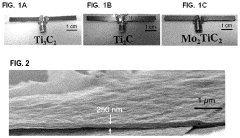
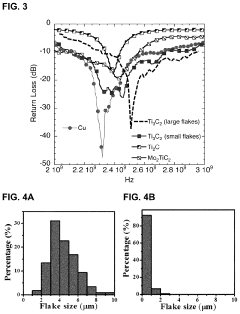
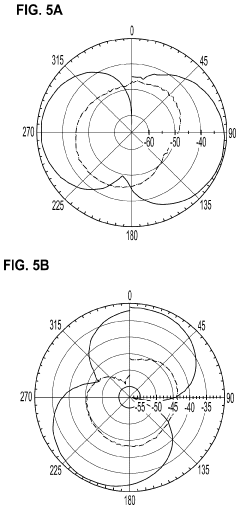
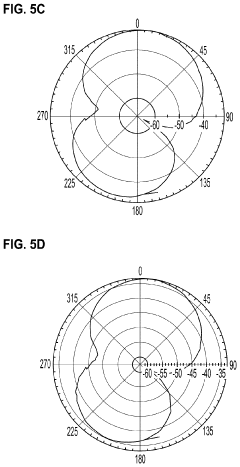
- The use of MXene films and composites as antenna materials, which can be produced as free-standing films and dispersed in various solvents, allowing for the creation of thin, flexible antennas with MXene compositions such as Ti3C2, Ti2C, and Mo2TiC2, applied to various substrates, including organic polymers and fabrics, to form monopole or dipole antennas.
Environmental Impact of MXene in Farming
The integration of MXene in precision agriculture practices has the potential to significantly impact the environmental aspects of farming. As a two-dimensional material with exceptional properties, MXene's application in agriculture could lead to both positive and negative environmental consequences.
One of the primary environmental benefits of utilizing MXene in precision agriculture is the potential reduction in chemical inputs. MXene-based sensors and monitoring systems can provide more accurate and real-time data on soil conditions, plant health, and nutrient levels. This enhanced precision allows farmers to apply fertilizers, pesticides, and water more efficiently, reducing overall chemical usage and minimizing runoff into surrounding ecosystems.
Furthermore, MXene's ability to act as a carrier for controlled release of nutrients and pesticides could lead to a decrease in the frequency and quantity of applications. This targeted delivery system not only improves the efficacy of agricultural inputs but also reduces the risk of environmental contamination and helps preserve soil health.
However, the widespread use of MXene in agriculture also raises concerns about its potential accumulation in soil and water systems. While initial studies suggest that MXene has low toxicity, long-term effects on soil microorganisms, plants, and aquatic ecosystems are not yet fully understood. Continuous monitoring and research will be crucial to assess any potential bioaccumulation or adverse effects on biodiversity.
MXene's impact on water management in agriculture is another significant environmental consideration. Its application in water purification and desalination technologies could lead to more efficient use of water resources in farming, particularly in water-scarce regions. This could help reduce the agricultural sector's overall water footprint and mitigate the strain on freshwater ecosystems.
The production and disposal of MXene-based agricultural products also warrant attention from an environmental perspective. While the material itself is derived from abundant elements, the manufacturing process may have energy and resource implications. Developing sustainable production methods and establishing proper disposal or recycling protocols for MXene-containing agricultural products will be essential to minimize their environmental footprint.
In terms of climate impact, MXene's potential to enhance crop yields and resource efficiency could indirectly contribute to reducing agriculture's carbon footprint. By optimizing inputs and potentially increasing crop resilience to environmental stresses, MXene-enabled precision agriculture may help mitigate some of the greenhouse gas emissions associated with conventional farming practices.
One of the primary environmental benefits of utilizing MXene in precision agriculture is the potential reduction in chemical inputs. MXene-based sensors and monitoring systems can provide more accurate and real-time data on soil conditions, plant health, and nutrient levels. This enhanced precision allows farmers to apply fertilizers, pesticides, and water more efficiently, reducing overall chemical usage and minimizing runoff into surrounding ecosystems.
Furthermore, MXene's ability to act as a carrier for controlled release of nutrients and pesticides could lead to a decrease in the frequency and quantity of applications. This targeted delivery system not only improves the efficacy of agricultural inputs but also reduces the risk of environmental contamination and helps preserve soil health.
However, the widespread use of MXene in agriculture also raises concerns about its potential accumulation in soil and water systems. While initial studies suggest that MXene has low toxicity, long-term effects on soil microorganisms, plants, and aquatic ecosystems are not yet fully understood. Continuous monitoring and research will be crucial to assess any potential bioaccumulation or adverse effects on biodiversity.
MXene's impact on water management in agriculture is another significant environmental consideration. Its application in water purification and desalination technologies could lead to more efficient use of water resources in farming, particularly in water-scarce regions. This could help reduce the agricultural sector's overall water footprint and mitigate the strain on freshwater ecosystems.
The production and disposal of MXene-based agricultural products also warrant attention from an environmental perspective. While the material itself is derived from abundant elements, the manufacturing process may have energy and resource implications. Developing sustainable production methods and establishing proper disposal or recycling protocols for MXene-containing agricultural products will be essential to minimize their environmental footprint.
In terms of climate impact, MXene's potential to enhance crop yields and resource efficiency could indirectly contribute to reducing agriculture's carbon footprint. By optimizing inputs and potentially increasing crop resilience to environmental stresses, MXene-enabled precision agriculture may help mitigate some of the greenhouse gas emissions associated with conventional farming practices.
Economic Feasibility of MXene Agricultural Tech
The economic feasibility of MXene agricultural technology is a critical factor in determining its potential for widespread adoption in precision agriculture. MXene, a two-dimensional transition metal carbide or nitride, has shown promising applications in various fields, including agriculture. However, the economic viability of implementing MXene-based solutions in farming practices requires careful consideration.
One of the primary economic advantages of MXene technology in agriculture is its potential to significantly improve crop yields. By enhancing nutrient delivery, water retention, and pest resistance, MXene-based products could lead to increased productivity per acre. This improved efficiency could translate into higher profits for farmers, potentially offsetting the initial investment in MXene technology.
The cost of production and scalability of MXene materials is a crucial factor in its economic feasibility. As research progresses and manufacturing processes are optimized, the production costs of MXene are expected to decrease. This reduction in costs could make MXene-based agricultural products more accessible to a broader range of farmers, from small-scale operations to large industrial farms.
Another economic consideration is the potential reduction in input costs. MXene-enhanced fertilizers and pesticides could be more effective at lower application rates, leading to decreased spending on these agricultural inputs. Additionally, the improved water retention properties of MXene could result in reduced irrigation needs, further lowering operational costs for farmers.
The durability and longevity of MXene-based agricultural products also contribute to their economic feasibility. If these materials prove to have a longer lifespan than traditional alternatives, the long-term cost-effectiveness could be significantly improved, despite potentially higher upfront costs.
Market demand for sustainable and environmentally friendly agricultural practices could drive the adoption of MXene technology. As consumers increasingly prioritize sustainably produced food, farmers implementing MXene-based solutions may benefit from premium pricing or increased market share, further enhancing the economic viability of the technology.
However, the economic feasibility of MXene in agriculture also faces challenges. The initial investment required for implementing new technologies can be a significant barrier, especially for smaller farms with limited capital. Additionally, the need for specialized equipment or training to effectively utilize MXene-based products could add to the overall costs.
In conclusion, while MXene shows promise in improving agricultural practices, its economic feasibility will depend on a balance between the benefits it offers and the costs associated with its implementation. As research continues and the technology matures, a clearer picture of its economic viability in precision agriculture will emerge.
One of the primary economic advantages of MXene technology in agriculture is its potential to significantly improve crop yields. By enhancing nutrient delivery, water retention, and pest resistance, MXene-based products could lead to increased productivity per acre. This improved efficiency could translate into higher profits for farmers, potentially offsetting the initial investment in MXene technology.
The cost of production and scalability of MXene materials is a crucial factor in its economic feasibility. As research progresses and manufacturing processes are optimized, the production costs of MXene are expected to decrease. This reduction in costs could make MXene-based agricultural products more accessible to a broader range of farmers, from small-scale operations to large industrial farms.
Another economic consideration is the potential reduction in input costs. MXene-enhanced fertilizers and pesticides could be more effective at lower application rates, leading to decreased spending on these agricultural inputs. Additionally, the improved water retention properties of MXene could result in reduced irrigation needs, further lowering operational costs for farmers.
The durability and longevity of MXene-based agricultural products also contribute to their economic feasibility. If these materials prove to have a longer lifespan than traditional alternatives, the long-term cost-effectiveness could be significantly improved, despite potentially higher upfront costs.
Market demand for sustainable and environmentally friendly agricultural practices could drive the adoption of MXene technology. As consumers increasingly prioritize sustainably produced food, farmers implementing MXene-based solutions may benefit from premium pricing or increased market share, further enhancing the economic viability of the technology.
However, the economic feasibility of MXene in agriculture also faces challenges. The initial investment required for implementing new technologies can be a significant barrier, especially for smaller farms with limited capital. Additionally, the need for specialized equipment or training to effectively utilize MXene-based products could add to the overall costs.
In conclusion, while MXene shows promise in improving agricultural practices, its economic feasibility will depend on a balance between the benefits it offers and the costs associated with its implementation. As research continues and the technology matures, a clearer picture of its economic viability in precision agriculture will emerge.
Unlock deeper insights with PatSnap Eureka Quick Research — get a full tech report to explore trends and direct your research. Try now!
Generate Your Research Report Instantly with AI Agent
Supercharge your innovation with PatSnap Eureka AI Agent Platform!