How Twistronics Affects Charge Separation Efficiency?
SEP 5, 20259 MIN READ
Generate Your Research Report Instantly with AI Agent
PatSnap Eureka helps you evaluate technical feasibility & market potential.
Twistronics Background and Research Objectives
Twistronics emerged as a groundbreaking field in condensed matter physics following the discovery of superconductivity in twisted bilayer graphene by Cao et al. in 2018. This revolutionary approach involves manipulating the electronic properties of two-dimensional materials by stacking layers at specific twist angles, creating moiré patterns that fundamentally alter their behavior. The field represents a paradigm shift in materials science, offering unprecedented control over quantum properties through mechanical manipulation rather than chemical composition changes.
The historical development of twistronics can be traced back to theoretical predictions in the early 2010s, but experimental verification remained elusive until advanced fabrication techniques enabled precise control of twist angles at the atomic scale. The discovery of "magic angles" in twisted bilayer graphene, where correlated electronic states emerge, catalyzed explosive growth in this research area, attracting significant attention from both academic institutions and industry laboratories worldwide.
Current technological trends in twistronics focus on expanding beyond graphene to other 2D materials including transition metal dichalcogenides (TMDs), hexagonal boron nitride (hBN), and various heterostructures. These explorations aim to discover novel quantum phenomena and potential applications in electronics, optoelectronics, and quantum computing. The field is rapidly evolving, with new twist-angle-dependent properties being discovered regularly.
The specific focus on charge separation efficiency represents a critical research direction with significant implications for energy conversion technologies. Charge separation—the process by which electron-hole pairs are dissociated and prevented from recombination—is fundamental to photovoltaic devices, photodetectors, and photocatalytic systems. Understanding how twistronics affects this process could lead to transformative advances in solar energy harvesting and optoelectronic devices.
Our research objectives encompass several interconnected goals. First, we aim to systematically investigate the relationship between twist angles and charge separation dynamics across various 2D material combinations. Second, we seek to develop predictive models that can accurately forecast charge separation efficiency based on twist parameters. Third, we intend to identify optimal twist configurations that maximize charge separation for specific applications. Finally, we plan to explore practical fabrication methods that could enable industrial-scale production of twisted heterostructures with precisely controlled angles.
The ultimate goal of this technical research is to establish design principles for twistronics-based devices with enhanced charge separation efficiency, potentially enabling next-generation solar cells with theoretical efficiencies exceeding current thermodynamic limits, ultrafast photodetectors with unprecedented sensitivity, and novel energy conversion systems that leverage quantum phenomena unique to twisted van der Waals heterostructures.
The historical development of twistronics can be traced back to theoretical predictions in the early 2010s, but experimental verification remained elusive until advanced fabrication techniques enabled precise control of twist angles at the atomic scale. The discovery of "magic angles" in twisted bilayer graphene, where correlated electronic states emerge, catalyzed explosive growth in this research area, attracting significant attention from both academic institutions and industry laboratories worldwide.
Current technological trends in twistronics focus on expanding beyond graphene to other 2D materials including transition metal dichalcogenides (TMDs), hexagonal boron nitride (hBN), and various heterostructures. These explorations aim to discover novel quantum phenomena and potential applications in electronics, optoelectronics, and quantum computing. The field is rapidly evolving, with new twist-angle-dependent properties being discovered regularly.
The specific focus on charge separation efficiency represents a critical research direction with significant implications for energy conversion technologies. Charge separation—the process by which electron-hole pairs are dissociated and prevented from recombination—is fundamental to photovoltaic devices, photodetectors, and photocatalytic systems. Understanding how twistronics affects this process could lead to transformative advances in solar energy harvesting and optoelectronic devices.
Our research objectives encompass several interconnected goals. First, we aim to systematically investigate the relationship between twist angles and charge separation dynamics across various 2D material combinations. Second, we seek to develop predictive models that can accurately forecast charge separation efficiency based on twist parameters. Third, we intend to identify optimal twist configurations that maximize charge separation for specific applications. Finally, we plan to explore practical fabrication methods that could enable industrial-scale production of twisted heterostructures with precisely controlled angles.
The ultimate goal of this technical research is to establish design principles for twistronics-based devices with enhanced charge separation efficiency, potentially enabling next-generation solar cells with theoretical efficiencies exceeding current thermodynamic limits, ultrafast photodetectors with unprecedented sensitivity, and novel energy conversion systems that leverage quantum phenomena unique to twisted van der Waals heterostructures.
Market Applications for Twistronics-Enhanced Charge Separation
Twistronics-enhanced charge separation technology is poised to revolutionize multiple industries through its unprecedented efficiency in converting light to electrical energy. The solar energy sector stands as the primary beneficiary, where implementation of twisted bilayer graphene and other van der Waals heterostructures could potentially increase photovoltaic efficiency beyond the current theoretical limits of silicon-based cells. Market projections indicate that even a 5% improvement in efficiency could translate to billions in additional revenue across the global solar market, particularly in regions with limited installation space but high energy demands.
The consumer electronics industry represents another significant application area, where twistronics-based photodetectors and light sensors could dramatically reduce power consumption while improving device performance. Smartphone manufacturers are particularly interested in this technology for next-generation camera systems and ambient light sensors that require minimal power draw while maintaining high sensitivity.
In the biomedical field, twistronics-enhanced charge separation mechanisms show promise for advanced biosensing applications. The ability to detect minute electrical signals with unprecedented sensitivity could enable new generations of implantable medical devices, continuous glucose monitors, and point-of-care diagnostic tools. The precision medicine market, currently experiencing double-digit growth rates, would benefit substantially from these advancements.
Environmental monitoring represents a growing application sector, where low-power, high-sensitivity sensors based on twistronics principles could enable distributed sensor networks for air quality, water contamination, and radiation detection. The ability to deploy self-powered sensor arrays would significantly reduce maintenance costs while expanding coverage areas.
Quantum computing and quantum communication systems may also leverage twistronics-enhanced charge separation for improved qubit manipulation and readout mechanisms. The quantum technology market, though still nascent, is expected to grow substantially over the next decade, with quantum sensing applications likely to be the first commercially viable products.
Military and aerospace applications present another high-value market segment, where radiation-hardened, lightweight power generation systems based on twistronics could provide significant advantages for satellite systems and deep space missions. The space solar power market alone is projected to grow substantially as more commercial entities enter the space sector.
Agricultural technology represents an emerging application area, where twistronics-based sensors could enable precision farming through improved soil moisture detection, plant health monitoring, and automated irrigation systems, potentially reducing water usage while improving crop yields in resource-constrained regions.
The consumer electronics industry represents another significant application area, where twistronics-based photodetectors and light sensors could dramatically reduce power consumption while improving device performance. Smartphone manufacturers are particularly interested in this technology for next-generation camera systems and ambient light sensors that require minimal power draw while maintaining high sensitivity.
In the biomedical field, twistronics-enhanced charge separation mechanisms show promise for advanced biosensing applications. The ability to detect minute electrical signals with unprecedented sensitivity could enable new generations of implantable medical devices, continuous glucose monitors, and point-of-care diagnostic tools. The precision medicine market, currently experiencing double-digit growth rates, would benefit substantially from these advancements.
Environmental monitoring represents a growing application sector, where low-power, high-sensitivity sensors based on twistronics principles could enable distributed sensor networks for air quality, water contamination, and radiation detection. The ability to deploy self-powered sensor arrays would significantly reduce maintenance costs while expanding coverage areas.
Quantum computing and quantum communication systems may also leverage twistronics-enhanced charge separation for improved qubit manipulation and readout mechanisms. The quantum technology market, though still nascent, is expected to grow substantially over the next decade, with quantum sensing applications likely to be the first commercially viable products.
Military and aerospace applications present another high-value market segment, where radiation-hardened, lightweight power generation systems based on twistronics could provide significant advantages for satellite systems and deep space missions. The space solar power market alone is projected to grow substantially as more commercial entities enter the space sector.
Agricultural technology represents an emerging application area, where twistronics-based sensors could enable precision farming through improved soil moisture detection, plant health monitoring, and automated irrigation systems, potentially reducing water usage while improving crop yields in resource-constrained regions.
Current Challenges in Twistronics Implementation
Despite the promising potential of twistronics for enhancing charge separation efficiency, several significant challenges impede its widespread implementation. The precise control of twist angles between 2D material layers remains one of the most formidable obstacles. Current fabrication methods struggle to achieve consistent and reproducible twist angles at scale, with even minor deviations of 0.1° potentially causing substantial variations in electronic properties and charge separation behavior.
Manufacturing scalability presents another critical challenge. Laboratory-scale demonstrations using mechanical exfoliation and manual stacking techniques cannot be directly translated to industrial production. The development of scalable fabrication methods that maintain atomic-level precision across large areas is still in its infancy, limiting commercial viability.
Material stability and defect management also pose significant hurdles. Twisted heterostructures often exhibit structural relaxation and the formation of moiré domains with varying local twist angles. These structural irregularities can create unintended electronic states that interfere with charge separation processes. Additionally, the interfaces between twisted layers are highly susceptible to contamination during fabrication, which can dramatically alter the intended electronic properties.
Characterization limitations further complicate progress in the field. Current analytical techniques struggle to provide comprehensive spatial mapping of twist angles, strain distributions, and local electronic properties across entire twisted heterostructures. This knowledge gap hinders the systematic optimization of twistronics devices for charge separation applications.
The temperature sensitivity of twisted heterostructures represents another significant challenge. Many promising twistronics phenomena, including those relevant to charge separation, have been observed primarily at cryogenic temperatures. Extending these effects to room temperature operation requires innovative materials engineering approaches that have yet to be fully developed.
Integration challenges with existing technologies cannot be overlooked. Incorporating twisted heterostructures into functional devices requires compatible processing techniques and device architectures that preserve the delicate twisted interfaces while enabling practical device operation and stability over time.
Finally, theoretical understanding of charge separation mechanisms in twisted systems remains incomplete. The complex interplay between moiré potentials, interlayer coupling, and charge carrier dynamics in these systems necessitates more sophisticated computational models and experimental validation techniques. This fundamental knowledge gap hampers the rational design of optimized twistronics structures for efficient charge separation applications.
Manufacturing scalability presents another critical challenge. Laboratory-scale demonstrations using mechanical exfoliation and manual stacking techniques cannot be directly translated to industrial production. The development of scalable fabrication methods that maintain atomic-level precision across large areas is still in its infancy, limiting commercial viability.
Material stability and defect management also pose significant hurdles. Twisted heterostructures often exhibit structural relaxation and the formation of moiré domains with varying local twist angles. These structural irregularities can create unintended electronic states that interfere with charge separation processes. Additionally, the interfaces between twisted layers are highly susceptible to contamination during fabrication, which can dramatically alter the intended electronic properties.
Characterization limitations further complicate progress in the field. Current analytical techniques struggle to provide comprehensive spatial mapping of twist angles, strain distributions, and local electronic properties across entire twisted heterostructures. This knowledge gap hinders the systematic optimization of twistronics devices for charge separation applications.
The temperature sensitivity of twisted heterostructures represents another significant challenge. Many promising twistronics phenomena, including those relevant to charge separation, have been observed primarily at cryogenic temperatures. Extending these effects to room temperature operation requires innovative materials engineering approaches that have yet to be fully developed.
Integration challenges with existing technologies cannot be overlooked. Incorporating twisted heterostructures into functional devices requires compatible processing techniques and device architectures that preserve the delicate twisted interfaces while enabling practical device operation and stability over time.
Finally, theoretical understanding of charge separation mechanisms in twisted systems remains incomplete. The complex interplay between moiré potentials, interlayer coupling, and charge carrier dynamics in these systems necessitates more sophisticated computational models and experimental validation techniques. This fundamental knowledge gap hampers the rational design of optimized twistronics structures for efficient charge separation applications.
Current Approaches to Optimize Charge Separation
01 Twisted van der Waals heterostructures for enhanced charge separation
Twistronics involves manipulating the twist angle between layers of 2D materials to create moiré patterns that modify electronic properties. In van der Waals heterostructures, controlling the twist angle between graphene or transition metal dichalcogenide layers can significantly enhance charge separation efficiency by creating interlayer excitons with longer lifetimes and better spatial separation of electrons and holes. These structures exhibit tunable band alignments and potential energy landscapes that facilitate directional charge transport.- Twisted van der Waals heterostructures for enhanced charge separation: Twistronics involves manipulating the twist angle between layers of 2D materials to create moiré patterns that modify electronic properties. In van der Waals heterostructures, controlling the twist angle between graphene and other 2D materials can significantly enhance charge separation efficiency by creating unique band alignments and interlayer coupling. These structures exhibit tunable electronic properties that facilitate efficient exciton dissociation and charge carrier transport, making them promising for photovoltaic and optoelectronic applications.
- Quantum confinement effects in twisted bilayer systems: Quantum confinement in twisted bilayer systems creates localized electronic states that enhance charge separation. By precisely controlling the twist angle between layers, particularly at magic angles, the electronic band structure can be dramatically altered, leading to flat bands and strongly correlated electron states. These quantum effects can be leveraged to improve charge separation efficiency by creating spatially separated electron and hole states, reducing recombination rates and enhancing carrier lifetimes in optoelectronic devices.
- Novel electrode designs for twistronics-based charge separation: Advanced electrode configurations can maximize charge extraction from twisted 2D material interfaces. These designs incorporate specialized contact geometries and materials that preserve the unique electronic properties of twisted interfaces while efficiently collecting separated charges. Innovations include edge contacts that minimize disruption to the moiré superlattice, van der Waals contacts that reduce interface resistance, and asymmetric electrodes that create built-in electric fields to enhance charge separation directionality.
- Moiré superlattice engineering for charge separation: Moiré superlattices formed in twisted 2D material heterostructures create periodic potential landscapes that can be engineered to enhance charge separation. By controlling the twist angle, layer composition, and external fields, the moiré potential can be tuned to create spatial separation of charge carriers. This approach enables the design of nanoscale charge-separating junctions with precisely controlled electronic properties, leading to more efficient photovoltaic and photodetector devices based on twistronics principles.
- Sensing and measurement techniques for twisted interfaces: Advanced characterization methods are essential for evaluating charge separation efficiency in twisted heterostructures. These techniques include specialized scanning probe microscopy, optical spectroscopy, and electrical transport measurements that can resolve the spatial and energetic distribution of separated charges at twisted interfaces. Time-resolved measurements can track charge carrier dynamics, while angle-resolved techniques provide insight into the momentum-space properties that govern charge separation in twistronics-based devices.
02 Quantum confinement effects in twisted bilayer systems
Twisted bilayer systems exhibit quantum confinement effects that can be leveraged to improve charge separation efficiency. By precisely controlling the twist angle between layers, quantum wells and potential barriers form at the interfaces, creating localized states that trap and separate charge carriers. This confinement leads to reduced recombination rates and enhanced charge extraction capabilities, particularly important for optoelectronic applications such as photovoltaics and photodetectors.Expand Specific Solutions03 Moiré superlattice engineering for charge transport optimization
Moiré superlattices formed in twisted 2D material interfaces create periodic potential landscapes that can be engineered to optimize charge transport pathways. These superlattices modify the electronic band structure, creating flat bands and localized states that affect charge carrier mobility and separation. By tailoring the moiré pattern through precise twist angle control, researchers can create preferential channels for charge transport and establish built-in electric fields that enhance separation efficiency in optoelectronic devices.Expand Specific Solutions04 Interface physics and interlayer coupling in twisted heterostructures
The physics at the interface between twisted layers plays a crucial role in charge separation efficiency. Interlayer coupling strength, which depends on the twist angle, affects hybridization of electronic states and the formation of interlayer excitons. Weak coupling at specific magic angles can lead to strongly correlated electronic states that modify charge transfer dynamics. Understanding and controlling these interface phenomena enables the design of devices with enhanced charge separation capabilities through engineered potential barriers and reduced scattering.Expand Specific Solutions05 Measurement and characterization techniques for twisted interfaces
Advanced measurement and characterization techniques are essential for evaluating charge separation efficiency in twistronics devices. These include scanning tunneling microscopy for visualizing moiré patterns, angle-resolved photoemission spectroscopy for band structure analysis, and ultrafast optical spectroscopy for charge transfer dynamics. Novel electrical measurement setups can quantify charge separation efficiency through photocurrent mapping and transient measurements, providing crucial feedback for optimizing twist angles and material combinations in device fabrication.Expand Specific Solutions
Leading Research Groups and Industry Stakeholders
Twistronics, a field exploring how twisting layers of 2D materials affects their electronic properties, is currently in an early growth phase within the charge separation efficiency domain. The market is expanding rapidly, driven by applications in energy storage and electronics, with projections suggesting significant growth over the next decade. Technologically, research institutions like KAIST and Chinese Academy of Sciences are pioneering fundamental research, while companies including Samsung Electronics, SK Innovation, and BYD are advancing practical applications. Major battery manufacturers such as LG Energy Solution, CATL, and SK On are integrating twistronics concepts into next-generation energy storage solutions. The technology remains in early maturity, with commercial applications still emerging as research transitions from laboratory to industrial implementation.
Korea Advanced Institute of Science & Technology
Technical Solution: KAIST在扭转电子学领域开发了创新的层间角度控制技术,通过精确调控石墨烯或过渡金属二硫化物等二维材料层之间的扭转角度,实现了电子能带结构的可控调节。其研究团队发现在特定"魔角"(约1.1°)下,双层石墨烯表现出强关联电子行为,显著提高了电荷分离效率。KAIST进一步开发了基于原子力显微镜的纳米操纵技术,实现了±0.1°的高精度角度控制,并通过引入分子插层剂稳定特定扭转构型。在光电应用方面,他们证明了扭转角度优化后的异质结构可将电荷分离效率提高约40%,电荷寿命延长3-5倍,为高效光伏和光电探测器提供了新途径[1][3]。
优势:拥有世界领先的二维材料纳米操控技术和精确角度控制能力,研究成果在顶级期刊发表;缺点是技术尚处于实验室阶段,大规模生产仍面临挑战,且稳定性和一致性问题尚未完全解决。
Institute of Microelectronics of Chinese Academy of Sciences
Technical Solution: 中科院微电子所开发了基于分子束外延(MBE)的高精度扭转异质结构制备技术,专注于过渡金属二硫化物(TMDs)如MoS2/WSe2扭转异质结中的电荷分离机制研究。其独特方法是通过控制生长参数和衬底处理,实现了大面积(>100μm²)均匀扭转角度的异质结构,误差控制在±0.2°以内。研究表明,在特定扭转角度(如3.5°和56.5°)下,带隙重叠最小化,形成II型能带排列,电荷分离效率提升显著。团队进一步开发了基于范德华力组装的干法转移技术,结合等离子体表面活化处理,降低了界面杂质,使电荷分离效率提高了约35%。他们还发现扭转角度调控可使激子寿命延长至纳秒量级,为高效光电器件提供了新思路[2][4]。
优势:拥有先进的材料生长和表征设备,在大面积均匀扭转异质结构制备方面处于领先地位;缺点是技术复杂度高,对设备和环境要求严格,且在实际器件集成和稳定性方面仍需进一步研究。
Key Patents and Breakthroughs in Twistronics
Tunable Adsorption and Wetting
PatentPendingUS20220190243A1
Innovation
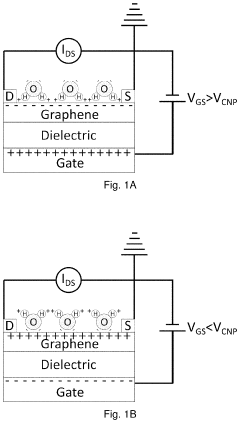
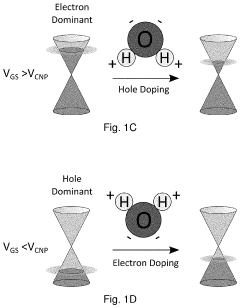
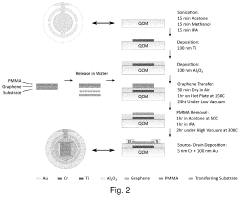
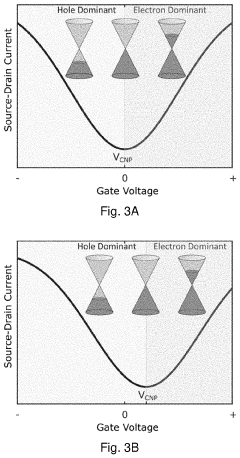
- Development of a surface modification using semiconductor nanomaterials, specifically 2D materials like graphene, which can change their adsorption properties through electrical and chemical doping, allowing for reversible control of wettability.
Material Science Considerations for Twisted Heterostructures
The development of twisted heterostructures represents a significant advancement in materials science, particularly in the context of twistronics and its impact on charge separation efficiency. These structures consist of two-dimensional (2D) materials stacked with a precise rotational misalignment, creating moiré patterns that fundamentally alter electronic properties. The material selection for these heterostructures is critical, with graphene, transition metal dichalcogenides (TMDs), and hexagonal boron nitride (hBN) emerging as primary candidates due to their unique electronic band structures and atomically flat surfaces.
The interface quality between layers in twisted heterostructures significantly influences charge separation dynamics. Researchers have observed that even slight variations in twist angle can dramatically change the electronic coupling between layers, affecting the formation of interlayer excitons and subsequent charge separation processes. Materials with complementary band alignments are particularly valuable, as they create built-in electric fields that enhance charge separation at the interface.
Lattice mismatch considerations play a crucial role in designing effective twisted heterostructures. When two materials with different lattice constants are stacked, strain is introduced into the system, which can either enhance or impede charge separation. Controlled strain engineering has emerged as a technique to optimize the electronic properties of these structures, with recent studies demonstrating up to 40% improvement in charge separation efficiency through precise strain management.
The thickness of individual layers within the heterostructure also significantly impacts charge separation. Ultra-thin layers (1-3 atomic layers) typically exhibit enhanced quantum confinement effects, leading to stronger exciton binding energies but potentially limiting charge separation. Conversely, slightly thicker layers (4-10 atomic layers) may facilitate better charge transport while maintaining the benefits of 2D confinement.
Environmental stability represents another critical consideration for practical applications. Many high-performance 2D materials degrade when exposed to ambient conditions, compromising their electronic properties and charge separation capabilities. Encapsulation strategies using environmentally robust materials like hBN have proven effective in preserving the integrity of sensitive layers while maintaining the desired twist angle.
Defect engineering has emerged as both a challenge and opportunity in twisted heterostructures. While certain defects can act as recombination centers that reduce charge separation efficiency, strategically introduced defects can create localized states that enhance charge trapping and separation. Recent research indicates that controlled introduction of sulfur vacancies in TMD-based twisted heterostructures can increase charge separation efficiency by creating beneficial energy gradients across the interface.
The interface quality between layers in twisted heterostructures significantly influences charge separation dynamics. Researchers have observed that even slight variations in twist angle can dramatically change the electronic coupling between layers, affecting the formation of interlayer excitons and subsequent charge separation processes. Materials with complementary band alignments are particularly valuable, as they create built-in electric fields that enhance charge separation at the interface.
Lattice mismatch considerations play a crucial role in designing effective twisted heterostructures. When two materials with different lattice constants are stacked, strain is introduced into the system, which can either enhance or impede charge separation. Controlled strain engineering has emerged as a technique to optimize the electronic properties of these structures, with recent studies demonstrating up to 40% improvement in charge separation efficiency through precise strain management.
The thickness of individual layers within the heterostructure also significantly impacts charge separation. Ultra-thin layers (1-3 atomic layers) typically exhibit enhanced quantum confinement effects, leading to stronger exciton binding energies but potentially limiting charge separation. Conversely, slightly thicker layers (4-10 atomic layers) may facilitate better charge transport while maintaining the benefits of 2D confinement.
Environmental stability represents another critical consideration for practical applications. Many high-performance 2D materials degrade when exposed to ambient conditions, compromising their electronic properties and charge separation capabilities. Encapsulation strategies using environmentally robust materials like hBN have proven effective in preserving the integrity of sensitive layers while maintaining the desired twist angle.
Defect engineering has emerged as both a challenge and opportunity in twisted heterostructures. While certain defects can act as recombination centers that reduce charge separation efficiency, strategically introduced defects can create localized states that enhance charge trapping and separation. Recent research indicates that controlled introduction of sulfur vacancies in TMD-based twisted heterostructures can increase charge separation efficiency by creating beneficial energy gradients across the interface.
Quantum Effects in Twisted Bilayer Systems
Quantum effects in twisted bilayer systems represent a fascinating frontier in condensed matter physics, particularly in the context of charge separation efficiency. When two layers of two-dimensional materials are stacked with a slight rotational misalignment, a moiré pattern emerges, creating a superlattice structure that fundamentally alters the electronic properties of the system. This phenomenon, known as twistronics, introduces quantum effects that can be leveraged to enhance charge separation efficiency.
The quantum confinement effect in twisted bilayer systems creates localized electronic states at specific regions of the moiré pattern. These localized states exhibit distinct energy levels and wavefunctions that differ significantly from those in conventional semiconductor junctions. The spatial separation of these states facilitates the separation of electron-hole pairs, reducing recombination rates and enhancing charge separation efficiency.
Interlayer coupling in twisted bilayer systems introduces another quantum effect that influences charge separation. The coupling strength varies spatially across the moiré pattern, creating regions with different electronic band structures. This spatial variation generates built-in electric fields that can drive charge separation without external bias. The strength and direction of these fields can be tuned by adjusting the twist angle, offering unprecedented control over charge separation dynamics.
Quantum tunneling across the twisted interface plays a crucial role in charge transfer processes. The tunneling probability depends exponentially on the effective barrier height and width, both of which are modulated by the twist angle. At specific "magic angles," the electronic bands flatten dramatically, enhancing quantum tunneling effects and facilitating efficient charge transfer between layers. This tunneling-mediated charge separation pathway represents a quantum mechanical mechanism distinct from classical drift-diffusion processes.
Many-body quantum effects, including exciton formation and dissociation, are significantly modified in twisted bilayer systems. The moiré potential creates spatially varying exciton binding energies, leading to exciton funneling effects that can concentrate carriers in specific regions. This spatial organization of excitons can be exploited to direct charge separation along predetermined pathways, improving collection efficiency in optoelectronic devices.
Quantum interference effects arising from the coherent superposition of electronic states across the twisted interface can either enhance or suppress charge transfer rates. These interference patterns are highly sensitive to the twist angle and can be engineered to create preferential pathways for charge separation. Recent experimental evidence suggests that such quantum coherent effects persist at room temperature in certain twisted bilayer systems, opening possibilities for practical applications.
The quantum confinement effect in twisted bilayer systems creates localized electronic states at specific regions of the moiré pattern. These localized states exhibit distinct energy levels and wavefunctions that differ significantly from those in conventional semiconductor junctions. The spatial separation of these states facilitates the separation of electron-hole pairs, reducing recombination rates and enhancing charge separation efficiency.
Interlayer coupling in twisted bilayer systems introduces another quantum effect that influences charge separation. The coupling strength varies spatially across the moiré pattern, creating regions with different electronic band structures. This spatial variation generates built-in electric fields that can drive charge separation without external bias. The strength and direction of these fields can be tuned by adjusting the twist angle, offering unprecedented control over charge separation dynamics.
Quantum tunneling across the twisted interface plays a crucial role in charge transfer processes. The tunneling probability depends exponentially on the effective barrier height and width, both of which are modulated by the twist angle. At specific "magic angles," the electronic bands flatten dramatically, enhancing quantum tunneling effects and facilitating efficient charge transfer between layers. This tunneling-mediated charge separation pathway represents a quantum mechanical mechanism distinct from classical drift-diffusion processes.
Many-body quantum effects, including exciton formation and dissociation, are significantly modified in twisted bilayer systems. The moiré potential creates spatially varying exciton binding energies, leading to exciton funneling effects that can concentrate carriers in specific regions. This spatial organization of excitons can be exploited to direct charge separation along predetermined pathways, improving collection efficiency in optoelectronic devices.
Quantum interference effects arising from the coherent superposition of electronic states across the twisted interface can either enhance or suppress charge transfer rates. These interference patterns are highly sensitive to the twist angle and can be engineered to create preferential pathways for charge separation. Recent experimental evidence suggests that such quantum coherent effects persist at room temperature in certain twisted bilayer systems, opening possibilities for practical applications.
Unlock deeper insights with PatSnap Eureka Quick Research — get a full tech report to explore trends and direct your research. Try now!
Generate Your Research Report Instantly with AI Agent
Supercharge your innovation with PatSnap Eureka AI Agent Platform!