

Implementing QNED in Next-Generation TV Production
JUN 19, 20259 MIN READ
Generate Your Research Report Instantly with AI Agent
PatSnap Eureka helps you evaluate technical feasibility & market potential.
QNED Technology Evolution
QNED (Quantum Nano Emitting Diode) technology has undergone significant evolution since its inception, marking a revolutionary advancement in display technology. The journey of QNED began with the development of quantum dot technology, which laid the foundation for enhanced color reproduction and brightness in displays.
In the early stages, researchers focused on improving the efficiency and stability of quantum dots, addressing challenges such as color shift and degradation over time. This phase saw the integration of quantum dots into LED backlighting systems, enhancing the color gamut and overall picture quality of LCD displays.
The next major milestone in QNED evolution came with the development of self-emissive quantum dot displays. This breakthrough eliminated the need for a separate backlight, allowing for better contrast ratios and deeper blacks. The transition from quantum dot-enhanced LED to self-emissive QNED marked a significant leap in display technology, promising OLED-like performance with potentially better longevity and lower production costs.
Recent advancements in QNED technology have focused on refining the nano-scale structure of quantum dots and improving their light-emitting properties. Scientists have made progress in developing more stable and efficient blue quantum dots, which have traditionally been the most challenging to produce. This breakthrough has paved the way for full-color QNED displays with improved color accuracy and energy efficiency.
The evolution of QNED has also seen advancements in manufacturing processes. Researchers have developed new methods for precisely depositing quantum dots onto substrates, enabling the production of larger QNED panels with consistent quality. This has been crucial in scaling up QNED technology for commercial TV production.
Another significant development in QNED evolution has been the integration of AI and machine learning algorithms to optimize display performance. These smart algorithms can dynamically adjust the quantum dot emission based on content and viewing conditions, further enhancing picture quality and energy efficiency.
Looking towards the future, the QNED technology roadmap includes further improvements in quantum dot efficiency, color purity, and lifespan. Researchers are exploring new materials and structures to push the boundaries of what's possible with QNED displays. The ultimate goal is to achieve perfect color reproduction, infinite contrast ratios, and ultra-high brightness levels while maintaining energy efficiency and long-term stability.
As QNED technology continues to evolve, it is poised to play a crucial role in next-generation TV production, offering a compelling alternative to existing display technologies like OLED and traditional LED-LCD. The ongoing advancements in QNED are expected to drive innovation in the broader display industry, potentially reshaping the landscape of consumer electronics and professional display applications.
In the early stages, researchers focused on improving the efficiency and stability of quantum dots, addressing challenges such as color shift and degradation over time. This phase saw the integration of quantum dots into LED backlighting systems, enhancing the color gamut and overall picture quality of LCD displays.
The next major milestone in QNED evolution came with the development of self-emissive quantum dot displays. This breakthrough eliminated the need for a separate backlight, allowing for better contrast ratios and deeper blacks. The transition from quantum dot-enhanced LED to self-emissive QNED marked a significant leap in display technology, promising OLED-like performance with potentially better longevity and lower production costs.
Recent advancements in QNED technology have focused on refining the nano-scale structure of quantum dots and improving their light-emitting properties. Scientists have made progress in developing more stable and efficient blue quantum dots, which have traditionally been the most challenging to produce. This breakthrough has paved the way for full-color QNED displays with improved color accuracy and energy efficiency.
The evolution of QNED has also seen advancements in manufacturing processes. Researchers have developed new methods for precisely depositing quantum dots onto substrates, enabling the production of larger QNED panels with consistent quality. This has been crucial in scaling up QNED technology for commercial TV production.
Another significant development in QNED evolution has been the integration of AI and machine learning algorithms to optimize display performance. These smart algorithms can dynamically adjust the quantum dot emission based on content and viewing conditions, further enhancing picture quality and energy efficiency.
Looking towards the future, the QNED technology roadmap includes further improvements in quantum dot efficiency, color purity, and lifespan. Researchers are exploring new materials and structures to push the boundaries of what's possible with QNED displays. The ultimate goal is to achieve perfect color reproduction, infinite contrast ratios, and ultra-high brightness levels while maintaining energy efficiency and long-term stability.
As QNED technology continues to evolve, it is poised to play a crucial role in next-generation TV production, offering a compelling alternative to existing display technologies like OLED and traditional LED-LCD. The ongoing advancements in QNED are expected to drive innovation in the broader display industry, potentially reshaping the landscape of consumer electronics and professional display applications.
Market Demand Analysis
The market demand for QNED (Quantum Nano Emitting Diode) technology in next-generation TV production is experiencing significant growth, driven by consumer desire for superior picture quality and enhanced viewing experiences. As consumers become more discerning about display technologies, QNED offers a compelling solution that bridges the gap between traditional LED and OLED displays.
QNED technology combines quantum dot and mini-LED backlighting to deliver improved contrast ratios, deeper blacks, and more vibrant colors compared to conventional LED TVs. This advancement addresses the increasing demand for HDR (High Dynamic Range) content and wider color gamuts in home entertainment systems. The market for premium TV sets, where QNED is positioned, has shown resilience even in challenging economic conditions, indicating a strong consumer appetite for high-end display technologies.
The global smart TV market, which encompasses QNED and other advanced display technologies, is projected to grow substantially in the coming years. This growth is fueled by factors such as increasing disposable income, rapid urbanization, and the proliferation of streaming services that offer 4K and 8K content. QNED TVs are well-positioned to capture a significant portion of this market, particularly among consumers who seek OLED-like performance at a more accessible price point.
In the commercial sector, there is a growing demand for large-format displays with superior image quality for applications such as digital signage, control rooms, and high-end conference facilities. QNED technology's ability to produce bright, high-contrast images makes it an attractive option for these professional environments, potentially expanding its market beyond consumer electronics.
The adoption of QNED in TV production is also driven by the ongoing trend of "premiumization" in the consumer electronics industry. Manufacturers are increasingly focusing on higher-margin, feature-rich products to differentiate themselves in a competitive market. QNED allows TV makers to offer a premium product that sits between their LED and OLED offerings, providing consumers with more choices and potentially increasing average selling prices.
Environmental considerations are becoming increasingly important to consumers, and QNED technology addresses this trend. Its energy efficiency compared to traditional LED backlighting systems appeals to environmentally conscious consumers and aligns with global energy efficiency regulations, which are becoming more stringent in many markets.
As the technology matures and production scales up, the cost of QNED TVs is expected to decrease, making them more accessible to a broader range of consumers. This price reduction, coupled with the technology's performance benefits, is likely to drive further market expansion and adoption in the coming years.
QNED technology combines quantum dot and mini-LED backlighting to deliver improved contrast ratios, deeper blacks, and more vibrant colors compared to conventional LED TVs. This advancement addresses the increasing demand for HDR (High Dynamic Range) content and wider color gamuts in home entertainment systems. The market for premium TV sets, where QNED is positioned, has shown resilience even in challenging economic conditions, indicating a strong consumer appetite for high-end display technologies.
The global smart TV market, which encompasses QNED and other advanced display technologies, is projected to grow substantially in the coming years. This growth is fueled by factors such as increasing disposable income, rapid urbanization, and the proliferation of streaming services that offer 4K and 8K content. QNED TVs are well-positioned to capture a significant portion of this market, particularly among consumers who seek OLED-like performance at a more accessible price point.
In the commercial sector, there is a growing demand for large-format displays with superior image quality for applications such as digital signage, control rooms, and high-end conference facilities. QNED technology's ability to produce bright, high-contrast images makes it an attractive option for these professional environments, potentially expanding its market beyond consumer electronics.
The adoption of QNED in TV production is also driven by the ongoing trend of "premiumization" in the consumer electronics industry. Manufacturers are increasingly focusing on higher-margin, feature-rich products to differentiate themselves in a competitive market. QNED allows TV makers to offer a premium product that sits between their LED and OLED offerings, providing consumers with more choices and potentially increasing average selling prices.
Environmental considerations are becoming increasingly important to consumers, and QNED technology addresses this trend. Its energy efficiency compared to traditional LED backlighting systems appeals to environmentally conscious consumers and aligns with global energy efficiency regulations, which are becoming more stringent in many markets.
As the technology matures and production scales up, the cost of QNED TVs is expected to decrease, making them more accessible to a broader range of consumers. This price reduction, coupled with the technology's performance benefits, is likely to drive further market expansion and adoption in the coming years.
QNED Implementation Challenges
QNED (Quantum Nano Emitting Diode) technology presents several significant implementation challenges in next-generation TV production. One of the primary obstacles is the complexity of manufacturing processes required to produce QNED displays at scale. The precise placement and alignment of nanoparticles demand highly sophisticated equipment and stringent quality control measures, which can lead to increased production costs and potential yield issues.
Another challenge lies in the optimization of quantum dot materials for QNED applications. While quantum dots offer superior color performance, their long-term stability and resistance to environmental factors such as heat and humidity need further improvement. This is crucial for ensuring the longevity and consistent performance of QNED displays in various consumer environments.
The integration of QNED technology with existing display manufacturing infrastructure poses additional hurdles. Many TV manufacturers have invested heavily in OLED or LCD production lines, and transitioning to QNED may require significant retooling and process adaptations. This transition could be both time-consuming and capital-intensive, potentially slowing down the widespread adoption of QNED in the TV industry.
Color management and calibration present another set of challenges for QNED implementation. The unique spectral characteristics of quantum dots require specialized color management systems and calibration techniques to ensure accurate and consistent color reproduction across different QNED displays and content types.
Power efficiency is an area where QNED technology still needs improvement. While QNED displays offer potential energy savings compared to some existing technologies, further optimization is required to match or exceed the power efficiency of OLED displays, particularly in HDR content scenarios where peak brightness is crucial.
Addressing motion handling and response time is another critical challenge for QNED displays. As consumers increasingly demand smoother motion for gaming and sports content, QNED technology must evolve to provide faster response times and reduced motion blur, competing with the performance of OLED and advanced LCD technologies in this aspect.
Lastly, the cost of QNED displays remains a significant barrier to widespread adoption. The advanced materials and manufacturing processes currently result in higher production costs compared to established display technologies. Achieving cost parity or offering compelling advantages to justify premium pricing will be essential for QNED to gain market traction in the competitive TV industry.
Another challenge lies in the optimization of quantum dot materials for QNED applications. While quantum dots offer superior color performance, their long-term stability and resistance to environmental factors such as heat and humidity need further improvement. This is crucial for ensuring the longevity and consistent performance of QNED displays in various consumer environments.
The integration of QNED technology with existing display manufacturing infrastructure poses additional hurdles. Many TV manufacturers have invested heavily in OLED or LCD production lines, and transitioning to QNED may require significant retooling and process adaptations. This transition could be both time-consuming and capital-intensive, potentially slowing down the widespread adoption of QNED in the TV industry.
Color management and calibration present another set of challenges for QNED implementation. The unique spectral characteristics of quantum dots require specialized color management systems and calibration techniques to ensure accurate and consistent color reproduction across different QNED displays and content types.
Power efficiency is an area where QNED technology still needs improvement. While QNED displays offer potential energy savings compared to some existing technologies, further optimization is required to match or exceed the power efficiency of OLED displays, particularly in HDR content scenarios where peak brightness is crucial.
Addressing motion handling and response time is another critical challenge for QNED displays. As consumers increasingly demand smoother motion for gaming and sports content, QNED technology must evolve to provide faster response times and reduced motion blur, competing with the performance of OLED and advanced LCD technologies in this aspect.
Lastly, the cost of QNED displays remains a significant barrier to widespread adoption. The advanced materials and manufacturing processes currently result in higher production costs compared to established display technologies. Achieving cost parity or offering compelling advantages to justify premium pricing will be essential for QNED to gain market traction in the competitive TV industry.
Current QNED Solutions
01 Quantum dot structure for enhanced light emission
QNED displays utilize advanced quantum dot structures to improve light emission efficiency and color purity. These structures often incorporate multiple layers or shells to enhance electron-hole recombination and reduce defects, resulting in superior picture quality with vibrant colors and high brightness.- Quantum dot structure for enhanced light emission: QNED displays utilize advanced quantum dot structures to improve light emission efficiency and color purity. These structures often incorporate multiple layers or specific materials to enhance electron-hole recombination and light output, resulting in superior picture quality with vibrant colors and high brightness.
- Nano-scale emitting diodes for improved resolution: QNED technology employs nano-scale emitting diodes, which allow for higher pixel density and improved resolution compared to traditional LED displays. The smaller size of these diodes enables more precise control over light emission, resulting in sharper images and better overall picture quality.
- Color conversion and light management techniques: QNED displays incorporate advanced color conversion and light management techniques to optimize picture quality. These may include specialized color filters, light-guiding structures, or optical coatings that enhance color gamut, contrast, and viewing angles, resulting in a more immersive visual experience.
- Integration of quantum dots with micro-LED technology: Some QNED displays combine quantum dot technology with micro-LED backlighting to achieve superior picture quality. This integration allows for precise local dimming, improved contrast ratios, and enhanced color reproduction, resulting in more lifelike and dynamic images.
- Advanced manufacturing processes for QNED displays: Innovative manufacturing techniques are employed to produce high-quality QNED displays. These processes may include specialized deposition methods, patterning techniques, or assembly procedures that ensure uniform quantum dot distribution, precise alignment of nano-emitters, and optimal integration with other display components, all contributing to improved picture quality.
02 Nano-scale emitting diodes for high resolution
QNED technology employs nano-scale emitting diodes, allowing for extremely high pixel density and resolution. This enables the creation of displays with exceptional sharpness and detail, contributing to improved picture quality and viewing experience.Expand Specific Solutions03 Color conversion and light management techniques
QNED displays incorporate advanced color conversion and light management techniques to optimize picture quality. These may include specialized color filters, light-guiding structures, and quantum dot color conversion layers to enhance color gamut, contrast, and overall visual performance.Expand Specific Solutions04 Integration of quantum dots with mini-LED backlighting
QNED technology often combines quantum dots with mini-LED backlighting to achieve superior local dimming capabilities. This integration allows for improved contrast ratios, deeper blacks, and enhanced HDR performance, resulting in a more dynamic and lifelike picture quality.Expand Specific Solutions05 Advanced manufacturing processes for uniform display quality
QNED displays employ sophisticated manufacturing processes to ensure uniform picture quality across the entire screen. These processes focus on precise deposition of quantum dot materials, consistent nano-scale diode formation, and advanced quality control measures to minimize defects and variations in brightness and color.Expand Specific Solutions
Key QNED Industry Players
The implementation of QNED in next-generation TV production is in its early stages, with the market showing significant growth potential. The technology is still evolving, with major players like BOE Technology Group, TCL China Star Optoelectronics, and Sharp Corp. leading research and development efforts. While QNED promises improved display quality, its market adoption is limited due to technical challenges and production costs. Companies such as Huawei Technologies and ZTE Corp. are also exploring QNED applications, indicating a competitive landscape spanning traditional display manufacturers and tech giants. The involvement of academic institutions like Fuzhou University and Harvard College suggests ongoing fundamental research to advance QNED technology, highlighting its current developmental phase and future prospects in the TV industry.
BOE Technology Group Co., Ltd.
Technical Solution: BOE has developed a QNED (Quantum Nano Emitting Diode) display technology that combines quantum dot and mini-LED technologies. Their approach involves using a blue mini-LED backlight with red and green quantum dot conversion layers. This allows for precise control of local dimming zones, enhancing contrast and color accuracy. BOE's QNED panels utilize advanced quantum dot materials and mini-LED chips to achieve a wide color gamut and high brightness levels. The company has also implemented sophisticated algorithms for color management and light distribution to optimize image quality.
Strengths: Superior color performance, high contrast ratios, and energy efficiency. Weaknesses: Higher production costs compared to traditional LCD, potential for screen uniformity issues in early iterations.
Hefei Visionox Technology Co., Ltd.
Technical Solution: Visionox has been exploring QNED technology as part of its display innovation efforts. Their approach focuses on combining quantum dot color conversion with mini-LED backlighting to create high-performance displays. Visionox's QNED panels utilize advanced quantum dot materials and precise deposition techniques to achieve a wide color gamut. The company has developed proprietary algorithms for local dimming control, optimizing contrast and reducing blooming effects. Visionox has also implemented innovative cooling solutions to maintain stable performance of their QNED displays, addressing potential thermal issues associated with high-brightness mini-LED backlights.
Strengths: Experience in OLED technology that can be applied to QNED development, potential for high color accuracy. Weaknesses: Relatively new entrant in QNED technology, may face challenges in competing with more established players.
QNED Core Innovations
Display panel, display device and method for manufacturing the display panel
PatentActiveCN112234151B
Innovation
- Design a display panel by setting a first photoluminescent layer on the light exit side of the backlight layer, and setting first bumps and blocks between adjacent light-emitting units to form a receiving space and ensure the uniformity of the luminescent film layer and molding accuracy to avoid stress concentration on the luminescent film layer.


Hybrid quantum dot light emitting diode (QLED) and fabrication method thereof
PatentActiveCN105185919A
Innovation
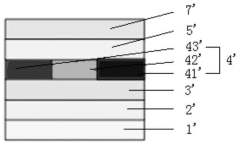
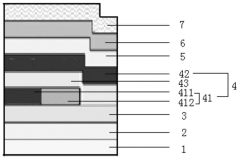
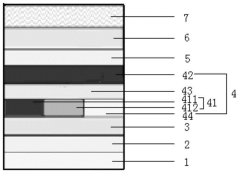
- A hybrid QLED structure containing a red/green quantum dot light-emitting layer and a blue evaporation material light-emitting layer is used, and the mixed connection layer and the blue evaporation material light-emitting layer are deposited by evaporation, and a hole transport layer based on the blue evaporation material is introduced. Optimize the transmission barriers of holes and electrons and improve interface stability.

QNED Supply Chain Analysis
The QNED (Quantum Nano Emitting Diode) supply chain analysis for next-generation TV production reveals a complex network of suppliers, manufacturers, and distributors. At the core of this supply chain are the specialized materials required for QNED technology, including quantum dots and nanoparticles. These components are primarily sourced from advanced materials companies and nanotechnology firms, with key players located in South Korea, Japan, and the United States.
The production of QNED panels involves multiple stages, each requiring specific expertise and equipment. The initial stage focuses on the synthesis and preparation of quantum dots, which is typically carried out by specialized chemical companies. These quantum dots are then integrated into the LED structure, a process that demands precision engineering and advanced manufacturing capabilities.
Panel manufacturers play a crucial role in the QNED supply chain, as they are responsible for assembling the final display units. Major TV manufacturers, such as Samsung and LG, have invested heavily in developing their in-house QNED production capabilities. However, smaller TV brands often rely on third-party panel suppliers, creating a secondary market for QNED panels.
The supply of critical components, such as driver ICs and optical films, is another essential aspect of the QNED supply chain. These components are typically sourced from established electronics suppliers, many of which are based in Taiwan and China. The availability and pricing of these components can significantly impact the overall production costs and timelines for QNED TVs.
Logistics and distribution networks form the final link in the QNED supply chain. As QNED technology is still relatively new, manufacturers are working to optimize their distribution channels to ensure efficient delivery to retailers and consumers. This includes establishing partnerships with specialized logistics providers capable of handling delicate electronic components.
The QNED supply chain faces several challenges, including the need for stringent quality control measures to ensure consistent performance of quantum dot materials. Additionally, the limited number of suppliers for certain key components creates potential bottlenecks and price fluctuations. To mitigate these risks, TV manufacturers are actively diversifying their supplier base and investing in vertical integration strategies.
As QNED technology continues to evolve, the supply chain is expected to become more robust and efficient. Increased competition among suppliers and advancements in manufacturing processes are likely to drive down costs and improve availability, ultimately benefiting both producers and consumers of next-generation QNED TVs.
The production of QNED panels involves multiple stages, each requiring specific expertise and equipment. The initial stage focuses on the synthesis and preparation of quantum dots, which is typically carried out by specialized chemical companies. These quantum dots are then integrated into the LED structure, a process that demands precision engineering and advanced manufacturing capabilities.
Panel manufacturers play a crucial role in the QNED supply chain, as they are responsible for assembling the final display units. Major TV manufacturers, such as Samsung and LG, have invested heavily in developing their in-house QNED production capabilities. However, smaller TV brands often rely on third-party panel suppliers, creating a secondary market for QNED panels.
The supply of critical components, such as driver ICs and optical films, is another essential aspect of the QNED supply chain. These components are typically sourced from established electronics suppliers, many of which are based in Taiwan and China. The availability and pricing of these components can significantly impact the overall production costs and timelines for QNED TVs.
Logistics and distribution networks form the final link in the QNED supply chain. As QNED technology is still relatively new, manufacturers are working to optimize their distribution channels to ensure efficient delivery to retailers and consumers. This includes establishing partnerships with specialized logistics providers capable of handling delicate electronic components.
The QNED supply chain faces several challenges, including the need for stringent quality control measures to ensure consistent performance of quantum dot materials. Additionally, the limited number of suppliers for certain key components creates potential bottlenecks and price fluctuations. To mitigate these risks, TV manufacturers are actively diversifying their supplier base and investing in vertical integration strategies.
As QNED technology continues to evolve, the supply chain is expected to become more robust and efficient. Increased competition among suppliers and advancements in manufacturing processes are likely to drive down costs and improve availability, ultimately benefiting both producers and consumers of next-generation QNED TVs.
Environmental Impact of QNED
The environmental impact of QNED (Quantum Nano Emitting Diode) technology in next-generation TV production is a crucial aspect to consider as the industry moves towards more advanced display technologies. QNED offers significant improvements in picture quality and energy efficiency compared to traditional LED and OLED displays, potentially leading to both positive and negative environmental implications.
One of the primary environmental benefits of QNED technology is its improved energy efficiency. QNED displays consume less power than their predecessors, resulting in reduced energy consumption during operation. This lower energy demand can contribute to decreased greenhouse gas emissions associated with electricity generation, particularly in regions heavily reliant on fossil fuels for power production.
The manufacturing process of QNED displays also presents environmental considerations. While the production of quantum dots and nanoparticles used in QNED technology requires specialized facilities and processes, the overall resource consumption may be lower compared to traditional display technologies. This could potentially lead to a reduction in raw material extraction and processing, which often have significant environmental impacts.
However, the use of rare earth elements and other specialized materials in QNED production raises concerns about resource depletion and the environmental impact of mining these materials. The industry must address the sustainable sourcing and responsible extraction of these elements to mitigate potential negative effects on ecosystems and local communities.
End-of-life management for QNED displays is another critical environmental consideration. As with other electronic devices, proper recycling and disposal of QNED TVs are essential to prevent harmful materials from entering landfills or contaminating soil and water sources. The industry must develop effective recycling processes to recover valuable materials and minimize waste.
The durability and lifespan of QNED displays may also contribute to their environmental impact. If QNED technology proves to be more long-lasting than current display technologies, it could reduce the frequency of TV replacements, thereby decreasing electronic waste generation and the associated environmental burden of manufacturing new devices.
In terms of packaging and transportation, the potential for QNED displays to be thinner and lighter than traditional TVs could lead to reduced material use in packaging and lower fuel consumption during shipping. This may result in a smaller carbon footprint associated with the distribution of QNED TVs.
As QNED technology continues to evolve, ongoing research and development efforts should focus on further improving its environmental performance. This includes exploring more sustainable materials, enhancing energy efficiency, and developing innovative recycling techniques to ensure that the environmental benefits of QNED outweigh any potential drawbacks.
One of the primary environmental benefits of QNED technology is its improved energy efficiency. QNED displays consume less power than their predecessors, resulting in reduced energy consumption during operation. This lower energy demand can contribute to decreased greenhouse gas emissions associated with electricity generation, particularly in regions heavily reliant on fossil fuels for power production.
The manufacturing process of QNED displays also presents environmental considerations. While the production of quantum dots and nanoparticles used in QNED technology requires specialized facilities and processes, the overall resource consumption may be lower compared to traditional display technologies. This could potentially lead to a reduction in raw material extraction and processing, which often have significant environmental impacts.
However, the use of rare earth elements and other specialized materials in QNED production raises concerns about resource depletion and the environmental impact of mining these materials. The industry must address the sustainable sourcing and responsible extraction of these elements to mitigate potential negative effects on ecosystems and local communities.
End-of-life management for QNED displays is another critical environmental consideration. As with other electronic devices, proper recycling and disposal of QNED TVs are essential to prevent harmful materials from entering landfills or contaminating soil and water sources. The industry must develop effective recycling processes to recover valuable materials and minimize waste.
The durability and lifespan of QNED displays may also contribute to their environmental impact. If QNED technology proves to be more long-lasting than current display technologies, it could reduce the frequency of TV replacements, thereby decreasing electronic waste generation and the associated environmental burden of manufacturing new devices.
In terms of packaging and transportation, the potential for QNED displays to be thinner and lighter than traditional TVs could lead to reduced material use in packaging and lower fuel consumption during shipping. This may result in a smaller carbon footprint associated with the distribution of QNED TVs.
As QNED technology continues to evolve, ongoing research and development efforts should focus on further improving its environmental performance. This includes exploring more sustainable materials, enhancing energy efficiency, and developing innovative recycling techniques to ensure that the environmental benefits of QNED outweigh any potential drawbacks.
Unlock deeper insights with PatSnap Eureka Quick Research — get a full tech report to explore trends and direct your research. Try now!
Generate Your Research Report Instantly with AI Agent
Supercharge your innovation with PatSnap Eureka AI Agent Platform!