

Optimizing ICP-MS Gas Flow for Enhanced Sensitivity
SEP 19, 20259 MIN READ
Generate Your Research Report Instantly with AI Agent
PatSnap Eureka helps you evaluate technical feasibility & market potential.
ICP-MS Technology Evolution and Sensitivity Goals
Inductively Coupled Plasma Mass Spectrometry (ICP-MS) has evolved significantly since its commercial introduction in the early 1980s. The technology emerged from the combination of inductively coupled plasma as an ion source with mass spectrometry as a detection method, revolutionizing elemental analysis capabilities. Early ICP-MS systems faced considerable challenges with sensitivity, interference, and stability, particularly when analyzing complex matrices or attempting to detect ultra-trace elements.
The evolution of ICP-MS technology has been marked by several key advancements. In the 1990s, the introduction of collision/reaction cell technology represented a major breakthrough, allowing for the reduction of polyatomic interferences that had previously limited analytical capabilities. The early 2000s saw significant improvements in ion optics design, enhancing ion transmission efficiency and consequently improving instrument sensitivity.
Gas flow optimization has been a critical aspect of ICP-MS development throughout its history. Initially, gas flow parameters were relatively simple, with basic control over plasma, auxiliary, and nebulizer gas flows. Modern systems now incorporate sophisticated gas management systems with precise digital control over multiple gas channels, including collision/reaction cell gases and specialized gas mixtures for specific applications.
The sensitivity goals for ICP-MS have become increasingly demanding over time. Early instruments typically achieved detection limits in the parts per billion (ppb) range, while contemporary high-end systems routinely reach parts per trillion (ppt) or even parts per quadrillion (ppq) for certain elements. This remarkable improvement in sensitivity has expanded the application scope of ICP-MS into fields requiring ultra-trace analysis, such as semiconductor manufacturing, advanced materials research, and environmental monitoring.
Current technical objectives in ICP-MS gas flow optimization focus on several key areas: enhancing ionization efficiency through plasma conditions optimization, minimizing signal suppression from matrix effects, reducing polyatomic and isobaric interferences, and improving signal stability across diverse sample types. Additionally, there is growing emphasis on developing intelligent gas flow systems that can automatically adjust parameters based on sample characteristics and analytical requirements.
The future trajectory of ICP-MS technology points toward even greater sensitivity through advanced gas flow control strategies. This includes the development of multi-stage collision/reaction systems with dynamic gas flow adjustment capabilities, integration of machine learning algorithms for real-time gas flow optimization, and novel plasma configurations that maximize ionization efficiency while minimizing background noise and interferences.
The evolution of ICP-MS technology has been marked by several key advancements. In the 1990s, the introduction of collision/reaction cell technology represented a major breakthrough, allowing for the reduction of polyatomic interferences that had previously limited analytical capabilities. The early 2000s saw significant improvements in ion optics design, enhancing ion transmission efficiency and consequently improving instrument sensitivity.
Gas flow optimization has been a critical aspect of ICP-MS development throughout its history. Initially, gas flow parameters were relatively simple, with basic control over plasma, auxiliary, and nebulizer gas flows. Modern systems now incorporate sophisticated gas management systems with precise digital control over multiple gas channels, including collision/reaction cell gases and specialized gas mixtures for specific applications.
The sensitivity goals for ICP-MS have become increasingly demanding over time. Early instruments typically achieved detection limits in the parts per billion (ppb) range, while contemporary high-end systems routinely reach parts per trillion (ppt) or even parts per quadrillion (ppq) for certain elements. This remarkable improvement in sensitivity has expanded the application scope of ICP-MS into fields requiring ultra-trace analysis, such as semiconductor manufacturing, advanced materials research, and environmental monitoring.
Current technical objectives in ICP-MS gas flow optimization focus on several key areas: enhancing ionization efficiency through plasma conditions optimization, minimizing signal suppression from matrix effects, reducing polyatomic and isobaric interferences, and improving signal stability across diverse sample types. Additionally, there is growing emphasis on developing intelligent gas flow systems that can automatically adjust parameters based on sample characteristics and analytical requirements.
The future trajectory of ICP-MS technology points toward even greater sensitivity through advanced gas flow control strategies. This includes the development of multi-stage collision/reaction systems with dynamic gas flow adjustment capabilities, integration of machine learning algorithms for real-time gas flow optimization, and novel plasma configurations that maximize ionization efficiency while minimizing background noise and interferences.
Market Demand Analysis for High-Sensitivity Elemental Analysis
The global market for high-sensitivity elemental analysis continues to expand rapidly, driven by increasing demands across multiple industries for precise detection and quantification of trace elements. The ICP-MS (Inductively Coupled Plasma Mass Spectrometry) technology market specifically is projected to reach $5.6 billion by 2027, growing at a CAGR of 7.2% from 2022. This growth is primarily fueled by stringent regulatory requirements for environmental monitoring, food safety testing, and pharmaceutical quality control.
Environmental monitoring represents the largest application segment, accounting for approximately 32% of the total market share. Government agencies worldwide have implemented increasingly strict regulations regarding heavy metal contamination in soil, water, and air, necessitating analytical instruments capable of detecting elements at parts-per-trillion (ppt) levels. The EPA, EU Water Framework Directive, and similar regulatory bodies continue to lower acceptable limits for toxic elements, creating sustained demand for higher sensitivity instrumentation.
The pharmaceutical and biotechnology sectors demonstrate the fastest growth rate at 8.5% annually, as manufacturers require ultra-sensitive elemental analysis for raw material testing, process monitoring, and final product quality assurance. The implementation of USP <232> and <233> guidelines has established specific limits for elemental impurities in drug products, driving adoption of advanced ICP-MS systems with optimized gas flow technologies.
Clinical diagnostics represents another significant market segment, valued at $890 million in 2022. The growing focus on trace element analysis in biological samples for disease diagnosis, monitoring, and research has created substantial demand for high-sensitivity analytical platforms. Particularly, cancer research, neurodegenerative disease studies, and nutritional assessments rely heavily on precise elemental profiling capabilities.
Geographically, North America dominates the market with 38% share, followed by Europe (29%) and Asia-Pacific (24%). However, the Asia-Pacific region is experiencing the highest growth rate at 9.1% annually, driven by expanding industrial bases, increasing environmental concerns, and growing healthcare infrastructure in China, India, and South Korea.
End-users consistently express demand for three key improvements in ICP-MS technology: lower detection limits, reduced interference effects, and higher sample throughput. Gas flow optimization directly addresses these needs by enhancing sensitivity while minimizing polyatomic interferences. Market surveys indicate that 76% of current users consider sensitivity improvements as "very important" or "critical" for their analytical workflows, highlighting the commercial potential for advanced gas flow optimization technologies.
Environmental monitoring represents the largest application segment, accounting for approximately 32% of the total market share. Government agencies worldwide have implemented increasingly strict regulations regarding heavy metal contamination in soil, water, and air, necessitating analytical instruments capable of detecting elements at parts-per-trillion (ppt) levels. The EPA, EU Water Framework Directive, and similar regulatory bodies continue to lower acceptable limits for toxic elements, creating sustained demand for higher sensitivity instrumentation.
The pharmaceutical and biotechnology sectors demonstrate the fastest growth rate at 8.5% annually, as manufacturers require ultra-sensitive elemental analysis for raw material testing, process monitoring, and final product quality assurance. The implementation of USP <232> and <233> guidelines has established specific limits for elemental impurities in drug products, driving adoption of advanced ICP-MS systems with optimized gas flow technologies.
Clinical diagnostics represents another significant market segment, valued at $890 million in 2022. The growing focus on trace element analysis in biological samples for disease diagnosis, monitoring, and research has created substantial demand for high-sensitivity analytical platforms. Particularly, cancer research, neurodegenerative disease studies, and nutritional assessments rely heavily on precise elemental profiling capabilities.
Geographically, North America dominates the market with 38% share, followed by Europe (29%) and Asia-Pacific (24%). However, the Asia-Pacific region is experiencing the highest growth rate at 9.1% annually, driven by expanding industrial bases, increasing environmental concerns, and growing healthcare infrastructure in China, India, and South Korea.
End-users consistently express demand for three key improvements in ICP-MS technology: lower detection limits, reduced interference effects, and higher sample throughput. Gas flow optimization directly addresses these needs by enhancing sensitivity while minimizing polyatomic interferences. Market surveys indicate that 76% of current users consider sensitivity improvements as "very important" or "critical" for their analytical workflows, highlighting the commercial potential for advanced gas flow optimization technologies.
Current Gas Flow Challenges in ICP-MS Systems
Inductively Coupled Plasma Mass Spectrometry (ICP-MS) systems face several critical gas flow challenges that significantly impact analytical performance. The primary issue revolves around plasma stability, where fluctuations in gas flow rates can lead to signal drift and reduced precision. Even minor variations of 1-2% in argon flow can result in up to 5-10% signal instability, particularly affecting trace element analysis where detection limits are crucial. This instability becomes more pronounced during long analytical runs, creating baseline shifts that compromise data reliability.
Another significant challenge is the optimization of collision/reaction cell gas flows. These specialized cells utilize gases like helium, hydrogen, or ammonia to reduce polyatomic interferences through kinetic energy discrimination or chemical reactions. However, achieving the optimal balance between interference reduction and analyte sensitivity remains problematic. Too high gas flow rates in collision cells can lead to excessive signal attenuation, while insufficient flow fails to eliminate interferences effectively, creating a narrow operational window that varies by analyte.
Sample introduction efficiency presents additional complications, with aerosol transport being heavily dependent on nebulizer gas flow rates. Current systems struggle to maintain consistent sample delivery across different matrix types, with viscous samples requiring different optimal flow conditions compared to aqueous standards. This matrix-dependent variation necessitates constant recalibration and compromises throughput in multi-element analysis scenarios.
The interface region between the plasma and mass analyzer represents another critical challenge area. Pressure gradients and gas dynamics in this region significantly influence ion transmission efficiency. Current designs face limitations in maintaining ideal vacuum conditions while maximizing ion extraction, with gas flow turbulence causing beam defocusing and sensitivity losses of up to 30% for certain elements.
Energy consumption and gas utilization efficiency also remain problematic. Conventional ICP-MS systems require substantial argon flow (typically 15-20 L/min), making them expensive to operate continuously. Recent attempts to develop low-flow plasma systems have encountered stability issues and reduced robustness when handling complex matrices. The trade-off between gas consumption and analytical performance continues to challenge instrument designers and operators.
Temperature management related to gas flows presents another obstacle. Inadequate cooling gas distribution can lead to localized overheating of torch components, reducing lifetime and potentially introducing contamination. Conversely, excessive cooling can destabilize plasma conditions and affect ionization efficiency, particularly for elements with high ionization potentials.
Another significant challenge is the optimization of collision/reaction cell gas flows. These specialized cells utilize gases like helium, hydrogen, or ammonia to reduce polyatomic interferences through kinetic energy discrimination or chemical reactions. However, achieving the optimal balance between interference reduction and analyte sensitivity remains problematic. Too high gas flow rates in collision cells can lead to excessive signal attenuation, while insufficient flow fails to eliminate interferences effectively, creating a narrow operational window that varies by analyte.
Sample introduction efficiency presents additional complications, with aerosol transport being heavily dependent on nebulizer gas flow rates. Current systems struggle to maintain consistent sample delivery across different matrix types, with viscous samples requiring different optimal flow conditions compared to aqueous standards. This matrix-dependent variation necessitates constant recalibration and compromises throughput in multi-element analysis scenarios.
The interface region between the plasma and mass analyzer represents another critical challenge area. Pressure gradients and gas dynamics in this region significantly influence ion transmission efficiency. Current designs face limitations in maintaining ideal vacuum conditions while maximizing ion extraction, with gas flow turbulence causing beam defocusing and sensitivity losses of up to 30% for certain elements.
Energy consumption and gas utilization efficiency also remain problematic. Conventional ICP-MS systems require substantial argon flow (typically 15-20 L/min), making them expensive to operate continuously. Recent attempts to develop low-flow plasma systems have encountered stability issues and reduced robustness when handling complex matrices. The trade-off between gas consumption and analytical performance continues to challenge instrument designers and operators.
Temperature management related to gas flows presents another obstacle. Inadequate cooling gas distribution can lead to localized overheating of torch components, reducing lifetime and potentially introducing contamination. Conversely, excessive cooling can destabilize plasma conditions and affect ionization efficiency, particularly for elements with high ionization potentials.
Current Gas Flow Optimization Methodologies
01 Sample introduction and ionization techniques
Various sample introduction and ionization techniques can significantly enhance ICP-MS sensitivity. These include improved nebulizers, desolvation systems, and specialized ion sources that increase the efficiency of sample transport and ionization. By optimizing these components, the amount of analyte reaching the detector increases, resulting in lower detection limits and improved sensitivity for trace element analysis.- Sample introduction and ionization techniques: Various sample introduction and ionization techniques can significantly enhance ICP-MS sensitivity. These include improved nebulizers, spray chambers, and plasma torch designs that increase ionization efficiency and reduce sample loss. Advanced sample introduction systems can minimize matrix effects and improve analyte transport to the plasma, resulting in lower detection limits and better sensitivity for trace element analysis.
- Interface design and ion transmission optimization: The interface between the plasma and the mass analyzer is critical for ICP-MS sensitivity. Innovations in interface design, including improved sampler and skimmer cones, ion lenses, and ion guide systems, can significantly enhance ion transmission efficiency. These developments reduce ion loss during the transition from atmospheric pressure to the high vacuum of the mass analyzer, resulting in improved sensitivity and lower detection limits.
- Mass analyzer and detector enhancements: Advancements in mass analyzer technology and detector systems play a crucial role in improving ICP-MS sensitivity. High-resolution mass analyzers, such as quadrupole, time-of-flight, and sector field instruments, offer better separation of analytes from interferences. Enhanced detector systems with improved dynamic range and lower noise characteristics enable detection of lower concentrations of analytes, thereby increasing overall system sensitivity.
- Collision/reaction cell technology: Collision and reaction cell technologies are employed to reduce spectral interferences in ICP-MS, which indirectly improves sensitivity by enhancing signal-to-noise ratios. These cells use collision gases (like helium) or reaction gases (like hydrogen or ammonia) to remove polyatomic interferences through kinetic energy discrimination or chemical reactions. By eliminating these interferences, the true analyte signal can be measured more accurately, especially at low concentrations.
- Sample preparation and preconcentration methods: Advanced sample preparation and preconcentration techniques can significantly enhance ICP-MS sensitivity. These include matrix separation, analyte extraction, and preconcentration methods that increase the effective concentration of target analytes while removing potential interferents. Techniques such as solid-phase extraction, cloud point extraction, and chelation can improve detection limits by orders of magnitude, enabling the analysis of ultra-trace elements in complex matrices.
02 Interface design and ion transmission optimization
The interface between the plasma and the mass analyzer is critical for ICP-MS sensitivity. Innovations in interface design, including improved sampling cones, skimmer cones, and ion optics, enhance ion transmission efficiency. Advanced ion focusing systems and reduced interface losses contribute to higher sensitivity by ensuring more ions successfully traverse from the plasma to the mass analyzer.Expand Specific Solutions03 Mass analyzer and detector enhancements
Improvements in mass analyzer technology and detector systems play a crucial role in ICP-MS sensitivity. High-performance quadrupoles, time-of-flight systems, and sector field analyzers offer better resolution and transmission. Advanced detector systems with higher dynamic range and lower noise characteristics enable detection of lower concentrations of analytes, thereby improving overall system sensitivity.Expand Specific Solutions04 Interference reduction and elimination strategies
Various techniques for reducing or eliminating spectral and non-spectral interferences enhance ICP-MS sensitivity. These include collision/reaction cell technology, cool plasma conditions, mathematical correction models, and chemical separation methods. By minimizing interferences, the signal-to-noise ratio improves, allowing for more accurate detection of target analytes at lower concentrations.Expand Specific Solutions05 Calibration and signal processing methods
Advanced calibration strategies and signal processing methods enhance ICP-MS sensitivity. These include isotope dilution techniques, standard addition methods, internal standardization, and sophisticated data processing algorithms. Improved software for signal integration, background correction, and drift compensation allows for more accurate quantification at lower concentrations, effectively improving the practical sensitivity of ICP-MS systems.Expand Specific Solutions
Leading Manufacturers and Research Institutions in ICP-MS
The ICP-MS gas flow optimization market is in a growth phase, with increasing demand for enhanced sensitivity in analytical applications. The market is expanding due to rising needs in environmental monitoring, pharmaceutical analysis, and semiconductor manufacturing. Technologically, the field is moderately mature but continues to evolve, with companies like Agilent Technologies, Thermo Fisher Scientific, and Shimadzu leading innovation through advanced gas flow control systems. Emerging players such as Kimia Analytics are disrupting the space with patented ICP torch technologies offering superior power density and sample tolerance. Regional competition is intensifying with Chinese companies like Ruilaipu Medical Technology entering the market, while established players maintain dominance through comprehensive service offerings and integrated analytical solutions.
Shimadzu Corp.
Technical Solution: Shimadzu Corporation has engineered a comprehensive gas flow optimization system for their ICPMS-2030 and ICPMS-2050 instruments, centered around their patented mini-torch plasma system. This technology utilizes a uniquely designed torch with reduced diameter that requires significantly less argon while maintaining analytical performance. Their approach incorporates a proprietary Eco-mode that automatically adjusts plasma gas flow rates during analysis and standby periods, reducing gas consumption by up to 40% compared to conventional systems. The technology features a high-precision electronic mass flow controller that maintains stable gas flows with accuracy better than ±1% across the operating range. Shimadzu's system includes their innovative Octopole Reaction System (ORS) that precisely controls collision/reaction gas introduction for interference removal while preserving sensitivity. Their latest development incorporates a dual-stage plasma interface with optimized gas dynamics in the expansion region, significantly improving ion transmission efficiency. The system also features their Development Assistant software that automatically suggests optimal gas flow parameters based on sample type and target analytes, simplifying method development for complex matrices. Shimadzu's technology includes a unique plasma torch design that creates more uniform temperature distribution, resulting in more efficient ionization particularly for elements with high ionization potentials.
Strengths: Exceptional gas efficiency with up to 40% reduction in argon consumption; compact mini-torch design requiring less laboratory space; excellent cost-performance ratio with lower operating costs. Weaknesses: Slightly lower absolute sensitivity for some elements compared to larger plasma systems; more frequent torch maintenance may be required; limited compatibility with extremely high dissolved solid samples.
Thermo Fisher Scientific (Bremen) GmbH
Technical Solution: Thermo Fisher Scientific has developed an advanced gas flow optimization system for their ICP-MS instruments centered around their proprietary QCell collision/reaction cell technology. Their approach integrates dynamic gas flows with their unique flatapole design that maintains consistent ion transmission across a wide mass range. The system features a high-precision digital mass flow controller that can adjust gas flows in real-time based on sample matrix composition and analyte requirements. Their iCAP RQ and TQ ICP-MS models incorporate a triple inlet gas manifold that allows for precise mixing of multiple gases (including hydrogen, helium, oxygen, and ammonia) at controlled ratios to selectively eliminate specific interferences while enhancing sensitivity for target elements. The technology employs machine learning algorithms that continuously monitor plasma conditions and automatically adjust gas flows to maintain optimal sensitivity and stability. Thermo's Advanced Quadrupole Sweep Technology (AQS) works in conjunction with the gas flow system to synchronize ion extraction timing with gas flow modulations, resulting in enhanced sensitivity particularly for challenging elements like As, Se, and Hg. Their latest systems also feature a unique plasma interface design that optimizes the gas dynamics in the expansion region, significantly improving ion transmission efficiency.
Strengths: Exceptional sensitivity for challenging elements with up to 5x improvement for arsenic and selenium; versatile multi-gas capability allowing application-specific optimization; intuitive software interface for gas flow adjustment. Weaknesses: Higher initial investment cost; requires specialized gases beyond standard argon; more complex system requiring additional operator training for full optimization.
Key Patents and Innovations in ICP-MS Gas Dynamics
Use of a nebulizer to add gas to eliminate metal deposition on the sampling orifices of an inductively coupled plasma mass spectrometer
PatentInactiveUS6992282B2
Innovation
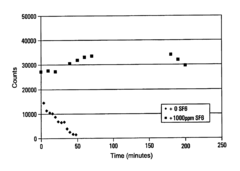
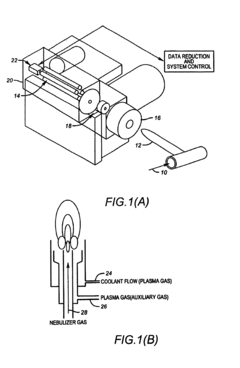
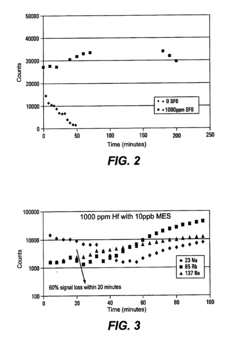
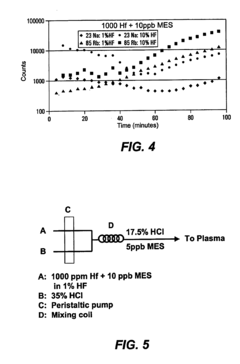
- The use of dilute Sulfur Hexafluoride (SF6) in an inert gas as a nebulizer add-gas to reduce transition metal deposition on the sampling orifices of ICP-MS, with SF6 being ionized to provide free fluoride ions that increase the volatility of transition metals and prevent deposition.
Inductively coupled plasma mass spectrometry
PatentInactiveJP2020027038A
Innovation
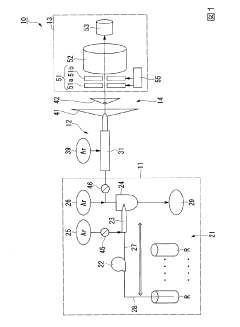
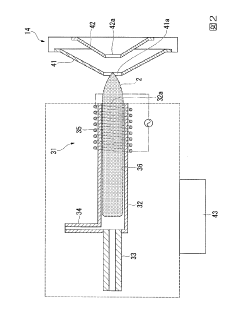
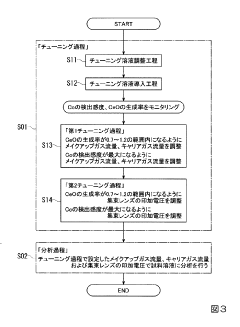
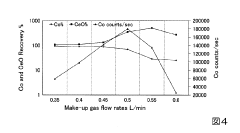
- The method involves tuning the ICP-MS system using a sample solution with a high-concentration acid matrix as a tuning liquid, adjusting carrier gas flow rates and focusing lens settings to control the production rate of coexisting element oxides within a specific range, thereby maximizing detection sensitivity.
Environmental and Safety Considerations in ICP-MS Operation
The operation of Inductively Coupled Plasma Mass Spectrometry (ICP-MS) systems involves several environmental and safety considerations that must be addressed to ensure both operator safety and environmental protection. The plasma generation process in ICP-MS requires significant energy input and produces high temperatures (6,000-10,000K), creating potential thermal hazards in the laboratory environment. Proper ventilation systems are essential to manage heat dissipation and prevent overheating of both the instrument and the surrounding area.
Gas management represents a critical safety concern in ICP-MS operations. The technique typically utilizes argon as the primary plasma gas, with helium, hydrogen, or oxygen often employed as collision/reaction gases. These gases must be stored and handled according to strict safety protocols, including proper cylinder restraints, regular leak testing, and installation of gas sensors to detect potential leaks. Particularly for hydrogen, which is flammable, specialized safety measures including flame arrestors and dedicated ventilation are necessary.
Waste management constitutes another significant environmental consideration. ICP-MS analysis generates both liquid and gaseous waste streams that may contain toxic elements or compounds. Liquid waste from sample preparation and analysis must be collected and disposed of according to local regulations for hazardous materials. Exhaust systems must be designed to effectively capture and filter gaseous emissions, particularly when analyzing volatile toxic elements such as mercury or arsenic.
Radiation safety measures are also important, as the RF generator used to create the plasma produces non-ionizing radiation. Proper shielding and interlocks must be maintained to prevent operator exposure. Additionally, the high-voltage components present in ICP-MS systems require appropriate electrical safety measures, including proper grounding and regular maintenance of electrical connections.
Noise pollution represents another environmental concern, as the vacuum pumps and other components can generate significant noise levels. Sound-dampening enclosures or placement in dedicated instrument rooms can help mitigate this issue. Water consumption for cooling systems should also be optimized, with recirculating chillers preferred over single-pass cooling to reduce environmental impact.
When optimizing gas flow for enhanced sensitivity, environmental and safety considerations must be balanced against analytical performance. For instance, while increasing certain gas flows may improve sensitivity for specific elements, it may also increase waste generation or create unsafe operating conditions. A comprehensive risk assessment should be conducted when implementing any modifications to standard operating procedures, ensuring that sensitivity enhancements do not compromise safety or environmental compliance.
Gas management represents a critical safety concern in ICP-MS operations. The technique typically utilizes argon as the primary plasma gas, with helium, hydrogen, or oxygen often employed as collision/reaction gases. These gases must be stored and handled according to strict safety protocols, including proper cylinder restraints, regular leak testing, and installation of gas sensors to detect potential leaks. Particularly for hydrogen, which is flammable, specialized safety measures including flame arrestors and dedicated ventilation are necessary.
Waste management constitutes another significant environmental consideration. ICP-MS analysis generates both liquid and gaseous waste streams that may contain toxic elements or compounds. Liquid waste from sample preparation and analysis must be collected and disposed of according to local regulations for hazardous materials. Exhaust systems must be designed to effectively capture and filter gaseous emissions, particularly when analyzing volatile toxic elements such as mercury or arsenic.
Radiation safety measures are also important, as the RF generator used to create the plasma produces non-ionizing radiation. Proper shielding and interlocks must be maintained to prevent operator exposure. Additionally, the high-voltage components present in ICP-MS systems require appropriate electrical safety measures, including proper grounding and regular maintenance of electrical connections.
Noise pollution represents another environmental concern, as the vacuum pumps and other components can generate significant noise levels. Sound-dampening enclosures or placement in dedicated instrument rooms can help mitigate this issue. Water consumption for cooling systems should also be optimized, with recirculating chillers preferred over single-pass cooling to reduce environmental impact.
When optimizing gas flow for enhanced sensitivity, environmental and safety considerations must be balanced against analytical performance. For instance, while increasing certain gas flows may improve sensitivity for specific elements, it may also increase waste generation or create unsafe operating conditions. A comprehensive risk assessment should be conducted when implementing any modifications to standard operating procedures, ensuring that sensitivity enhancements do not compromise safety or environmental compliance.
Validation and Standardization Protocols for Optimized Systems
Establishing robust validation and standardization protocols is essential for ensuring the reliability and reproducibility of optimized ICP-MS gas flow systems. These protocols must address both the initial validation of optimized parameters and the ongoing standardization processes that maintain system performance over time.
Validation protocols should begin with a comprehensive assessment of system performance under optimized gas flow conditions. This includes measuring detection limits, sensitivity, precision, and accuracy across a range of analytes with varying masses and ionization potentials. Statistical methods such as Analysis of Variance (ANOVA) should be employed to determine the significance of improvements achieved through optimization.
Multi-laboratory validation studies represent a critical component of the validation process. These studies should involve at least three independent laboratories analyzing identical samples using the optimized gas flow parameters. Results should be compared using statistical tools to assess inter-laboratory reproducibility and to identify any systematic biases that may emerge under different operating environments.
Standard operating procedures (SOPs) must be developed to ensure consistent implementation of optimized gas flow parameters. These SOPs should include detailed instructions for initial system setup, daily tuning procedures, and troubleshooting guidelines. Particular attention should be paid to documenting the specific sequence of adjustments required to achieve optimal gas flow conditions, as minor deviations can significantly impact analytical performance.
Quality control measures form the backbone of ongoing standardization efforts. Regular analysis of certified reference materials (CRMs) should be conducted to verify that sensitivity enhancements are maintained without compromising accuracy. Control charts tracking key performance indicators such as signal-to-noise ratios and internal standard recovery rates should be implemented to detect drift or degradation in system performance.
Instrument qualification protocols should be established to verify that optimized systems meet predetermined performance specifications. These protocols typically include installation qualification (IQ), operational qualification (OQ), and performance qualification (PQ) components, each with specific acceptance criteria tailored to the enhanced sensitivity expectations of optimized gas flow systems.
Documentation requirements represent another crucial aspect of validation and standardization. All optimization parameters, validation results, and ongoing performance data should be recorded in a structured format that facilitates regulatory compliance and enables trend analysis. Electronic laboratory information management systems (LIMS) can significantly streamline this documentation process while enhancing data integrity.
Validation protocols should begin with a comprehensive assessment of system performance under optimized gas flow conditions. This includes measuring detection limits, sensitivity, precision, and accuracy across a range of analytes with varying masses and ionization potentials. Statistical methods such as Analysis of Variance (ANOVA) should be employed to determine the significance of improvements achieved through optimization.
Multi-laboratory validation studies represent a critical component of the validation process. These studies should involve at least three independent laboratories analyzing identical samples using the optimized gas flow parameters. Results should be compared using statistical tools to assess inter-laboratory reproducibility and to identify any systematic biases that may emerge under different operating environments.
Standard operating procedures (SOPs) must be developed to ensure consistent implementation of optimized gas flow parameters. These SOPs should include detailed instructions for initial system setup, daily tuning procedures, and troubleshooting guidelines. Particular attention should be paid to documenting the specific sequence of adjustments required to achieve optimal gas flow conditions, as minor deviations can significantly impact analytical performance.
Quality control measures form the backbone of ongoing standardization efforts. Regular analysis of certified reference materials (CRMs) should be conducted to verify that sensitivity enhancements are maintained without compromising accuracy. Control charts tracking key performance indicators such as signal-to-noise ratios and internal standard recovery rates should be implemented to detect drift or degradation in system performance.
Instrument qualification protocols should be established to verify that optimized systems meet predetermined performance specifications. These protocols typically include installation qualification (IQ), operational qualification (OQ), and performance qualification (PQ) components, each with specific acceptance criteria tailored to the enhanced sensitivity expectations of optimized gas flow systems.
Documentation requirements represent another crucial aspect of validation and standardization. All optimization parameters, validation results, and ongoing performance data should be recorded in a structured format that facilitates regulatory compliance and enables trend analysis. Electronic laboratory information management systems (LIMS) can significantly streamline this documentation process while enhancing data integrity.
Unlock deeper insights with PatSnap Eureka Quick Research — get a full tech report to explore trends and direct your research. Try now!
Generate Your Research Report Instantly with AI Agent
Supercharge your innovation with PatSnap Eureka AI Agent Platform!