

TIM vs Thermal Paste vs Pad: Performance Comparison
MAR 27, 20269 MIN READ
Generate Your Research Report Instantly with AI Agent
Patsnap Eureka helps you evaluate technical feasibility & market potential.
TIM Technology Background and Performance Goals
Thermal Interface Materials (TIMs) have emerged as critical components in modern electronic systems, serving as the essential bridge between heat-generating components and heat dissipation solutions. The fundamental principle underlying TIM technology involves replacing air gaps between surfaces with materials possessing superior thermal conductivity, thereby facilitating efficient heat transfer from hot spots to cooling systems.
The evolution of TIM technology traces back to the early days of semiconductor development when simple thermal greases were first introduced to address basic heat management challenges. As electronic devices became increasingly powerful and compact, the thermal management requirements grew exponentially, driving continuous innovation in TIM formulations and application methods.
Traditional thermal management approaches relied heavily on mechanical contact between components and heat sinks, which proved inadequate due to microscopic surface irregularities that trapped air pockets. These air gaps, with thermal conductivity values around 0.026 W/mK, created significant thermal barriers that impeded heat flow and led to component overheating.
The development trajectory of TIMs has been shaped by the relentless pursuit of higher thermal conductivity, improved reliability, and enhanced application convenience. Early thermal pastes utilized silicone-based matrices filled with thermally conductive particles such as aluminum oxide or zinc oxide. These formulations provided modest improvements over air gaps but suffered from pump-out effects and degradation over time.
Contemporary TIM technology encompasses three primary categories: thermal pastes, thermal pads, and advanced engineered solutions. Each category addresses specific application requirements and performance criteria, reflecting the diverse thermal management challenges across different industries and use cases.
The performance goals for modern TIM technology center on achieving optimal thermal conductivity while maintaining long-term stability and ease of application. Primary objectives include minimizing thermal resistance, ensuring consistent performance across temperature cycling, preventing material degradation, and facilitating reliable manufacturing processes.
Current industry standards target thermal conductivity values ranging from 1 W/mK for basic applications to over 15 W/mK for high-performance solutions. Additionally, modern TIMs must demonstrate excellent wetting properties, minimal volatile content, and compatibility with various substrate materials including metals, ceramics, and polymers.
The technological advancement in TIM development continues to be driven by emerging applications in electric vehicles, 5G infrastructure, artificial intelligence processors, and renewable energy systems, where thermal management directly impacts system performance, reliability, and operational efficiency.
The evolution of TIM technology traces back to the early days of semiconductor development when simple thermal greases were first introduced to address basic heat management challenges. As electronic devices became increasingly powerful and compact, the thermal management requirements grew exponentially, driving continuous innovation in TIM formulations and application methods.
Traditional thermal management approaches relied heavily on mechanical contact between components and heat sinks, which proved inadequate due to microscopic surface irregularities that trapped air pockets. These air gaps, with thermal conductivity values around 0.026 W/mK, created significant thermal barriers that impeded heat flow and led to component overheating.
The development trajectory of TIMs has been shaped by the relentless pursuit of higher thermal conductivity, improved reliability, and enhanced application convenience. Early thermal pastes utilized silicone-based matrices filled with thermally conductive particles such as aluminum oxide or zinc oxide. These formulations provided modest improvements over air gaps but suffered from pump-out effects and degradation over time.
Contemporary TIM technology encompasses three primary categories: thermal pastes, thermal pads, and advanced engineered solutions. Each category addresses specific application requirements and performance criteria, reflecting the diverse thermal management challenges across different industries and use cases.
The performance goals for modern TIM technology center on achieving optimal thermal conductivity while maintaining long-term stability and ease of application. Primary objectives include minimizing thermal resistance, ensuring consistent performance across temperature cycling, preventing material degradation, and facilitating reliable manufacturing processes.
Current industry standards target thermal conductivity values ranging from 1 W/mK for basic applications to over 15 W/mK for high-performance solutions. Additionally, modern TIMs must demonstrate excellent wetting properties, minimal volatile content, and compatibility with various substrate materials including metals, ceramics, and polymers.
The technological advancement in TIM development continues to be driven by emerging applications in electric vehicles, 5G infrastructure, artificial intelligence processors, and renewable energy systems, where thermal management directly impacts system performance, reliability, and operational efficiency.
Market Demand for Advanced Thermal Management Solutions
The global thermal management market is experiencing unprecedented growth driven by the exponential increase in electronic device performance and miniaturization trends. Modern processors, graphics cards, and power electronics generate significantly higher heat densities than previous generations, creating critical thermal challenges that directly impact device reliability, performance, and lifespan. This thermal bottleneck has become a primary limiting factor in advancing computing performance, making effective thermal interface materials essential components rather than optional accessories.
Data centers represent one of the most demanding segments for advanced thermal management solutions. The proliferation of artificial intelligence, machine learning workloads, and cloud computing services has led to server processors operating at maximum thermal design power for extended periods. Traditional cooling approaches are reaching their physical limits, necessitating superior thermal interface materials that can maintain consistent performance under continuous high-temperature operation while ensuring long-term reliability.
Consumer electronics markets are simultaneously driving demand for thinner, more efficient thermal solutions. Smartphones, tablets, and ultrabooks require thermal interface materials that provide excellent heat transfer while occupying minimal space. The gaming industry particularly demands high-performance thermal solutions as graphics processing units and central processing units push thermal boundaries to deliver enhanced user experiences.
Automotive electrification has emerged as a transformative market driver for thermal management technologies. Electric vehicle battery packs, power inverters, and charging systems require robust thermal interface materials capable of operating across extreme temperature ranges while maintaining safety standards. The automotive industry's reliability requirements and volume production scales are reshaping thermal interface material specifications and manufacturing approaches.
Industrial applications including renewable energy systems, telecommunications infrastructure, and manufacturing equipment continue expanding their thermal management requirements. Solar inverters, wind turbine controllers, and industrial automation systems demand thermal solutions that can withstand harsh environmental conditions while providing consistent performance over decades of operation.
The semiconductor industry's transition toward advanced packaging technologies such as chiplet designs, three-dimensional integration, and heterogeneous computing architectures is creating new thermal management challenges. These advanced packaging approaches require thermal interface materials with precise application characteristics and superior thermal conductivity to manage complex heat dissipation patterns across multiple integrated components.
Data centers represent one of the most demanding segments for advanced thermal management solutions. The proliferation of artificial intelligence, machine learning workloads, and cloud computing services has led to server processors operating at maximum thermal design power for extended periods. Traditional cooling approaches are reaching their physical limits, necessitating superior thermal interface materials that can maintain consistent performance under continuous high-temperature operation while ensuring long-term reliability.
Consumer electronics markets are simultaneously driving demand for thinner, more efficient thermal solutions. Smartphones, tablets, and ultrabooks require thermal interface materials that provide excellent heat transfer while occupying minimal space. The gaming industry particularly demands high-performance thermal solutions as graphics processing units and central processing units push thermal boundaries to deliver enhanced user experiences.
Automotive electrification has emerged as a transformative market driver for thermal management technologies. Electric vehicle battery packs, power inverters, and charging systems require robust thermal interface materials capable of operating across extreme temperature ranges while maintaining safety standards. The automotive industry's reliability requirements and volume production scales are reshaping thermal interface material specifications and manufacturing approaches.
Industrial applications including renewable energy systems, telecommunications infrastructure, and manufacturing equipment continue expanding their thermal management requirements. Solar inverters, wind turbine controllers, and industrial automation systems demand thermal solutions that can withstand harsh environmental conditions while providing consistent performance over decades of operation.
The semiconductor industry's transition toward advanced packaging technologies such as chiplet designs, three-dimensional integration, and heterogeneous computing architectures is creating new thermal management challenges. These advanced packaging approaches require thermal interface materials with precise application characteristics and superior thermal conductivity to manage complex heat dissipation patterns across multiple integrated components.
Current State and Challenges in TIM Technologies
The thermal interface materials industry currently faces significant technological and market challenges that impact the comparative performance of traditional thermal pastes, thermal pads, and advanced TIM solutions. Despite decades of development, achieving optimal thermal management remains a complex engineering challenge across multiple application domains.
Traditional thermal pastes, while offering excellent thermal conductivity ranging from 3-12 W/mK, present substantial application challenges including inconsistent thickness control, pump-out effects under thermal cycling, and degradation over extended operational periods. The manual application process introduces variability in performance, making it difficult to achieve consistent results in high-volume manufacturing environments.
Thermal pads represent a more controlled approach with predetermined thickness and easier handling characteristics. However, current pad technologies typically exhibit lower thermal conductivity compared to high-performance pastes, generally ranging from 1-6 W/mK. The challenge lies in developing pad materials that can maintain mechanical integrity while achieving thermal performance comparable to liquid alternatives.
Advanced TIM technologies face the fundamental challenge of balancing multiple competing requirements simultaneously. Materials must exhibit high thermal conductivity while maintaining low thermal resistance, mechanical compliance for surface conformity, chemical stability across wide temperature ranges, and compatibility with diverse substrate materials including metals, ceramics, and polymers.
Manufacturing scalability presents another critical challenge. While laboratory-scale TIM formulations may demonstrate exceptional thermal performance, translating these achievements to industrial-scale production often results in performance degradation or cost prohibitive manufacturing processes. The integration of nanomaterials, such as carbon nanotubes or graphene, shows promise but faces challenges in achieving uniform dispersion and preventing agglomeration during long-term storage.
Reliability assessment remains problematic across all TIM categories. Current testing methodologies often fail to accurately predict long-term performance under real-world operating conditions, including thermal cycling, mechanical stress, and environmental exposure. This limitation makes it difficult to establish definitive performance comparisons between different TIM approaches.
The automotive and electronics industries demand increasingly stringent performance requirements, pushing current TIM technologies toward their operational limits. High-power density applications require materials capable of handling heat fluxes exceeding 100 W/cm², while maintaining interface temperatures below critical thresholds for semiconductor reliability.
Traditional thermal pastes, while offering excellent thermal conductivity ranging from 3-12 W/mK, present substantial application challenges including inconsistent thickness control, pump-out effects under thermal cycling, and degradation over extended operational periods. The manual application process introduces variability in performance, making it difficult to achieve consistent results in high-volume manufacturing environments.
Thermal pads represent a more controlled approach with predetermined thickness and easier handling characteristics. However, current pad technologies typically exhibit lower thermal conductivity compared to high-performance pastes, generally ranging from 1-6 W/mK. The challenge lies in developing pad materials that can maintain mechanical integrity while achieving thermal performance comparable to liquid alternatives.
Advanced TIM technologies face the fundamental challenge of balancing multiple competing requirements simultaneously. Materials must exhibit high thermal conductivity while maintaining low thermal resistance, mechanical compliance for surface conformity, chemical stability across wide temperature ranges, and compatibility with diverse substrate materials including metals, ceramics, and polymers.
Manufacturing scalability presents another critical challenge. While laboratory-scale TIM formulations may demonstrate exceptional thermal performance, translating these achievements to industrial-scale production often results in performance degradation or cost prohibitive manufacturing processes. The integration of nanomaterials, such as carbon nanotubes or graphene, shows promise but faces challenges in achieving uniform dispersion and preventing agglomeration during long-term storage.
Reliability assessment remains problematic across all TIM categories. Current testing methodologies often fail to accurately predict long-term performance under real-world operating conditions, including thermal cycling, mechanical stress, and environmental exposure. This limitation makes it difficult to establish definitive performance comparisons between different TIM approaches.
The automotive and electronics industries demand increasingly stringent performance requirements, pushing current TIM technologies toward their operational limits. High-power density applications require materials capable of handling heat fluxes exceeding 100 W/cm², while maintaining interface temperatures below critical thresholds for semiconductor reliability.
Existing TIM Solutions and Performance Metrics
01 Thermal interface materials with enhanced thermal conductivity using filler particles
Thermal interface materials can be formulated with various filler particles such as metal particles, ceramic particles, or carbon-based materials to enhance thermal conductivity. The selection and distribution of filler particles significantly impacts the overall thermal performance. The particle size, shape, and concentration are optimized to achieve maximum heat transfer efficiency while maintaining appropriate mechanical properties.- Thermal interface materials with enhanced thermal conductivity using filler particles: Thermal interface materials can be formulated with various filler particles such as metal particles, ceramic particles, or carbon-based materials to enhance thermal conductivity. The selection and distribution of filler particles significantly impacts the overall thermal performance. The particle size, shape, and concentration are optimized to achieve maximum heat transfer efficiency while maintaining appropriate mechanical properties.
- Phase change thermal interface materials for improved contact and conformability: Phase change materials are designed to transition from solid to liquid state at specific temperatures, allowing them to flow and fill microscopic gaps between surfaces. This improves thermal contact and reduces thermal resistance. These materials combine the handling convenience of solid pads with the conformability of pastes, offering advantages in both application and performance.
- Thermal pad structures with multi-layer configurations: Multi-layer thermal pad designs incorporate different material layers to optimize both thermal performance and mechanical properties. These structures may include base layers for structural support, thermally conductive layers for heat transfer, and adhesive layers for attachment. The layered approach allows for customization of thickness, flexibility, and thermal resistance to meet specific application requirements.
- Polymer-based thermal interface materials with controlled viscosity and dispensability: Polymer matrix thermal interface materials are formulated with specific rheological properties to enable easy dispensing and application while maintaining stability. The viscosity is controlled through polymer selection, filler loading, and additives to achieve optimal flow characteristics during application and proper wetting of surfaces. These materials offer advantages in automated manufacturing processes.
- Thermal interface materials with graphene or carbon nanotube additives for superior heat dissipation: Advanced thermal interface materials incorporate graphene, carbon nanotubes, or other nano-scale carbon structures to achieve exceptional thermal conductivity. These carbon-based additives create efficient heat transfer pathways within the material matrix. The orientation and dispersion of these nano-structures are critical factors in achieving optimal thermal performance while maintaining manufacturability.
02 Phase change thermal interface materials for improved contact and conformability
Phase change materials are designed to transition from solid to liquid state at specific temperatures, allowing them to flow and fill microscopic gaps between surfaces. This improves thermal contact and reduces thermal resistance. These materials combine the handling advantages of solid pads with the conformability of pastes, offering a balance between ease of application and thermal performance.Expand Specific Solutions03 Thermal pads with structured surfaces and controlled thickness
Thermal pads are engineered with specific thickness tolerances and surface structures to ensure consistent thermal performance across applications. The pad design includes considerations for compression characteristics, allowing them to conform to surface irregularities while maintaining structural integrity. Material composition and manufacturing processes are optimized to achieve uniform thermal conductivity throughout the pad.Expand Specific Solutions04 Composite thermal interface materials combining multiple thermal transfer mechanisms
Advanced thermal interface materials utilize composite structures that combine different materials and mechanisms for heat transfer. These may include layered structures, gradient compositions, or hybrid materials that leverage both conductive and convective heat transfer. The composite approach allows for optimization of multiple performance parameters including thermal conductivity, mechanical compliance, and long-term reliability.Expand Specific Solutions05 Application methods and dispensing systems for thermal interface materials
The performance of thermal interface materials is significantly influenced by application methods and dispensing techniques. Automated dispensing systems, screen printing, and stencil application methods are developed to ensure consistent material thickness and coverage. Proper application techniques minimize voids and air pockets, which are critical for achieving optimal thermal performance in production environments.Expand Specific Solutions
Key Players in TIM and Thermal Management Industry
The thermal interface materials (TIM) market is experiencing rapid growth driven by increasing demand for efficient heat management in electronics, automotive, and data center applications. The industry is in a mature development stage with established players like Intel Corp., 3M Innovative Properties Co., and Henkel IP & Holding GmbH leading traditional solutions, while emerging companies such as Changzhou Fuxi Technology Co. and Nanjing GuanXu New Material Technology Co. are advancing next-generation materials including graphene-based solutions. Technology maturity varies significantly across segments, with conventional thermal pastes and pads representing well-established solutions, while advanced TIMs incorporating nanomaterials and phase-change materials are still evolving. Major semiconductor manufacturers like GlobalFoundries and NXP USA are driving innovation requirements, while material specialists including Dow Silicones Corp. and Indium Corporation are developing specialized formulations to meet increasingly demanding thermal performance specifications in compact electronic designs.
Intel Corp.
Technical Solution: Intel has developed advanced thermal interface materials including metal-based TIMs and polymer thermal pads for CPU and GPU applications. Their solutions focus on optimizing thermal conductivity ranging from 1-8 W/mK depending on application requirements. Intel's approach involves systematic performance comparison studies between traditional thermal paste, phase-change materials, and advanced thermal pads to achieve optimal heat dissipation in high-performance processors. They utilize both experimental testing and computational fluid dynamics modeling to evaluate thermal resistance, pump-out resistance, and long-term reliability across different TIM technologies.
Strengths: Extensive R&D resources and deep understanding of semiconductor thermal management requirements. Weaknesses: Solutions primarily optimized for their own processor architectures, limiting broader applicability.
Henkel IP & Holding GmbH
Technical Solution: Henkel offers comprehensive thermal management solutions including BERGQUIST thermal interface materials, comparing liquid thermal compounds, phase-change materials, and thermal pads. Their performance studies demonstrate thermal conductivity ranges from 0.7 W/mK for basic thermal pads to over 5 W/mK for advanced filled compounds. Henkel conducts extensive comparative analysis focusing on thermal impedance, application methods, reworkability, and cost-effectiveness. Their research includes accelerated aging tests, thermal cycling performance, and pump-out resistance evaluation across different TIM technologies to provide optimal solutions for electronics cooling applications.
Strengths: Broad portfolio of thermal materials with extensive application experience across industries. Weaknesses: Higher cost compared to commodity thermal interface solutions.
Core Innovations in High-Performance TIM Technologies
Thermal interface material structures
PatentActiveUS20200221602A1
Innovation
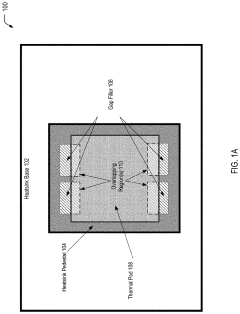
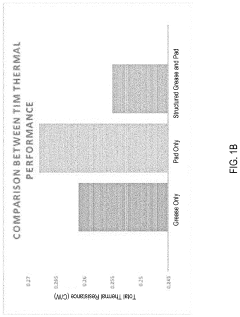
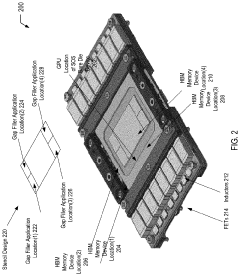
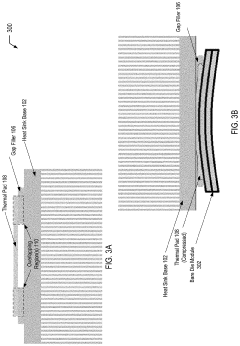
- A thermal interface material structure comprising a first layer of gap filler material and a second layer of a solid thermal pad, with overlapping regions to address the limitations of single-layer solutions, providing improved gap filling and thermal conductivity across varying gap sizes while eliminating the need for complex processing and stringent cleanliness requirements.
Liquid metal paste containing metal particle additive
PatentWO2023122207A1
Innovation
- A liquid metal paste composed of 92.5wt% to 99.9wt% gallium or gallium alloy combined with 0.1wt% to 7.5wt% metal particles like Ag, Au, Cu, or Ni, optionally coated with organic compounds to prevent intermetallic compound formation, enhancing thermal conductivity and adhesion on various substrates.


Environmental and Safety Regulations for TIM Materials
The regulatory landscape for thermal interface materials encompasses multiple jurisdictions with varying requirements for chemical composition, environmental impact, and worker safety. In the United States, the Environmental Protection Agency (EPA) regulates TIM materials under the Toxic Substances Control Act (TSCA), requiring manufacturers to report chemical substances and their potential environmental effects. The European Union's Registration, Evaluation, Authorisation and Restriction of Chemicals (REACH) regulation imposes stringent requirements on TIM manufacturers, mandating comprehensive safety data sheets and restricting hazardous substances like certain heavy metals and volatile organic compounds commonly found in thermal pastes.
Occupational safety standards play a crucial role in TIM material selection and handling. The Occupational Safety and Health Administration (OSHA) in the US and similar agencies worldwide establish permissible exposure limits for substances used in thermal interface materials. Silver-based thermal pastes, while offering superior thermal conductivity, face scrutiny due to potential nanoparticle exposure risks during application and maintenance procedures. Silicone-based compounds must comply with workplace air quality standards, particularly regarding volatile siloxane emissions.
Environmental disposal regulations significantly impact TIM material lifecycle management. Electronic waste directives, such as the EU's Waste Electrical and Electronic Equipment (WEEE) directive, affect how thermal interface materials are handled during device end-of-life processing. Thermal pads containing halogenated compounds face restrictions under persistent organic pollutant regulations, driving manufacturers toward halogen-free formulations.
Emerging regulations focus on sustainability and circular economy principles. The EU's proposed "right to repair" legislation may influence TIM selection criteria, favoring materials that facilitate component replacement and recycling. Additionally, carbon footprint reporting requirements are beginning to affect material selection decisions, with manufacturers increasingly documenting the environmental impact of their thermal management solutions throughout the product lifecycle.
Compliance certification processes vary significantly across material types, with thermal pastes requiring more extensive documentation due to their liquid nature and potential for worker exposure compared to solid thermal pads.
Occupational safety standards play a crucial role in TIM material selection and handling. The Occupational Safety and Health Administration (OSHA) in the US and similar agencies worldwide establish permissible exposure limits for substances used in thermal interface materials. Silver-based thermal pastes, while offering superior thermal conductivity, face scrutiny due to potential nanoparticle exposure risks during application and maintenance procedures. Silicone-based compounds must comply with workplace air quality standards, particularly regarding volatile siloxane emissions.
Environmental disposal regulations significantly impact TIM material lifecycle management. Electronic waste directives, such as the EU's Waste Electrical and Electronic Equipment (WEEE) directive, affect how thermal interface materials are handled during device end-of-life processing. Thermal pads containing halogenated compounds face restrictions under persistent organic pollutant regulations, driving manufacturers toward halogen-free formulations.
Emerging regulations focus on sustainability and circular economy principles. The EU's proposed "right to repair" legislation may influence TIM selection criteria, favoring materials that facilitate component replacement and recycling. Additionally, carbon footprint reporting requirements are beginning to affect material selection decisions, with manufacturers increasingly documenting the environmental impact of their thermal management solutions throughout the product lifecycle.
Compliance certification processes vary significantly across material types, with thermal pastes requiring more extensive documentation due to their liquid nature and potential for worker exposure compared to solid thermal pads.
Standardization and Testing Methodologies for TIM Performance
The establishment of standardized testing methodologies for thermal interface materials represents a critical foundation for accurate performance comparison across different TIM categories. Current industry standards primarily rely on ASTM D5470 and ISO 22007-2 protocols, which define thermal impedance measurement procedures under controlled conditions. These standards specify parameters including contact pressure, temperature differentials, and surface preparation requirements that directly influence measurement accuracy and reproducibility.
Testing methodology variations significantly impact comparative analysis between thermal pastes, pads, and advanced TIM solutions. Standard test fixtures typically employ flat, smooth surfaces with specified roughness parameters, yet real-world applications often involve irregular surfaces and varying contact pressures. This discrepancy necessitates the development of application-specific testing protocols that better reflect actual operating conditions while maintaining measurement consistency.
Thermal impedance measurement techniques have evolved to address the unique characteristics of different TIM types. Steady-state methods provide fundamental thermal resistance values, while transient testing approaches offer insights into thermal response characteristics and long-term stability. The integration of both methodologies enables comprehensive performance evaluation that accounts for material behavior under dynamic thermal cycling conditions.
Standardization challenges emerge from the diverse physical properties inherent to different TIM categories. Thermal pads require specific compression testing protocols to determine optimal thickness and pressure relationships, while thermal pastes demand pump-out resistance evaluation under thermal cycling. Advanced TIMs, including phase-change materials and liquid metal solutions, necessitate specialized handling procedures and extended stability testing protocols.
Industry consensus on testing parameters remains fragmented, with different sectors adopting varying measurement standards based on specific application requirements. Automotive applications emphasize long-term reliability testing under extreme temperature variations, while consumer electronics focus on thin-line performance and ease of application. This diversity in testing approaches complicates direct performance comparisons and highlights the need for unified evaluation frameworks.
Future standardization efforts must address emerging TIM technologies and application scenarios, incorporating automated testing capabilities and real-time performance monitoring. The development of standardized aging protocols and failure mode analysis procedures will enhance the predictive value of comparative studies, enabling more informed material selection decisions across diverse thermal management applications.
Testing methodology variations significantly impact comparative analysis between thermal pastes, pads, and advanced TIM solutions. Standard test fixtures typically employ flat, smooth surfaces with specified roughness parameters, yet real-world applications often involve irregular surfaces and varying contact pressures. This discrepancy necessitates the development of application-specific testing protocols that better reflect actual operating conditions while maintaining measurement consistency.
Thermal impedance measurement techniques have evolved to address the unique characteristics of different TIM types. Steady-state methods provide fundamental thermal resistance values, while transient testing approaches offer insights into thermal response characteristics and long-term stability. The integration of both methodologies enables comprehensive performance evaluation that accounts for material behavior under dynamic thermal cycling conditions.
Standardization challenges emerge from the diverse physical properties inherent to different TIM categories. Thermal pads require specific compression testing protocols to determine optimal thickness and pressure relationships, while thermal pastes demand pump-out resistance evaluation under thermal cycling. Advanced TIMs, including phase-change materials and liquid metal solutions, necessitate specialized handling procedures and extended stability testing protocols.
Industry consensus on testing parameters remains fragmented, with different sectors adopting varying measurement standards based on specific application requirements. Automotive applications emphasize long-term reliability testing under extreme temperature variations, while consumer electronics focus on thin-line performance and ease of application. This diversity in testing approaches complicates direct performance comparisons and highlights the need for unified evaluation frameworks.
Future standardization efforts must address emerging TIM technologies and application scenarios, incorporating automated testing capabilities and real-time performance monitoring. The development of standardized aging protocols and failure mode analysis procedures will enhance the predictive value of comparative studies, enabling more informed material selection decisions across diverse thermal management applications.
Unlock deeper insights with Patsnap Eureka Quick Research — get a full tech report to explore trends and direct your research. Try now!
Generate Your Research Report Instantly with AI Agent
Supercharge your innovation with Patsnap Eureka AI Agent Platform!