

TIM Performance vs Application Conditions
MAR 27, 20269 MIN READ
Generate Your Research Report Instantly with AI Agent
Patsnap Eureka helps you evaluate technical feasibility & market potential.
TIM Technology Background and Performance Goals
Thermal Interface Materials (TIMs) have emerged as critical components in modern electronic systems, serving as the essential bridge between heat-generating components and heat dissipation solutions. The fundamental purpose of TIMs is to fill microscopic air gaps and surface irregularities between mating surfaces, thereby reducing thermal resistance and enhancing heat transfer efficiency. As electronic devices continue to evolve toward higher power densities and miniaturization, the demand for advanced thermal management solutions has intensified significantly.
The evolution of TIM technology traces back to the early days of semiconductor packaging, where simple thermal greases and pads were sufficient for basic heat dissipation requirements. However, the exponential growth in processing power and the corresponding increase in heat generation have driven continuous innovation in this field. Modern applications span across diverse sectors including consumer electronics, automotive systems, data centers, telecommunications infrastructure, and high-performance computing platforms.
Contemporary TIM technology encompasses a broad spectrum of materials and formulations, ranging from traditional silicone-based compounds to advanced phase-change materials, metal-filled polymers, and carbon nanotube composites. Each category offers distinct advantages and limitations, making material selection highly dependent on specific application requirements and operating conditions.
The primary performance objectives for TIM technology center around achieving optimal thermal conductivity while maintaining mechanical reliability, chemical stability, and cost-effectiveness. Thermal conductivity values typically range from 1 W/mK for basic polymer-based materials to over 400 W/mK for advanced metallic solutions. However, thermal performance alone does not determine suitability, as factors such as bond line thickness, contact pressure, temperature cycling resistance, and long-term stability play equally crucial roles.
Application conditions significantly influence TIM performance characteristics, creating complex interdependencies that must be carefully evaluated. Temperature extremes, mechanical stress, humidity exposure, and chemical compatibility requirements all impact material behavior and longevity. Understanding these relationships is essential for developing next-generation thermal management solutions that can meet the increasingly demanding requirements of modern electronic systems while ensuring reliable operation across diverse environmental conditions.
The evolution of TIM technology traces back to the early days of semiconductor packaging, where simple thermal greases and pads were sufficient for basic heat dissipation requirements. However, the exponential growth in processing power and the corresponding increase in heat generation have driven continuous innovation in this field. Modern applications span across diverse sectors including consumer electronics, automotive systems, data centers, telecommunications infrastructure, and high-performance computing platforms.
Contemporary TIM technology encompasses a broad spectrum of materials and formulations, ranging from traditional silicone-based compounds to advanced phase-change materials, metal-filled polymers, and carbon nanotube composites. Each category offers distinct advantages and limitations, making material selection highly dependent on specific application requirements and operating conditions.
The primary performance objectives for TIM technology center around achieving optimal thermal conductivity while maintaining mechanical reliability, chemical stability, and cost-effectiveness. Thermal conductivity values typically range from 1 W/mK for basic polymer-based materials to over 400 W/mK for advanced metallic solutions. However, thermal performance alone does not determine suitability, as factors such as bond line thickness, contact pressure, temperature cycling resistance, and long-term stability play equally crucial roles.
Application conditions significantly influence TIM performance characteristics, creating complex interdependencies that must be carefully evaluated. Temperature extremes, mechanical stress, humidity exposure, and chemical compatibility requirements all impact material behavior and longevity. Understanding these relationships is essential for developing next-generation thermal management solutions that can meet the increasingly demanding requirements of modern electronic systems while ensuring reliable operation across diverse environmental conditions.
Market Demand for TIM in Various Applications
The thermal interface materials market demonstrates significant diversity across multiple application sectors, each presenting distinct performance requirements and growth trajectories. Electronics cooling represents the largest market segment, driven by continuous miniaturization of electronic devices and increasing power densities in consumer electronics, automotive systems, and industrial equipment. The proliferation of high-performance computing, artificial intelligence processors, and 5G infrastructure has created substantial demand for advanced TIM solutions capable of managing extreme heat flux conditions.
Automotive applications constitute a rapidly expanding market segment, particularly with the accelerated adoption of electric vehicles and autonomous driving technologies. Power electronics modules, battery thermal management systems, and advanced driver assistance systems require specialized TIM solutions that can withstand harsh operating environments while maintaining consistent thermal performance across wide temperature ranges. The automotive sector's stringent reliability requirements and long operational lifespans drive demand for premium TIM products with enhanced durability characteristics.
Data center and server applications represent another high-growth market segment, fueled by cloud computing expansion and increasing computational demands. These applications require TIM solutions optimized for continuous operation under high thermal loads, with emphasis on long-term stability and minimal pump-out characteristics. The trend toward liquid cooling systems in high-performance computing environments has created new opportunities for specialized TIM formulations designed for hybrid cooling architectures.
LED lighting applications continue to drive steady demand for cost-effective TIM solutions, particularly in commercial and industrial lighting systems where thermal management directly impacts operational lifespan and energy efficiency. The market emphasizes solutions that balance thermal performance with manufacturing cost considerations, often favoring gap-filling materials that accommodate varying component tolerances.
Telecommunications infrastructure, including base stations and network equipment, generates consistent demand for TIM products capable of outdoor operation under extreme environmental conditions. These applications prioritize weather resistance, UV stability, and maintained performance across broad temperature cycling ranges, creating opportunities for specialized formulations targeting harsh environment applications.
Automotive applications constitute a rapidly expanding market segment, particularly with the accelerated adoption of electric vehicles and autonomous driving technologies. Power electronics modules, battery thermal management systems, and advanced driver assistance systems require specialized TIM solutions that can withstand harsh operating environments while maintaining consistent thermal performance across wide temperature ranges. The automotive sector's stringent reliability requirements and long operational lifespans drive demand for premium TIM products with enhanced durability characteristics.
Data center and server applications represent another high-growth market segment, fueled by cloud computing expansion and increasing computational demands. These applications require TIM solutions optimized for continuous operation under high thermal loads, with emphasis on long-term stability and minimal pump-out characteristics. The trend toward liquid cooling systems in high-performance computing environments has created new opportunities for specialized TIM formulations designed for hybrid cooling architectures.
LED lighting applications continue to drive steady demand for cost-effective TIM solutions, particularly in commercial and industrial lighting systems where thermal management directly impacts operational lifespan and energy efficiency. The market emphasizes solutions that balance thermal performance with manufacturing cost considerations, often favoring gap-filling materials that accommodate varying component tolerances.
Telecommunications infrastructure, including base stations and network equipment, generates consistent demand for TIM products capable of outdoor operation under extreme environmental conditions. These applications prioritize weather resistance, UV stability, and maintained performance across broad temperature cycling ranges, creating opportunities for specialized formulations targeting harsh environment applications.
Current TIM Performance Challenges Under Different Conditions
Thermal Interface Materials face significant performance degradation when exposed to varying operational environments, with temperature cycling representing one of the most critical challenges. During repeated heating and cooling cycles, TIMs experience thermal expansion and contraction mismatches with adjacent substrates, leading to delamination, crack formation, and progressive loss of thermal conductivity. This phenomenon is particularly pronounced in automotive and aerospace applications where temperature swings can exceed 150°C.
High-temperature exposure presents another fundamental challenge, as many conventional TIMs begin to deteriorate at temperatures above 150°C. Polymer-based materials suffer from thermal degradation, crosslinking changes, and volatile component evaporation, while metal-filled compounds may experience filler particle migration and matrix decomposition. These effects result in increased thermal resistance and reduced long-term reliability.
Mechanical stress conditions significantly impact TIM performance through compression set and shear deformation. Under sustained mechanical loading, viscoelastic TIMs exhibit permanent deformation that creates air gaps and reduces contact area with heat-generating components. Vibration environments compound this issue by introducing dynamic stresses that accelerate material fatigue and interfacial bond weakening.
Humidity and moisture exposure create additional performance challenges, particularly for hygroscopic TIM formulations. Water absorption leads to dimensional changes, reduced thermal conductivity, and potential corrosion of metallic fillers. In sealed electronic assemblies, moisture can cause outgassing and contamination of sensitive components during thermal cycling.
Chemical compatibility issues arise when TIMs interact with cleaning solvents, flux residues, or component materials over extended periods. These interactions can cause material softening, hardening, or chemical breakdown that compromises thermal performance. Silicone-based TIMs are particularly susceptible to contamination from low molecular weight siloxanes that can migrate to sensitive surfaces.
The combination of multiple environmental stressors creates synergistic effects that exceed the sum of individual stress impacts. For instance, simultaneous exposure to high temperature and humidity accelerates hydrolysis reactions, while mechanical stress under thermal cycling conditions exacerbates crack propagation and interfacial failure modes.
High-temperature exposure presents another fundamental challenge, as many conventional TIMs begin to deteriorate at temperatures above 150°C. Polymer-based materials suffer from thermal degradation, crosslinking changes, and volatile component evaporation, while metal-filled compounds may experience filler particle migration and matrix decomposition. These effects result in increased thermal resistance and reduced long-term reliability.
Mechanical stress conditions significantly impact TIM performance through compression set and shear deformation. Under sustained mechanical loading, viscoelastic TIMs exhibit permanent deformation that creates air gaps and reduces contact area with heat-generating components. Vibration environments compound this issue by introducing dynamic stresses that accelerate material fatigue and interfacial bond weakening.
Humidity and moisture exposure create additional performance challenges, particularly for hygroscopic TIM formulations. Water absorption leads to dimensional changes, reduced thermal conductivity, and potential corrosion of metallic fillers. In sealed electronic assemblies, moisture can cause outgassing and contamination of sensitive components during thermal cycling.
Chemical compatibility issues arise when TIMs interact with cleaning solvents, flux residues, or component materials over extended periods. These interactions can cause material softening, hardening, or chemical breakdown that compromises thermal performance. Silicone-based TIMs are particularly susceptible to contamination from low molecular weight siloxanes that can migrate to sensitive surfaces.
The combination of multiple environmental stressors creates synergistic effects that exceed the sum of individual stress impacts. For instance, simultaneous exposure to high temperature and humidity accelerates hydrolysis reactions, while mechanical stress under thermal cycling conditions exacerbates crack propagation and interfacial failure modes.
Existing TIM Solutions for Diverse Application Conditions
01 Thermal interface material composition optimization
Development of thermal interface materials with optimized compositions to enhance thermal conductivity and heat dissipation performance. These materials typically incorporate various fillers, polymers, and additives to achieve desired thermal properties while maintaining mechanical stability and processability.- Thermal interface material composition and formulation: Thermal interface materials (TIMs) can be formulated with specific compositions to enhance thermal conductivity and heat dissipation performance. These materials typically include thermally conductive fillers, polymer matrices, and additives that optimize the interface between heat-generating components and heat sinks. The formulation focuses on achieving low thermal resistance while maintaining mechanical stability and ease of application.
- Phase change materials for thermal management: Phase change materials can be incorporated into thermal interface solutions to improve heat transfer efficiency. These materials undergo phase transitions at specific temperatures, absorbing or releasing thermal energy to maintain optimal operating temperatures. The integration of phase change materials helps manage thermal spikes and provides consistent thermal performance across varying operational conditions.
- Nanoparticle-enhanced thermal conductivity: The incorporation of nanoparticles into thermal interface materials significantly enhances thermal conductivity. Various types of nanoparticles, including metallic, ceramic, and carbon-based materials, can be dispersed within the matrix to create efficient thermal pathways. This approach improves heat dissipation while maintaining desirable mechanical and processing properties of the thermal interface material.
- Application methods and dispensing techniques: Advanced application and dispensing techniques for thermal interface materials ensure uniform coverage and optimal thermal contact between surfaces. These methods include screen printing, stenciling, and automated dispensing systems that control material thickness and distribution. Proper application techniques are critical for achieving consistent thermal performance and reliability in electronic assemblies.
- Testing and characterization of thermal performance: Comprehensive testing methodologies are employed to evaluate and characterize the thermal performance of interface materials. These include measurements of thermal resistance, thermal conductivity, and long-term stability under various environmental conditions. Standardized testing protocols ensure that thermal interface materials meet performance specifications and reliability requirements for different applications.
02 High thermal conductivity filler integration
Integration of high thermal conductivity fillers such as metal particles, carbon-based materials, or ceramic compounds into thermal interface materials to significantly improve heat transfer capabilities. The selection and distribution of these fillers are critical for achieving optimal thermal performance.Expand Specific Solutions03 Phase change thermal interface materials
Utilization of phase change materials in thermal interface applications that transition between solid and liquid states at specific temperatures, enabling improved contact and conformability between surfaces. These materials provide enhanced thermal performance by filling microscopic gaps and reducing thermal resistance.Expand Specific Solutions04 Manufacturing and application methods
Advanced manufacturing techniques and application methods for thermal interface materials, including coating processes, dispensing systems, and curing procedures that ensure uniform coverage and optimal bonding. These methods are designed to improve production efficiency and material performance consistency.Expand Specific Solutions05 Performance testing and characterization
Comprehensive testing methodologies and characterization techniques for evaluating thermal interface material performance, including thermal resistance measurement, reliability assessment under various environmental conditions, and long-term stability analysis. These evaluations ensure materials meet specific application requirements.Expand Specific Solutions
Key Players in TIM Industry and Market Competition
The TIM (Thermal Interface Material) performance optimization market represents a mature yet rapidly evolving sector driven by increasing thermal management demands in electronics and automotive applications. The industry spans multiple development stages, from established semiconductor giants like Intel and GlobalFoundries advancing cutting-edge thermal solutions, to specialized materials companies like Dow Silicones and Alpha Assembly Solutions refining traditional approaches. Market size continues expanding significantly, fueled by AI computing, electric vehicles, and 5G infrastructure requiring superior heat dissipation. Technology maturity varies considerably across segments - while conventional TIMs are well-established, next-generation solutions incorporating advanced nanomaterials from companies like BNNT Materials and novel polymer formulations from Resonac represent emerging frontiers. Leading players including IBM, Huawei, and Lam Research are integrating application-specific TIM solutions into their systems, while research institutions like Rensselaer Polytechnic Institute drive fundamental innovations, creating a competitive landscape characterized by both incremental improvements and breakthrough material technologies.
Intel Corp.
Technical Solution: Intel has developed comprehensive thermal interface material (TIM) solutions optimized for various application conditions. Their approach focuses on advanced polymer-based TIMs with thermal conductivity ranging from 1.5 to 8.5 W/mK depending on application requirements. Intel's TIM technology incorporates phase change materials that adapt to different operating temperatures, ensuring optimal thermal performance across varying workloads. The company has implemented multi-layer TIM architectures in their processors, combining different materials to achieve both high thermal conductivity and mechanical compliance. Their research emphasizes the relationship between TIM thickness, contact pressure, and thermal resistance, developing predictive models that correlate performance with specific application conditions such as power density and ambient temperature variations.
Strengths: Industry-leading research in processor thermal management, extensive validation across diverse computing applications, strong integration with silicon design. Weaknesses: Solutions primarily optimized for computing applications, limited focus on extreme environment conditions.
International Business Machines Corp.
Technical Solution: IBM has developed advanced TIM solutions focusing on high-performance computing and data center applications. Their approach utilizes liquid metal TIMs and advanced polymer composites designed to maintain consistent thermal performance under varying operational conditions. IBM's research emphasizes the correlation between TIM performance degradation and environmental factors such as thermal cycling, humidity, and mechanical stress. The company has pioneered predictive analytics models that forecast TIM performance based on application-specific parameters including power density, duty cycles, and ambient conditions. Their solutions incorporate self-healing polymer matrices that maintain thermal pathways even under mechanical deformation, ensuring long-term reliability in enterprise computing environments.
Strengths: Advanced materials research capabilities, strong focus on enterprise-grade reliability, comprehensive performance modeling. Weaknesses: Higher cost solutions, complex implementation requirements for specialized applications.
Core Innovations in Condition-Adaptive TIM Technologies
Thermal interface material
PatentActiveIN7138CHENP2014A
Innovation
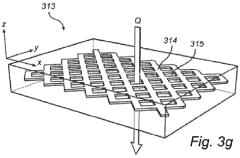
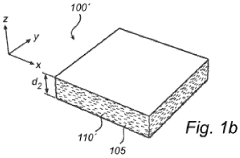
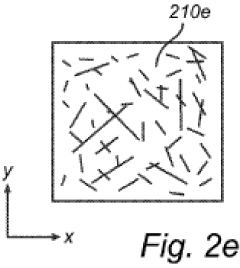
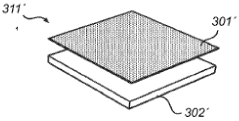
- A TIM with an activable shrinkage material that increases in thickness upon activation, providing enhanced contact pressure and robustness by expanding in the z-direction, thus eliminating the need for external pressure and addressing surface curvature and roughness, using heat-sensitive fibers or monomers that polymerize or expand to enhance thermal interface performance.
A thermal interface material, an integrated circuit assembly, and a method for thermally connecting layers
PatentPendingUS20250069987A1
Innovation
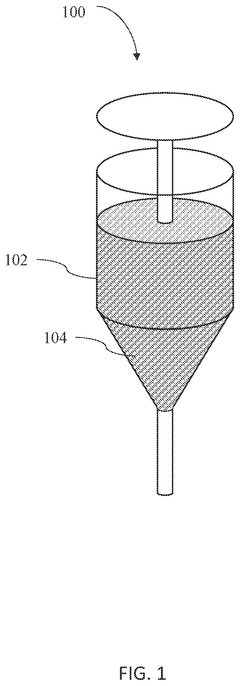
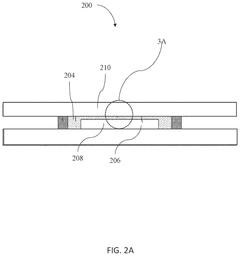
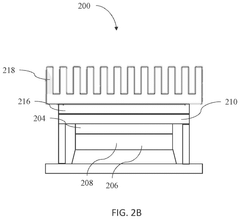
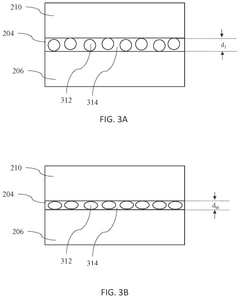
- A thermal interface material comprising 8% to 70% by volume of a polymer component and at least 30% by volume of liquid metal droplets, where the polymer component is composed of specific polymers with varying molecular weights and includes polybutadiene, enabling strong adhesion, stretchability, and low thermal resistance.
Environmental and Safety Standards for TIM Applications
Thermal Interface Materials (TIMs) must comply with stringent environmental and safety standards to ensure reliable operation across diverse application conditions. These standards encompass multiple regulatory frameworks including RoHS (Restriction of Hazardous Substances), REACH (Registration, Evaluation, Authorization and Restriction of Chemicals), and UL (Underwriters Laboratories) certifications. The complexity of modern electronic systems demands TIM formulations that not only deliver superior thermal performance but also meet increasingly strict environmental compliance requirements.
Environmental standards primarily focus on restricting hazardous substances such as lead, mercury, cadmium, hexavalent chromium, and various brominated flame retardants. TIM manufacturers must demonstrate that their products contain these substances below specified threshold levels, typically measured in parts per million. Additionally, volatile organic compound (VOC) emissions are regulated under various international standards, requiring TIMs to maintain low outgassing characteristics even under elevated temperature conditions.
Safety standards address both manufacturing and end-use considerations. Flammability ratings according to UL 94 standards are crucial for TIMs used in high-power applications where thermal runaway scenarios could occur. Materials must demonstrate appropriate flame retardancy without compromising thermal conductivity or mechanical properties. Toxicity assessments evaluate potential health risks during manufacturing, installation, and disposal phases of the product lifecycle.
Temperature cycling and long-term stability testing form critical components of safety validation. TIMs must maintain their thermal and mechanical properties through repeated thermal stress cycles while avoiding degradation that could release harmful compounds. Accelerated aging tests simulate years of operational exposure to validate material stability under various environmental conditions including humidity, temperature extremes, and chemical exposure.
Emerging regulations increasingly emphasize lifecycle environmental impact, driving development of bio-based and recyclable TIM formulations. These next-generation materials must balance environmental compliance with performance requirements, often necessitating innovative approaches to achieve thermal conductivity targets while meeting sustainability mandates. Compliance documentation and traceability requirements continue to expand, requiring comprehensive material characterization and supply chain transparency.
Environmental standards primarily focus on restricting hazardous substances such as lead, mercury, cadmium, hexavalent chromium, and various brominated flame retardants. TIM manufacturers must demonstrate that their products contain these substances below specified threshold levels, typically measured in parts per million. Additionally, volatile organic compound (VOC) emissions are regulated under various international standards, requiring TIMs to maintain low outgassing characteristics even under elevated temperature conditions.
Safety standards address both manufacturing and end-use considerations. Flammability ratings according to UL 94 standards are crucial for TIMs used in high-power applications where thermal runaway scenarios could occur. Materials must demonstrate appropriate flame retardancy without compromising thermal conductivity or mechanical properties. Toxicity assessments evaluate potential health risks during manufacturing, installation, and disposal phases of the product lifecycle.
Temperature cycling and long-term stability testing form critical components of safety validation. TIMs must maintain their thermal and mechanical properties through repeated thermal stress cycles while avoiding degradation that could release harmful compounds. Accelerated aging tests simulate years of operational exposure to validate material stability under various environmental conditions including humidity, temperature extremes, and chemical exposure.
Emerging regulations increasingly emphasize lifecycle environmental impact, driving development of bio-based and recyclable TIM formulations. These next-generation materials must balance environmental compliance with performance requirements, often necessitating innovative approaches to achieve thermal conductivity targets while meeting sustainability mandates. Compliance documentation and traceability requirements continue to expand, requiring comprehensive material characterization and supply chain transparency.
Performance Testing and Validation Methods for TIM
Performance testing and validation of Thermal Interface Materials (TIM) requires comprehensive methodologies that account for the diverse application environments these materials encounter. The testing framework must encompass both standardized laboratory conditions and real-world operational scenarios to ensure accurate performance characterization across varying thermal, mechanical, and environmental parameters.
Laboratory-based testing protocols form the foundation of TIM validation, utilizing controlled environments to establish baseline performance metrics. Thermal conductivity measurements through ASTM D5470 and similar standards provide fundamental heat transfer characteristics under specified contact pressures and temperatures. These controlled conditions enable precise measurement of thermal resistance, allowing for direct comparison between different TIM formulations and establishing performance benchmarks.
Accelerated aging tests simulate long-term operational conditions by exposing TIM samples to elevated temperatures, thermal cycling, and humidity variations. These protocols typically involve temperature ranges from -40°C to 150°C with controlled cycling rates to evaluate material stability and performance degradation over extended periods. Pump-out testing specifically addresses material migration under sustained pressure and temperature exposure, critical for predicting long-term reliability in electronic applications.
Real-world validation requires testing under actual application conditions, incorporating factors such as component geometry, surface roughness variations, and dynamic thermal loads. In-situ thermal resistance measurements using embedded thermocouples or thermal imaging provide direct performance feedback under operational conditions. This approach captures the influence of mounting pressure variations, surface preparation quality, and thermal cycling effects that laboratory testing may not fully replicate.
Mechanical property validation encompasses compression set testing, adhesion strength measurement, and flexibility assessment under thermal stress. These parameters directly impact TIM performance as they determine contact quality and material integrity over operational lifetimes. Testing protocols must evaluate both initial application characteristics and long-term mechanical stability under repeated thermal cycling.
Environmental stress testing expands validation scope to include exposure to moisture, chemical vapors, and electromagnetic fields that may affect TIM performance in specific applications. Outgassing measurements ensure compatibility with sensitive electronic components, while chemical compatibility testing verifies material stability in contact with various substrate materials and protective coatings commonly encountered in electronic assemblies.
Laboratory-based testing protocols form the foundation of TIM validation, utilizing controlled environments to establish baseline performance metrics. Thermal conductivity measurements through ASTM D5470 and similar standards provide fundamental heat transfer characteristics under specified contact pressures and temperatures. These controlled conditions enable precise measurement of thermal resistance, allowing for direct comparison between different TIM formulations and establishing performance benchmarks.
Accelerated aging tests simulate long-term operational conditions by exposing TIM samples to elevated temperatures, thermal cycling, and humidity variations. These protocols typically involve temperature ranges from -40°C to 150°C with controlled cycling rates to evaluate material stability and performance degradation over extended periods. Pump-out testing specifically addresses material migration under sustained pressure and temperature exposure, critical for predicting long-term reliability in electronic applications.
Real-world validation requires testing under actual application conditions, incorporating factors such as component geometry, surface roughness variations, and dynamic thermal loads. In-situ thermal resistance measurements using embedded thermocouples or thermal imaging provide direct performance feedback under operational conditions. This approach captures the influence of mounting pressure variations, surface preparation quality, and thermal cycling effects that laboratory testing may not fully replicate.
Mechanical property validation encompasses compression set testing, adhesion strength measurement, and flexibility assessment under thermal stress. These parameters directly impact TIM performance as they determine contact quality and material integrity over operational lifetimes. Testing protocols must evaluate both initial application characteristics and long-term mechanical stability under repeated thermal cycling.
Environmental stress testing expands validation scope to include exposure to moisture, chemical vapors, and electromagnetic fields that may affect TIM performance in specific applications. Outgassing measurements ensure compatibility with sensitive electronic components, while chemical compatibility testing verifies material stability in contact with various substrate materials and protective coatings commonly encountered in electronic assemblies.
Unlock deeper insights with Patsnap Eureka Quick Research — get a full tech report to explore trends and direct your research. Try now!
Generate Your Research Report Instantly with AI Agent
Supercharge your innovation with Patsnap Eureka AI Agent Platform!