

TIM Performance vs Material Composition
MAR 27, 20269 MIN READ
Generate Your Research Report Instantly with AI Agent
PatSnap Eureka helps you evaluate technical feasibility & market potential.
TIM Technology Background and Performance Goals
Thermal Interface Materials (TIMs) have emerged as critical components in modern electronic systems, serving as the essential bridge between heat-generating components and heat dissipation solutions. The fundamental principle underlying TIM technology involves creating an efficient thermal pathway that minimizes thermal resistance while maintaining electrical isolation where required. As electronic devices continue to evolve toward higher power densities and miniaturization, the demand for advanced thermal management solutions has intensified dramatically.
The historical development of TIM technology can be traced back to the early days of semiconductor packaging, where simple thermal greases and pads were sufficient for basic heat dissipation needs. However, the exponential growth in processing power and the corresponding increase in heat generation have driven continuous innovation in material science and thermal engineering. Traditional air gaps between surfaces, which possess extremely poor thermal conductivity, necessitated the development of materials that could conform to surface irregularities while providing superior thermal transport properties.
Modern TIM applications span across diverse sectors including consumer electronics, automotive systems, telecommunications infrastructure, and high-performance computing platforms. Each application domain presents unique challenges in terms of operating temperature ranges, mechanical stress tolerance, long-term reliability, and cost constraints. The automotive industry, for instance, requires TIMs that can withstand extreme temperature cycling and vibration, while data center applications prioritize materials with exceptional thermal conductivity and pump-out resistance.
The primary performance objectives for contemporary TIM development center around achieving optimal thermal conductivity while maintaining mechanical integrity and processability. Thermal conductivity values ranging from 1 W/mK for basic applications to over 20 W/mK for high-performance solutions represent the current industry benchmarks. Additionally, minimizing bond line thickness has become increasingly important, as thinner interfaces directly correlate with reduced thermal resistance according to Fourier's law of heat conduction.
Reliability considerations have gained prominence as electronic systems are expected to operate for extended periods under demanding conditions. TIM materials must demonstrate resistance to thermal cycling, humidity exposure, and mechanical stress without significant degradation in thermal performance. The development of materials that maintain stable properties over operational lifetimes exceeding 10 years has become a critical design requirement, particularly for automotive and industrial applications where replacement costs are prohibitive.
The historical development of TIM technology can be traced back to the early days of semiconductor packaging, where simple thermal greases and pads were sufficient for basic heat dissipation needs. However, the exponential growth in processing power and the corresponding increase in heat generation have driven continuous innovation in material science and thermal engineering. Traditional air gaps between surfaces, which possess extremely poor thermal conductivity, necessitated the development of materials that could conform to surface irregularities while providing superior thermal transport properties.
Modern TIM applications span across diverse sectors including consumer electronics, automotive systems, telecommunications infrastructure, and high-performance computing platforms. Each application domain presents unique challenges in terms of operating temperature ranges, mechanical stress tolerance, long-term reliability, and cost constraints. The automotive industry, for instance, requires TIMs that can withstand extreme temperature cycling and vibration, while data center applications prioritize materials with exceptional thermal conductivity and pump-out resistance.
The primary performance objectives for contemporary TIM development center around achieving optimal thermal conductivity while maintaining mechanical integrity and processability. Thermal conductivity values ranging from 1 W/mK for basic applications to over 20 W/mK for high-performance solutions represent the current industry benchmarks. Additionally, minimizing bond line thickness has become increasingly important, as thinner interfaces directly correlate with reduced thermal resistance according to Fourier's law of heat conduction.
Reliability considerations have gained prominence as electronic systems are expected to operate for extended periods under demanding conditions. TIM materials must demonstrate resistance to thermal cycling, humidity exposure, and mechanical stress without significant degradation in thermal performance. The development of materials that maintain stable properties over operational lifetimes exceeding 10 years has become a critical design requirement, particularly for automotive and industrial applications where replacement costs are prohibitive.
Market Demand for Advanced Thermal Interface Materials
The global thermal interface materials market is experiencing unprecedented growth driven by the exponential increase in electronic device performance and miniaturization demands. Modern electronic systems generate significantly higher heat densities, creating critical thermal management challenges that traditional cooling solutions cannot adequately address. This surge in thermal requirements has positioned advanced TIMs as essential components across multiple industries.
Data centers represent one of the most significant demand drivers, as cloud computing infrastructure continues expanding globally. High-performance processors and graphics cards in these facilities require sophisticated thermal management solutions to maintain operational efficiency and prevent thermal throttling. The automotive sector has emerged as another major growth catalyst, particularly with the rapid adoption of electric vehicles and autonomous driving technologies that incorporate numerous heat-generating electronic components.
Consumer electronics markets continue driving substantial TIM demand through increasingly powerful smartphones, tablets, and gaming devices. The proliferation of 5G technology has intensified thermal challenges, as 5G chipsets generate considerably more heat than their predecessors while operating in increasingly compact form factors. This technological shift has created urgent requirements for TIMs with superior thermal conductivity and reliability characteristics.
Industrial applications spanning telecommunications infrastructure, renewable energy systems, and advanced manufacturing equipment have contributed to expanding market demand. LED lighting systems, power electronics, and industrial automation equipment all require specialized thermal management solutions to ensure optimal performance and longevity.
The aerospace and defense sectors present specialized market segments demanding TIMs capable of operating under extreme environmental conditions. These applications require materials that maintain thermal performance across wide temperature ranges while meeting stringent reliability and safety standards.
Emerging technologies including artificial intelligence processors, quantum computing systems, and advanced semiconductor packaging techniques are creating new market opportunities. These cutting-edge applications often require custom TIM formulations optimized for specific thermal and mechanical properties, driving demand for innovative material compositions and manufacturing processes.
Regional market dynamics show particularly strong growth in Asia-Pacific regions, driven by concentrated electronics manufacturing and increasing adoption of electric vehicles. North American and European markets demonstrate steady demand growth, particularly in high-performance computing and automotive applications.
Data centers represent one of the most significant demand drivers, as cloud computing infrastructure continues expanding globally. High-performance processors and graphics cards in these facilities require sophisticated thermal management solutions to maintain operational efficiency and prevent thermal throttling. The automotive sector has emerged as another major growth catalyst, particularly with the rapid adoption of electric vehicles and autonomous driving technologies that incorporate numerous heat-generating electronic components.
Consumer electronics markets continue driving substantial TIM demand through increasingly powerful smartphones, tablets, and gaming devices. The proliferation of 5G technology has intensified thermal challenges, as 5G chipsets generate considerably more heat than their predecessors while operating in increasingly compact form factors. This technological shift has created urgent requirements for TIMs with superior thermal conductivity and reliability characteristics.
Industrial applications spanning telecommunications infrastructure, renewable energy systems, and advanced manufacturing equipment have contributed to expanding market demand. LED lighting systems, power electronics, and industrial automation equipment all require specialized thermal management solutions to ensure optimal performance and longevity.
The aerospace and defense sectors present specialized market segments demanding TIMs capable of operating under extreme environmental conditions. These applications require materials that maintain thermal performance across wide temperature ranges while meeting stringent reliability and safety standards.
Emerging technologies including artificial intelligence processors, quantum computing systems, and advanced semiconductor packaging techniques are creating new market opportunities. These cutting-edge applications often require custom TIM formulations optimized for specific thermal and mechanical properties, driving demand for innovative material compositions and manufacturing processes.
Regional market dynamics show particularly strong growth in Asia-Pacific regions, driven by concentrated electronics manufacturing and increasing adoption of electric vehicles. North American and European markets demonstrate steady demand growth, particularly in high-performance computing and automotive applications.
Current TIM Performance Limitations and Material Challenges
Thermal Interface Materials currently face significant performance limitations that constrain their effectiveness in advanced thermal management applications. The primary challenge lies in achieving optimal thermal conductivity while maintaining mechanical integrity and long-term reliability. Most conventional TIMs exhibit thermal conductivity values ranging from 1-8 W/mK, which proves insufficient for high-power density electronic devices that generate substantial heat flux densities exceeding 100 W/cm².
The fundamental trade-off between thermal performance and mechanical properties represents a critical limitation. High thermal conductivity fillers, such as aluminum nitride, boron nitride, and diamond particles, often compromise the material's flexibility and processability when incorporated at concentrations necessary for superior thermal performance. This results in increased brittleness, reduced adhesion, and potential delamination under thermal cycling conditions.
Interface resistance poses another substantial challenge, particularly at the microscopic level where surface roughness and air gaps significantly impede heat transfer. Current TIMs struggle to achieve intimate contact with mating surfaces, leading to thermal boundary resistance that can account for 30-50% of total thermal resistance in the heat transfer path. The wetting characteristics of polymer-based TIMs on various substrate materials remain inconsistent, creating reliability concerns in critical applications.
Material degradation under operational conditions presents ongoing challenges for TIM performance sustainability. Thermal cycling, mechanical stress, and chemical interactions with adjacent materials can cause filler particle migration, matrix degradation, and bond line thickness variations. These phenomena result in progressive thermal performance deterioration, with some materials experiencing 20-40% conductivity reduction over extended operational periods.
Manufacturing and application constraints further limit TIM effectiveness. Many high-performance formulations require specialized dispensing equipment, controlled atmosphere processing, or elevated temperature curing, increasing implementation complexity and cost. The challenge of achieving uniform bond line thickness across large surface areas while maintaining consistent thermal performance remains a significant manufacturing hurdle.
Emerging high-power applications, including electric vehicle power electronics, 5G infrastructure, and advanced computing systems, demand TIM performance levels that exceed current material capabilities. These applications require thermal conductivities exceeding 20 W/mK combined with operational temperature ranges from -40°C to 200°C, presenting formidable material science challenges that current TIM technologies cannot adequately address.
The fundamental trade-off between thermal performance and mechanical properties represents a critical limitation. High thermal conductivity fillers, such as aluminum nitride, boron nitride, and diamond particles, often compromise the material's flexibility and processability when incorporated at concentrations necessary for superior thermal performance. This results in increased brittleness, reduced adhesion, and potential delamination under thermal cycling conditions.
Interface resistance poses another substantial challenge, particularly at the microscopic level where surface roughness and air gaps significantly impede heat transfer. Current TIMs struggle to achieve intimate contact with mating surfaces, leading to thermal boundary resistance that can account for 30-50% of total thermal resistance in the heat transfer path. The wetting characteristics of polymer-based TIMs on various substrate materials remain inconsistent, creating reliability concerns in critical applications.
Material degradation under operational conditions presents ongoing challenges for TIM performance sustainability. Thermal cycling, mechanical stress, and chemical interactions with adjacent materials can cause filler particle migration, matrix degradation, and bond line thickness variations. These phenomena result in progressive thermal performance deterioration, with some materials experiencing 20-40% conductivity reduction over extended operational periods.
Manufacturing and application constraints further limit TIM effectiveness. Many high-performance formulations require specialized dispensing equipment, controlled atmosphere processing, or elevated temperature curing, increasing implementation complexity and cost. The challenge of achieving uniform bond line thickness across large surface areas while maintaining consistent thermal performance remains a significant manufacturing hurdle.
Emerging high-power applications, including electric vehicle power electronics, 5G infrastructure, and advanced computing systems, demand TIM performance levels that exceed current material capabilities. These applications require thermal conductivities exceeding 20 W/mK combined with operational temperature ranges from -40°C to 200°C, presenting formidable material science challenges that current TIM technologies cannot adequately address.
Existing TIM Solutions and Material Compositions
01 Thermal interface material composition and formulation
Development of thermal interface materials with specific compositions to enhance heat transfer properties. These materials are designed with particular formulations including polymers, fillers, and additives to optimize thermal conductivity and mechanical properties. The composition focuses on achieving desired viscosity, adhesion, and stability characteristics for effective thermal management applications.- Thermal interface material composition and formulation: Development of thermal interface materials with specific compositions to enhance heat transfer properties. These materials are formulated with various components including polymers, fillers, and additives to achieve optimal thermal conductivity and mechanical properties. The formulations focus on achieving the right balance between thermal performance and ease of application.
- Enhanced thermal conductivity through filler materials: Incorporation of high thermal conductivity filler materials to improve the overall performance of thermal interface materials. These fillers can include metallic particles, ceramic materials, carbon-based materials, or other thermally conductive substances that are dispersed within a matrix to create pathways for efficient heat dissipation.
- Manufacturing processes and application methods: Methods for producing and applying thermal interface materials to ensure consistent performance and reliability. These processes include techniques for mixing, dispensing, curing, and bonding the materials to substrates. The manufacturing approaches aim to minimize defects and ensure uniform coverage for optimal thermal management.
- Phase change and adaptive thermal materials: Development of thermal interface materials that can change phase or adapt their properties based on temperature conditions. These materials provide dynamic thermal management by transitioning between different states to optimize heat transfer under varying operational conditions. The adaptive nature allows for improved performance across different temperature ranges.
- Reliability and long-term performance stability: Focus on ensuring the durability and consistent performance of thermal interface materials over extended periods of use. This includes resistance to thermal cycling, mechanical stress, and environmental factors that could degrade performance. Testing methods and material designs are developed to maintain thermal efficiency throughout the product lifecycle.
02 Manufacturing methods for thermal interface materials
Processes and techniques for producing thermal interface materials with improved performance characteristics. These methods include mixing procedures, curing processes, and application techniques that ensure uniform distribution of components and optimal material properties. The manufacturing approaches focus on scalability and consistency in producing high-performance thermal management solutions.Expand Specific Solutions03 Enhanced thermal conductivity through filler materials
Incorporation of specialized filler materials to improve the thermal conductivity of interface materials. These fillers include various conductive particles, nanostructures, and composite materials that create efficient heat transfer pathways. The selection and distribution of fillers are optimized to maximize thermal performance while maintaining other desirable properties such as flexibility and adhesion.Expand Specific Solutions04 Application-specific thermal interface solutions
Development of thermal interface materials tailored for specific applications and operating conditions. These solutions address particular requirements such as high-temperature stability, electrical insulation, or compatibility with specific substrates. The materials are designed to meet industry-specific standards and performance criteria for electronics, automotive, or industrial applications.Expand Specific Solutions05 Performance testing and characterization methods
Methods and systems for evaluating and characterizing the performance of thermal interface materials. These approaches include measurement techniques for thermal resistance, conductivity assessment, and long-term stability testing. The characterization methods enable optimization of material properties and validation of performance under various operating conditions.Expand Specific Solutions
Key Players in TIM Manufacturing and Material Industry
The thermal interface materials (TIM) performance versus material composition research field represents a mature yet rapidly evolving market driven by increasing thermal management demands in electronics and automotive sectors. The industry is experiencing significant growth, with market size expanding due to rising power densities in semiconductors and electric vehicle adoption. Technology maturity varies considerably across market players, with established giants like Intel Corp., 3M Innovative Properties Co., and Dow Silicones Corp. leading advanced material development, while specialized companies such as Arieca Inc. and Tianjin Laird Tech Ltd. focus on innovative composite solutions. Research institutions like Industrial Technology Research Institute and Purdue Research Foundation contribute fundamental breakthroughs, while semiconductor manufacturers including GlobalFoundries Inc. and Lam Research Corp. drive application-specific requirements, creating a competitive landscape characterized by both incremental improvements and disruptive material innovations.
Intel Corp.
Technical Solution: Intel has developed advanced thermal interface materials focusing on high-performance computing applications. Their TIM solutions incorporate metal-filled polymer composites and phase change materials optimized for processor thermal management. The company's research emphasizes the relationship between filler particle size distribution, matrix polymer selection, and thermal conductivity performance. Intel's TIM formulations typically achieve thermal conductivity values ranging from 3-8 W/mK while maintaining low thermal resistance at the interface. Their materials are engineered to withstand thermal cycling and provide long-term reliability in high-power density applications.
Strengths: Deep integration with semiconductor manufacturing processes, extensive thermal characterization capabilities, proven reliability in high-performance applications. Weaknesses: Limited availability to external markets, focus primarily on silicon-based applications, higher cost compared to commodity solutions.
International Business Machines Corp.
Technical Solution: IBM has conducted extensive research on thermal interface materials for data center and high-performance computing applications. Their approach focuses on nanostructured materials including carbon nanotube arrays and graphene-enhanced composites. IBM's TIM research investigates the correlation between material microstructure and thermal transport properties, developing solutions that achieve thermal conductivities exceeding 10 W/mK. The company has pioneered liquid metal TIMs and hybrid organic-inorganic composites that maintain performance under extreme thermal cycling conditions. Their materials are designed for server processors and AI accelerators requiring efficient heat dissipation.
Strengths: Advanced nanomaterial expertise, strong fundamental research capabilities, focus on next-generation computing applications. Weaknesses: Limited commercial manufacturing scale, high development costs, complex application processes requiring specialized equipment.
Core Material Innovations in High-Performance TIMs
Thermal interface material (TIM) with carbon nanotubes (CNT) and low thermal impedance
PatentInactiveUS20070147472A1
Innovation
- A thermal interface material composed of carbon nanotubes as fillers and silicone thermal grease as the matrix, with chloroform as a solvent, is developed to reduce thermal resistance and impedance by optimizing the volume fraction and structure of the fillers, and a resistor network model is used to accurately measure and predict thermal conductivity.


Thermal interface materials comprising liquid metal droplets and solid thermally conductive particles, circuit assemblies formed therefrom, and methods of manufacture thereof
PatentWO2025128172A1
Innovation
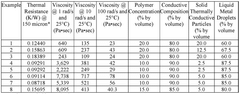
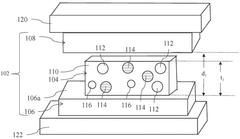
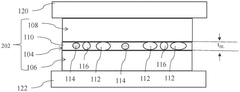
- A thermal interface material comprising 5% to 80% by volume of a polymer component and 20% to 95% by volume of a conductive component, where the conductive component includes 25% to 99% by volume of liquid metal droplets and 1% to 75% by volume of solid thermally conductive particles, dispersed throughout the polymer component.

Environmental Impact Assessment of TIM Materials
The environmental implications of thermal interface materials have become increasingly critical as the electronics industry faces mounting pressure to adopt sustainable practices. Traditional TIM materials, particularly those containing heavy metals, rare earth elements, and synthetic polymers, present significant environmental challenges throughout their lifecycle from extraction to disposal.
Manufacturing processes for conventional TIMs often involve energy-intensive procedures and generate substantial carbon footprints. Silver-based thermal pastes, while offering excellent thermal conductivity, require mining operations that can cause soil contamination and water pollution. Similarly, synthetic polymer matrices used in thermal pads contribute to plastic waste accumulation and release volatile organic compounds during production.
The disposal phase presents equally concerning challenges. Many TIM materials contain non-biodegradable components that persist in landfills for decades. Electronic waste containing TIMs often ends up in developing countries where improper recycling methods release toxic substances into local ecosystems. Heavy metals from thermal compounds can leach into groundwater systems, posing long-term environmental and health risks.
Recent regulatory frameworks, including RoHS directives and REACH compliance requirements, have accelerated the development of environmentally conscious TIM alternatives. Bio-based thermal interface materials derived from natural polymers and sustainable fillers are emerging as viable solutions. These materials demonstrate comparable thermal performance while offering biodegradability and reduced toxicity profiles.
Life cycle assessment studies reveal that next-generation TIMs incorporating recycled materials and renewable resources can reduce environmental impact by up to 40% compared to traditional formulations. Carbon nanotube-enhanced bio-polymers and graphene-based sustainable composites represent promising directions for achieving both high thermal performance and environmental compatibility.
The transition toward sustainable TIM materials requires comprehensive evaluation of their environmental footprint, including raw material sourcing, manufacturing energy consumption, operational efficiency, and end-of-life disposal options. This holistic approach ensures that performance improvements do not compromise environmental stewardship objectives.
Manufacturing processes for conventional TIMs often involve energy-intensive procedures and generate substantial carbon footprints. Silver-based thermal pastes, while offering excellent thermal conductivity, require mining operations that can cause soil contamination and water pollution. Similarly, synthetic polymer matrices used in thermal pads contribute to plastic waste accumulation and release volatile organic compounds during production.
The disposal phase presents equally concerning challenges. Many TIM materials contain non-biodegradable components that persist in landfills for decades. Electronic waste containing TIMs often ends up in developing countries where improper recycling methods release toxic substances into local ecosystems. Heavy metals from thermal compounds can leach into groundwater systems, posing long-term environmental and health risks.
Recent regulatory frameworks, including RoHS directives and REACH compliance requirements, have accelerated the development of environmentally conscious TIM alternatives. Bio-based thermal interface materials derived from natural polymers and sustainable fillers are emerging as viable solutions. These materials demonstrate comparable thermal performance while offering biodegradability and reduced toxicity profiles.
Life cycle assessment studies reveal that next-generation TIMs incorporating recycled materials and renewable resources can reduce environmental impact by up to 40% compared to traditional formulations. Carbon nanotube-enhanced bio-polymers and graphene-based sustainable composites represent promising directions for achieving both high thermal performance and environmental compatibility.
The transition toward sustainable TIM materials requires comprehensive evaluation of their environmental footprint, including raw material sourcing, manufacturing energy consumption, operational efficiency, and end-of-life disposal options. This holistic approach ensures that performance improvements do not compromise environmental stewardship objectives.
Standardization and Testing Methods for TIM Performance
The establishment of standardized testing methodologies for thermal interface materials represents a critical foundation for advancing TIM performance evaluation and ensuring reliable material characterization across the industry. Current standardization efforts primarily focus on thermal conductivity measurement protocols, with ASTM D5470 serving as the predominant standard for steady-state thermal transmission properties. This method employs a guarded heat flow meter approach, providing consistent baseline measurements for comparative analysis.
However, the complexity of TIM performance evaluation extends beyond simple thermal conductivity measurements. The JEDEC JESD51 series standards address thermal characterization of electronic packages, incorporating real-world application scenarios that better reflect actual operating conditions. These standards consider factors such as contact pressure, surface roughness, and temperature cycling effects, which significantly influence TIM performance in practical applications.
Testing methodology standardization faces considerable challenges due to the diverse nature of TIM materials and their application-specific requirements. Different material compositions, ranging from silicone-based compounds to phase-change materials and metallic interfaces, require tailored testing approaches to accurately capture their thermal performance characteristics. The lack of universally accepted protocols for emerging TIM technologies, particularly nanocomposite materials, creates inconsistencies in performance reporting across manufacturers and research institutions.
International collaboration efforts through organizations such as ISO and IEC are working to harmonize testing standards globally. The development of ISO 22007 series standards for thermal properties measurement provides a framework for consistent evaluation methodologies. These standards emphasize the importance of sample preparation, measurement uncertainty quantification, and environmental condition control during testing procedures.
Advanced testing methodologies are emerging to address the limitations of traditional steady-state measurements. Transient thermal analysis techniques, including laser flash analysis and thermal transient testing, offer insights into dynamic thermal behavior and interface resistance characteristics. These methods provide more comprehensive understanding of TIM performance under varying operational conditions, supporting better material selection and optimization strategies for specific applications.
However, the complexity of TIM performance evaluation extends beyond simple thermal conductivity measurements. The JEDEC JESD51 series standards address thermal characterization of electronic packages, incorporating real-world application scenarios that better reflect actual operating conditions. These standards consider factors such as contact pressure, surface roughness, and temperature cycling effects, which significantly influence TIM performance in practical applications.
Testing methodology standardization faces considerable challenges due to the diverse nature of TIM materials and their application-specific requirements. Different material compositions, ranging from silicone-based compounds to phase-change materials and metallic interfaces, require tailored testing approaches to accurately capture their thermal performance characteristics. The lack of universally accepted protocols for emerging TIM technologies, particularly nanocomposite materials, creates inconsistencies in performance reporting across manufacturers and research institutions.
International collaboration efforts through organizations such as ISO and IEC are working to harmonize testing standards globally. The development of ISO 22007 series standards for thermal properties measurement provides a framework for consistent evaluation methodologies. These standards emphasize the importance of sample preparation, measurement uncertainty quantification, and environmental condition control during testing procedures.
Advanced testing methodologies are emerging to address the limitations of traditional steady-state measurements. Transient thermal analysis techniques, including laser flash analysis and thermal transient testing, offer insights into dynamic thermal behavior and interface resistance characteristics. These methods provide more comprehensive understanding of TIM performance under varying operational conditions, supporting better material selection and optimization strategies for specific applications.
Unlock deeper insights with PatSnap Eureka Quick Research — get a full tech report to explore trends and direct your research. Try now!
Generate Your Research Report Instantly with AI Agent
Supercharge your innovation with PatSnap Eureka AI Agent Platform!