

TIM Performance vs Mechanical Stress
MAR 27, 20269 MIN READ
Generate Your Research Report Instantly with AI Agent
Patsnap Eureka helps you evaluate technical feasibility & market potential.
TIM Thermal Interface Material Background and Performance Goals
Thermal Interface Materials represent a critical component class in modern electronic systems, serving as the essential bridge between heat-generating components and heat dissipation solutions. These materials have evolved from simple thermal greases to sophisticated engineered solutions that address the growing thermal management challenges in high-performance electronics. The fundamental purpose of TIMs is to eliminate air gaps and minimize thermal resistance at interfaces between surfaces with inherent roughness and imperfections.
The historical development of TIMs traces back to the early days of semiconductor packaging, where basic silicone-based thermal compounds were sufficient for low-power applications. As electronic devices became more powerful and compact, the thermal management requirements intensified dramatically. The evolution progressed through various material innovations including metal-filled polymers, phase change materials, carbon-based composites, and advanced nanostructured solutions.
Contemporary TIM applications span across diverse sectors including consumer electronics, automotive systems, data centers, telecommunications infrastructure, and aerospace applications. Each application domain presents unique performance requirements, operating conditions, and reliability expectations. The automotive industry, for instance, demands TIMs that can withstand extreme temperature cycling and vibration, while data center applications prioritize long-term thermal stability and pump-out resistance.
The primary performance objectives for modern TIMs encompass multiple critical parameters that must be optimized simultaneously. Thermal conductivity remains the fundamental metric, with targets ranging from 1-15 W/mK depending on the application requirements. However, thermal performance alone is insufficient without considering mechanical properties, electrical characteristics, and long-term reliability factors.
Mechanical stress resistance has emerged as a paramount concern in TIM development, particularly as electronic assemblies become more complex and subjected to harsh operating environments. The ability to maintain thermal performance under mechanical loading, thermal cycling, and dynamic stress conditions directly impacts system reliability and operational lifespan. This challenge is further complicated by the need to balance thermal performance with mechanical compliance, as materials with excellent thermal properties often exhibit poor mechanical characteristics.
The integration of mechanical stress considerations into TIM performance evaluation represents a paradigm shift in material development strategies. Traditional approaches focused primarily on optimizing thermal properties, but contemporary requirements demand comprehensive understanding of stress-performance relationships. This evolution reflects the increasing sophistication of electronic systems and the critical importance of thermal management in overall system performance and reliability.
The historical development of TIMs traces back to the early days of semiconductor packaging, where basic silicone-based thermal compounds were sufficient for low-power applications. As electronic devices became more powerful and compact, the thermal management requirements intensified dramatically. The evolution progressed through various material innovations including metal-filled polymers, phase change materials, carbon-based composites, and advanced nanostructured solutions.
Contemporary TIM applications span across diverse sectors including consumer electronics, automotive systems, data centers, telecommunications infrastructure, and aerospace applications. Each application domain presents unique performance requirements, operating conditions, and reliability expectations. The automotive industry, for instance, demands TIMs that can withstand extreme temperature cycling and vibration, while data center applications prioritize long-term thermal stability and pump-out resistance.
The primary performance objectives for modern TIMs encompass multiple critical parameters that must be optimized simultaneously. Thermal conductivity remains the fundamental metric, with targets ranging from 1-15 W/mK depending on the application requirements. However, thermal performance alone is insufficient without considering mechanical properties, electrical characteristics, and long-term reliability factors.
Mechanical stress resistance has emerged as a paramount concern in TIM development, particularly as electronic assemblies become more complex and subjected to harsh operating environments. The ability to maintain thermal performance under mechanical loading, thermal cycling, and dynamic stress conditions directly impacts system reliability and operational lifespan. This challenge is further complicated by the need to balance thermal performance with mechanical compliance, as materials with excellent thermal properties often exhibit poor mechanical characteristics.
The integration of mechanical stress considerations into TIM performance evaluation represents a paradigm shift in material development strategies. Traditional approaches focused primarily on optimizing thermal properties, but contemporary requirements demand comprehensive understanding of stress-performance relationships. This evolution reflects the increasing sophistication of electronic systems and the critical importance of thermal management in overall system performance and reliability.
Market Demand for Stress-Resistant Thermal Interface Materials
The global thermal interface materials market is experiencing unprecedented growth driven by the increasing complexity and miniaturization of electronic devices across multiple industries. Consumer electronics, automotive systems, telecommunications infrastructure, and data centers are generating higher heat densities while simultaneously requiring more compact form factors, creating an urgent need for advanced thermal management solutions.
Traditional thermal interface materials face significant limitations when subjected to mechanical stress conditions commonly encountered in real-world applications. Thermal cycling, vibration, shock loads, and assembly pressures can cause material degradation, delamination, and performance deterioration over time. This reliability gap has created substantial market demand for stress-resistant formulations that maintain consistent thermal performance throughout product lifecycles.
The automotive sector represents one of the most demanding applications for stress-resistant thermal interface materials. Electric vehicle power electronics, advanced driver assistance systems, and autonomous driving processors operate in harsh environments with extreme temperature fluctuations, constant vibration, and mechanical shock. These conditions require thermal interface materials that can withstand repeated stress cycles without compromising heat dissipation capabilities or electrical isolation properties.
Data center and telecommunications equipment present another critical market segment driving demand for mechanically robust thermal solutions. High-performance processors and power amplifiers in these applications experience significant thermal cycling during operation, while server maintenance and component replacement subject thermal interfaces to mechanical stress. The growing adoption of edge computing and 5G infrastructure is further intensifying these requirements.
Aerospace and defense applications demand thermal interface materials with exceptional stress resistance due to extreme operating conditions including high G-forces, temperature extremes, and long-term reliability requirements. The expanding commercial space industry and increasing deployment of military electronics in challenging environments are creating new market opportunities for advanced stress-resistant formulations.
Industrial automation and renewable energy systems also contribute to market demand as these sectors increasingly rely on power electronics that must operate reliably in mechanically demanding environments. Wind turbine inverters, solar power converters, and industrial motor drives require thermal management solutions that maintain performance despite continuous mechanical stress exposure.
The market is responding with increased investment in research and development of novel material formulations, including advanced polymer matrices, reinforced structures, and hybrid solutions that balance thermal performance with mechanical durability. This growing demand is driving innovation across the thermal interface materials industry.
Traditional thermal interface materials face significant limitations when subjected to mechanical stress conditions commonly encountered in real-world applications. Thermal cycling, vibration, shock loads, and assembly pressures can cause material degradation, delamination, and performance deterioration over time. This reliability gap has created substantial market demand for stress-resistant formulations that maintain consistent thermal performance throughout product lifecycles.
The automotive sector represents one of the most demanding applications for stress-resistant thermal interface materials. Electric vehicle power electronics, advanced driver assistance systems, and autonomous driving processors operate in harsh environments with extreme temperature fluctuations, constant vibration, and mechanical shock. These conditions require thermal interface materials that can withstand repeated stress cycles without compromising heat dissipation capabilities or electrical isolation properties.
Data center and telecommunications equipment present another critical market segment driving demand for mechanically robust thermal solutions. High-performance processors and power amplifiers in these applications experience significant thermal cycling during operation, while server maintenance and component replacement subject thermal interfaces to mechanical stress. The growing adoption of edge computing and 5G infrastructure is further intensifying these requirements.
Aerospace and defense applications demand thermal interface materials with exceptional stress resistance due to extreme operating conditions including high G-forces, temperature extremes, and long-term reliability requirements. The expanding commercial space industry and increasing deployment of military electronics in challenging environments are creating new market opportunities for advanced stress-resistant formulations.
Industrial automation and renewable energy systems also contribute to market demand as these sectors increasingly rely on power electronics that must operate reliably in mechanically demanding environments. Wind turbine inverters, solar power converters, and industrial motor drives require thermal management solutions that maintain performance despite continuous mechanical stress exposure.
The market is responding with increased investment in research and development of novel material formulations, including advanced polymer matrices, reinforced structures, and hybrid solutions that balance thermal performance with mechanical durability. This growing demand is driving innovation across the thermal interface materials industry.
Current TIM Performance Degradation Under Mechanical Stress
Thermal Interface Materials experience significant performance degradation when subjected to various forms of mechanical stress during their operational lifecycle. The primary degradation mechanisms include thermal cycling-induced fatigue, compression set, and interfacial delamination. These phenomena collectively contribute to increased thermal resistance and reduced heat transfer efficiency over time.
Thermal cycling represents one of the most critical stress factors affecting TIM performance. During repeated heating and cooling cycles, TIMs undergo expansion and contraction at different rates compared to adjacent substrates. This differential thermal expansion creates internal stresses that can lead to crack formation, void generation, and material property changes. Studies have shown that thermal conductivity can decrease by 15-30% after 1000 thermal cycles in conventional polymer-based TIMs.
Compression set degradation occurs when TIMs are subjected to sustained mechanical loads, particularly in applications with high clamping pressures. Over extended periods, viscoelastic materials exhibit permanent deformation, reducing their ability to maintain intimate contact with mating surfaces. This phenomenon is especially pronounced in silicone-based TIMs, where compression set values can exceed 50% after prolonged exposure to elevated temperatures and pressures.
Interfacial delamination represents another critical failure mode, where mechanical stresses cause separation between the TIM and substrate surfaces. This degradation mechanism is particularly problematic in high-power applications where thermal expansion mismatches are significant. Delamination results in the formation of air gaps, which dramatically increase thermal resistance due to air's poor thermal conductivity.
Vibration and shock loading further exacerbate TIM degradation by introducing dynamic stress components. These mechanical disturbances can accelerate crack propagation, promote particle settling in filled materials, and disrupt the thermal conduction pathways. Research indicates that vibration exposure can reduce TIM thermal performance by 20-40% compared to static loading conditions.
The degradation rate varies significantly among different TIM categories. Phase change materials typically show better stress tolerance due to their ability to reflow and self-heal minor defects. Conversely, rigid materials like graphite pads may exhibit brittle failure modes under mechanical stress, leading to catastrophic performance loss rather than gradual degradation.
Thermal cycling represents one of the most critical stress factors affecting TIM performance. During repeated heating and cooling cycles, TIMs undergo expansion and contraction at different rates compared to adjacent substrates. This differential thermal expansion creates internal stresses that can lead to crack formation, void generation, and material property changes. Studies have shown that thermal conductivity can decrease by 15-30% after 1000 thermal cycles in conventional polymer-based TIMs.
Compression set degradation occurs when TIMs are subjected to sustained mechanical loads, particularly in applications with high clamping pressures. Over extended periods, viscoelastic materials exhibit permanent deformation, reducing their ability to maintain intimate contact with mating surfaces. This phenomenon is especially pronounced in silicone-based TIMs, where compression set values can exceed 50% after prolonged exposure to elevated temperatures and pressures.
Interfacial delamination represents another critical failure mode, where mechanical stresses cause separation between the TIM and substrate surfaces. This degradation mechanism is particularly problematic in high-power applications where thermal expansion mismatches are significant. Delamination results in the formation of air gaps, which dramatically increase thermal resistance due to air's poor thermal conductivity.
Vibration and shock loading further exacerbate TIM degradation by introducing dynamic stress components. These mechanical disturbances can accelerate crack propagation, promote particle settling in filled materials, and disrupt the thermal conduction pathways. Research indicates that vibration exposure can reduce TIM thermal performance by 20-40% compared to static loading conditions.
The degradation rate varies significantly among different TIM categories. Phase change materials typically show better stress tolerance due to their ability to reflow and self-heal minor defects. Conversely, rigid materials like graphite pads may exhibit brittle failure modes under mechanical stress, leading to catastrophic performance loss rather than gradual degradation.
Existing Solutions for Mechanical Stress-Resistant TIMs
01 Thermal interface material composition and formulation
Development of thermal interface materials with specific compositions to enhance heat transfer properties. These materials are formulated with various components including polymers, fillers, and additives to achieve optimal thermal conductivity and mechanical properties. The formulations focus on achieving the right balance between thermal performance and ease of application.- Thermal interface material composition and formulation: Development of thermal interface materials with specific compositions to enhance heat transfer properties. These materials typically include thermally conductive fillers, polymer matrices, and additives that improve the interface between heat-generating components and heat sinks. The formulations are designed to minimize thermal resistance while maintaining mechanical stability and ease of application.
- High thermal conductivity filler materials: Incorporation of advanced filler materials with high thermal conductivity to improve overall thermal performance. These fillers may include metal particles, ceramic materials, carbon-based materials, or hybrid combinations that enhance heat dissipation capabilities. The selection and distribution of fillers are optimized to achieve maximum thermal conductivity while maintaining processability.
- Manufacturing processes and application methods: Specialized manufacturing techniques and application methods for thermal interface materials to ensure optimal performance. These processes include mixing procedures, curing conditions, dispensing methods, and surface preparation techniques that affect the final thermal performance. The methods are designed to achieve uniform thickness, minimize voids, and ensure proper adhesion.
- Phase change and thermal management materials: Development of phase change materials and advanced thermal management solutions that adapt to varying temperature conditions. These materials can transition between different states to optimize heat transfer under different operating conditions. The technology focuses on maintaining consistent thermal performance across a wide temperature range while providing long-term reliability.
- Performance testing and characterization methods: Methods and systems for evaluating thermal interface material performance through standardized testing protocols. These approaches measure key parameters such as thermal resistance, thermal conductivity, bond line thickness, and long-term stability under various environmental conditions. The characterization techniques help optimize material selection and application for specific thermal management requirements.
02 High thermal conductivity filler materials
Incorporation of high thermal conductivity fillers such as metal particles, carbon-based materials, or ceramic particles to improve the overall thermal performance of interface materials. These fillers are selected and processed to maximize heat dissipation while maintaining material stability and workability. The particle size, shape, and distribution of fillers are optimized for enhanced performance.Expand Specific Solutions03 Application methods and processing techniques
Various methods for applying and processing thermal interface materials to ensure proper contact between heat-generating components and heat sinks. These techniques include dispensing, screen printing, and compression methods that optimize the interface layer thickness and uniformity. The processing parameters are controlled to achieve consistent performance across different applications.Expand Specific Solutions04 Phase change and curing mechanisms
Thermal interface materials that utilize phase change properties or curing mechanisms to adapt to operating conditions and improve long-term reliability. These materials may transition between states or undergo chemical reactions to optimize thermal contact and maintain performance over time. The mechanisms are designed to accommodate thermal cycling and mechanical stress.Expand Specific Solutions05 Performance testing and characterization methods
Methods and systems for evaluating thermal interface material performance including thermal resistance measurement, reliability testing, and characterization of physical properties. These testing protocols assess material behavior under various operating conditions and environmental stresses. The evaluation criteria ensure materials meet specific performance requirements for different applications.Expand Specific Solutions
Key Players in TIM and Thermal Management Industry
The TIM (Thermal Interface Material) performance versus mechanical stress technology field represents a mature but rapidly evolving market driven by increasing demands for thermal management in high-performance electronics and aerospace applications. The industry is experiencing significant growth, with market expansion fueled by semiconductor miniaturization and power density increases. Technology maturity varies significantly across players, with established semiconductor leaders like Intel, Taiwan Semiconductor Manufacturing, and STMicroelectronics driving advanced material innovations, while aerospace giants including Safran Aircraft Engines, Airbus, and Siemens focus on high-reliability applications. Industrial technology companies such as Bosch, 3M Innovative Properties, and Infineon Technologies contribute specialized material solutions. The competitive landscape shows consolidation around companies with strong R&D capabilities and manufacturing scale, particularly those serving automotive, aerospace, and consumer electronics sectors where thermal management under mechanical stress is critical for performance and reliability.
Siemens AG
Technical Solution: Siemens has developed comprehensive thermal interface material solutions that maintain performance under varying mechanical stress conditions through advanced polymer matrix composites and phase-change materials. Their approach integrates real-time monitoring systems that track both thermal conductivity and mechanical deformation, enabling predictive maintenance in industrial applications. The company's TIM formulations incorporate stress-resistant fillers and flexible binders that adapt to thermal cycling while maintaining consistent heat transfer properties across temperature ranges from -40°C to 200°C.
Strengths: Robust industrial-grade solutions with proven reliability in harsh environments, comprehensive monitoring capabilities. Weaknesses: Higher cost compared to standard TIMs, complex integration requirements for monitoring systems.
Robert Bosch GmbH
Technical Solution: Bosch has developed thermal interface materials optimized for automotive applications where mechanical stress from vibration, thermal cycling, and packaging constraints significantly impact TIM performance. Their approach utilizes hybrid organic-inorganic composites that maintain thermal pathways under mechanical deformation through innovative filler networking and stress-absorbing polymer matrices. The materials are designed to withstand automotive environmental conditions while preserving thermal conductivity performance, incorporating anti-aging additives that prevent degradation under long-term mechanical stress exposure in powertrain and electronic control unit applications.
Strengths: Automotive industry expertise, proven durability under harsh conditions, comprehensive environmental testing. Weaknesses: Primarily automotive-focused solutions, may require adaptation for other industrial applications.
Core Innovations in Stress-Tolerant Thermal Interface Design
A semiconductor device package comprising a thermal interface material with improved handling properties
PatentActiveEP3937227A9
Innovation
- A semiconductor device package incorporating an electrically conductive carrier, a semiconductor die, and an encapsulant with an electrically insulating and thermally conductive interface structure made from an epoxy resin matrix filled with metal oxide or metal nitride filler particles, offering a glass transition temperature range of -40°C to 150°C, ensuring hardness and scratch resistance at room temperature and softness at operating temperatures for effective thermal coupling.


A thermal interface material, an integrated circuit assembly, and a method for thermally connecting layers
PatentPendingUS20250069987A1
Innovation
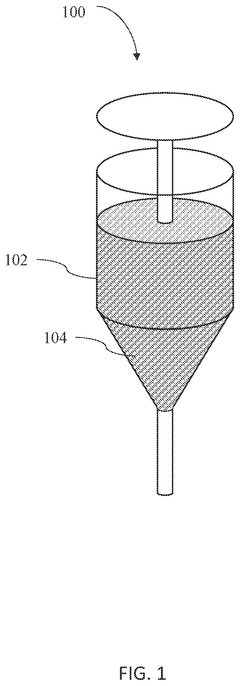
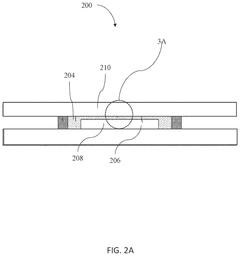
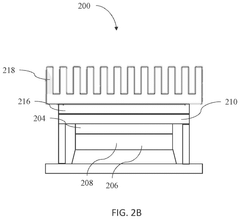
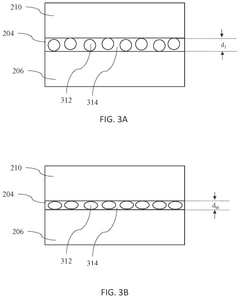
- A thermal interface material comprising 8% to 70% by volume of a polymer component and at least 30% by volume of liquid metal droplets, where the polymer component is composed of specific polymers with varying molecular weights and includes polybutadiene, enabling strong adhesion, stretchability, and low thermal resistance.
Reliability Standards for TIM in High-Stress Applications
The establishment of comprehensive reliability standards for thermal interface materials (TIM) in high-stress applications has become increasingly critical as electronic systems operate under more demanding mechanical conditions. Current industry standards primarily focus on thermal performance metrics while inadequately addressing the complex interplay between mechanical stress and long-term reliability. This gap necessitates the development of specialized testing protocols and acceptance criteria that account for stress-induced degradation mechanisms.
Existing reliability frameworks, including JEDEC and IPC standards, provide foundational guidelines for TIM evaluation but lack specific provisions for high-stress environments. These standards typically emphasize thermal cycling and aging tests without incorporating concurrent mechanical loading scenarios. The absence of standardized stress-thermal coupling tests creates inconsistencies in reliability assessment across different applications and manufacturers.
The development of robust reliability standards must encompass multiple stress vectors, including compressive loading, shear stress, and cyclic mechanical fatigue. Standard test methodologies should incorporate accelerated life testing under combined thermal and mechanical stress conditions, with clearly defined failure criteria based on thermal resistance degradation thresholds. Temperature cycling tests should be enhanced to include mechanical stress application during thermal transitions, simulating real-world operating conditions more accurately.
Critical parameters requiring standardization include maximum allowable thermal resistance increase over operational lifetime, mechanical stress limits for different TIM categories, and standardized test fixtures for reproducible stress application. The standards should also define minimum sample sizes, statistical analysis methods, and confidence intervals for reliability predictions. Environmental factors such as humidity, vibration, and chemical exposure must be integrated into comprehensive test protocols.
Industry collaboration is essential for establishing universally accepted reliability standards that balance performance requirements with practical implementation constraints. These standards should accommodate emerging TIM technologies while providing backward compatibility with existing materials. Regular revision cycles must be established to incorporate technological advances and field experience data, ensuring the standards remain relevant as high-stress applications continue to evolve in complexity and performance demands.
Existing reliability frameworks, including JEDEC and IPC standards, provide foundational guidelines for TIM evaluation but lack specific provisions for high-stress environments. These standards typically emphasize thermal cycling and aging tests without incorporating concurrent mechanical loading scenarios. The absence of standardized stress-thermal coupling tests creates inconsistencies in reliability assessment across different applications and manufacturers.
The development of robust reliability standards must encompass multiple stress vectors, including compressive loading, shear stress, and cyclic mechanical fatigue. Standard test methodologies should incorporate accelerated life testing under combined thermal and mechanical stress conditions, with clearly defined failure criteria based on thermal resistance degradation thresholds. Temperature cycling tests should be enhanced to include mechanical stress application during thermal transitions, simulating real-world operating conditions more accurately.
Critical parameters requiring standardization include maximum allowable thermal resistance increase over operational lifetime, mechanical stress limits for different TIM categories, and standardized test fixtures for reproducible stress application. The standards should also define minimum sample sizes, statistical analysis methods, and confidence intervals for reliability predictions. Environmental factors such as humidity, vibration, and chemical exposure must be integrated into comprehensive test protocols.
Industry collaboration is essential for establishing universally accepted reliability standards that balance performance requirements with practical implementation constraints. These standards should accommodate emerging TIM technologies while providing backward compatibility with existing materials. Regular revision cycles must be established to incorporate technological advances and field experience data, ensuring the standards remain relevant as high-stress applications continue to evolve in complexity and performance demands.
Environmental Impact Assessment of Advanced TIM Materials
The environmental implications of advanced thermal interface materials (TIMs) have become increasingly critical as the electronics industry faces mounting pressure to adopt sustainable practices while maintaining high thermal performance standards. Traditional TIM materials, including metal-based thermal pastes and silicone compounds, often contain heavy metals, volatile organic compounds, and non-biodegradable polymers that pose significant environmental challenges throughout their lifecycle.
Advanced TIM materials such as graphene-enhanced composites, carbon nanotube arrays, and bio-based thermal polymers present both opportunities and challenges from an environmental perspective. While these materials often demonstrate superior thermal conductivity and mechanical stress resistance, their production processes frequently involve energy-intensive synthesis methods and potentially hazardous chemical precursors. The manufacturing of graphene-based TIMs, for instance, requires high-temperature processing and chemical vapor deposition techniques that contribute to substantial carbon footprints.
The lifecycle assessment of advanced TIMs reveals complex environmental trade-offs. Materials like liquid metal alloys offer exceptional thermal performance but raise concerns regarding resource scarcity and end-of-life disposal. Gallium-indium-based TIMs, while providing excellent conformability under mechanical stress, require careful handling due to their reactive nature and potential environmental persistence. Conversely, bio-derived thermal interface materials, though environmentally friendlier in composition, may exhibit reduced thermal performance and durability under mechanical stress conditions.
Regulatory frameworks are increasingly influencing TIM material selection, with restrictions on hazardous substances driving innovation toward greener alternatives. The European Union's RoHS directive and REACH regulation have prompted manufacturers to develop lead-free, halogen-free formulations that maintain thermal efficiency while reducing environmental impact. These regulatory pressures have accelerated research into recyclable TIM materials and closed-loop manufacturing processes.
Emerging assessment methodologies now incorporate mechanical stress testing alongside environmental impact evaluation, recognizing that material longevity directly affects overall sustainability. Advanced TIMs that maintain thermal performance under repeated thermal cycling and mechanical loading reduce replacement frequency, thereby minimizing cumulative environmental impact despite potentially higher initial production costs.
The development of standardized environmental assessment protocols for TIM materials remains an ongoing challenge, particularly when evaluating the complex interactions between thermal performance, mechanical reliability, and environmental sustainability across diverse application scenarios.
Advanced TIM materials such as graphene-enhanced composites, carbon nanotube arrays, and bio-based thermal polymers present both opportunities and challenges from an environmental perspective. While these materials often demonstrate superior thermal conductivity and mechanical stress resistance, their production processes frequently involve energy-intensive synthesis methods and potentially hazardous chemical precursors. The manufacturing of graphene-based TIMs, for instance, requires high-temperature processing and chemical vapor deposition techniques that contribute to substantial carbon footprints.
The lifecycle assessment of advanced TIMs reveals complex environmental trade-offs. Materials like liquid metal alloys offer exceptional thermal performance but raise concerns regarding resource scarcity and end-of-life disposal. Gallium-indium-based TIMs, while providing excellent conformability under mechanical stress, require careful handling due to their reactive nature and potential environmental persistence. Conversely, bio-derived thermal interface materials, though environmentally friendlier in composition, may exhibit reduced thermal performance and durability under mechanical stress conditions.
Regulatory frameworks are increasingly influencing TIM material selection, with restrictions on hazardous substances driving innovation toward greener alternatives. The European Union's RoHS directive and REACH regulation have prompted manufacturers to develop lead-free, halogen-free formulations that maintain thermal efficiency while reducing environmental impact. These regulatory pressures have accelerated research into recyclable TIM materials and closed-loop manufacturing processes.
Emerging assessment methodologies now incorporate mechanical stress testing alongside environmental impact evaluation, recognizing that material longevity directly affects overall sustainability. Advanced TIMs that maintain thermal performance under repeated thermal cycling and mechanical loading reduce replacement frequency, thereby minimizing cumulative environmental impact despite potentially higher initial production costs.
The development of standardized environmental assessment protocols for TIM materials remains an ongoing challenge, particularly when evaluating the complex interactions between thermal performance, mechanical reliability, and environmental sustainability across diverse application scenarios.
Unlock deeper insights with Patsnap Eureka Quick Research — get a full tech report to explore trends and direct your research. Try now!
Generate Your Research Report Instantly with AI Agent
Supercharge your innovation with Patsnap Eureka AI Agent Platform!