

TIM Performance vs Performance Stability
MAR 27, 20269 MIN READ
Generate Your Research Report Instantly with AI Agent
Patsnap Eureka helps you evaluate technical feasibility & market potential.
TIM Technology Background and Performance Goals
Thermal Interface Materials (TIM) have emerged as critical components in modern electronic systems, serving as the essential bridge between heat-generating components and heat dissipation solutions. The fundamental purpose of TIM technology lies in minimizing thermal resistance at interfaces where air gaps would otherwise impede efficient heat transfer. As electronic devices continue to evolve toward higher power densities and miniaturization, the role of TIM has become increasingly pivotal in maintaining optimal operating temperatures and ensuring system reliability.
The historical development of TIM technology traces back to the early days of semiconductor packaging, where simple thermal greases were initially employed to address basic heat dissipation needs. Over the decades, the technology has undergone significant transformation, evolving from basic silicone-based compounds to sophisticated engineered materials incorporating advanced fillers, phase change materials, and nanostructured components. This evolution has been driven by the relentless pursuit of improved thermal conductivity, enhanced reliability, and better long-term performance stability.
Contemporary TIM applications span across diverse sectors, from consumer electronics and automotive systems to high-performance computing and telecommunications infrastructure. The technology has become particularly crucial in CPU and GPU cooling solutions, LED thermal management, power electronics, and electric vehicle battery systems. Each application domain presents unique challenges regarding thermal performance requirements, operating temperature ranges, and mechanical stress conditions.
The primary technical objectives in current TIM research focus on achieving optimal balance between immediate thermal performance and long-term stability. Performance goals typically center on maximizing thermal conductivity while minimizing thermal resistance across the interface. However, equally important is the pursuit of performance stability, which encompasses maintaining consistent thermal properties over extended operational periods, temperature cycling, and various environmental conditions.
Modern TIM development targets thermal conductivity values ranging from 1 W/mK for basic applications to over 15 W/mK for high-performance scenarios. Simultaneously, performance stability requirements demand minimal degradation in thermal properties over thousands of thermal cycles, extended exposure to elevated temperatures, and resistance to mechanical stress-induced changes. The challenge lies in achieving these dual objectives without compromising other essential characteristics such as ease of application, cost-effectiveness, and environmental compliance.
The technological roadmap for TIM advancement emphasizes the integration of novel materials, including graphene-based composites, carbon nanotube networks, and advanced metal-filled polymers, while addressing the fundamental trade-offs between peak performance and sustained reliability in real-world operating conditions.
The historical development of TIM technology traces back to the early days of semiconductor packaging, where simple thermal greases were initially employed to address basic heat dissipation needs. Over the decades, the technology has undergone significant transformation, evolving from basic silicone-based compounds to sophisticated engineered materials incorporating advanced fillers, phase change materials, and nanostructured components. This evolution has been driven by the relentless pursuit of improved thermal conductivity, enhanced reliability, and better long-term performance stability.
Contemporary TIM applications span across diverse sectors, from consumer electronics and automotive systems to high-performance computing and telecommunications infrastructure. The technology has become particularly crucial in CPU and GPU cooling solutions, LED thermal management, power electronics, and electric vehicle battery systems. Each application domain presents unique challenges regarding thermal performance requirements, operating temperature ranges, and mechanical stress conditions.
The primary technical objectives in current TIM research focus on achieving optimal balance between immediate thermal performance and long-term stability. Performance goals typically center on maximizing thermal conductivity while minimizing thermal resistance across the interface. However, equally important is the pursuit of performance stability, which encompasses maintaining consistent thermal properties over extended operational periods, temperature cycling, and various environmental conditions.
Modern TIM development targets thermal conductivity values ranging from 1 W/mK for basic applications to over 15 W/mK for high-performance scenarios. Simultaneously, performance stability requirements demand minimal degradation in thermal properties over thousands of thermal cycles, extended exposure to elevated temperatures, and resistance to mechanical stress-induced changes. The challenge lies in achieving these dual objectives without compromising other essential characteristics such as ease of application, cost-effectiveness, and environmental compliance.
The technological roadmap for TIM advancement emphasizes the integration of novel materials, including graphene-based composites, carbon nanotube networks, and advanced metal-filled polymers, while addressing the fundamental trade-offs between peak performance and sustained reliability in real-world operating conditions.
Market Demand for High-Performance TIM Solutions
The global thermal interface materials market is experiencing unprecedented growth driven by the exponential increase in electronic device performance requirements and miniaturization trends. Modern electronic systems generate significantly higher heat densities, creating critical thermal management challenges that demand advanced TIM solutions with superior performance characteristics and long-term stability.
Data centers represent one of the most demanding market segments, where server processors and graphics processing units operate at increasingly higher power densities. The proliferation of artificial intelligence workloads and high-performance computing applications has intensified thermal management requirements, driving demand for TIMs that can maintain consistent performance under continuous high-temperature operation while ensuring system reliability over extended periods.
The automotive electronics sector presents another rapidly expanding market opportunity, particularly with the accelerated adoption of electric vehicles and autonomous driving technologies. Power electronics modules, battery management systems, and advanced driver assistance systems require TIMs that can withstand harsh operating environments while maintaining thermal performance stability throughout the vehicle's operational lifetime. The automotive industry's stringent reliability standards create substantial demand for TIMs with proven long-term performance consistency.
Consumer electronics manufacturers face mounting pressure to deliver thinner, more powerful devices while maintaining acceptable surface temperatures and battery life. Smartphones, tablets, and laptops increasingly rely on high-performance TIMs to manage heat generated by advanced processors and graphics chips. The challenge lies in balancing immediate thermal performance with long-term stability as devices are expected to maintain performance over several years of use.
The telecommunications infrastructure market, driven by widespread deployment of advanced wireless networks, requires TIMs capable of handling high-power radio frequency components and base station equipment. These applications demand materials that can maintain thermal performance consistency across wide temperature ranges and extended operational periods, often in challenging outdoor environments.
Industrial applications, including power electronics, renewable energy systems, and manufacturing equipment, represent significant market opportunities for high-performance TIMs. These sectors prioritize long-term reliability and performance stability, as equipment downtime can result in substantial economic losses. The growing emphasis on energy efficiency and system longevity further amplifies demand for TIMs that can maintain consistent thermal performance throughout extended operational lifecycles.
Data centers represent one of the most demanding market segments, where server processors and graphics processing units operate at increasingly higher power densities. The proliferation of artificial intelligence workloads and high-performance computing applications has intensified thermal management requirements, driving demand for TIMs that can maintain consistent performance under continuous high-temperature operation while ensuring system reliability over extended periods.
The automotive electronics sector presents another rapidly expanding market opportunity, particularly with the accelerated adoption of electric vehicles and autonomous driving technologies. Power electronics modules, battery management systems, and advanced driver assistance systems require TIMs that can withstand harsh operating environments while maintaining thermal performance stability throughout the vehicle's operational lifetime. The automotive industry's stringent reliability standards create substantial demand for TIMs with proven long-term performance consistency.
Consumer electronics manufacturers face mounting pressure to deliver thinner, more powerful devices while maintaining acceptable surface temperatures and battery life. Smartphones, tablets, and laptops increasingly rely on high-performance TIMs to manage heat generated by advanced processors and graphics chips. The challenge lies in balancing immediate thermal performance with long-term stability as devices are expected to maintain performance over several years of use.
The telecommunications infrastructure market, driven by widespread deployment of advanced wireless networks, requires TIMs capable of handling high-power radio frequency components and base station equipment. These applications demand materials that can maintain thermal performance consistency across wide temperature ranges and extended operational periods, often in challenging outdoor environments.
Industrial applications, including power electronics, renewable energy systems, and manufacturing equipment, represent significant market opportunities for high-performance TIMs. These sectors prioritize long-term reliability and performance stability, as equipment downtime can result in substantial economic losses. The growing emphasis on energy efficiency and system longevity further amplifies demand for TIMs that can maintain consistent thermal performance throughout extended operational lifecycles.
Current TIM Performance vs Stability Challenges
Thermal Interface Materials face significant performance versus stability trade-offs that represent fundamental challenges in thermal management applications. The primary challenge lies in achieving optimal thermal conductivity while maintaining long-term material integrity under varying operational conditions. High-performance TIMs often exhibit excellent initial thermal properties but may suffer from degradation mechanisms that compromise their effectiveness over time.
Temperature cycling presents one of the most critical stability challenges for TIMs. During repeated heating and cooling cycles, materials experience thermal expansion and contraction, leading to mechanical stress accumulation. This cyclical stress can cause delamination at interfaces, crack formation within the material matrix, and gradual loss of contact pressure between mating surfaces. The resulting air gaps significantly increase thermal resistance, negating the initial performance advantages.
Pump-out phenomenon represents another major stability concern, particularly affecting liquid and gel-based TIMs. Under thermal cycling and mechanical vibration, these materials tend to migrate away from the intended interface area, creating non-uniform thickness distribution and potential dry spots. This migration not only reduces thermal performance but also creates reliability risks in critical applications where consistent thermal management is essential.
Material aging and chemical degradation pose long-term stability challenges across all TIM categories. Exposure to elevated temperatures accelerates polymer chain scission, filler particle agglomeration, and volatile component evaporation. These degradation mechanisms progressively alter the material's thermal and mechanical properties, leading to performance drift that can be difficult to predict and compensate for in system design.
Interface compatibility issues create additional complexity in TIM performance stability. Different substrate materials exhibit varying coefficients of thermal expansion, surface roughness characteristics, and chemical reactivity. These mismatches can lead to interfacial stress concentration, adhesion failure, and accelerated degradation at critical thermal pathways. The challenge intensifies when considering the diverse material combinations encountered in modern electronic assemblies.
Measurement and characterization difficulties further complicate the assessment of TIM performance versus stability trade-offs. Standard testing methodologies often focus on initial thermal performance under controlled conditions, providing limited insight into long-term behavior under realistic operational stresses. The lack of standardized accelerated aging protocols makes it challenging to predict field performance and establish reliable design margins for thermal management systems.
Temperature cycling presents one of the most critical stability challenges for TIMs. During repeated heating and cooling cycles, materials experience thermal expansion and contraction, leading to mechanical stress accumulation. This cyclical stress can cause delamination at interfaces, crack formation within the material matrix, and gradual loss of contact pressure between mating surfaces. The resulting air gaps significantly increase thermal resistance, negating the initial performance advantages.
Pump-out phenomenon represents another major stability concern, particularly affecting liquid and gel-based TIMs. Under thermal cycling and mechanical vibration, these materials tend to migrate away from the intended interface area, creating non-uniform thickness distribution and potential dry spots. This migration not only reduces thermal performance but also creates reliability risks in critical applications where consistent thermal management is essential.
Material aging and chemical degradation pose long-term stability challenges across all TIM categories. Exposure to elevated temperatures accelerates polymer chain scission, filler particle agglomeration, and volatile component evaporation. These degradation mechanisms progressively alter the material's thermal and mechanical properties, leading to performance drift that can be difficult to predict and compensate for in system design.
Interface compatibility issues create additional complexity in TIM performance stability. Different substrate materials exhibit varying coefficients of thermal expansion, surface roughness characteristics, and chemical reactivity. These mismatches can lead to interfacial stress concentration, adhesion failure, and accelerated degradation at critical thermal pathways. The challenge intensifies when considering the diverse material combinations encountered in modern electronic assemblies.
Measurement and characterization difficulties further complicate the assessment of TIM performance versus stability trade-offs. Standard testing methodologies often focus on initial thermal performance under controlled conditions, providing limited insight into long-term behavior under realistic operational stresses. The lack of standardized accelerated aging protocols makes it challenging to predict field performance and establish reliable design margins for thermal management systems.
Existing TIM Performance Optimization Solutions
01 Thermal interface material composition optimization
Thermal interface materials (TIMs) can be formulated with specific compositions to enhance thermal conductivity and performance. The selection of base materials, fillers, and additives plays a crucial role in achieving optimal heat transfer properties. Advanced formulations may include metal particles, carbon-based materials, or ceramic fillers dispersed in polymer matrices to improve thermal performance while maintaining mechanical stability.- Thermal interface material composition optimization: Thermal interface materials (TIM) can be formulated with specific compositions to enhance thermal conductivity and performance. The selection of base materials, fillers, and additives plays a crucial role in achieving optimal heat dissipation properties. Advanced formulations may include metal particles, ceramic fillers, or carbon-based materials to improve thermal performance while maintaining mechanical stability.
- Performance stability under thermal cycling: Maintaining consistent performance of thermal interface materials under repeated heating and cooling cycles is critical for long-term reliability. Formulations can be designed to resist degradation, pump-out, and delamination during thermal cycling. Specific polymer matrices and cross-linking agents help maintain the structural integrity and thermal properties over extended operational periods.
- Enhanced adhesion and bonding properties: Improved adhesion between thermal interface materials and substrate surfaces ensures stable thermal contact and prevents performance degradation. Surface treatment methods and adhesive additives can be incorporated to enhance bonding strength. These modifications help maintain consistent thermal resistance values throughout the product lifecycle and prevent interface separation under mechanical stress.
- Low thermal resistance and high conductivity materials: Development of thermal interface materials with minimized thermal resistance and maximized thermal conductivity is essential for high-performance applications. Novel material combinations and processing techniques enable the creation of products with superior heat transfer capabilities. These materials are designed to fill microscopic gaps and irregularities at interfaces to establish efficient thermal pathways.
- Mechanical stability and durability enhancement: Ensuring mechanical stability of thermal interface materials under various environmental conditions and mechanical stresses is vital for reliable performance. Formulations can incorporate reinforcing agents and stabilizers to improve resistance to vibration, compression, and shear forces. Enhanced durability characteristics prevent material degradation and maintain consistent thermal performance over the operational lifetime of electronic devices.
02 Performance stability under thermal cycling
Maintaining consistent performance of thermal interface materials under repeated thermal cycling conditions is critical for long-term reliability. Materials must resist degradation, pump-out, and delamination when subjected to temperature fluctuations. Formulations can be designed with enhanced adhesion properties and structural integrity to ensure stable thermal resistance over extended operational periods.Expand Specific Solutions03 Phase change thermal interface materials
Phase change materials offer unique advantages for thermal management by transitioning between solid and liquid states at specific temperatures. These materials can conform to surface irregularities and fill air gaps more effectively, improving thermal contact. The performance stability of phase change materials depends on controlling their melting point, viscosity, and preventing material migration during operation.Expand Specific Solutions04 Mechanical properties and reliability testing
The mechanical characteristics of thermal interface materials significantly impact their performance stability. Testing methodologies evaluate properties such as compression resistance, shear strength, and elastic modulus under various environmental conditions. Materials must maintain structural integrity while accommodating thermal expansion mismatches between components to ensure reliable long-term operation.Expand Specific Solutions05 Application methods and interface optimization
The method of applying thermal interface materials and optimizing the interface between components affects overall thermal performance. Techniques include screen printing, dispensing, and pre-formed pads, each offering different advantages for specific applications. Proper surface preparation, bondline thickness control, and curing processes are essential for achieving consistent performance and minimizing thermal resistance.Expand Specific Solutions
Key Players in TIM Manufacturing Industry
The TIM (Thermal Interface Material) performance versus stability research field represents a mature yet rapidly evolving market driven by increasing thermal management demands in electronics and automotive sectors. The industry demonstrates significant market expansion, particularly in high-performance computing and electric vehicle applications. Technology maturity varies considerably across players, with established semiconductor giants like Taiwan Semiconductor Manufacturing, Advanced Micro Devices, and Qualcomm leading advanced thermal solutions development, while companies such as IBM, Synopsys, and Siemens provide sophisticated simulation and design tools. Chinese players including Huawei Technologies and research institutions like Beihang University and Huazhong University of Science & Technology contribute substantial R&D capabilities. The competitive landscape shows convergence between traditional electronics manufacturers, automotive suppliers like Robert Bosch, and specialized technology firms, indicating cross-industry collaboration in addressing thermal management challenges for next-generation applications.
International Business Machines Corp.
Technical Solution: IBM has developed comprehensive TIM (Thermal Interface Material) performance analysis methodologies focusing on the balance between thermal conductivity and long-term stability. Their approach integrates advanced thermal modeling with reliability testing protocols, utilizing machine learning algorithms to predict TIM degradation patterns over extended operational periods. The company's research emphasizes the correlation between thermal cycling stress and material stability, developing predictive models that can forecast performance degradation up to 10 years in advance. IBM's TIM solutions incorporate novel polymer matrices with enhanced thermal pathways while maintaining mechanical flexibility to ensure consistent performance under varying thermal loads and environmental conditions.
Strengths: Advanced predictive modeling capabilities and extensive reliability testing infrastructure. Weaknesses: High implementation costs and complex integration requirements for existing systems.
Huawei Technologies Co., Ltd.
Technical Solution: Huawei has developed innovative TIM solutions that prioritize both high thermal performance and exceptional stability for telecommunications and computing applications. Their research focuses on hybrid TIM formulations combining graphene-enhanced polymers with phase-change materials to achieve optimal heat dissipation while maintaining consistent performance over extended operational periods. The company's approach includes comprehensive accelerated aging tests and real-world deployment studies to validate long-term stability. Huawei's TIM technology incorporates self-healing properties that help maintain thermal interface integrity even after thousands of thermal cycles, ensuring reliable performance in mission-critical applications such as 5G base stations and data center equipment.
Strengths: Self-healing TIM technology and extensive field validation in telecommunications infrastructure. Weaknesses: Limited availability in certain markets due to regulatory restrictions and higher material costs.
Core Innovations in TIM Stability Enhancement
Using in situ capacitance measurements to monitor the stability of interface materials in complex PCB assemblies and other structures
PatentInactiveUS20190323983A1
Innovation
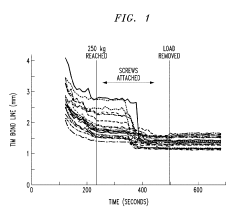
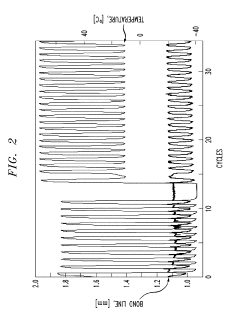
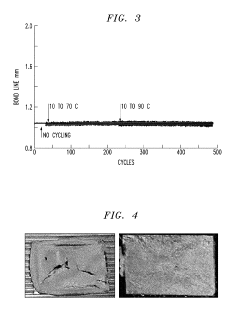
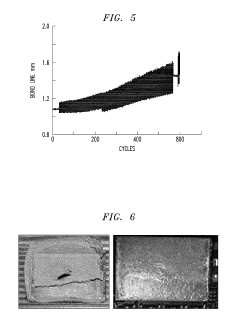
- The use of in-situ capacitance measurements between electrodes on opposite sides of a gap filled with TIM, subjected to changing physical conditions, allows for real-time monitoring of electrical capacitance, enabling precise measurement of bond line thickness and thermal performance, even in complex assemblies with multiple components sharing a common heat spreader.
A semiconductor device package comprising a thermal interface material with improved handling properties
PatentActiveEP3937227A9
Innovation
- A semiconductor device package incorporating an electrically conductive carrier, a semiconductor die, and an encapsulant with an electrically insulating and thermally conductive interface structure made from an epoxy resin matrix filled with metal oxide or metal nitride filler particles, offering a glass transition temperature range of -40°C to 150°C, ensuring hardness and scratch resistance at room temperature and softness at operating temperatures for effective thermal coupling.


Environmental Standards for TIM Applications
Environmental standards for Thermal Interface Materials (TIM) applications have become increasingly stringent as electronic devices operate in more demanding conditions and require enhanced reliability. These standards encompass temperature cycling, humidity exposure, vibration resistance, and chemical compatibility requirements that directly impact both performance and stability characteristics of TIM solutions.
Temperature cycling standards, such as JEDEC JESD22-A104 and IEC 60068-2-14, define the operational boundaries for TIM materials across extreme temperature ranges typically spanning from -55°C to +150°C or higher. These standards evaluate how thermal conductivity, bond line thickness, and adhesion properties change under repeated thermal stress, which is crucial for understanding the relationship between performance degradation and long-term stability.
Humidity and moisture resistance standards, including JEDEC JESD22-A101 and MIL-STD-810, assess TIM behavior under various moisture conditions. These evaluations are particularly important as moisture absorption can significantly alter thermal performance while simultaneously affecting material stability through hydrolysis, corrosion, or dimensional changes that compromise interface integrity.
Vibration and mechanical stress standards, such as JEDEC JESD22-B103 and IEC 60068-2-6, examine how mechanical forces affect TIM performance stability. These standards help determine whether materials maintain consistent thermal performance under dynamic loading conditions commonly encountered in automotive, aerospace, and mobile applications.
Chemical compatibility standards address outgassing, corrosion resistance, and material interactions according to ASTM E595 and similar protocols. These requirements ensure that TIM materials do not degrade surrounding components while maintaining their own performance characteristics over extended operational periods.
Compliance with these environmental standards requires careful balance between optimizing thermal performance and ensuring long-term stability, as materials that excel in one area may compromise in another under standardized stress conditions.
Temperature cycling standards, such as JEDEC JESD22-A104 and IEC 60068-2-14, define the operational boundaries for TIM materials across extreme temperature ranges typically spanning from -55°C to +150°C or higher. These standards evaluate how thermal conductivity, bond line thickness, and adhesion properties change under repeated thermal stress, which is crucial for understanding the relationship between performance degradation and long-term stability.
Humidity and moisture resistance standards, including JEDEC JESD22-A101 and MIL-STD-810, assess TIM behavior under various moisture conditions. These evaluations are particularly important as moisture absorption can significantly alter thermal performance while simultaneously affecting material stability through hydrolysis, corrosion, or dimensional changes that compromise interface integrity.
Vibration and mechanical stress standards, such as JEDEC JESD22-B103 and IEC 60068-2-6, examine how mechanical forces affect TIM performance stability. These standards help determine whether materials maintain consistent thermal performance under dynamic loading conditions commonly encountered in automotive, aerospace, and mobile applications.
Chemical compatibility standards address outgassing, corrosion resistance, and material interactions according to ASTM E595 and similar protocols. These requirements ensure that TIM materials do not degrade surrounding components while maintaining their own performance characteristics over extended operational periods.
Compliance with these environmental standards requires careful balance between optimizing thermal performance and ensuring long-term stability, as materials that excel in one area may compromise in another under standardized stress conditions.
Reliability Testing Methods for TIM Performance
Reliability testing methods for TIM performance evaluation encompass a comprehensive suite of standardized protocols designed to assess both immediate thermal performance and long-term stability characteristics. These methodologies are critical for validating TIM materials under various operational conditions and predicting their behavior throughout expected service lifecycles.
Thermal cycling testing represents a fundamental approach for evaluating TIM reliability, subjecting materials to repeated temperature fluctuations that simulate real-world operating conditions. This method typically involves cycling between predetermined temperature extremes, ranging from -40°C to 150°C, with controlled ramp rates and dwell times. The testing protocol monitors thermal resistance changes, interface degradation, and material property variations across hundreds to thousands of cycles.
Accelerated aging tests provide insights into long-term performance stability by exposing TIM materials to elevated temperatures, humidity, and other environmental stressors. These tests employ Arrhenius acceleration principles to compress years of operational exposure into weeks or months of laboratory testing. Temperature-humidity bias testing, high-temperature storage, and thermal shock protocols are commonly implemented to evaluate material degradation mechanisms.
Power cycling methodologies simulate actual device operation by applying electrical loads that generate thermal gradients across TIM interfaces. This approach captures the dynamic thermal stresses experienced during real-world power fluctuations, including rapid temperature transitions and thermal expansion mismatches between mating surfaces.
Mechanical stress testing evaluates TIM performance under various loading conditions, including compression, shear, and vibration scenarios. These tests assess interface stability, material flow characteristics, and bond line thickness variations that directly impact thermal performance over time.
Advanced characterization techniques complement traditional testing methods by providing detailed insights into failure mechanisms. Thermal impedance spectroscopy, scanning acoustic microscopy, and cross-sectional analysis enable identification of void formation, delamination, and material degradation patterns that affect long-term reliability.
Standardized test protocols, including ASTM D5470, JEDEC JESD51 series, and IEC standards, provide framework guidelines for consistent and reproducible reliability assessments across different laboratories and applications.
Thermal cycling testing represents a fundamental approach for evaluating TIM reliability, subjecting materials to repeated temperature fluctuations that simulate real-world operating conditions. This method typically involves cycling between predetermined temperature extremes, ranging from -40°C to 150°C, with controlled ramp rates and dwell times. The testing protocol monitors thermal resistance changes, interface degradation, and material property variations across hundreds to thousands of cycles.
Accelerated aging tests provide insights into long-term performance stability by exposing TIM materials to elevated temperatures, humidity, and other environmental stressors. These tests employ Arrhenius acceleration principles to compress years of operational exposure into weeks or months of laboratory testing. Temperature-humidity bias testing, high-temperature storage, and thermal shock protocols are commonly implemented to evaluate material degradation mechanisms.
Power cycling methodologies simulate actual device operation by applying electrical loads that generate thermal gradients across TIM interfaces. This approach captures the dynamic thermal stresses experienced during real-world power fluctuations, including rapid temperature transitions and thermal expansion mismatches between mating surfaces.
Mechanical stress testing evaluates TIM performance under various loading conditions, including compression, shear, and vibration scenarios. These tests assess interface stability, material flow characteristics, and bond line thickness variations that directly impact thermal performance over time.
Advanced characterization techniques complement traditional testing methods by providing detailed insights into failure mechanisms. Thermal impedance spectroscopy, scanning acoustic microscopy, and cross-sectional analysis enable identification of void formation, delamination, and material degradation patterns that affect long-term reliability.
Standardized test protocols, including ASTM D5470, JEDEC JESD51 series, and IEC standards, provide framework guidelines for consistent and reproducible reliability assessments across different laboratories and applications.
Unlock deeper insights with Patsnap Eureka Quick Research — get a full tech report to explore trends and direct your research. Try now!
Generate Your Research Report Instantly with AI Agent
Supercharge your innovation with Patsnap Eureka AI Agent Platform!