QNED Utilization in Future-Proofing Display Tech
JUN 19, 20259 MIN READ
Generate Your Research Report Instantly with AI Agent
PatSnap Eureka helps you evaluate technical feasibility & market potential.
QNED Technology Evolution
QNED (Quantum Nano Emitting Diode) technology has undergone significant evolution since its inception, marking a revolutionary advancement in display technology. The journey of QNED began with the integration of quantum dot technology and mini-LED backlighting, aiming to overcome the limitations of traditional LCD and OLED displays.
In its early stages, QNED focused on enhancing color accuracy and brightness. Researchers worked on refining the quantum dot material composition to achieve a wider color gamut and improve energy efficiency. This phase saw the development of blue light-emitting quantum dots, which were crucial for creating a full-color display without relying on color filters.
As the technology progressed, attention shifted towards miniaturization of the LED components. The reduction in LED size allowed for more precise local dimming, significantly improving contrast ratios and black levels. This advancement brought QNED displays closer to the performance of OLED screens while maintaining the advantages of LCD technology, such as higher brightness and longer lifespan.
A major milestone in QNED evolution was the development of self-emissive quantum dots. This breakthrough eliminated the need for a separate backlight layer, simplifying the display structure and potentially reducing production costs. Self-emissive QNED displays promised to combine the best features of OLED and QLED technologies, offering perfect blacks, wide viewing angles, and high brightness.
Recent years have seen a focus on scaling up QNED technology for mass production. Engineers have been working on improving manufacturing processes to increase yield rates and reduce costs. This has involved developing new deposition techniques for quantum dots and optimizing the integration of nano-scale LEDs into large display panels.
The latest developments in QNED technology are centered around enhancing energy efficiency and display longevity. Researchers are exploring new quantum dot materials that offer higher quantum yield and better stability under various environmental conditions. Additionally, efforts are being made to improve the color purity and reduce the full-width half-maximum (FWHM) of quantum dot emissions, leading to more vibrant and accurate color reproduction.
Looking ahead, the QNED technology roadmap includes further advancements in pixel density, response times, and power consumption. There is ongoing research into incorporating artificial intelligence for real-time image processing and adaptive display optimization. These innovations aim to position QNED as a future-proof display technology capable of meeting the evolving demands of consumers and industries alike.
In its early stages, QNED focused on enhancing color accuracy and brightness. Researchers worked on refining the quantum dot material composition to achieve a wider color gamut and improve energy efficiency. This phase saw the development of blue light-emitting quantum dots, which were crucial for creating a full-color display without relying on color filters.
As the technology progressed, attention shifted towards miniaturization of the LED components. The reduction in LED size allowed for more precise local dimming, significantly improving contrast ratios and black levels. This advancement brought QNED displays closer to the performance of OLED screens while maintaining the advantages of LCD technology, such as higher brightness and longer lifespan.
A major milestone in QNED evolution was the development of self-emissive quantum dots. This breakthrough eliminated the need for a separate backlight layer, simplifying the display structure and potentially reducing production costs. Self-emissive QNED displays promised to combine the best features of OLED and QLED technologies, offering perfect blacks, wide viewing angles, and high brightness.
Recent years have seen a focus on scaling up QNED technology for mass production. Engineers have been working on improving manufacturing processes to increase yield rates and reduce costs. This has involved developing new deposition techniques for quantum dots and optimizing the integration of nano-scale LEDs into large display panels.
The latest developments in QNED technology are centered around enhancing energy efficiency and display longevity. Researchers are exploring new quantum dot materials that offer higher quantum yield and better stability under various environmental conditions. Additionally, efforts are being made to improve the color purity and reduce the full-width half-maximum (FWHM) of quantum dot emissions, leading to more vibrant and accurate color reproduction.
Looking ahead, the QNED technology roadmap includes further advancements in pixel density, response times, and power consumption. There is ongoing research into incorporating artificial intelligence for real-time image processing and adaptive display optimization. These innovations aim to position QNED as a future-proof display technology capable of meeting the evolving demands of consumers and industries alike.
Display Market Trends
The display market is experiencing significant shifts driven by technological advancements and changing consumer preferences. QNED (Quantum Nano Emitting Diode) technology is emerging as a potential game-changer in this landscape, offering a promising future for display innovation. The global display market continues to grow, with projections indicating substantial expansion in the coming years.
Consumer demand for higher resolution, improved color accuracy, and enhanced energy efficiency is reshaping the market. There is a noticeable trend towards larger screen sizes, particularly in the television segment, as consumers seek more immersive viewing experiences. This trend is complemented by the increasing adoption of 4K and 8K resolutions, which QNED technology is well-positioned to support.
The shift towards flexible and foldable displays is gaining momentum, especially in the smartphone and wearable device sectors. While QNED technology is not inherently flexible, its potential for miniaturization and high pixel density makes it a contender for integration into next-generation flexible display solutions.
In the commercial and industrial sectors, there is growing demand for high-brightness, high-contrast displays capable of operating in diverse lighting conditions. QNED's superior luminance and contrast ratio capabilities align well with these market requirements, potentially opening new avenues for adoption in outdoor signage, automotive displays, and industrial control panels.
The ongoing transition from traditional LCD and LED technologies to more advanced display solutions is a key market trend. OLED has gained significant market share, particularly in premium smartphones and high-end televisions. However, QNED technology presents a compelling alternative, offering many of OLED's benefits while potentially addressing some of its limitations, such as burn-in and limited lifespan.
Sustainability and energy efficiency are becoming increasingly important factors in consumer purchasing decisions and regulatory requirements. QNED's potential for improved energy efficiency compared to existing technologies could position it favorably in this eco-conscious market environment.
The COVID-19 pandemic has accelerated the adoption of remote work and distance learning, leading to increased demand for high-quality displays across various device categories. This trend is expected to have lasting effects on the display market, with continued emphasis on visual quality and eye comfort for extended use scenarios.
As the display market continues to evolve, QNED technology stands at the intersection of several key trends. Its potential to deliver superior image quality, energy efficiency, and durability aligns well with current market demands and future projections. The success of QNED in capturing market share will depend on factors such as manufacturing scalability, cost-effectiveness, and its ability to differentiate itself from established and emerging display technologies.
Consumer demand for higher resolution, improved color accuracy, and enhanced energy efficiency is reshaping the market. There is a noticeable trend towards larger screen sizes, particularly in the television segment, as consumers seek more immersive viewing experiences. This trend is complemented by the increasing adoption of 4K and 8K resolutions, which QNED technology is well-positioned to support.
The shift towards flexible and foldable displays is gaining momentum, especially in the smartphone and wearable device sectors. While QNED technology is not inherently flexible, its potential for miniaturization and high pixel density makes it a contender for integration into next-generation flexible display solutions.
In the commercial and industrial sectors, there is growing demand for high-brightness, high-contrast displays capable of operating in diverse lighting conditions. QNED's superior luminance and contrast ratio capabilities align well with these market requirements, potentially opening new avenues for adoption in outdoor signage, automotive displays, and industrial control panels.
The ongoing transition from traditional LCD and LED technologies to more advanced display solutions is a key market trend. OLED has gained significant market share, particularly in premium smartphones and high-end televisions. However, QNED technology presents a compelling alternative, offering many of OLED's benefits while potentially addressing some of its limitations, such as burn-in and limited lifespan.
Sustainability and energy efficiency are becoming increasingly important factors in consumer purchasing decisions and regulatory requirements. QNED's potential for improved energy efficiency compared to existing technologies could position it favorably in this eco-conscious market environment.
The COVID-19 pandemic has accelerated the adoption of remote work and distance learning, leading to increased demand for high-quality displays across various device categories. This trend is expected to have lasting effects on the display market, with continued emphasis on visual quality and eye comfort for extended use scenarios.
As the display market continues to evolve, QNED technology stands at the intersection of several key trends. Its potential to deliver superior image quality, energy efficiency, and durability aligns well with current market demands and future projections. The success of QNED in capturing market share will depend on factors such as manufacturing scalability, cost-effectiveness, and its ability to differentiate itself from established and emerging display technologies.
QNED Technical Challenges
QNED (Quantum Nano Emitting Diode) technology, while promising, faces several significant technical challenges in its development and implementation for future-proofing display technology. One of the primary hurdles is the precise control and uniformity of quantum dot synthesis. The size and composition of quantum dots directly affect their emission properties, and achieving consistent performance across large-scale production remains a complex task.
Another major challenge lies in the integration of quantum dots with micro-LED technology. The process of accurately placing and aligning quantum dots with micro-LEDs at a nanoscale level requires advanced manufacturing techniques that are still being refined. This integration is crucial for achieving the desired color purity and brightness in QNED displays.
The stability and longevity of quantum dots under various operating conditions pose additional challenges. Quantum dots can be sensitive to environmental factors such as temperature, humidity, and oxidation, which can lead to degradation over time. Developing robust encapsulation methods to protect quantum dots without compromising their optical properties is an ongoing area of research.
Color conversion efficiency is another critical aspect that needs improvement. While quantum dots offer superior color performance, maximizing the energy transfer from the micro-LED to the quantum dots and minimizing losses in the conversion process are essential for achieving high efficiency and low power consumption in QNED displays.
The thermal management of QNED displays presents a unique challenge. The combination of micro-LEDs and quantum dots can generate significant heat, which needs to be effectively dissipated to maintain performance and longevity. Developing innovative cooling solutions that are compatible with the thin form factor of modern displays is a key area of focus.
Scaling up production to meet commercial demands is a substantial hurdle. The manufacturing processes for both micro-LEDs and quantum dots are complex and currently have low yields, making mass production costly. Improving production efficiency and yield rates is crucial for making QNED technology economically viable for widespread adoption.
Lastly, optimizing the driving electronics and control systems for QNED displays presents its own set of challenges. The precise control required for individual micro-LED pixels, combined with the unique characteristics of quantum dot color conversion, necessitates the development of specialized driver ICs and control algorithms to fully leverage the technology's potential.
Another major challenge lies in the integration of quantum dots with micro-LED technology. The process of accurately placing and aligning quantum dots with micro-LEDs at a nanoscale level requires advanced manufacturing techniques that are still being refined. This integration is crucial for achieving the desired color purity and brightness in QNED displays.
The stability and longevity of quantum dots under various operating conditions pose additional challenges. Quantum dots can be sensitive to environmental factors such as temperature, humidity, and oxidation, which can lead to degradation over time. Developing robust encapsulation methods to protect quantum dots without compromising their optical properties is an ongoing area of research.
Color conversion efficiency is another critical aspect that needs improvement. While quantum dots offer superior color performance, maximizing the energy transfer from the micro-LED to the quantum dots and minimizing losses in the conversion process are essential for achieving high efficiency and low power consumption in QNED displays.
The thermal management of QNED displays presents a unique challenge. The combination of micro-LEDs and quantum dots can generate significant heat, which needs to be effectively dissipated to maintain performance and longevity. Developing innovative cooling solutions that are compatible with the thin form factor of modern displays is a key area of focus.
Scaling up production to meet commercial demands is a substantial hurdle. The manufacturing processes for both micro-LEDs and quantum dots are complex and currently have low yields, making mass production costly. Improving production efficiency and yield rates is crucial for making QNED technology economically viable for widespread adoption.
Lastly, optimizing the driving electronics and control systems for QNED displays presents its own set of challenges. The precise control required for individual micro-LED pixels, combined with the unique characteristics of quantum dot color conversion, necessitates the development of specialized driver ICs and control algorithms to fully leverage the technology's potential.
Current QNED Solutions
01 Advanced QNED structure and fabrication
Innovations in QNED structure and fabrication techniques focus on improving quantum dot integration, enhancing light emission efficiency, and optimizing nano-scale architectures. These advancements aim to create more stable and high-performance quantum nano-emitting diodes, paving the way for future-proof display technologies.- Quantum dot-based light emitting diodes: QNED technology utilizes quantum dots to enhance light emission properties. These nanoscale semiconductor particles offer improved color purity, brightness, and energy efficiency compared to traditional LED technologies. The quantum dots can be tuned to emit specific wavelengths of light, allowing for more precise color control in displays and lighting applications.
- Nanostructure fabrication techniques: Advanced fabrication methods are crucial for producing high-quality QNED devices. These techniques include epitaxial growth, lithography, and self-assembly processes to create precise nanostructures. Improved manufacturing processes lead to better uniformity, higher yield, and enhanced performance of QNED devices, contributing to their future-proofing potential.
- Integration with existing display technologies: QNED technology can be integrated with current display technologies such as LCD and OLED. This compatibility allows for gradual adoption and improvement of existing display systems without requiring a complete overhaul of manufacturing infrastructure. The integration can lead to hybrid displays that combine the benefits of multiple technologies.
- Energy efficiency and power consumption optimization: QNED devices offer improved energy efficiency compared to conventional LEDs. Research focuses on optimizing power consumption through better electron-hole recombination, reduced heat generation, and improved light extraction. These advancements contribute to longer device lifespans and reduced environmental impact, making QNED technology more sustainable for future applications.
- Scalability and mass production techniques: To ensure the future viability of QNED technology, research is focused on developing scalable production methods. This includes improving the synthesis of quantum dots, developing large-area fabrication techniques, and enhancing the consistency of device performance. Advancements in these areas will enable cost-effective mass production, making QNED technology more accessible for widespread adoption in various applications.
02 Enhanced color gamut and display quality
QNED technology developments are targeting wider color gamuts, improved color accuracy, and enhanced brightness levels. These improvements are achieved through precise control of quantum dot properties and innovative light management techniques, ensuring QNED displays remain competitive in future display markets.Expand Specific Solutions03 Energy efficiency and power management
Future-proofing QNED technology involves significant focus on improving energy efficiency and power management. This includes developing low-power driving schemes, optimizing quantum dot excitation methods, and enhancing overall device efficiency to meet future energy standards and consumer expectations.Expand Specific Solutions04 Durability and lifespan enhancement
Efforts to future-proof QNED technology include improving the durability and lifespan of quantum dots and device structures. This involves developing new encapsulation methods, enhancing material stability, and implementing advanced degradation prevention techniques to ensure long-term performance and reliability.Expand Specific Solutions05 Integration with emerging technologies
QNED future-proofing strategies involve integration with emerging technologies such as flexible displays, transparent screens, and advanced control systems. This includes developing compatible materials and processes, as well as exploring synergies with other cutting-edge display and electronic technologies to ensure QNED remains relevant in future applications.Expand Specific Solutions
Key QNED Industry Players
The QNED (Quantum Nano Emitting Diode) technology in display systems is currently in its early development stage, with significant potential for future-proofing display technology. The market size is expected to grow rapidly as QNED offers advantages in brightness, color accuracy, and energy efficiency. While the technology is not yet fully mature, several key players are actively advancing its development. Companies like Samsung Display, LG Display, and BOE Technology Group are investing heavily in QNED research and development. TCL China Star Optoelectronics and Sharp Corp. are also exploring QNED applications. As the technology progresses, we can expect increased competition and innovation from these major display manufacturers, potentially reshaping the display industry landscape in the coming years.
BOE Technology Group Co., Ltd.
Technical Solution: BOE has been actively researching QNED (Quantum Nano Emitting Diode) technology as part of their future-proofing display strategy. Their approach involves integrating quantum dot technology with mini-LED backlighting to create a hybrid display that offers superior color performance and contrast ratios. BOE's QNED panels use a combination of blue mini-LEDs as the backlight source and quantum dots for color conversion, resulting in improved color gamut and energy efficiency compared to traditional LCD displays.
Strengths: Superior color performance, high contrast ratios, and improved energy efficiency. Weaknesses: Higher production costs and complexity in manufacturing process compared to traditional LCD displays.
Samsung Display Co., Ltd.
Technical Solution: Samsung Display has been at the forefront of QNED research and development. Their approach focuses on creating a self-emissive display technology that combines quantum dots with nanorod LEDs. Samsung's QNED technology aims to overcome the limitations of OLED displays by offering improved brightness, longer lifespan, and reduced risk of burn-in. The company has developed a unique method of aligning quantum dots and nanorod LEDs using an electric field, which allows for precise control over light emission and color reproduction.
Strengths: Potential for higher brightness and longer lifespan than OLED, reduced burn-in risk. Weaknesses: Still in development stage, potential high production costs in initial phases.
QNED Core Innovations
Light emitting device and fabricating method thereof, display device
PatentActiveUS20180054872A1
Innovation
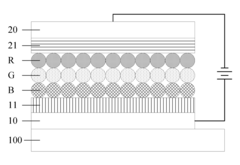
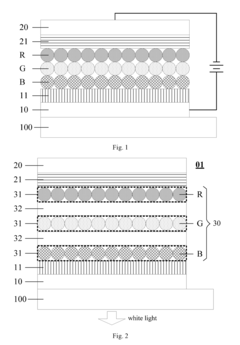
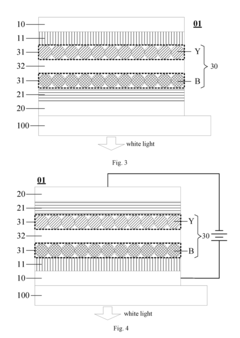
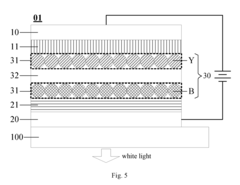
- Incorporating a transparent insulating layer between neighboring QD light-emitting layers of different colors in a light-emitting device, which blocks high-energy exciton transfer and acts as a buffer to maintain light balance and prevent electric leakage.
Quantum-nano light emitting diode pixel and quantum-nano light emitting diode display device
PatentActiveUS20190081261A1
Innovation
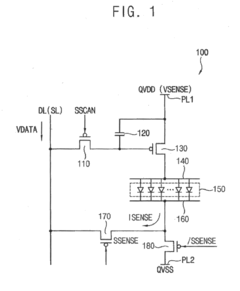
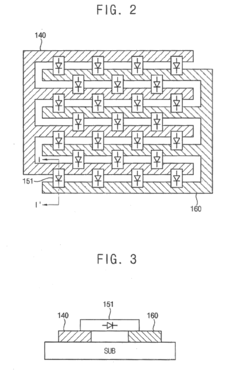
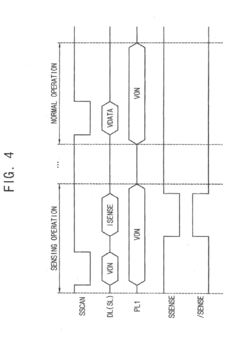
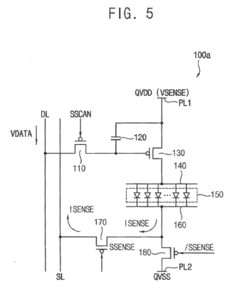
- A Q-NED pixel and display device design that includes a switching transistor, storage capacitor, driving transistor, and sensing transistors to sense and compensate for ohmic contact resistance deviations, utilizing inorganic materials like gallium nitride for the Q-NEDs, with anode and cathode electrodes having a comb shape to enhance light emission efficiency and maintain luminance over time.
QNED Manufacturing Process
The QNED (Quantum Nano Emitting Diode) manufacturing process represents a significant advancement in display technology, combining the benefits of quantum dot and mini-LED technologies. This process involves several key stages, each crucial for the production of high-quality QNED displays.
The first stage in QNED manufacturing is the preparation of the quantum dot material. This involves synthesizing nanocrystals of specific sizes and compositions to achieve the desired color output. The quantum dots are typically made from semiconductor materials such as indium phosphide or cadmium selenide, carefully engineered to emit precise wavelengths of light when excited.
Following quantum dot preparation, the next critical step is the fabrication of the mini-LED backlight. This process utilizes advanced semiconductor manufacturing techniques to create arrays of miniature LEDs, typically less than 200 micrometers in size. These mini-LEDs are arranged in a precise pattern to provide localized dimming and enhanced contrast control.
The integration of quantum dots with the mini-LED backlight is a crucial and complex phase of the manufacturing process. This involves depositing a thin layer of quantum dots over the mini-LED array, ensuring uniform distribution and optimal light conversion efficiency. Advanced deposition techniques such as inkjet printing or photolithography are employed to achieve precise placement of quantum dots.
Once the quantum dot layer is applied, the next step is the assembly of the LCD panel. This includes the integration of color filters, polarizers, and liquid crystal layers. The careful alignment of these components is essential to maximize the color gamut and viewing angles of the final display.
The manufacturing process also includes the integration of driving circuits and control systems. These electronic components are responsible for managing the mini-LED backlighting and controlling the liquid crystal layer, enabling features such as local dimming and high dynamic range (HDR) performance.
Quality control is a critical aspect of QNED manufacturing. This involves rigorous testing of color accuracy, brightness uniformity, and contrast performance. Advanced imaging systems and spectrophotometers are used to ensure that each display meets the stringent standards required for high-end consumer and professional applications.
The final stages of QNED manufacturing involve packaging and integration into the final product. This includes the addition of protective layers, bezels, and interfaces for connecting to external devices. The entire assembly process is carefully controlled to maintain the integrity of the delicate quantum dot and mini-LED components.
The first stage in QNED manufacturing is the preparation of the quantum dot material. This involves synthesizing nanocrystals of specific sizes and compositions to achieve the desired color output. The quantum dots are typically made from semiconductor materials such as indium phosphide or cadmium selenide, carefully engineered to emit precise wavelengths of light when excited.
Following quantum dot preparation, the next critical step is the fabrication of the mini-LED backlight. This process utilizes advanced semiconductor manufacturing techniques to create arrays of miniature LEDs, typically less than 200 micrometers in size. These mini-LEDs are arranged in a precise pattern to provide localized dimming and enhanced contrast control.
The integration of quantum dots with the mini-LED backlight is a crucial and complex phase of the manufacturing process. This involves depositing a thin layer of quantum dots over the mini-LED array, ensuring uniform distribution and optimal light conversion efficiency. Advanced deposition techniques such as inkjet printing or photolithography are employed to achieve precise placement of quantum dots.
Once the quantum dot layer is applied, the next step is the assembly of the LCD panel. This includes the integration of color filters, polarizers, and liquid crystal layers. The careful alignment of these components is essential to maximize the color gamut and viewing angles of the final display.
The manufacturing process also includes the integration of driving circuits and control systems. These electronic components are responsible for managing the mini-LED backlighting and controlling the liquid crystal layer, enabling features such as local dimming and high dynamic range (HDR) performance.
Quality control is a critical aspect of QNED manufacturing. This involves rigorous testing of color accuracy, brightness uniformity, and contrast performance. Advanced imaging systems and spectrophotometers are used to ensure that each display meets the stringent standards required for high-end consumer and professional applications.
The final stages of QNED manufacturing involve packaging and integration into the final product. This includes the addition of protective layers, bezels, and interfaces for connecting to external devices. The entire assembly process is carefully controlled to maintain the integrity of the delicate quantum dot and mini-LED components.
QNED Energy Efficiency
QNED (Quantum Nano Emitting Diode) technology represents a significant advancement in display energy efficiency, offering substantial improvements over existing technologies. This innovative approach combines the benefits of quantum dots and mini-LED backlighting to create a more power-efficient display solution.
One of the primary factors contributing to QNED's energy efficiency is its use of quantum dots. These nanocrystals can convert blue light into precise red and green wavelengths with minimal energy loss. This process results in a more efficient color production compared to traditional color filters, which absorb a significant portion of light to achieve the desired colors.
The mini-LED backlighting system in QNED displays also plays a crucial role in energy conservation. By utilizing thousands of tiny LEDs, QNED technology allows for more precise local dimming control. This feature enables the display to selectively illuminate only the necessary areas of the screen, significantly reducing power consumption in darker scenes or when displaying content with varying brightness levels.
Furthermore, QNED displays benefit from improved light management techniques. The quantum dot layer and advanced optical films help to maximize light transmission and minimize internal reflections. This optimization ensures that a higher percentage of the light generated by the backlight reaches the viewer, reducing the overall power required to achieve the desired brightness levels.
The energy efficiency of QNED technology also extends to its thermal management capabilities. The improved light conversion efficiency and reduced power consumption result in less heat generation compared to conventional LCD or OLED displays. This reduction in heat output not only contributes to energy savings but also enhances the longevity and reliability of the display.
In practical applications, QNED displays have demonstrated notable energy savings compared to their counterparts. Early estimates suggest that QNED technology can reduce power consumption by up to 30% compared to traditional LCD displays of similar size and brightness. This improvement in energy efficiency translates to lower operating costs and reduced environmental impact, making QNED an attractive option for both consumer and commercial applications.
As QNED technology continues to evolve, further advancements in energy efficiency are expected. Ongoing research focuses on enhancing quantum dot efficiency, optimizing mini-LED designs, and improving light management techniques. These developments promise to push the boundaries of display energy efficiency even further, solidifying QNED's position as a future-proof display technology.
One of the primary factors contributing to QNED's energy efficiency is its use of quantum dots. These nanocrystals can convert blue light into precise red and green wavelengths with minimal energy loss. This process results in a more efficient color production compared to traditional color filters, which absorb a significant portion of light to achieve the desired colors.
The mini-LED backlighting system in QNED displays also plays a crucial role in energy conservation. By utilizing thousands of tiny LEDs, QNED technology allows for more precise local dimming control. This feature enables the display to selectively illuminate only the necessary areas of the screen, significantly reducing power consumption in darker scenes or when displaying content with varying brightness levels.
Furthermore, QNED displays benefit from improved light management techniques. The quantum dot layer and advanced optical films help to maximize light transmission and minimize internal reflections. This optimization ensures that a higher percentage of the light generated by the backlight reaches the viewer, reducing the overall power required to achieve the desired brightness levels.
The energy efficiency of QNED technology also extends to its thermal management capabilities. The improved light conversion efficiency and reduced power consumption result in less heat generation compared to conventional LCD or OLED displays. This reduction in heat output not only contributes to energy savings but also enhances the longevity and reliability of the display.
In practical applications, QNED displays have demonstrated notable energy savings compared to their counterparts. Early estimates suggest that QNED technology can reduce power consumption by up to 30% compared to traditional LCD displays of similar size and brightness. This improvement in energy efficiency translates to lower operating costs and reduced environmental impact, making QNED an attractive option for both consumer and commercial applications.
As QNED technology continues to evolve, further advancements in energy efficiency are expected. Ongoing research focuses on enhancing quantum dot efficiency, optimizing mini-LED designs, and improving light management techniques. These developments promise to push the boundaries of display energy efficiency even further, solidifying QNED's position as a future-proof display technology.
Unlock deeper insights with PatSnap Eureka Quick Research — get a full tech report to explore trends and direct your research. Try now!
Generate Your Research Report Instantly with AI Agent
Supercharge your innovation with PatSnap Eureka AI Agent Platform!