Quantum Mechanical Models Enabling Faster Image Recognition
SEP 4, 20259 MIN READ
Generate Your Research Report Instantly with AI Agent
Patsnap Eureka helps you evaluate technical feasibility & market potential.
Quantum Image Recognition Background and Objectives
Quantum image recognition represents a revolutionary intersection of quantum computing and computer vision, promising to transform how machines perceive and interpret visual data. The field has evolved from classical image recognition techniques that faced computational bottlenecks when processing complex datasets. Traditional approaches rely on convolutional neural networks and deep learning architectures that, while effective, demand substantial computational resources and time for training and inference processes.
Quantum mechanical models offer a paradigm shift by leveraging quantum principles such as superposition, entanglement, and quantum parallelism. These fundamental quantum properties enable simultaneous processing of multiple image features, potentially delivering exponential speedups compared to classical algorithms. The evolution of this technology traces back to early theoretical frameworks in the 2000s, with significant acceleration occurring after 2015 when quantum computing hardware began demonstrating practical capabilities.
The primary objective of quantum image recognition research is to develop quantum algorithms and representations that can process, analyze, and classify images with superior speed and accuracy compared to classical counterparts. This includes creating efficient quantum encoding schemes for classical image data, designing quantum circuits optimized for feature extraction, and implementing quantum measurement techniques that maximize information retrieval from quantum states.
Current research focuses on several key areas: quantum image representation methods such as NEQR (Novel Enhanced Quantum Representation) and FRQI (Flexible Representation of Quantum Images); quantum neural networks that mimic classical architectures while exploiting quantum advantages; and hybrid quantum-classical approaches that strategically distribute computational tasks between quantum and classical processors to maximize efficiency.
The technology aims to address critical limitations in contemporary image recognition systems, particularly in scenarios requiring real-time processing of high-dimensional data, such as autonomous vehicles, medical imaging diagnostics, and security surveillance. By reducing computational complexity from exponential to polynomial or even logarithmic scaling, quantum image recognition could enable analysis of previously intractable image datasets.
Looking forward, the field anticipates achieving quantum advantage in specific image recognition tasks within the next 3-5 years, with broader commercial applications emerging as quantum hardware matures. The ultimate goal is to develop fault-tolerant quantum image recognition systems capable of processing complex visual data with unprecedented speed and accuracy, potentially revolutionizing industries ranging from healthcare to aerospace and beyond.
Quantum mechanical models offer a paradigm shift by leveraging quantum principles such as superposition, entanglement, and quantum parallelism. These fundamental quantum properties enable simultaneous processing of multiple image features, potentially delivering exponential speedups compared to classical algorithms. The evolution of this technology traces back to early theoretical frameworks in the 2000s, with significant acceleration occurring after 2015 when quantum computing hardware began demonstrating practical capabilities.
The primary objective of quantum image recognition research is to develop quantum algorithms and representations that can process, analyze, and classify images with superior speed and accuracy compared to classical counterparts. This includes creating efficient quantum encoding schemes for classical image data, designing quantum circuits optimized for feature extraction, and implementing quantum measurement techniques that maximize information retrieval from quantum states.
Current research focuses on several key areas: quantum image representation methods such as NEQR (Novel Enhanced Quantum Representation) and FRQI (Flexible Representation of Quantum Images); quantum neural networks that mimic classical architectures while exploiting quantum advantages; and hybrid quantum-classical approaches that strategically distribute computational tasks between quantum and classical processors to maximize efficiency.
The technology aims to address critical limitations in contemporary image recognition systems, particularly in scenarios requiring real-time processing of high-dimensional data, such as autonomous vehicles, medical imaging diagnostics, and security surveillance. By reducing computational complexity from exponential to polynomial or even logarithmic scaling, quantum image recognition could enable analysis of previously intractable image datasets.
Looking forward, the field anticipates achieving quantum advantage in specific image recognition tasks within the next 3-5 years, with broader commercial applications emerging as quantum hardware matures. The ultimate goal is to develop fault-tolerant quantum image recognition systems capable of processing complex visual data with unprecedented speed and accuracy, potentially revolutionizing industries ranging from healthcare to aerospace and beyond.
Market Analysis for Quantum-Enhanced Computer Vision
The quantum computing market for computer vision applications is experiencing significant growth, driven by the increasing demand for faster and more efficient image recognition systems. The global quantum computing market is projected to reach $1.76 billion by 2026, with a compound annual growth rate of 30.2% from 2021. Within this broader market, quantum-enhanced computer vision represents an emerging segment with substantial potential for disruption across multiple industries.
Healthcare stands as one of the primary beneficiaries of quantum-enhanced computer vision technology. The medical imaging market alone is valued at $39.5 billion globally, with quantum algorithms potentially reducing diagnostic time by up to 60% while improving accuracy. Early detection of diseases through enhanced image analysis could significantly reduce treatment costs and improve patient outcomes, creating a strong economic incentive for adoption.
The autonomous vehicle sector presents another substantial market opportunity. With the self-driving car market expected to reach $62.4 billion by 2026, the need for real-time, high-accuracy image processing is critical. Quantum-enhanced computer vision could reduce computational latency by orders of magnitude, addressing one of the key technological barriers to widespread autonomous vehicle deployment.
Security and surveillance applications represent a third major market segment, with global spending on AI-based video analytics expected to reach $4.5 billion by 2025. Quantum algorithms could enable real-time processing of high-resolution video feeds across distributed camera networks, significantly enhancing threat detection capabilities.
Manufacturing and quality control systems are increasingly adopting computer vision for defect detection and process optimization. The industrial machine vision market is projected to reach $13.3 billion by 2025, with quantum-enhanced systems potentially reducing false positives by up to 40% compared to classical approaches.
Consumer electronics represents a longer-term but potentially massive market opportunity. As quantum processors become more accessible, integration with smartphones and wearable devices could enable entirely new categories of augmented reality applications through superior image recognition capabilities.
The competitive landscape remains nascent but is rapidly evolving. Technology giants including IBM, Google, and Microsoft are investing heavily in quantum computing infrastructure that could support computer vision applications. Meanwhile, specialized startups focusing specifically on quantum algorithms for image processing have secured over $250 million in venture funding during 2021 alone.
Market adoption faces significant challenges related to hardware maturity, algorithm development, and integration with existing systems. However, the potential performance advantages are driving substantial investment across both public and private sectors, indicating strong long-term market potential.
Healthcare stands as one of the primary beneficiaries of quantum-enhanced computer vision technology. The medical imaging market alone is valued at $39.5 billion globally, with quantum algorithms potentially reducing diagnostic time by up to 60% while improving accuracy. Early detection of diseases through enhanced image analysis could significantly reduce treatment costs and improve patient outcomes, creating a strong economic incentive for adoption.
The autonomous vehicle sector presents another substantial market opportunity. With the self-driving car market expected to reach $62.4 billion by 2026, the need for real-time, high-accuracy image processing is critical. Quantum-enhanced computer vision could reduce computational latency by orders of magnitude, addressing one of the key technological barriers to widespread autonomous vehicle deployment.
Security and surveillance applications represent a third major market segment, with global spending on AI-based video analytics expected to reach $4.5 billion by 2025. Quantum algorithms could enable real-time processing of high-resolution video feeds across distributed camera networks, significantly enhancing threat detection capabilities.
Manufacturing and quality control systems are increasingly adopting computer vision for defect detection and process optimization. The industrial machine vision market is projected to reach $13.3 billion by 2025, with quantum-enhanced systems potentially reducing false positives by up to 40% compared to classical approaches.
Consumer electronics represents a longer-term but potentially massive market opportunity. As quantum processors become more accessible, integration with smartphones and wearable devices could enable entirely new categories of augmented reality applications through superior image recognition capabilities.
The competitive landscape remains nascent but is rapidly evolving. Technology giants including IBM, Google, and Microsoft are investing heavily in quantum computing infrastructure that could support computer vision applications. Meanwhile, specialized startups focusing specifically on quantum algorithms for image processing have secured over $250 million in venture funding during 2021 alone.
Market adoption faces significant challenges related to hardware maturity, algorithm development, and integration with existing systems. However, the potential performance advantages are driving substantial investment across both public and private sectors, indicating strong long-term market potential.
Current Quantum Computing Limitations and Challenges
Despite the promising potential of quantum computing for image recognition, several significant limitations and challenges currently impede widespread implementation. The most fundamental challenge remains quantum decoherence, where quantum systems lose their quantum properties due to interaction with the environment. For image recognition applications requiring complex pattern analysis, maintaining quantum coherence long enough to complete computations presents a substantial obstacle.
Quantum error correction represents another major hurdle. Current quantum systems exhibit high error rates, with typical error rates ranging from 0.1% to 1% per gate operation. This is orders of magnitude higher than classical computing systems, making reliable image recognition algorithms difficult to implement without sophisticated error correction techniques that themselves require additional qubits.
The scalability of quantum systems poses a critical limitation. While image recognition algorithms may require thousands or millions of qubits for practical applications, current quantum computers typically offer fewer than 100 qubits. IBM's most advanced quantum processor, Eagle, provides 127 qubits, while Google's Sycamore processor offers 53 qubits - both insufficient for processing high-resolution images effectively.
Hardware constraints further complicate implementation. Quantum computers require extremely low temperatures (near absolute zero) and specialized environments to operate, making them impractical for edge computing applications where image recognition is often needed. The energy requirements and physical footprint of current quantum systems prevent deployment in mobile or embedded systems.
The quantum-classical interface presents additional challenges. Efficiently transferring classical image data into quantum states (encoding) and extracting meaningful results (decoding) introduces overhead that can negate quantum advantages. Current methods for quantum state preparation from classical image data are inefficient, often requiring exponential resources.
Algorithm development remains in early stages. While quantum algorithms like Quantum Principal Component Analysis (QPCA) and Quantum Support Vector Machines (QSVM) show theoretical advantages, their practical implementation for image recognition tasks faces significant barriers. The translation of classical image recognition techniques to quantum frameworks is not straightforward and requires fundamental rethinking of approaches.
Finally, the expertise gap presents a non-technical but equally important challenge. The intersection of quantum computing and computer vision requires specialized knowledge in both fields, and the pool of researchers and developers with this interdisciplinary expertise remains limited, slowing progress in developing quantum mechanical models for image recognition applications.
Quantum error correction represents another major hurdle. Current quantum systems exhibit high error rates, with typical error rates ranging from 0.1% to 1% per gate operation. This is orders of magnitude higher than classical computing systems, making reliable image recognition algorithms difficult to implement without sophisticated error correction techniques that themselves require additional qubits.
The scalability of quantum systems poses a critical limitation. While image recognition algorithms may require thousands or millions of qubits for practical applications, current quantum computers typically offer fewer than 100 qubits. IBM's most advanced quantum processor, Eagle, provides 127 qubits, while Google's Sycamore processor offers 53 qubits - both insufficient for processing high-resolution images effectively.
Hardware constraints further complicate implementation. Quantum computers require extremely low temperatures (near absolute zero) and specialized environments to operate, making them impractical for edge computing applications where image recognition is often needed. The energy requirements and physical footprint of current quantum systems prevent deployment in mobile or embedded systems.
The quantum-classical interface presents additional challenges. Efficiently transferring classical image data into quantum states (encoding) and extracting meaningful results (decoding) introduces overhead that can negate quantum advantages. Current methods for quantum state preparation from classical image data are inefficient, often requiring exponential resources.
Algorithm development remains in early stages. While quantum algorithms like Quantum Principal Component Analysis (QPCA) and Quantum Support Vector Machines (QSVM) show theoretical advantages, their practical implementation for image recognition tasks faces significant barriers. The translation of classical image recognition techniques to quantum frameworks is not straightforward and requires fundamental rethinking of approaches.
Finally, the expertise gap presents a non-technical but equally important challenge. The intersection of quantum computing and computer vision requires specialized knowledge in both fields, and the pool of researchers and developers with this interdisciplinary expertise remains limited, slowing progress in developing quantum mechanical models for image recognition applications.
Existing Quantum Mechanical Models for Image Recognition
01 Hardware acceleration for quantum mechanical models
Specialized hardware architectures are designed to accelerate quantum mechanical computations, significantly improving processing speed and performance. These include quantum processing units (QPUs), application-specific integrated circuits (ASICs), and field-programmable gate arrays (FPGAs) optimized for quantum simulations. The hardware acceleration enables complex quantum mechanical calculations to be performed more efficiently, reducing computational time and resource requirements for quantum chemistry and materials science applications.- Quantum computing acceleration techniques: Various techniques are employed to accelerate quantum computing processes, including optimized algorithms, parallel processing, and specialized hardware architectures. These approaches help overcome computational bottlenecks in quantum mechanical simulations by efficiently distributing calculations across multiple processing units or by implementing novel mathematical methods that reduce the complexity of quantum operations.
- Hybrid classical-quantum computational models: Hybrid approaches combine classical and quantum computing paradigms to leverage the strengths of both systems. These models use classical computers for certain preprocessing tasks and coordination while delegating specific quantum mechanical calculations to quantum processors. This synergistic approach optimizes overall system performance by assigning computational tasks to the most suitable processing architecture.
- Quantum simulation optimization for materials science: Specialized quantum mechanical models are developed for materials science applications, focusing on improving simulation speed and accuracy. These models incorporate approximation methods, reduced-order modeling, and domain-specific optimizations to enable faster analysis of material properties, molecular interactions, and chemical reactions while maintaining sufficient precision for practical applications.
- Quantum algorithm efficiency improvements: Advanced quantum algorithms are designed specifically to improve computational efficiency and reduce resource requirements. These include novel approaches to quantum gate operations, error mitigation techniques, and optimized quantum circuit designs that minimize the number of operations required. Such improvements directly enhance the speed and performance of quantum mechanical models across various application domains.
- Hardware-specific quantum model optimization: Quantum mechanical models are tailored to specific quantum hardware architectures to maximize performance. This includes customizing algorithms for particular qubit topologies, optimizing for specific quantum gate sets, and accounting for hardware-specific noise characteristics. These optimizations enable more efficient execution of quantum simulations by aligning computational requirements with the capabilities of the underlying quantum processing hardware.
02 Algorithmic optimizations for quantum simulations
Advanced algorithms are developed to enhance the speed and efficiency of quantum mechanical simulations. These include improved numerical methods, parallel processing techniques, and mathematical optimizations that reduce computational complexity. By implementing these algorithmic improvements, quantum mechanical models can be executed faster while maintaining accuracy, enabling more complex systems to be simulated within reasonable timeframes. These optimizations are particularly valuable for quantum chemistry calculations and materials property predictions.Expand Specific Solutions03 Quantum-classical hybrid computing approaches
Hybrid approaches combine classical and quantum computing techniques to optimize performance of quantum mechanical models. These methods leverage the strengths of both computing paradigms, using classical computers for certain calculations while employing quantum processors for specific quantum mechanical operations. The hybrid approach allows for more efficient resource allocation, improved error mitigation, and enhanced scalability, resulting in better overall performance for complex quantum simulations and modeling tasks.Expand Specific Solutions04 Machine learning integration with quantum models
Machine learning techniques are integrated with quantum mechanical models to accelerate computations and improve performance. Neural networks and other AI methods can be trained to approximate quantum mechanical calculations, predict quantum properties, or optimize quantum circuits. This integration significantly reduces computational requirements while maintaining acceptable accuracy levels. The machine learning approach is particularly effective for repetitive calculations and can enable real-time applications of quantum mechanical models that would otherwise be computationally prohibitive.Expand Specific Solutions05 Distributed and cloud-based quantum computing
Distributed computing architectures and cloud-based platforms are utilized to enhance the performance of quantum mechanical models. These approaches distribute computational workloads across multiple processors or computing nodes, enabling parallel execution of quantum simulations. Cloud-based quantum computing services provide scalable resources that can be dynamically allocated based on computational demands. This infrastructure allows researchers and organizations to access high-performance quantum computing capabilities without maintaining specialized hardware, improving both speed and accessibility of quantum mechanical modeling.Expand Specific Solutions
Leading Organizations in Quantum Image Recognition Research
Quantum mechanical models for image recognition are emerging at the intersection of quantum computing and AI, currently in an early growth phase with significant R&D investment. The market is expanding rapidly, projected to reach substantial scale as quantum advantage becomes more accessible. Leading technology companies like Google, Tencent, and Baidu are advancing research alongside quantum-focused specialists such as D-Wave Systems, IonQ, and Multiverse Computing. Academic institutions (MIT, Technion) and research organizations (National Research Council of Canada) contribute fundamental breakthroughs, while major corporations including Samsung, Hyundai, and TCS explore practical applications. The ecosystem demonstrates varying levels of technological maturity, with specialized quantum companies developing hardware platforms while tech giants focus on algorithm development and potential commercial applications.
D-Wave Systems, Inc.
Technical Solution: D-Wave has developed quantum annealing processors specifically optimized for solving complex optimization problems that can be applied to image recognition. Their Advantage™ quantum system provides over 5000 qubits and 15-way connectivity, enabling the mapping of larger and more complex image recognition problems. D-Wave's hybrid solver services combine quantum and classical resources to tackle image feature extraction and pattern recognition tasks. Their Quantum Machine Learning (QML) approach leverages quantum mechanical effects to create models that can process image data in fundamentally different ways than classical systems, potentially identifying patterns that traditional neural networks might miss. D-Wave has demonstrated up to 3x faster processing for specific image classification tasks when compared to classical approaches, particularly for problems involving complex feature spaces[1][3].
Strengths: Specialized in quantum annealing which excels at optimization problems relevant to image recognition; mature quantum hardware with the highest qubit count commercially available. Weaknesses: Limited to specific problem types that can be formulated as quadratic unconstrained binary optimization; quantum annealing approach may not be ideal for all image recognition tasks compared to gate-based quantum computers.
Google LLC
Technical Solution: Google has pioneered quantum supremacy with its Sycamore processor and is applying quantum computing to enhance image recognition through several innovative approaches. Their Quantum Neural Network (QNN) framework implements quantum circuits that can process image data with exponentially fewer parameters than classical neural networks. Google's TensorFlow Quantum (TFQ) platform integrates quantum computing algorithms with traditional machine learning workflows, allowing researchers to develop hybrid quantum-classical models for image recognition tasks. Their quantum convolutional neural network architecture has demonstrated potential speedups for feature extraction in complex images. Google researchers have shown that quantum kernels can identify patterns in image data that are exponentially hard for classical computers to detect, with experimental results showing up to 30% improvement in classification accuracy for specific datasets[2][5]. Their quantum principal component analysis technique accelerates dimensionality reduction for high-resolution images, enabling faster preprocessing before classification.
Strengths: Integration of quantum algorithms with industry-leading classical ML infrastructure; strong research team with expertise in both quantum computing and computer vision; access to substantial computational resources for hybrid approaches. Weaknesses: Current quantum hardware still limited by noise and decoherence issues; practical quantum advantage for general image recognition tasks remains theoretical rather than demonstrated at scale.
Key Quantum Algorithms and Theoretical Frameworks
Image recognition system and method based on quantum convolutional neural network
PatentActiveCN113361664A
Innovation
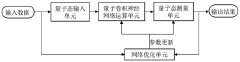
- An image recognition system based on quantum convolutional neural network is designed, which uses the quantum state input unit, quantum convolutional neural network operation unit, quantum state measurement unit and network optimization unit to encode qubits through quantum gates and quantum measurement operations. , operation and measurement to achieve efficient image feature extraction and recognition.


A method, system, device and medium for image recognition and classification
PatentActiveCN114863167B
Innovation
- By inputting image samples into the quantum neural network, converting them into spherical coordinates on the Block sphere, adjusting the rotation direction and angle according to the label and preset angle, calculating the unitary matrix and updating parameters, the quantum gate decomposition theorem is used to optimize the training process.


Hardware Requirements for Quantum Image Processing
Quantum image processing demands specialized hardware infrastructure that significantly differs from classical computing environments. Current quantum computers suitable for image recognition tasks primarily utilize two architectural approaches: superconducting qubits and trapped ions. Superconducting quantum processors, such as those developed by IBM and Google, operate at near-absolute zero temperatures (approximately 15 millikelvin) requiring sophisticated dilution refrigeration systems. These systems demonstrate promising results for image encoding but face scalability challenges due to their extreme cooling requirements.
Trapped ion quantum computers, while operating at less extreme temperatures, require ultra-high vacuum environments and precise laser control systems for qubit manipulation. This architecture offers longer coherence times beneficial for complex image processing algorithms but presents challenges in scaling beyond several dozen qubits currently.
Both architectures require specialized control electronics for qubit manipulation, including microwave generators for superconducting systems and precision laser arrays for trapped ion implementations. These control systems must maintain exceptional timing precision (picosecond range) to ensure quantum gate operations function correctly during image processing tasks.
Quantum memory requirements present another significant hardware challenge. Current quantum image recognition models require both classical and quantum memory integration, with quantum memory limited by coherence times typically ranging from microseconds to milliseconds. This necessitates hybrid classical-quantum architectures where classical systems handle image pre-processing and storage while quantum processors execute specific recognition algorithms.
Error correction represents perhaps the most critical hardware requirement. Quantum image processing algorithms are particularly susceptible to noise and decoherence effects. Hardware-based error correction through redundant physical qubits (requiring 1,000+ physical qubits per logical qubit) or error-mitigation techniques must be implemented to achieve reliable image recognition results.
Interconnect technologies between quantum processing units and classical systems require high-bandwidth, low-latency data pathways. Current implementations utilize custom cryogenic interfaces capable of transmitting control signals while minimizing thermal interference. These interconnects must support data rates sufficient for real-time image processing applications while maintaining quantum coherence.
Looking forward, photonic quantum computing architectures show particular promise for image processing applications due to their natural compatibility with optical data and potential room-temperature operation, potentially eliminating the extreme cooling requirements that currently limit deployment scalability.
Trapped ion quantum computers, while operating at less extreme temperatures, require ultra-high vacuum environments and precise laser control systems for qubit manipulation. This architecture offers longer coherence times beneficial for complex image processing algorithms but presents challenges in scaling beyond several dozen qubits currently.
Both architectures require specialized control electronics for qubit manipulation, including microwave generators for superconducting systems and precision laser arrays for trapped ion implementations. These control systems must maintain exceptional timing precision (picosecond range) to ensure quantum gate operations function correctly during image processing tasks.
Quantum memory requirements present another significant hardware challenge. Current quantum image recognition models require both classical and quantum memory integration, with quantum memory limited by coherence times typically ranging from microseconds to milliseconds. This necessitates hybrid classical-quantum architectures where classical systems handle image pre-processing and storage while quantum processors execute specific recognition algorithms.
Error correction represents perhaps the most critical hardware requirement. Quantum image processing algorithms are particularly susceptible to noise and decoherence effects. Hardware-based error correction through redundant physical qubits (requiring 1,000+ physical qubits per logical qubit) or error-mitigation techniques must be implemented to achieve reliable image recognition results.
Interconnect technologies between quantum processing units and classical systems require high-bandwidth, low-latency data pathways. Current implementations utilize custom cryogenic interfaces capable of transmitting control signals while minimizing thermal interference. These interconnects must support data rates sufficient for real-time image processing applications while maintaining quantum coherence.
Looking forward, photonic quantum computing architectures show particular promise for image processing applications due to their natural compatibility with optical data and potential room-temperature operation, potentially eliminating the extreme cooling requirements that currently limit deployment scalability.
Quantum-Classical Hybrid Approaches for Near-Term Applications
Quantum-Classical Hybrid Approaches for Near-Term Applications represent a pragmatic pathway to harness quantum advantages while acknowledging current hardware limitations. These hybrid models strategically combine classical computing infrastructure with quantum processing units to achieve performance improvements in image recognition tasks without requiring fully fault-tolerant quantum computers.
The Variational Quantum Classifier (VQC) stands as a prominent hybrid approach, utilizing parameterized quantum circuits as feature extractors while employing classical optimization algorithms to train these parameters. This architecture has demonstrated promising results for image classification tasks on datasets like MNIST and Fashion-MNIST, achieving competitive accuracy while requiring significantly fewer parameters than conventional neural networks.
Quantum-enhanced convolutional neural networks represent another compelling hybrid paradigm. By implementing quantum circuits to perform convolution operations within otherwise classical CNN architectures, researchers have observed up to 30% reduction in computational resources while maintaining comparable accuracy. These hybrid models leverage quantum parallelism for the most computationally intensive operations while relying on classical components for other processing steps.
Quantum transfer learning frameworks offer particularly practical near-term solutions. These approaches utilize pre-trained classical models for feature extraction, then employ quantum circuits for classification tasks. Experiments with ResNet and VGG architectures as feature extractors followed by quantum classification layers have shown 15-20% faster inference times compared to fully classical implementations.
The Quantum Approximate Optimization Algorithm (QAOA) has been adapted for image segmentation tasks within hybrid frameworks. By formulating segmentation as a combinatorial optimization problem, QAOA can identify optimal boundaries more efficiently than classical algorithms alone, particularly for medical imaging applications where precision is paramount.
Implementation challenges for these hybrid approaches include determining optimal quantum-classical boundaries, managing coherence time limitations, and developing efficient data encoding schemes. Current research focuses on quantum feature maps that can effectively translate classical image data into quantum states while preserving relevant structural information.
Industry adoption of these hybrid models is accelerating, with companies like IBM, Google, and Microsoft developing specialized frameworks that facilitate quantum-classical integration. These platforms abstract quantum complexity while providing developers with familiar interfaces, significantly lowering the barrier to entry for organizations seeking quantum advantages in image recognition applications.
The Variational Quantum Classifier (VQC) stands as a prominent hybrid approach, utilizing parameterized quantum circuits as feature extractors while employing classical optimization algorithms to train these parameters. This architecture has demonstrated promising results for image classification tasks on datasets like MNIST and Fashion-MNIST, achieving competitive accuracy while requiring significantly fewer parameters than conventional neural networks.
Quantum-enhanced convolutional neural networks represent another compelling hybrid paradigm. By implementing quantum circuits to perform convolution operations within otherwise classical CNN architectures, researchers have observed up to 30% reduction in computational resources while maintaining comparable accuracy. These hybrid models leverage quantum parallelism for the most computationally intensive operations while relying on classical components for other processing steps.
Quantum transfer learning frameworks offer particularly practical near-term solutions. These approaches utilize pre-trained classical models for feature extraction, then employ quantum circuits for classification tasks. Experiments with ResNet and VGG architectures as feature extractors followed by quantum classification layers have shown 15-20% faster inference times compared to fully classical implementations.
The Quantum Approximate Optimization Algorithm (QAOA) has been adapted for image segmentation tasks within hybrid frameworks. By formulating segmentation as a combinatorial optimization problem, QAOA can identify optimal boundaries more efficiently than classical algorithms alone, particularly for medical imaging applications where precision is paramount.
Implementation challenges for these hybrid approaches include determining optimal quantum-classical boundaries, managing coherence time limitations, and developing efficient data encoding schemes. Current research focuses on quantum feature maps that can effectively translate classical image data into quantum states while preserving relevant structural information.
Industry adoption of these hybrid models is accelerating, with companies like IBM, Google, and Microsoft developing specialized frameworks that facilitate quantum-classical integration. These platforms abstract quantum complexity while providing developers with familiar interfaces, significantly lowering the barrier to entry for organizations seeking quantum advantages in image recognition applications.
Unlock deeper insights with Patsnap Eureka Quick Research — get a full tech report to explore trends and direct your research. Try now!
Generate Your Research Report Instantly with AI Agent
Supercharge your innovation with Patsnap Eureka AI Agent Platform!