

Selective Adhesion Mechanisms in Soft Pneumatic Actuators
OCT 11, 20259 MIN READ
Generate Your Research Report Instantly with AI Agent
PatSnap Eureka helps you evaluate technical feasibility & market potential.
Soft Pneumatic Actuator Evolution and Objectives
Soft pneumatic actuators (SPAs) have evolved significantly over the past decades, transitioning from simple inflatable structures to sophisticated biomimetic systems capable of complex movements and interactions with their environment. The earliest iterations of SPAs emerged in the 1950s as basic pneumatic artificial muscles, primarily designed for linear actuation. These rudimentary systems laid the groundwork for subsequent innovations but lacked the versatility and control mechanisms seen in modern designs.
The 1990s marked a pivotal shift with the introduction of silicone-based soft materials, enabling greater flexibility and compliance. This period saw the development of the McKibben pneumatic artificial muscle, which utilized braided mesh structures to convert radial expansion into axial contraction, mimicking biological muscle function. However, these systems still operated with binary functionality—either fully extended or contracted—without selective adhesion capabilities.
The early 2000s witnessed the integration of microfluidics and soft lithography techniques, allowing for more intricate channel designs within pneumatic networks. This advancement facilitated the creation of SPAs with multiple degrees of freedom and more nuanced movement patterns. Researchers began exploring biomimetic designs inspired by octopus tentacles, elephant trunks, and plant movements, recognizing the potential for soft robotics to replicate natural motion mechanisms.
A significant breakthrough occurred around 2010 with the development of programmable matter concepts, where SPAs could be designed to change shape, stiffness, and functionality in response to specific stimuli. This period also saw the first explorations into selective adhesion mechanisms, primarily through the integration of gecko-inspired microstructures and switchable adhesive surfaces.
The current technological trajectory aims to develop SPAs with highly localized and controllable adhesion properties that can be activated and deactivated on demand. Key objectives include creating systems capable of adhering to diverse surface textures and materials, maintaining adhesion under varying load conditions, and achieving rapid switching between adhesive and non-adhesive states with minimal energy input.
Future research goals focus on enhancing the precision and reliability of selective adhesion mechanisms while reducing system complexity and energy requirements. This includes developing multi-modal adhesion strategies that combine electrostatic, van der Waals, and mechanical interlocking principles to optimize performance across different operational environments. Additionally, there is growing interest in creating self-healing adhesive interfaces that can maintain functionality despite wear or damage.
The ultimate objective is to produce SPAs with human-like or superior dexterity and tactile capabilities, enabling applications ranging from delicate medical procedures to robust industrial manipulation tasks in unstructured environments.
The 1990s marked a pivotal shift with the introduction of silicone-based soft materials, enabling greater flexibility and compliance. This period saw the development of the McKibben pneumatic artificial muscle, which utilized braided mesh structures to convert radial expansion into axial contraction, mimicking biological muscle function. However, these systems still operated with binary functionality—either fully extended or contracted—without selective adhesion capabilities.
The early 2000s witnessed the integration of microfluidics and soft lithography techniques, allowing for more intricate channel designs within pneumatic networks. This advancement facilitated the creation of SPAs with multiple degrees of freedom and more nuanced movement patterns. Researchers began exploring biomimetic designs inspired by octopus tentacles, elephant trunks, and plant movements, recognizing the potential for soft robotics to replicate natural motion mechanisms.
A significant breakthrough occurred around 2010 with the development of programmable matter concepts, where SPAs could be designed to change shape, stiffness, and functionality in response to specific stimuli. This period also saw the first explorations into selective adhesion mechanisms, primarily through the integration of gecko-inspired microstructures and switchable adhesive surfaces.
The current technological trajectory aims to develop SPAs with highly localized and controllable adhesion properties that can be activated and deactivated on demand. Key objectives include creating systems capable of adhering to diverse surface textures and materials, maintaining adhesion under varying load conditions, and achieving rapid switching between adhesive and non-adhesive states with minimal energy input.
Future research goals focus on enhancing the precision and reliability of selective adhesion mechanisms while reducing system complexity and energy requirements. This includes developing multi-modal adhesion strategies that combine electrostatic, van der Waals, and mechanical interlocking principles to optimize performance across different operational environments. Additionally, there is growing interest in creating self-healing adhesive interfaces that can maintain functionality despite wear or damage.
The ultimate objective is to produce SPAs with human-like or superior dexterity and tactile capabilities, enabling applications ranging from delicate medical procedures to robust industrial manipulation tasks in unstructured environments.
Market Applications and Demand Analysis
The market for Selective Adhesion Mechanisms in Soft Pneumatic Actuators has witnessed significant growth in recent years, driven by increasing demand across multiple industries. The global soft robotics market, which encompasses these actuators, was valued at approximately $645 million in 2020 and is projected to reach $2.1 billion by 2026, representing a compound annual growth rate of 21.5%. Selective adhesion technology specifically addresses a critical need within this market by enabling precise object manipulation with variable gripping forces.
Healthcare applications represent the largest market segment, with surgical robotics and rehabilitation devices leading adoption. Medical professionals require actuators capable of handling delicate tissues with precise control, creating substantial demand for selective adhesion mechanisms that can adjust their gripping force based on the target material. The aging population in developed countries further accelerates this demand, as rehabilitation and assistive devices become increasingly necessary.
Manufacturing and logistics sectors constitute the second-largest market segment, where the need for versatile gripping solutions capable of handling objects with varying shapes, sizes, and fragility drives adoption. The trend toward automation in these industries, coupled with labor shortages, has intensified the need for advanced gripping technologies that can replicate human dexterity while maintaining production efficiency.
Consumer electronics manufacturing presents another significant market opportunity, as selective adhesion mechanisms enable the handling of sensitive components during assembly processes. The miniaturization trend in electronics creates demand for actuators capable of manipulating increasingly smaller parts without damage.
Geographically, North America and Europe currently lead market adoption, primarily due to their advanced healthcare systems and manufacturing bases. However, the Asia-Pacific region is expected to witness the fastest growth rate, driven by rapid industrialization, increasing healthcare expenditure, and substantial investments in automation technologies.
Market challenges include cost considerations, as selective adhesion mechanisms typically require more sophisticated materials and control systems than conventional grippers. Additionally, durability concerns in industrial environments and the need for standardization across applications represent barriers to wider adoption.
Customer feedback indicates growing interest in energy-efficient designs and systems that can operate autonomously with minimal human intervention. This trend aligns with broader sustainability goals across industries and suggests a market shift toward more environmentally conscious technological solutions.
Healthcare applications represent the largest market segment, with surgical robotics and rehabilitation devices leading adoption. Medical professionals require actuators capable of handling delicate tissues with precise control, creating substantial demand for selective adhesion mechanisms that can adjust their gripping force based on the target material. The aging population in developed countries further accelerates this demand, as rehabilitation and assistive devices become increasingly necessary.
Manufacturing and logistics sectors constitute the second-largest market segment, where the need for versatile gripping solutions capable of handling objects with varying shapes, sizes, and fragility drives adoption. The trend toward automation in these industries, coupled with labor shortages, has intensified the need for advanced gripping technologies that can replicate human dexterity while maintaining production efficiency.
Consumer electronics manufacturing presents another significant market opportunity, as selective adhesion mechanisms enable the handling of sensitive components during assembly processes. The miniaturization trend in electronics creates demand for actuators capable of manipulating increasingly smaller parts without damage.
Geographically, North America and Europe currently lead market adoption, primarily due to their advanced healthcare systems and manufacturing bases. However, the Asia-Pacific region is expected to witness the fastest growth rate, driven by rapid industrialization, increasing healthcare expenditure, and substantial investments in automation technologies.
Market challenges include cost considerations, as selective adhesion mechanisms typically require more sophisticated materials and control systems than conventional grippers. Additionally, durability concerns in industrial environments and the need for standardization across applications represent barriers to wider adoption.
Customer feedback indicates growing interest in energy-efficient designs and systems that can operate autonomously with minimal human intervention. This trend aligns with broader sustainability goals across industries and suggests a market shift toward more environmentally conscious technological solutions.
Current Selective Adhesion Technologies and Barriers
Selective adhesion technologies in soft pneumatic actuators currently employ several distinct mechanisms, each with specific advantages and limitations. Electrostatic adhesion represents one of the most widely implemented approaches, utilizing controllable electrostatic forces between the actuator surface and target objects. This technology offers rapid activation/deactivation cycles and relatively low power consumption during sustained adhesion. However, its effectiveness diminishes significantly on non-conductive surfaces and in high-humidity environments, limiting practical applications in diverse operational conditions.
Vacuum-based adhesion systems constitute another prevalent solution, generating negative pressure differentials to create strong adhesive forces. These systems can achieve substantial holding forces on smooth surfaces and demonstrate versatility across various material types. The primary barriers include high energy consumption for continuous operation, sensitivity to surface irregularities, and potential for complete adhesion failure if seal integrity is compromised.
Gecko-inspired dry adhesives mimic the microscopic structures found on gecko feet, employing van der Waals forces for adhesion. These biomimetic solutions offer impressive adhesion-to-weight ratios and function effectively on various surface types without leaving residue. Current limitations include manufacturing complexity of hierarchical micro/nanostructures, gradual performance degradation after repeated use, and reduced effectiveness on wet or dusty surfaces.
Magnetically-activated adhesion mechanisms utilize embedded magnetic particles within soft actuator materials that can be selectively magnetized. While offering strong adhesion to ferromagnetic surfaces and excellent durability, these systems face significant barriers including limited applicability to non-ferrous materials and potential electromagnetic interference with sensitive equipment.
Chemical adhesion approaches, including switchable adhesives that respond to environmental stimuli (pH, temperature, light), represent an emerging technology with promising selectivity. However, these face substantial challenges in achieving rapid adhesion cycling, maintaining long-term chemical stability, and managing potential contamination issues in practical applications.
The integration of these adhesion mechanisms with soft pneumatic actuators presents additional technical barriers, particularly in maintaining actuator compliance while incorporating adhesion components. Current solutions often compromise either the mechanical flexibility of the actuator or the effectiveness of the adhesion mechanism. Furthermore, control systems capable of precisely modulating adhesion forces in coordination with actuator movement remain underdeveloped, limiting the potential for complex manipulation tasks.
Vacuum-based adhesion systems constitute another prevalent solution, generating negative pressure differentials to create strong adhesive forces. These systems can achieve substantial holding forces on smooth surfaces and demonstrate versatility across various material types. The primary barriers include high energy consumption for continuous operation, sensitivity to surface irregularities, and potential for complete adhesion failure if seal integrity is compromised.
Gecko-inspired dry adhesives mimic the microscopic structures found on gecko feet, employing van der Waals forces for adhesion. These biomimetic solutions offer impressive adhesion-to-weight ratios and function effectively on various surface types without leaving residue. Current limitations include manufacturing complexity of hierarchical micro/nanostructures, gradual performance degradation after repeated use, and reduced effectiveness on wet or dusty surfaces.
Magnetically-activated adhesion mechanisms utilize embedded magnetic particles within soft actuator materials that can be selectively magnetized. While offering strong adhesion to ferromagnetic surfaces and excellent durability, these systems face significant barriers including limited applicability to non-ferrous materials and potential electromagnetic interference with sensitive equipment.
Chemical adhesion approaches, including switchable adhesives that respond to environmental stimuli (pH, temperature, light), represent an emerging technology with promising selectivity. However, these face substantial challenges in achieving rapid adhesion cycling, maintaining long-term chemical stability, and managing potential contamination issues in practical applications.
The integration of these adhesion mechanisms with soft pneumatic actuators presents additional technical barriers, particularly in maintaining actuator compliance while incorporating adhesion components. Current solutions often compromise either the mechanical flexibility of the actuator or the effectiveness of the adhesion mechanism. Furthermore, control systems capable of precisely modulating adhesion forces in coordination with actuator movement remain underdeveloped, limiting the potential for complex manipulation tasks.
Existing Selective Adhesion Solutions in SPAs
01 Soft pneumatic actuators with adhesive surfaces
Soft pneumatic actuators can be designed with specialized adhesive surfaces that enable selective attachment to various objects or surfaces. These actuators utilize controlled air pressure to manipulate the adhesive interface, allowing for attachment and detachment on demand. The adhesive properties can be engineered to work on different surface types, making these actuators versatile for gripping applications in robotics and automation.- Soft pneumatic actuators with adhesive surfaces: Soft pneumatic actuators can be designed with specialized adhesive surfaces that enable selective attachment to various substrates. These actuators utilize controlled inflation and deflation mechanisms to engage or disengage adhesion as needed. The adhesive properties can be engineered through surface texturing, material selection, or coating applications, allowing for reversible adhesion that can be activated through pneumatic pressure changes.
- Biomimetic adhesion mechanisms in soft robotics: Inspired by natural adhesion mechanisms found in organisms like geckos and octopuses, soft pneumatic actuators can incorporate biomimetic features for selective adhesion. These designs often include microstructured surfaces, suction cup-like elements, or specialized materials that mimic biological adhesion principles. The pneumatic control allows for precise modulation of adhesive forces, enabling attachment to various surfaces including rough, smooth, wet, or dry substrates.
- Control systems for adhesion modulation: Advanced control systems enable precise regulation of adhesive properties in soft pneumatic actuators. These systems incorporate sensors, feedback mechanisms, and algorithms to adjust pneumatic pressure, resulting in controlled adhesion engagement and release. The control architecture allows for adaptive responses to different surface conditions and operational requirements, optimizing the adhesive performance based on real-time environmental factors.
- Multi-material composite structures for selective adhesion: Soft pneumatic actuators can be fabricated using composite structures that combine different materials with varying mechanical and adhesive properties. These multi-material designs enable localized control of stiffness, compliance, and adhesion characteristics. By strategically incorporating elastomers, fibers, and specialized coatings, these actuators can achieve selective adhesion patterns that can be activated through pneumatic actuation in specific regions.
- Application-specific adhesion mechanisms: Specialized soft pneumatic actuators with selective adhesion capabilities are designed for specific applications such as medical devices, manufacturing automation, and robotic manipulation. These application-tailored systems incorporate unique adhesion mechanisms optimized for particular operational environments. Features may include biocompatible adhesives for medical applications, high-strength temporary bonding for industrial assembly, or delicate handling capabilities for fragile object manipulation.
02 Biomimetic adhesion mechanisms for soft actuators
Inspired by natural adhesion mechanisms found in organisms like geckos and octopuses, these soft pneumatic actuators incorporate biomimetic design principles to achieve selective adhesion. The systems may use microstructured surfaces, van der Waals forces, or suction-based mechanisms that can be pneumatically controlled. These bio-inspired designs enable effective adhesion on various surfaces including rough, smooth, wet, or dry substrates.Expand Specific Solutions03 Control systems for selective adhesion in pneumatic actuators
Advanced control systems enable precise management of adhesion properties in soft pneumatic actuators. These systems regulate air pressure, timing, and distribution within the actuator to achieve selective adhesion. The control mechanisms may incorporate sensors for feedback, allowing real-time adjustment of adhesive properties based on environmental conditions or task requirements. This precise control enables applications requiring delicate handling or operation in variable environments.Expand Specific Solutions04 Multi-material composite structures for adhesive actuators
Soft pneumatic actuators with selective adhesion capabilities often utilize composite structures made from multiple materials with different properties. These may include elastomers with varying stiffness, embedded fibers for directional control, and specialized surface coatings for enhanced adhesion. The strategic combination of materials enables the creation of actuators with anisotropic behavior, where adhesion can be selectively activated in specific directions or regions of the device.Expand Specific Solutions05 Applications of selective adhesion pneumatic actuators
Soft pneumatic actuators with selective adhesion find applications across various fields including medical devices, manufacturing automation, and robotic manipulation. In medical contexts, they enable gentle tissue manipulation during surgical procedures. In manufacturing, they facilitate handling of delicate or irregularly shaped components. For robotics, they enhance gripping capabilities on diverse surfaces. The ability to control adhesion on demand makes these actuators particularly valuable for tasks requiring precise attachment and release cycles.Expand Specific Solutions
Leading Research Institutions and Industrial Players
The field of Selective Adhesion Mechanisms in Soft Pneumatic Actuators is currently in an emerging growth phase, with the market expected to reach significant expansion as soft robotics applications proliferate across industries. Academic institutions lead technological development, with Harvard College, Cornell University, and Jilin University establishing foundational research. Commercial entities like Oxipital AI and RIVERFIELD Inc. are beginning to translate academic innovations into practical applications. The technology maturity varies across sub-domains, with basic adhesion mechanisms well-understood but selective and controllable adhesion systems still developing. Integration of advanced materials science from Korea Institute of Machinery & Materials and BorgWarner's manufacturing expertise is accelerating the transition from laboratory prototypes to commercial viability in industrial automation, healthcare, and consumer robotics sectors.
President & Fellows of Harvard College
Technical Solution: Harvard's Wyss Institute has pioneered selective adhesion mechanisms in soft pneumatic actuators through their groundbreaking work on bioinspired soft robotics. Their technology utilizes micropatterned surfaces with controllable adhesion properties that can be activated and deactivated through pneumatic pressure changes. The system employs a multi-layer design with specialized elastomeric materials featuring microscale structures that create van der Waals forces when pressed against surfaces. By controlling internal air pressure, these structures can be engaged or disengaged, allowing for precise adhesion control. Harvard researchers have developed actuators capable of supporting loads up to 100 times their weight while maintaining the ability to release on command through pressure modulation. This technology has been integrated into their soft robotic grippers that can handle delicate objects without damage and adhere to various surface textures and geometries.
Strengths: Superior biomimetic design principles derived from extensive biological research; exceptional strength-to-weight ratio in adhesion mechanisms; precise control over adhesion-release cycles; compatibility with various surface types. Weaknesses: Requires sophisticated manufacturing techniques for micropatterned surfaces; potential durability concerns with repeated adhesion cycles; performance may degrade on extremely rough or dusty surfaces.
Cornell University
Technical Solution: Cornell University has developed an innovative approach to selective adhesion in soft pneumatic actuators through their Organic Robotics Lab. Their technology incorporates electroadhesive elements within soft pneumatic structures, creating a hybrid system that combines the conformability of pneumatics with electrically controlled adhesion. The actuators feature embedded flexible electrodes within silicone-based structures that generate electrostatic forces when voltage is applied. This allows for rapid switching between adhesive and non-adhesive states independent of the pneumatic actuation state. Cornell's system utilizes a multi-layer fabrication process where conductive and non-conductive elastomers are precisely arranged to create localized adhesion zones. Their actuators can generate adhesive forces up to 3 kPa on various surfaces while maintaining the inherent compliance and safety advantages of soft robotics. The technology has been demonstrated in wall-climbing robots and delicate object manipulation tasks where traditional grippers would fail.
Strengths: Dual-mode operation combining pneumatic actuation with electroadhesion for enhanced versatility; rapid switching between adhesive states; works on diverse surface materials including non-conductive surfaces. Weaknesses: Requires power supply for electroadhesion functionality; potential for reduced effectiveness in humid environments; more complex control systems needed to coordinate pneumatic and electrical inputs.
Key Patents and Research on Adhesion Control
Pneumatic soft actuators with tunable force-displacement relation and methods and machines therefor
PatentPendingUS20230373082A1
Innovation
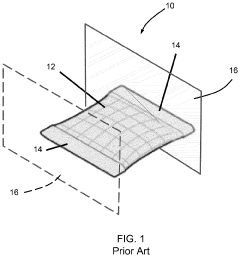
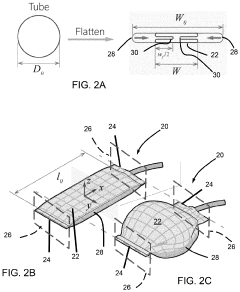
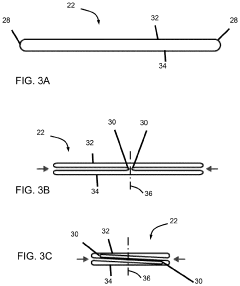
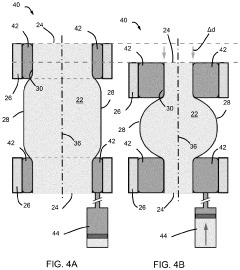
- A pneumatic soft actuator with an inflatable pouch featuring symmetrical folds at its ends, allowing for active modification of the end geometry through a branched tendon and spool mechanism, enabling adjustment of the force-strain relationship and range of motion without altering the pouch's composition or structure.
Material Science Considerations for Adhesion Performance
The material science aspects of selective adhesion in soft pneumatic actuators represent a critical frontier in the development of advanced robotic systems. The adhesion performance of these actuators fundamentally depends on the intricate interplay between surface chemistry, mechanical properties, and structural design of the materials employed. Current research indicates that van der Waals forces, electrostatic interactions, and mechanical interlocking mechanisms collectively contribute to the adhesion capabilities of soft actuators.
Surface modification techniques have emerged as powerful approaches to enhance selective adhesion. These include plasma treatment, chemical functionalization, and the application of specialized coatings that can alter surface energy and introduce specific chemical groups. For instance, silane-based treatments have demonstrated remarkable success in modulating the hydrophobicity of silicone elastomers, thereby controlling their adhesion properties under varying environmental conditions.
The viscoelastic properties of materials used in soft pneumatic actuators significantly influence adhesion performance. Materials with optimized viscoelasticity can conform to surface irregularities at the microscale, maximizing contact area and consequently enhancing adhesion strength. Recent studies have explored composite materials that combine elastomers with functional fillers such as carbon nanotubes or metallic nanoparticles to achieve tunable viscoelastic responses.
Biomimetic approaches have gained substantial traction in material selection and design. Inspired by natural adhesion systems like gecko feet and octopus suckers, researchers have developed micropatterned surfaces with hierarchical structures that demonstrate remarkable adhesion capabilities. These bio-inspired materials often incorporate features at multiple length scales, from nanometers to millimeters, to optimize both adhesion strength and selectivity.
Environmental responsiveness represents another crucial dimension in material selection. Materials that can dynamically alter their adhesion properties in response to external stimuli (temperature, humidity, pH, or electrical signals) offer unprecedented control over selective adhesion. Stimuli-responsive polymers, particularly those based on poly(N-isopropylacrylamide) and its derivatives, have shown promising results in creating actuators with switchable adhesion properties.
Durability and fatigue resistance of adhesive interfaces present ongoing challenges. The repeated attachment-detachment cycles in practical applications can lead to material degradation and diminished adhesion performance over time. Recent advances in self-healing materials and damage-resistant composites offer potential solutions to extend the operational lifespan of adhesive interfaces in soft pneumatic actuators.
Surface modification techniques have emerged as powerful approaches to enhance selective adhesion. These include plasma treatment, chemical functionalization, and the application of specialized coatings that can alter surface energy and introduce specific chemical groups. For instance, silane-based treatments have demonstrated remarkable success in modulating the hydrophobicity of silicone elastomers, thereby controlling their adhesion properties under varying environmental conditions.
The viscoelastic properties of materials used in soft pneumatic actuators significantly influence adhesion performance. Materials with optimized viscoelasticity can conform to surface irregularities at the microscale, maximizing contact area and consequently enhancing adhesion strength. Recent studies have explored composite materials that combine elastomers with functional fillers such as carbon nanotubes or metallic nanoparticles to achieve tunable viscoelastic responses.
Biomimetic approaches have gained substantial traction in material selection and design. Inspired by natural adhesion systems like gecko feet and octopus suckers, researchers have developed micropatterned surfaces with hierarchical structures that demonstrate remarkable adhesion capabilities. These bio-inspired materials often incorporate features at multiple length scales, from nanometers to millimeters, to optimize both adhesion strength and selectivity.
Environmental responsiveness represents another crucial dimension in material selection. Materials that can dynamically alter their adhesion properties in response to external stimuli (temperature, humidity, pH, or electrical signals) offer unprecedented control over selective adhesion. Stimuli-responsive polymers, particularly those based on poly(N-isopropylacrylamide) and its derivatives, have shown promising results in creating actuators with switchable adhesion properties.
Durability and fatigue resistance of adhesive interfaces present ongoing challenges. The repeated attachment-detachment cycles in practical applications can lead to material degradation and diminished adhesion performance over time. Recent advances in self-healing materials and damage-resistant composites offer potential solutions to extend the operational lifespan of adhesive interfaces in soft pneumatic actuators.
Biomimetic Approaches to Selective Adhesion Design
Nature has perfected selective adhesion mechanisms through millions of years of evolution, providing invaluable inspiration for engineering solutions in soft pneumatic actuators. Biomimetic approaches to selective adhesion design draw directly from biological systems that demonstrate remarkable adhesion capabilities under varying conditions.
The gecko's foot represents one of the most studied biological models for selective adhesion. Its hierarchical structure of setae and spatulae enables strong van der Waals interactions with surfaces while allowing for easy detachment through directional control. This principle has been adapted in soft pneumatic actuators by incorporating microstructured surfaces that can be dynamically reconfigured through pneumatic actuation, enabling controlled attachment and detachment cycles.
Octopus suckers offer another compelling model, utilizing pressure differentials for powerful yet reversible adhesion. These biological structures have inspired vacuum-based gripping mechanisms in soft actuators that can conform to irregular surfaces while maintaining strong adhesion forces. The integration of micropatterned surfaces within these suction-based systems has significantly enhanced their performance on various substrate materials.
Plant-inspired adhesion mechanisms, such as those found in climbing plants with specialized attachment pads, demonstrate how selective chemical bonding can be employed for temporary adhesion. Researchers have developed soft actuators with stimuli-responsive polymers that can switch between adhesive and non-adhesive states in response to pneumatic pressure changes, mimicking these natural systems.
Mussels' byssus threads provide insights into wet adhesion mechanisms that maintain effectiveness underwater or in humid conditions. This has led to the development of moisture-resistant adhesive interfaces for soft pneumatic grippers that can operate reliably in challenging environments. The incorporation of catechol-based chemistry, similar to that found in mussel adhesive proteins, has shown particular promise in these applications.
The dynamic control of surface properties observed in sea cucumbers has inspired adaptive adhesion systems in soft robotics. These organisms can rapidly alter their tissue stiffness and adhesive properties through biochemical regulation. Similarly, engineered soft actuators now incorporate materials that can transition between rigid and compliant states, allowing for precise modulation of adhesion strength during operation.
Cross-disciplinary collaboration between biologists and engineers continues to yield innovative biomimetic solutions for selective adhesion challenges in soft pneumatic systems, with particular focus on improving adhesion strength, selectivity, and longevity while maintaining the inherent compliance and adaptability that make soft actuators valuable.
The gecko's foot represents one of the most studied biological models for selective adhesion. Its hierarchical structure of setae and spatulae enables strong van der Waals interactions with surfaces while allowing for easy detachment through directional control. This principle has been adapted in soft pneumatic actuators by incorporating microstructured surfaces that can be dynamically reconfigured through pneumatic actuation, enabling controlled attachment and detachment cycles.
Octopus suckers offer another compelling model, utilizing pressure differentials for powerful yet reversible adhesion. These biological structures have inspired vacuum-based gripping mechanisms in soft actuators that can conform to irregular surfaces while maintaining strong adhesion forces. The integration of micropatterned surfaces within these suction-based systems has significantly enhanced their performance on various substrate materials.
Plant-inspired adhesion mechanisms, such as those found in climbing plants with specialized attachment pads, demonstrate how selective chemical bonding can be employed for temporary adhesion. Researchers have developed soft actuators with stimuli-responsive polymers that can switch between adhesive and non-adhesive states in response to pneumatic pressure changes, mimicking these natural systems.
Mussels' byssus threads provide insights into wet adhesion mechanisms that maintain effectiveness underwater or in humid conditions. This has led to the development of moisture-resistant adhesive interfaces for soft pneumatic grippers that can operate reliably in challenging environments. The incorporation of catechol-based chemistry, similar to that found in mussel adhesive proteins, has shown particular promise in these applications.
The dynamic control of surface properties observed in sea cucumbers has inspired adaptive adhesion systems in soft robotics. These organisms can rapidly alter their tissue stiffness and adhesive properties through biochemical regulation. Similarly, engineered soft actuators now incorporate materials that can transition between rigid and compliant states, allowing for precise modulation of adhesion strength during operation.
Cross-disciplinary collaboration between biologists and engineers continues to yield innovative biomimetic solutions for selective adhesion challenges in soft pneumatic systems, with particular focus on improving adhesion strength, selectivity, and longevity while maintaining the inherent compliance and adaptability that make soft actuators valuable.
Unlock deeper insights with PatSnap Eureka Quick Research — get a full tech report to explore trends and direct your research. Try now!
Generate Your Research Report Instantly with AI Agent
Supercharge your innovation with PatSnap Eureka AI Agent Platform!