Silicone Rubber's Role in High-Performance Filter Technologies
JUL 8, 20259 MIN READ
Generate Your Research Report Instantly with AI Agent
Patsnap Eureka helps you evaluate technical feasibility & market potential.
Silicone Rubber Filtration Evolution
The evolution of silicone rubber in filtration technologies represents a significant advancement in the field of high-performance filters. Initially developed in the 1940s, silicone rubber quickly gained attention for its unique properties, including excellent thermal stability, chemical resistance, and flexibility. These characteristics made it an ideal candidate for various industrial applications, including filtration systems.
In the 1960s and 1970s, researchers began exploring the potential of silicone rubber in membrane filtration. The material's ability to form thin, porous structures with controlled pore sizes opened up new possibilities for selective filtration processes. This period saw the development of silicone rubber membranes for gas separation and liquid filtration applications.
The 1980s marked a turning point in silicone rubber filtration technology with the introduction of cross-linked silicone rubber membranes. These membranes exhibited improved mechanical strength and chemical resistance, allowing for their use in more demanding filtration environments. This innovation led to the adoption of silicone rubber filters in industries such as pharmaceuticals, food processing, and water treatment.
During the 1990s and early 2000s, advancements in material science and manufacturing techniques further enhanced the performance of silicone rubber filters. The development of composite membranes, combining silicone rubber with other materials like polyethylene or polypropylene, resulted in filters with superior selectivity and durability. These composite filters found applications in challenging separation processes, such as the removal of volatile organic compounds from air and the purification of industrial wastewater.
In recent years, the focus has shifted towards the development of nanostructured silicone rubber filters. By incorporating nanoparticles or creating nanoscale surface features, researchers have been able to enhance the filtration efficiency and selectivity of silicone rubber membranes. These nanostructured filters have shown promise in applications ranging from air purification to biomedical separations.
The latest trend in silicone rubber filtration technology involves the integration of smart materials and responsive elements. By incorporating stimuli-responsive polymers or electrically conductive additives, researchers are developing silicone rubber filters that can adapt to changing environmental conditions or be controlled externally. These smart filters have the potential to revolutionize industries such as healthcare, environmental monitoring, and advanced manufacturing.
As we look to the future, the evolution of silicone rubber in filtration technologies continues to accelerate. Ongoing research focuses on improving the material's performance, developing novel manufacturing techniques, and exploring new applications. With its unique combination of properties and versatility, silicone rubber is poised to play an increasingly important role in addressing global challenges related to water scarcity, air pollution, and sustainable industrial processes.
In the 1960s and 1970s, researchers began exploring the potential of silicone rubber in membrane filtration. The material's ability to form thin, porous structures with controlled pore sizes opened up new possibilities for selective filtration processes. This period saw the development of silicone rubber membranes for gas separation and liquid filtration applications.
The 1980s marked a turning point in silicone rubber filtration technology with the introduction of cross-linked silicone rubber membranes. These membranes exhibited improved mechanical strength and chemical resistance, allowing for their use in more demanding filtration environments. This innovation led to the adoption of silicone rubber filters in industries such as pharmaceuticals, food processing, and water treatment.
During the 1990s and early 2000s, advancements in material science and manufacturing techniques further enhanced the performance of silicone rubber filters. The development of composite membranes, combining silicone rubber with other materials like polyethylene or polypropylene, resulted in filters with superior selectivity and durability. These composite filters found applications in challenging separation processes, such as the removal of volatile organic compounds from air and the purification of industrial wastewater.
In recent years, the focus has shifted towards the development of nanostructured silicone rubber filters. By incorporating nanoparticles or creating nanoscale surface features, researchers have been able to enhance the filtration efficiency and selectivity of silicone rubber membranes. These nanostructured filters have shown promise in applications ranging from air purification to biomedical separations.
The latest trend in silicone rubber filtration technology involves the integration of smart materials and responsive elements. By incorporating stimuli-responsive polymers or electrically conductive additives, researchers are developing silicone rubber filters that can adapt to changing environmental conditions or be controlled externally. These smart filters have the potential to revolutionize industries such as healthcare, environmental monitoring, and advanced manufacturing.
As we look to the future, the evolution of silicone rubber in filtration technologies continues to accelerate. Ongoing research focuses on improving the material's performance, developing novel manufacturing techniques, and exploring new applications. With its unique combination of properties and versatility, silicone rubber is poised to play an increasingly important role in addressing global challenges related to water scarcity, air pollution, and sustainable industrial processes.
High-Performance Filter Market Analysis
The high-performance filter market has experienced significant growth in recent years, driven by increasing demand for advanced filtration solutions across various industries. This market segment encompasses a wide range of filter types, including air filters, water filters, and industrial process filters, all designed to meet stringent performance requirements.
The global high-performance filter market is primarily fueled by stringent environmental regulations, growing awareness of air and water quality, and the need for efficient filtration in industrial processes. Industries such as automotive, healthcare, electronics, and aerospace are major contributors to market growth, as they require advanced filtration technologies to meet their specific needs.
In the automotive sector, high-performance filters are essential for improving engine efficiency and reducing emissions. The healthcare industry relies on these filters for clean room environments and medical device manufacturing. The electronics industry requires ultra-clean environments for semiconductor production, driving demand for high-efficiency particulate air (HEPA) filters.
The market is characterized by continuous innovation and technological advancements. Manufacturers are focusing on developing filters with improved efficiency, longer lifespan, and reduced pressure drop. Nanotechnology and advanced materials, including silicone rubber, are playing crucial roles in enhancing filter performance and durability.
Geographically, North America and Europe hold significant market shares due to strict environmental regulations and high adoption rates of advanced technologies. However, the Asia-Pacific region is expected to witness the fastest growth, driven by rapid industrialization, urbanization, and increasing environmental concerns in countries like China and India.
Key market players include 3M Company, Donaldson Company, Inc., Pall Corporation, and Parker Hannifin Corporation. These companies are investing heavily in research and development to maintain their competitive edge and expand their product portfolios.
The COVID-19 pandemic has further accelerated market growth, particularly in the healthcare and personal protective equipment sectors. The increased focus on air quality and hygiene has led to a surge in demand for high-performance air filtration systems in various settings, including hospitals, offices, and public spaces.
Looking ahead, the high-performance filter market is poised for continued growth. Factors such as increasing industrial activities, growing environmental concerns, and the need for advanced filtration in emerging technologies like electric vehicles and renewable energy systems are expected to drive market expansion in the coming years.
The global high-performance filter market is primarily fueled by stringent environmental regulations, growing awareness of air and water quality, and the need for efficient filtration in industrial processes. Industries such as automotive, healthcare, electronics, and aerospace are major contributors to market growth, as they require advanced filtration technologies to meet their specific needs.
In the automotive sector, high-performance filters are essential for improving engine efficiency and reducing emissions. The healthcare industry relies on these filters for clean room environments and medical device manufacturing. The electronics industry requires ultra-clean environments for semiconductor production, driving demand for high-efficiency particulate air (HEPA) filters.
The market is characterized by continuous innovation and technological advancements. Manufacturers are focusing on developing filters with improved efficiency, longer lifespan, and reduced pressure drop. Nanotechnology and advanced materials, including silicone rubber, are playing crucial roles in enhancing filter performance and durability.
Geographically, North America and Europe hold significant market shares due to strict environmental regulations and high adoption rates of advanced technologies. However, the Asia-Pacific region is expected to witness the fastest growth, driven by rapid industrialization, urbanization, and increasing environmental concerns in countries like China and India.
Key market players include 3M Company, Donaldson Company, Inc., Pall Corporation, and Parker Hannifin Corporation. These companies are investing heavily in research and development to maintain their competitive edge and expand their product portfolios.
The COVID-19 pandemic has further accelerated market growth, particularly in the healthcare and personal protective equipment sectors. The increased focus on air quality and hygiene has led to a surge in demand for high-performance air filtration systems in various settings, including hospitals, offices, and public spaces.
Looking ahead, the high-performance filter market is poised for continued growth. Factors such as increasing industrial activities, growing environmental concerns, and the need for advanced filtration in emerging technologies like electric vehicles and renewable energy systems are expected to drive market expansion in the coming years.
Silicone Rubber Filter Tech Challenges
Silicone rubber has emerged as a critical material in high-performance filter technologies, offering unique properties that address several key challenges in filtration systems. One of the primary technical hurdles is achieving a balance between filtration efficiency and pressure drop. Silicone rubber's flexibility and elasticity allow for the creation of filter media with precisely controlled pore sizes, enabling high particle capture rates while maintaining low resistance to airflow.
Another significant challenge is the durability and longevity of filter materials in harsh environments. Silicone rubber exhibits exceptional chemical resistance and thermal stability, making it suitable for applications in corrosive atmospheres and high-temperature settings. This resilience extends the operational life of filters and reduces maintenance frequency, addressing the industry's demand for more robust filtration solutions.
The need for adaptable filter designs that can conform to various geometries and space constraints presents an additional technical obstacle. Silicone rubber's moldability and shape retention properties facilitate the production of complex filter structures, enabling engineers to create custom-fit solutions for diverse applications, from automotive air intakes to industrial gas purification systems.
Moisture management in filter systems is a persistent challenge, particularly in humid environments. Silicone rubber's hydrophobic nature helps repel water, preventing the growth of mold and bacteria that can compromise filter performance and air quality. This characteristic is especially valuable in HVAC systems and respiratory protection devices.
The development of smart filtration technologies introduces new technical hurdles. Integrating sensors and responsive elements into filter media requires materials that can accommodate electronic components without compromising filtration efficiency. Silicone rubber's compatibility with various additives and its ability to be formulated with conductive properties make it a promising candidate for such advanced filter systems.
Scalability and cost-effectiveness in manufacturing high-performance filters remain ongoing challenges. While silicone rubber offers excellent performance characteristics, optimizing production processes to reduce material costs and increase output rates is crucial for widespread adoption. Innovations in silicone rubber formulations and processing techniques are needed to address these economic constraints while maintaining the material's superior filtration properties.
Another significant challenge is the durability and longevity of filter materials in harsh environments. Silicone rubber exhibits exceptional chemical resistance and thermal stability, making it suitable for applications in corrosive atmospheres and high-temperature settings. This resilience extends the operational life of filters and reduces maintenance frequency, addressing the industry's demand for more robust filtration solutions.
The need for adaptable filter designs that can conform to various geometries and space constraints presents an additional technical obstacle. Silicone rubber's moldability and shape retention properties facilitate the production of complex filter structures, enabling engineers to create custom-fit solutions for diverse applications, from automotive air intakes to industrial gas purification systems.
Moisture management in filter systems is a persistent challenge, particularly in humid environments. Silicone rubber's hydrophobic nature helps repel water, preventing the growth of mold and bacteria that can compromise filter performance and air quality. This characteristic is especially valuable in HVAC systems and respiratory protection devices.
The development of smart filtration technologies introduces new technical hurdles. Integrating sensors and responsive elements into filter media requires materials that can accommodate electronic components without compromising filtration efficiency. Silicone rubber's compatibility with various additives and its ability to be formulated with conductive properties make it a promising candidate for such advanced filter systems.
Scalability and cost-effectiveness in manufacturing high-performance filters remain ongoing challenges. While silicone rubber offers excellent performance characteristics, optimizing production processes to reduce material costs and increase output rates is crucial for widespread adoption. Innovations in silicone rubber formulations and processing techniques are needed to address these economic constraints while maintaining the material's superior filtration properties.
Current Silicone Rubber Filter Solutions
01 Composition and formulation of silicone rubber
Silicone rubber compositions typically consist of silicone polymers, fillers, and curing agents. The formulation can be adjusted to achieve specific properties such as hardness, elasticity, and heat resistance. Various additives may be incorporated to enhance performance characteristics or provide additional functionalities.- Composition and formulation of silicone rubber: Silicone rubber compositions typically consist of silicone polymers, fillers, and curing agents. The formulation can be adjusted to achieve specific properties such as hardness, elasticity, and heat resistance. Various additives may be incorporated to enhance performance characteristics or provide additional functionalities.
- Manufacturing processes for silicone rubber products: Different manufacturing techniques are employed to produce silicone rubber products, including molding, extrusion, and calendering. These processes involve mixing the raw materials, shaping the compound, and curing it to achieve the desired form. Advanced manufacturing methods may incorporate automation and precision control for improved quality and efficiency.
- Modifications and enhancements to silicone rubber properties: Researchers continually work on modifying silicone rubber to enhance its properties. This includes improving heat resistance, increasing tensile strength, enhancing electrical insulation, and developing self-healing capabilities. Various techniques such as chemical modification, blending with other materials, and incorporation of nanoparticles are explored to achieve these enhancements.
- Applications of silicone rubber in various industries: Silicone rubber finds widespread use across multiple industries due to its unique properties. It is utilized in medical devices, automotive parts, electrical insulation, consumer products, and aerospace components. The material's biocompatibility, durability, and resistance to extreme temperatures make it suitable for diverse applications.
- Environmental considerations and sustainability of silicone rubber: As environmental concerns grow, research is focused on developing more sustainable silicone rubber formulations. This includes exploring bio-based alternatives, improving recyclability, and reducing the environmental impact of production processes. Efforts are also directed towards enhancing the durability and longevity of silicone rubber products to minimize waste.
02 Manufacturing processes for silicone rubber products
Different manufacturing techniques are employed to produce silicone rubber products, including molding, extrusion, and calendering. These processes involve careful control of temperature, pressure, and curing conditions to achieve desired product specifications. Advanced manufacturing methods may incorporate automation and precision control systems.Expand Specific Solutions03 Modifications and improvements to silicone rubber properties
Researchers continually work on enhancing silicone rubber properties through various modifications. This includes the development of new polymer structures, incorporation of novel fillers or reinforcing agents, and the use of specialized additives to improve characteristics such as tear strength, compression set, and chemical resistance.Expand Specific Solutions04 Applications of silicone rubber in various industries
Silicone rubber finds widespread use across multiple industries due to its unique properties. It is utilized in medical devices, automotive components, electrical insulation, consumer products, and aerospace applications. The material's biocompatibility, heat resistance, and durability make it suitable for diverse and demanding environments.Expand Specific Solutions05 Environmental considerations and sustainability in silicone rubber production
There is growing focus on developing environmentally friendly silicone rubber formulations and production processes. This includes the use of bio-based materials, reduction of volatile organic compounds, and implementation of recycling techniques for silicone rubber products. Efforts are also being made to improve energy efficiency in manufacturing and reduce the overall environmental footprint of silicone rubber production.Expand Specific Solutions
Key Players in Silicone Filter Industry
The market for high-performance filter technologies utilizing silicone rubber is in a growth phase, driven by increasing demand across various industries. The global market size is expanding, with projections indicating significant growth in the coming years. Technologically, the field is advancing rapidly, with key players like Shin-Etsu Chemical, Wacker Chemie, and Dow Silicones leading innovation. These companies, along with others such as Evonik Operations and China Petroleum & Chemical Corp., are investing heavily in R&D to improve silicone rubber properties for filtration applications. The competitive landscape is characterized by a mix of established chemical giants and specialized silicone manufacturers, each leveraging their expertise to gain market share in this evolving sector.
Shin-Etsu Chemical Co., Ltd.
Technical Solution: Shin-Etsu Chemical has developed advanced silicone rubber compounds specifically designed for high-performance filter technologies. Their proprietary formulations incorporate fine silica particles and specialized cross-linking agents to create microporous structures ideal for filtration[1]. These silicone rubber filters demonstrate excellent chemical resistance, thermal stability up to 200°C, and maintain flexibility even at low temperatures[2]. The company has also introduced self-healing silicone rubber membranes that can repair minor damage, extending filter lifespan in harsh environments[3]. Shin-Etsu's filters are particularly effective in removing particulates down to 0.1 microns in size, making them suitable for clean room applications and sensitive industrial processes[4].
Strengths: Superior chemical resistance, wide temperature range operability, self-healing capabilities. Weaknesses: Higher cost compared to traditional filter materials, potential for silicone leaching in certain applications.
Dow Silicones Corp.
Technical Solution: Dow Silicones has pioneered the development of silicone rubber-based filter technologies with their SILASTIC™ line of products. Their approach focuses on creating highly permeable silicone membranes with precisely controlled pore sizes, achieved through a proprietary emulsion polymerization process[1]. These filters exhibit exceptional durability, with some variants capable of withstanding over 1 million compression cycles without significant degradation[2]. Dow's silicone rubber filters are particularly noted for their biocompatibility, making them ideal for medical and pharmaceutical applications. The company has also developed hybrid silicone-fluoropolymer composites that combine the flexibility of silicone with the chemical inertness of fluoropolymers, expanding the range of filtration applications[3].
Strengths: Excellent durability and cycle life, high biocompatibility, innovative hybrid materials. Weaknesses: Limited effectiveness in extremely high-temperature environments, potential for biofouling in certain applications.
Innovative Silicone Filter Technologies
Addition reaction-curable liquid silicone rubber compositions and process of preparing same
PatentActiveUS20050277725A1
Innovation
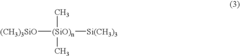
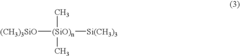
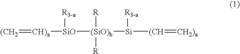
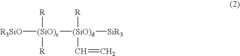
- An addition reaction-curable liquid silicone rubber composition comprising specific organopolysiloxanes, finely divided silica, hexamethyldisilazane, water, and an organohydrogenpolysiloxane, along with a hydrosilation catalyst, is developed, allowing for a cured product with a hardness of at least 75 and an elongation at break of at least 200%, enabling broader application beyond insulation potting.
Improved PIB barrier coating composition for permeation reduction of silicone rubber parts
PatentWO2005035637A1
Innovation
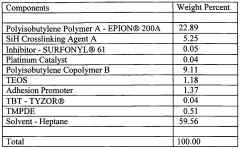
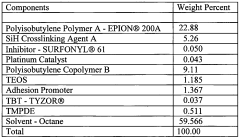
- A cured polyisobutylene coating composition is applied to untreated silicone rubber substrates, comprising a polyisobutylene polymer, crosslinking agent, catalyst, and an adhesion promoter containing polysiloxane and epoxy silane, eliminating the need for surface treatment.
Environmental Impact of Silicone Filters
The environmental impact of silicone filters is a critical consideration in the development and application of high-performance filter technologies. Silicone rubber, as a key component in these filters, offers several advantages that contribute to improved environmental outcomes. One of the primary benefits is the durability and longevity of silicone filters, which significantly reduces the frequency of filter replacements. This, in turn, leads to a decrease in waste generation and resource consumption associated with filter production and disposal.
Silicone filters also demonstrate excellent chemical resistance, allowing them to withstand exposure to various pollutants and harsh environmental conditions without degrading. This characteristic ensures consistent filtration performance over extended periods, reducing the risk of contaminant release into the environment due to filter failure. Additionally, the flexibility and elasticity of silicone rubber enable the creation of filters with complex geometries and fine pore structures, enhancing filtration efficiency and potentially reducing energy consumption in filtration systems.
From a lifecycle perspective, silicone filters generally have a lower environmental footprint compared to traditional filter materials. The production of silicone rubber requires less energy and generates fewer greenhouse gas emissions than many alternative materials. Furthermore, silicone's inert nature means it does not leach harmful chemicals into the environment during use or disposal, minimizing potential ecological impacts.
However, it is important to note that the end-of-life management of silicone filters presents some challenges. While silicone rubber is theoretically recyclable, the current infrastructure for recycling silicone products is limited in many regions. This can result in silicone filters being disposed of in landfills, where they may persist for extended periods due to their resistance to biodegradation.
Efforts are underway to address these end-of-life issues, including research into more efficient silicone recycling processes and the development of biodegradable silicone composites. Some manufacturers are also exploring take-back programs and closed-loop recycling systems for silicone filters, aiming to reduce waste and promote a more circular economy approach.
In the context of air and water filtration applications, silicone filters contribute to improved environmental quality by effectively removing pollutants and particulates. Their use in industrial processes, automotive applications, and HVAC systems helps reduce emissions and improve air and water quality, indirectly benefiting ecosystems and human health.
As environmental regulations become more stringent, the role of silicone filters in meeting compliance standards is likely to grow. Their ability to perform under extreme conditions and maintain efficiency over time makes them valuable tools in addressing environmental challenges across various industries.
Silicone filters also demonstrate excellent chemical resistance, allowing them to withstand exposure to various pollutants and harsh environmental conditions without degrading. This characteristic ensures consistent filtration performance over extended periods, reducing the risk of contaminant release into the environment due to filter failure. Additionally, the flexibility and elasticity of silicone rubber enable the creation of filters with complex geometries and fine pore structures, enhancing filtration efficiency and potentially reducing energy consumption in filtration systems.
From a lifecycle perspective, silicone filters generally have a lower environmental footprint compared to traditional filter materials. The production of silicone rubber requires less energy and generates fewer greenhouse gas emissions than many alternative materials. Furthermore, silicone's inert nature means it does not leach harmful chemicals into the environment during use or disposal, minimizing potential ecological impacts.
However, it is important to note that the end-of-life management of silicone filters presents some challenges. While silicone rubber is theoretically recyclable, the current infrastructure for recycling silicone products is limited in many regions. This can result in silicone filters being disposed of in landfills, where they may persist for extended periods due to their resistance to biodegradation.
Efforts are underway to address these end-of-life issues, including research into more efficient silicone recycling processes and the development of biodegradable silicone composites. Some manufacturers are also exploring take-back programs and closed-loop recycling systems for silicone filters, aiming to reduce waste and promote a more circular economy approach.
In the context of air and water filtration applications, silicone filters contribute to improved environmental quality by effectively removing pollutants and particulates. Their use in industrial processes, automotive applications, and HVAC systems helps reduce emissions and improve air and water quality, indirectly benefiting ecosystems and human health.
As environmental regulations become more stringent, the role of silicone filters in meeting compliance standards is likely to grow. Their ability to perform under extreme conditions and maintain efficiency over time makes them valuable tools in addressing environmental challenges across various industries.
Silicone Filter Manufacturing Processes
The manufacturing processes for silicone filters involve several key steps that leverage the unique properties of silicone rubber to create high-performance filtration solutions. The process typically begins with the preparation of the silicone rubber compound, which is carefully formulated to achieve the desired mechanical and chemical properties for the specific filtration application.
One common method for producing silicone filters is injection molding. This process involves injecting the liquid silicone rubber (LSR) into a precisely designed mold under high pressure. The mold is then heated to cure the silicone, resulting in a solid, elastomeric filter structure. Injection molding allows for the creation of complex filter geometries with high precision and repeatability, making it ideal for large-scale production of silicone filters.
Another manufacturing technique is extrusion, which is particularly useful for producing tubular or sheet-like silicone filter elements. In this process, the silicone compound is forced through a die with a specific cross-sectional profile. The extruded silicone is then cured, often using a continuous vulcanization process, to achieve the final filter form.
For more specialized applications, such as microporous silicone membranes, advanced techniques like phase separation or leaching processes may be employed. These methods create a network of interconnected pores within the silicone matrix, enhancing its filtration capabilities at the microscopic level.
Post-processing steps are often crucial in silicone filter manufacturing. These may include surface treatments to modify the filter's hydrophobicity or hydrophilicity, depending on the intended application. Additionally, precision cutting, shaping, or bonding processes may be used to create composite filter structures or to integrate the silicone filter elements into larger filtration systems.
Quality control is a critical aspect of silicone filter manufacturing. Rigorous testing procedures are implemented throughout the production process to ensure consistency in pore size, mechanical strength, chemical resistance, and overall filtration efficiency. Advanced imaging techniques, such as scanning electron microscopy, are often used to verify the microstructure of the filters.
The manufacturing processes for silicone filters are continually evolving, with ongoing research focused on improving production efficiency, enhancing filter performance, and developing new silicone formulations. Innovations in areas such as 3D printing of silicone materials are opening up new possibilities for creating highly customized and complex filter designs, potentially revolutionizing certain aspects of silicone filter manufacturing in the future.
One common method for producing silicone filters is injection molding. This process involves injecting the liquid silicone rubber (LSR) into a precisely designed mold under high pressure. The mold is then heated to cure the silicone, resulting in a solid, elastomeric filter structure. Injection molding allows for the creation of complex filter geometries with high precision and repeatability, making it ideal for large-scale production of silicone filters.
Another manufacturing technique is extrusion, which is particularly useful for producing tubular or sheet-like silicone filter elements. In this process, the silicone compound is forced through a die with a specific cross-sectional profile. The extruded silicone is then cured, often using a continuous vulcanization process, to achieve the final filter form.
For more specialized applications, such as microporous silicone membranes, advanced techniques like phase separation or leaching processes may be employed. These methods create a network of interconnected pores within the silicone matrix, enhancing its filtration capabilities at the microscopic level.
Post-processing steps are often crucial in silicone filter manufacturing. These may include surface treatments to modify the filter's hydrophobicity or hydrophilicity, depending on the intended application. Additionally, precision cutting, shaping, or bonding processes may be used to create composite filter structures or to integrate the silicone filter elements into larger filtration systems.
Quality control is a critical aspect of silicone filter manufacturing. Rigorous testing procedures are implemented throughout the production process to ensure consistency in pore size, mechanical strength, chemical resistance, and overall filtration efficiency. Advanced imaging techniques, such as scanning electron microscopy, are often used to verify the microstructure of the filters.
The manufacturing processes for silicone filters are continually evolving, with ongoing research focused on improving production efficiency, enhancing filter performance, and developing new silicone formulations. Innovations in areas such as 3D printing of silicone materials are opening up new possibilities for creating highly customized and complex filter designs, potentially revolutionizing certain aspects of silicone filter manufacturing in the future.
Unlock deeper insights with Patsnap Eureka Quick Research — get a full tech report to explore trends and direct your research. Try now!
Generate Your Research Report Instantly with AI Agent
Supercharge your innovation with Patsnap Eureka AI Agent Platform!