
Solid-State Transformers Vs Hybrid Transformers: Technology Mix
APR 20, 202610 MIN READ
Generate Your Research Report Instantly with AI Agent
Patsnap Eureka helps you evaluate technical feasibility & market potential.
SST vs Hybrid Transformer Technology Background and Goals
The evolution of power electronics has reached a critical juncture where traditional electromagnetic transformers face increasing limitations in modern electrical systems. Solid-State Transformers (SSTs) and Hybrid Transformers represent two distinct technological approaches addressing the growing demands for efficient, compact, and intelligent power conversion solutions. This technological convergence stems from the urgent need to modernize aging electrical infrastructure while accommodating renewable energy integration, electric vehicle charging networks, and smart grid implementations.
SSTs, also known as power electronic transformers, eliminate the traditional magnetic core and copper windings entirely, relying on semiconductor devices and high-frequency switching techniques. This approach enables bidirectional power flow, voltage regulation, and advanced grid functionalities within a significantly reduced footprint. The technology leverages wide-bandgap semiconductors such as silicon carbide (SiC) and gallium nitride (GaN) to achieve higher switching frequencies and improved efficiency ratings.
Hybrid Transformers represent a middle-ground approach, combining conventional magnetic components with power electronic circuits. This configuration maintains the robustness and cost-effectiveness of traditional transformers while incorporating selective electronic enhancements for specific functionalities. The hybrid architecture typically integrates tap-changing mechanisms, voltage regulation circuits, and monitoring systems with conventional transformer cores.
The primary technological goal driving both approaches centers on achieving higher power density, improved efficiency, and enhanced controllability compared to conventional transformers. SSTs target complete digitization of power conversion processes, enabling real-time grid optimization, fault isolation, and seamless integration with renewable energy sources. The technology aims to achieve power densities exceeding 10 kW/kg while maintaining efficiency levels above 98%.
Hybrid Transformers pursue more incremental improvements, focusing on cost-effective modernization of existing infrastructure. The primary objectives include extending transformer lifespan, improving load management capabilities, and providing basic smart grid compatibility without requiring complete system overhauls. This approach targets efficiency improvements of 2-5% over conventional transformers while adding intelligent monitoring and control features.
Both technologies share common goals of reducing environmental impact through improved efficiency, enabling better grid stability through advanced control capabilities, and supporting the transition toward renewable energy systems. The fundamental challenge lies in balancing technological advancement with economic viability and system reliability requirements.
SSTs, also known as power electronic transformers, eliminate the traditional magnetic core and copper windings entirely, relying on semiconductor devices and high-frequency switching techniques. This approach enables bidirectional power flow, voltage regulation, and advanced grid functionalities within a significantly reduced footprint. The technology leverages wide-bandgap semiconductors such as silicon carbide (SiC) and gallium nitride (GaN) to achieve higher switching frequencies and improved efficiency ratings.
Hybrid Transformers represent a middle-ground approach, combining conventional magnetic components with power electronic circuits. This configuration maintains the robustness and cost-effectiveness of traditional transformers while incorporating selective electronic enhancements for specific functionalities. The hybrid architecture typically integrates tap-changing mechanisms, voltage regulation circuits, and monitoring systems with conventional transformer cores.
The primary technological goal driving both approaches centers on achieving higher power density, improved efficiency, and enhanced controllability compared to conventional transformers. SSTs target complete digitization of power conversion processes, enabling real-time grid optimization, fault isolation, and seamless integration with renewable energy sources. The technology aims to achieve power densities exceeding 10 kW/kg while maintaining efficiency levels above 98%.
Hybrid Transformers pursue more incremental improvements, focusing on cost-effective modernization of existing infrastructure. The primary objectives include extending transformer lifespan, improving load management capabilities, and providing basic smart grid compatibility without requiring complete system overhauls. This approach targets efficiency improvements of 2-5% over conventional transformers while adding intelligent monitoring and control features.
Both technologies share common goals of reducing environmental impact through improved efficiency, enabling better grid stability through advanced control capabilities, and supporting the transition toward renewable energy systems. The fundamental challenge lies in balancing technological advancement with economic viability and system reliability requirements.
Market Demand Analysis for Advanced Transformer Solutions
The global power infrastructure is undergoing a fundamental transformation driven by the integration of renewable energy sources, smart grid technologies, and the increasing demand for efficient power conversion systems. Traditional electromagnetic transformers, while reliable, face significant limitations in meeting the evolving requirements of modern electrical networks. The market is experiencing unprecedented demand for advanced transformer solutions that can handle bidirectional power flow, provide enhanced controllability, and support the integration of distributed energy resources.
Solid-state transformers represent a revolutionary approach to power conversion, offering capabilities that extend far beyond conventional transformers. The market demand for SSTs is primarily driven by their ability to provide voltage regulation, power factor correction, and harmonic filtering in a single device. Industries such as renewable energy integration, electric vehicle charging infrastructure, and data centers are showing strong interest in SST technology due to its compact design and advanced control capabilities.
Hybrid transformers are emerging as a pragmatic solution that combines the reliability of conventional transformers with selective solid-state enhancements. This technology mix addresses market segments where complete solid-state solutions may be cost-prohibitive while still providing improved functionality. The hybrid approach is particularly attractive for utility-scale applications where gradual technology adoption is preferred over complete system overhauls.
The renewable energy sector represents the largest growth driver for advanced transformer solutions. Wind and solar installations require sophisticated power conversion systems that can handle variable input conditions and provide grid-compliant output. Both SSTs and hybrid transformers offer superior performance in these applications compared to traditional solutions, with the market showing strong preference for technologies that can enhance grid stability and power quality.
Industrial applications are increasingly demanding transformer solutions that can support digitalization initiatives and Industry 4.0 implementations. Advanced transformers with integrated monitoring, diagnostics, and communication capabilities are becoming essential for smart manufacturing environments. The ability to provide real-time data on power quality, efficiency metrics, and predictive maintenance indicators is driving significant market interest.
The electric vehicle charging infrastructure market presents substantial opportunities for both SST and hybrid transformer technologies. Fast-charging stations require power conversion systems that can efficiently handle high-power levels while maintaining compact footprints and providing advanced grid interaction capabilities. The growing deployment of charging networks globally is creating sustained demand for these advanced solutions.
Utility companies are showing increasing interest in transformer technologies that can enhance grid flexibility and support the transition to smart grid architectures. The need for improved voltage regulation, reactive power compensation, and fault isolation capabilities is driving market demand for solutions that go beyond traditional transformer functionality.
Solid-state transformers represent a revolutionary approach to power conversion, offering capabilities that extend far beyond conventional transformers. The market demand for SSTs is primarily driven by their ability to provide voltage regulation, power factor correction, and harmonic filtering in a single device. Industries such as renewable energy integration, electric vehicle charging infrastructure, and data centers are showing strong interest in SST technology due to its compact design and advanced control capabilities.
Hybrid transformers are emerging as a pragmatic solution that combines the reliability of conventional transformers with selective solid-state enhancements. This technology mix addresses market segments where complete solid-state solutions may be cost-prohibitive while still providing improved functionality. The hybrid approach is particularly attractive for utility-scale applications where gradual technology adoption is preferred over complete system overhauls.
The renewable energy sector represents the largest growth driver for advanced transformer solutions. Wind and solar installations require sophisticated power conversion systems that can handle variable input conditions and provide grid-compliant output. Both SSTs and hybrid transformers offer superior performance in these applications compared to traditional solutions, with the market showing strong preference for technologies that can enhance grid stability and power quality.
Industrial applications are increasingly demanding transformer solutions that can support digitalization initiatives and Industry 4.0 implementations. Advanced transformers with integrated monitoring, diagnostics, and communication capabilities are becoming essential for smart manufacturing environments. The ability to provide real-time data on power quality, efficiency metrics, and predictive maintenance indicators is driving significant market interest.
The electric vehicle charging infrastructure market presents substantial opportunities for both SST and hybrid transformer technologies. Fast-charging stations require power conversion systems that can efficiently handle high-power levels while maintaining compact footprints and providing advanced grid interaction capabilities. The growing deployment of charging networks globally is creating sustained demand for these advanced solutions.
Utility companies are showing increasing interest in transformer technologies that can enhance grid flexibility and support the transition to smart grid architectures. The need for improved voltage regulation, reactive power compensation, and fault isolation capabilities is driving market demand for solutions that go beyond traditional transformer functionality.
Current State and Challenges of SST and Hybrid Technologies
Solid-State Transformers represent a paradigm shift from traditional electromagnetic transformers, utilizing power electronics and semiconductor devices to achieve voltage transformation, isolation, and power conditioning. Current SST implementations primarily employ silicon-based IGBTs and MOSFETs, though wide bandgap semiconductors like SiC and GaN are increasingly adopted for higher efficiency and power density. Commercial SST systems typically achieve efficiency rates of 95-97% while offering bidirectional power flow, reactive power compensation, and grid stabilization capabilities.
Hybrid transformer technologies combine conventional magnetic coupling with power electronic interfaces, creating a bridge between traditional and fully solid-state approaches. These systems integrate electromagnetic transformers with active power electronic converters, enabling enhanced controllability while maintaining the robustness of conventional designs. Current hybrid implementations often feature tap-changing mechanisms controlled by power electronics, providing dynamic voltage regulation and improved grid integration capabilities.
The primary technical challenges facing SST deployment include semiconductor reliability under high-voltage stress, thermal management complexities, and electromagnetic interference mitigation. Silicon-based devices face voltage blocking limitations, necessitating complex series connections that introduce reliability concerns. Wide bandgap semiconductors, while offering superior performance characteristics, present manufacturing cost challenges and require specialized gate drive circuits and packaging technologies.
Hybrid systems encounter different but equally significant challenges, particularly in optimizing the interface between electromagnetic and electronic components. Coordination between mechanical tap changers and power electronic controllers introduces complexity in control algorithms and system response times. Additionally, the dual nature of hybrid systems creates potential failure modes that require sophisticated monitoring and protection schemes.
Cost remains a critical barrier for both technologies, with SST systems currently commanding 3-5 times the price of conventional transformers due to semiconductor expenses and complex control systems. Manufacturing scalability presents another challenge, as current production volumes cannot achieve the economies of scale necessary for widespread adoption. Furthermore, standardization efforts lag behind technological development, creating uncertainty in specifications and testing protocols.
Grid integration challenges persist across both technologies, particularly regarding fault current contribution and protection coordination. SST systems struggle to provide adequate fault current levels for existing protection schemes, while hybrid systems must balance electromagnetic and electronic response characteristics. Cybersecurity concerns also emerge as these intelligent systems introduce communication interfaces and remote monitoring capabilities, expanding the attack surface for grid infrastructure.
Hybrid transformer technologies combine conventional magnetic coupling with power electronic interfaces, creating a bridge between traditional and fully solid-state approaches. These systems integrate electromagnetic transformers with active power electronic converters, enabling enhanced controllability while maintaining the robustness of conventional designs. Current hybrid implementations often feature tap-changing mechanisms controlled by power electronics, providing dynamic voltage regulation and improved grid integration capabilities.
The primary technical challenges facing SST deployment include semiconductor reliability under high-voltage stress, thermal management complexities, and electromagnetic interference mitigation. Silicon-based devices face voltage blocking limitations, necessitating complex series connections that introduce reliability concerns. Wide bandgap semiconductors, while offering superior performance characteristics, present manufacturing cost challenges and require specialized gate drive circuits and packaging technologies.
Hybrid systems encounter different but equally significant challenges, particularly in optimizing the interface between electromagnetic and electronic components. Coordination between mechanical tap changers and power electronic controllers introduces complexity in control algorithms and system response times. Additionally, the dual nature of hybrid systems creates potential failure modes that require sophisticated monitoring and protection schemes.
Cost remains a critical barrier for both technologies, with SST systems currently commanding 3-5 times the price of conventional transformers due to semiconductor expenses and complex control systems. Manufacturing scalability presents another challenge, as current production volumes cannot achieve the economies of scale necessary for widespread adoption. Furthermore, standardization efforts lag behind technological development, creating uncertainty in specifications and testing protocols.
Grid integration challenges persist across both technologies, particularly regarding fault current contribution and protection coordination. SST systems struggle to provide adequate fault current levels for existing protection schemes, while hybrid systems must balance electromagnetic and electronic response characteristics. Cybersecurity concerns also emerge as these intelligent systems introduce communication interfaces and remote monitoring capabilities, expanding the attack surface for grid infrastructure.
Current Technology Solutions for SST and Hybrid Mix
01 Solid-state transformer topology and circuit architecture
Solid-state transformers utilize power electronic converters and semiconductor devices to replace traditional magnetic transformers. These architectures typically employ modular multilevel converter topologies, cascaded H-bridge configurations, or matrix converter structures to achieve voltage transformation and power conversion. The circuit designs focus on high-frequency switching operations, enabling compact size and improved efficiency compared to conventional transformers. Advanced control algorithms coordinate the switching patterns to maintain voltage regulation and power quality.- Solid-state transformer architecture and power conversion topology: Solid-state transformers utilize power electronic converters to replace traditional magnetic transformers, enabling bidirectional power flow and voltage conversion through semiconductor switching devices. These architectures typically employ multi-stage conversion topologies including AC-DC rectification, DC-DC conversion, and DC-AC inversion stages. The modular design allows for scalable voltage and power ratings while providing enhanced controllability and efficiency compared to conventional transformers.
- Hybrid transformer combining magnetic and electronic components: Hybrid transformers integrate traditional magnetic core transformers with power electronic circuits to achieve improved performance characteristics. This combination leverages the advantages of both technologies, where the magnetic component provides galvanic isolation and basic voltage transformation, while the electronic portion enables active control, power factor correction, and harmonic filtering. The hybrid approach offers a balance between cost, efficiency, and functionality.
- Control strategies and modulation techniques for solid-state transformers: Advanced control algorithms are essential for managing the complex operation of solid-state transformers, including voltage regulation, power flow control, and grid synchronization. These strategies employ various modulation techniques such as pulse width modulation, phase shift control, and multi-level switching to optimize converter performance. The control systems also incorporate protection mechanisms, fault detection, and communication interfaces for smart grid integration.
- High-frequency magnetic components and core design: The use of high-frequency operation in solid-state and hybrid transformers enables significant reduction in magnetic component size and weight. Specialized core materials, winding configurations, and thermal management techniques are employed to handle high-frequency switching while minimizing losses. The design considerations include core material selection, flux density optimization, and insulation systems capable of withstanding high voltage stress at elevated frequencies.
- Grid integration and power quality enhancement features: Solid-state and hybrid transformers provide advanced grid interface capabilities including reactive power compensation, harmonic mitigation, and voltage sag support. These systems can actively manage power quality issues while facilitating the integration of renewable energy sources and distributed generation. Additional features include fault current limiting, islanding detection, and bidirectional energy flow management for modern smart grid applications.
02 Hybrid transformer combining magnetic and electronic components
Hybrid transformers integrate traditional magnetic core-based transformers with power electronic circuits to leverage advantages of both technologies. This combination allows for enhanced functionality including voltage regulation, power factor correction, and harmonic filtering while maintaining the reliability of magnetic components. The hybrid approach optimizes the balance between efficiency, cost, and performance by selectively applying power electronics where most beneficial. These designs often incorporate partial power processing techniques to reduce the rating requirements of electronic components.Expand Specific Solutions03 Control systems and modulation strategies
Advanced control methodologies are essential for managing the complex operation of solid-state and hybrid transformers. These systems implement sophisticated modulation techniques such as pulse width modulation, space vector modulation, or selective harmonic elimination to optimize switching patterns. The control algorithms handle voltage balancing across multiple converter modules, reactive power compensation, and dynamic response to load variations. Digital signal processors and field-programmable gate arrays enable real-time control with high precision and fast response times.Expand Specific Solutions04 Thermal management and cooling solutions
Effective thermal management is critical for solid-state and hybrid transformers due to high power densities and semiconductor heat generation. Cooling systems employ various techniques including forced air cooling, liquid cooling, heat pipes, or phase-change materials to maintain optimal operating temperatures. The thermal design considers heat sink configurations, thermal interface materials, and airflow optimization to ensure reliable operation under different load conditions. Advanced monitoring systems track temperature distributions to prevent hotspots and enable predictive maintenance.Expand Specific Solutions05 Grid integration and power quality enhancement
Solid-state and hybrid transformers provide advanced grid interface capabilities including voltage regulation, harmonic mitigation, and power factor correction. These devices can actively compensate for grid disturbances, support renewable energy integration, and enable bidirectional power flow for energy storage systems. The transformers incorporate protection features such as fault current limiting, islanding detection, and ride-through capabilities for grid disturbances. Communication interfaces allow integration with smart grid systems for coordinated control and monitoring of distributed energy resources.Expand Specific Solutions
Major Players in SST and Hybrid Transformer Market
The solid-state versus hybrid transformer technology landscape represents an emerging market in the early growth stage, driven by increasing demand for grid modernization and renewable energy integration. The global market is experiencing rapid expansion, with significant investments from both established power electronics companies and innovative startups. Technology maturity varies considerably across players, with traditional manufacturers like ABB Ltd., Eaton Intelligent Power Ltd., and Hitachi Energy Switzerland AG leveraging decades of conventional transformer expertise while transitioning to solid-state solutions. Specialized companies such as IONATE Ltd are pioneering hybrid approaches, combining solid-state technology with traditional transformer robustness through products like their Hybrid Intelligent Transformer. Asian manufacturers including Delta Electronics, Samsung Electronics, Huawei Digital Power Technologies, and Sungrow Power Supply are advancing rapidly in power electronics integration. Research institutions like Xi'an Jiaotong University, North China Electric Power University, and Technische Universiteit Eindhoven are driving fundamental technology development, while automotive players such as Toyota Motor Corp. and Honda Motor Co. are exploring applications in electric vehicle infrastructure, indicating cross-industry convergence and accelerating technological maturation.
Delta Electronics, Inc.
Technical Solution: Delta Electronics has developed solid-state transformer solutions specifically targeting renewable energy integration and microgrid applications. Their SST technology features a matrix converter topology that enables direct AC-AC conversion without intermediate DC stages, reducing conversion losses and improving overall system efficiency to 97%. The system incorporates advanced digital signal processing for real-time control and monitoring of power flow, voltage regulation, and grid synchronization. Delta's SST solutions support multiple input and output voltage levels simultaneously, making them suitable for complex distribution networks. The technology includes integrated energy storage interfaces and supports bidirectional power flow for vehicle-to-grid applications and distributed energy resource management.
Strengths: Strong expertise in power electronics and renewable energy systems, cost-effective manufacturing capabilities, comprehensive energy management solutions. Weaknesses: Limited presence in utility-scale applications, relatively newer entrant in transformer markets.
Huawei Digital Power Technologies Co Ltd
Technical Solution: Huawei Digital Power has developed intelligent solid-state transformer technology that integrates artificial intelligence and cloud connectivity for autonomous grid management. Their SST systems utilize advanced silicon carbide power modules with proprietary control algorithms that optimize performance based on real-time grid conditions. The technology features a modular multilevel converter design with redundancy capabilities ensuring high reliability and availability above 99.5%. Huawei's SST solutions incorporate 5G communication modules for ultra-low latency grid control and support edge computing capabilities for local decision making. The system provides comprehensive grid services including frequency regulation, voltage support, and power quality enhancement while maintaining compact form factor with power density exceeding 10kW/liter.
Strengths: Advanced digital technologies and AI integration, strong R&D capabilities, comprehensive communication and control systems. Weaknesses: Limited established presence in traditional power markets, potential regulatory challenges in some regions.
Core Patent Analysis in SST vs Hybrid Technologies
Solid-state transformer having uninterrupted operation ability under ac/DC fault and control method thereof
PatentActiveUS20220166343A1
Innovation
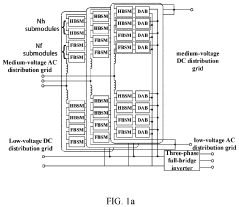
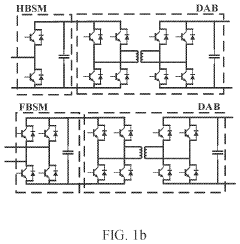
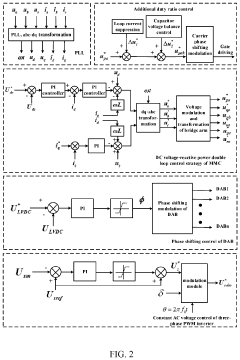
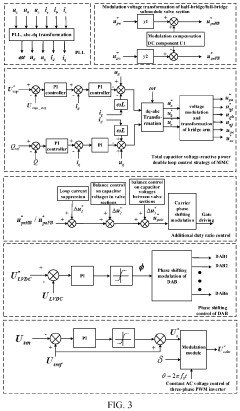
- A hybrid modular multilevel solid-state transformer with isolated dual-active-bridge converters and a three-phase full-bridge inverter, utilizing half-bridge and full-bridge submodules interconnected via DC capacitors, allows for uninterrupted operation under AC/DC faults by locking faulty ports and maintaining stable voltage and power flow through advanced control strategies.
Load tap changer
PatentWO2009073875A1
Innovation
- A hybrid load tap changer design incorporating a mechanical switch and semiconductor devices, where the mechanical switch shunts the semiconductor devices to create different conducting paths, eliminating the need for bridging reactors and current limiting devices, and utilizing gate trigger circuits to control thyristor pairs for efficient tap changes.


Grid Integration Standards for Advanced Transformers
The integration of solid-state transformers (SSTs) and hybrid transformers into existing power grids requires adherence to comprehensive standards that address both technical performance and operational safety. Current grid integration standards are evolving to accommodate the unique characteristics of these advanced transformer technologies, which differ significantly from conventional electromagnetic transformers in their control capabilities, response times, and operational parameters.
IEEE 1547 series standards provide the foundational framework for distributed energy resource interconnection, which directly applies to SST and hybrid transformer deployments. These standards establish requirements for voltage regulation, frequency response, and ride-through capabilities that advanced transformers must meet. However, the dynamic nature of SSTs necessitates additional considerations beyond traditional transformer standards, particularly regarding their power electronic interfaces and bidirectional power flow capabilities.
IEC 61850 communication protocols have become increasingly critical for advanced transformer integration, enabling real-time monitoring and control functions that leverage the inherent intelligence of SSTs and hybrid systems. These standards facilitate seamless data exchange between transformers and grid management systems, supporting advanced grid functionalities such as demand response and distributed energy management.
Grid codes are being updated globally to accommodate the enhanced capabilities of advanced transformers. European Network Codes, particularly the Requirements for Generators (RfG) and Demand Connection Code (DCC), are incorporating provisions for power electronic-based equipment that directly impact SST and hybrid transformer specifications. These codes address fault ride-through requirements, reactive power capabilities, and grid support functions that advanced transformers can provide.
Cybersecurity standards, including IEC 62351 and NIST frameworks, are becoming paramount as advanced transformers introduce digital interfaces and communication capabilities that create potential attack vectors. The integration standards must address secure communication protocols, authentication mechanisms, and resilience against cyber threats while maintaining operational reliability.
Testing and certification procedures are being developed to validate compliance with grid integration requirements. These procedures must account for the complex interactions between power electronics, control systems, and grid conditions that characterize advanced transformer operations, ensuring reliable performance across diverse operating scenarios.
IEEE 1547 series standards provide the foundational framework for distributed energy resource interconnection, which directly applies to SST and hybrid transformer deployments. These standards establish requirements for voltage regulation, frequency response, and ride-through capabilities that advanced transformers must meet. However, the dynamic nature of SSTs necessitates additional considerations beyond traditional transformer standards, particularly regarding their power electronic interfaces and bidirectional power flow capabilities.
IEC 61850 communication protocols have become increasingly critical for advanced transformer integration, enabling real-time monitoring and control functions that leverage the inherent intelligence of SSTs and hybrid systems. These standards facilitate seamless data exchange between transformers and grid management systems, supporting advanced grid functionalities such as demand response and distributed energy management.
Grid codes are being updated globally to accommodate the enhanced capabilities of advanced transformers. European Network Codes, particularly the Requirements for Generators (RfG) and Demand Connection Code (DCC), are incorporating provisions for power electronic-based equipment that directly impact SST and hybrid transformer specifications. These codes address fault ride-through requirements, reactive power capabilities, and grid support functions that advanced transformers can provide.
Cybersecurity standards, including IEC 62351 and NIST frameworks, are becoming paramount as advanced transformers introduce digital interfaces and communication capabilities that create potential attack vectors. The integration standards must address secure communication protocols, authentication mechanisms, and resilience against cyber threats while maintaining operational reliability.
Testing and certification procedures are being developed to validate compliance with grid integration requirements. These procedures must account for the complex interactions between power electronics, control systems, and grid conditions that characterize advanced transformer operations, ensuring reliable performance across diverse operating scenarios.
Power Electronics Reliability in Mixed Transformer Systems
Power electronics reliability represents a critical consideration in mixed transformer systems where solid-state transformers (SSTs) and hybrid transformers operate in integrated configurations. The complexity of these systems introduces unique reliability challenges that differ significantly from traditional transformer applications, requiring comprehensive analysis of failure modes, degradation mechanisms, and system-level interactions.
Semiconductor devices in SSTs face multiple stress factors including thermal cycling, voltage transients, and electromagnetic interference from adjacent hybrid components. Silicon carbide and gallium nitride devices, while offering superior performance characteristics, exhibit different aging patterns compared to conventional silicon-based components. The reliability of these wide-bandgap semiconductors becomes particularly critical when operating in mixed systems where load sharing and fault tolerance depend on consistent performance across different transformer technologies.
Hybrid transformer systems introduce additional complexity through the interaction between magnetic and electronic components. The magnetic cores in hybrid designs experience varying flux densities and frequencies when operating alongside SSTs, potentially accelerating core losses and thermal stress. Insulation systems must withstand not only traditional AC voltages but also high-frequency switching transients generated by adjacent solid-state components, creating new dielectric stress patterns that require specialized reliability assessment methodologies.
Thermal management emerges as a paramount reliability concern in mixed transformer configurations. SSTs generate concentrated heat loads from semiconductor switching losses, while hybrid transformers produce distributed thermal profiles from magnetic losses. The thermal coupling between these systems can create hotspots and temperature gradients that accelerate component degradation. Advanced thermal modeling and monitoring systems become essential for maintaining reliability margins across the entire mixed system architecture.
Control system reliability adds another layer of complexity, as mixed transformer systems require sophisticated coordination algorithms to manage power flow between different transformer technologies. Communication failures, sensor drift, and control algorithm instabilities can cascade into system-wide reliability issues. Redundant control architectures and fail-safe operating modes become critical design considerations for maintaining system reliability under various fault conditions.
Predictive maintenance strategies for mixed transformer systems must account for the different failure signatures and degradation patterns of solid-state and hybrid components. Machine learning algorithms trained on multi-modal sensor data can identify early warning signs of component degradation, enabling proactive maintenance scheduling that maximizes system availability while minimizing unexpected failures in these complex mixed-technology environments.
Semiconductor devices in SSTs face multiple stress factors including thermal cycling, voltage transients, and electromagnetic interference from adjacent hybrid components. Silicon carbide and gallium nitride devices, while offering superior performance characteristics, exhibit different aging patterns compared to conventional silicon-based components. The reliability of these wide-bandgap semiconductors becomes particularly critical when operating in mixed systems where load sharing and fault tolerance depend on consistent performance across different transformer technologies.
Hybrid transformer systems introduce additional complexity through the interaction between magnetic and electronic components. The magnetic cores in hybrid designs experience varying flux densities and frequencies when operating alongside SSTs, potentially accelerating core losses and thermal stress. Insulation systems must withstand not only traditional AC voltages but also high-frequency switching transients generated by adjacent solid-state components, creating new dielectric stress patterns that require specialized reliability assessment methodologies.
Thermal management emerges as a paramount reliability concern in mixed transformer configurations. SSTs generate concentrated heat loads from semiconductor switching losses, while hybrid transformers produce distributed thermal profiles from magnetic losses. The thermal coupling between these systems can create hotspots and temperature gradients that accelerate component degradation. Advanced thermal modeling and monitoring systems become essential for maintaining reliability margins across the entire mixed system architecture.
Control system reliability adds another layer of complexity, as mixed transformer systems require sophisticated coordination algorithms to manage power flow between different transformer technologies. Communication failures, sensor drift, and control algorithm instabilities can cascade into system-wide reliability issues. Redundant control architectures and fail-safe operating modes become critical design considerations for maintaining system reliability under various fault conditions.
Predictive maintenance strategies for mixed transformer systems must account for the different failure signatures and degradation patterns of solid-state and hybrid components. Machine learning algorithms trained on multi-modal sensor data can identify early warning signs of component degradation, enabling proactive maintenance scheduling that maximizes system availability while minimizing unexpected failures in these complex mixed-technology environments.
Unlock deeper insights with Patsnap Eureka Quick Research — get a full tech report to explore trends and direct your research. Try now!
Generate Your Research Report Instantly with AI Agent
Supercharge your innovation with Patsnap Eureka AI Agent Platform!