Top Strategies for Reducing ICP-MS Detection Limits
SEP 19, 20259 MIN READ
Generate Your Research Report Instantly with AI Agent
PatSnap Eureka helps you evaluate technical feasibility & market potential.
ICP-MS Technology Evolution and Detection Goals
Inductively Coupled Plasma Mass Spectrometry (ICP-MS) has evolved significantly since its commercial introduction in the early 1980s. This analytical technique combines the high-temperature ICP source with a mass spectrometer to detect and quantify trace elements at concentrations below parts per trillion (ppt). The evolution of ICP-MS technology has been driven by the increasing demand for lower detection limits across various industries including environmental monitoring, pharmaceutical analysis, semiconductor manufacturing, and clinical diagnostics.
The initial ICP-MS systems featured quadrupole mass analyzers with detection limits in the parts per billion (ppb) range. Throughout the 1990s, significant advancements in interface design, ion optics, and vacuum systems led to improved ion transmission and reduced background interference, pushing detection limits into the parts per trillion range. The introduction of collision/reaction cell technology in the late 1990s represented a pivotal advancement, effectively addressing polyatomic interferences that had previously limited detection capabilities for certain elements.
The early 2000s witnessed the emergence of high-resolution ICP-MS systems utilizing magnetic sector analyzers, capable of resolving spectral interferences through superior mass resolution. This development was particularly valuable for complex matrices where conventional quadrupole systems struggled with overlapping signals. Concurrently, improvements in sample introduction systems, including desolvation nebulizers and laser ablation techniques, expanded the application scope while enhancing sensitivity.
Recent technological innovations have focused on multi-collector ICP-MS for precise isotope ratio measurements and triple quadrupole systems that offer unprecedented selectivity through tandem mass spectrometry. These advancements have pushed detection limits for many elements into the parts per quadrillion (ppq) range, enabling analyses previously considered impossible.
The primary goals driving ICP-MS technology development include achieving sub-ppt detection limits consistently across the periodic table, improving tolerance to complex matrices without compromising sensitivity, and enhancing measurement precision at ultra-trace levels. Additional objectives include reducing sample volume requirements, minimizing spectral and non-spectral interferences, and developing more robust calibration methods for ultra-trace analysis.
As environmental regulations become increasingly stringent and biomedical research delves deeper into the role of trace elements in health and disease, the demand for lower detection limits continues to grow. Future ICP-MS development aims to overcome current limitations in detecting elements like arsenic, selenium, and iron at ultra-trace levels in complex biological matrices, while also addressing challenges in measuring isotope ratios with precision better than 0.01% relative standard deviation.
The initial ICP-MS systems featured quadrupole mass analyzers with detection limits in the parts per billion (ppb) range. Throughout the 1990s, significant advancements in interface design, ion optics, and vacuum systems led to improved ion transmission and reduced background interference, pushing detection limits into the parts per trillion range. The introduction of collision/reaction cell technology in the late 1990s represented a pivotal advancement, effectively addressing polyatomic interferences that had previously limited detection capabilities for certain elements.
The early 2000s witnessed the emergence of high-resolution ICP-MS systems utilizing magnetic sector analyzers, capable of resolving spectral interferences through superior mass resolution. This development was particularly valuable for complex matrices where conventional quadrupole systems struggled with overlapping signals. Concurrently, improvements in sample introduction systems, including desolvation nebulizers and laser ablation techniques, expanded the application scope while enhancing sensitivity.
Recent technological innovations have focused on multi-collector ICP-MS for precise isotope ratio measurements and triple quadrupole systems that offer unprecedented selectivity through tandem mass spectrometry. These advancements have pushed detection limits for many elements into the parts per quadrillion (ppq) range, enabling analyses previously considered impossible.
The primary goals driving ICP-MS technology development include achieving sub-ppt detection limits consistently across the periodic table, improving tolerance to complex matrices without compromising sensitivity, and enhancing measurement precision at ultra-trace levels. Additional objectives include reducing sample volume requirements, minimizing spectral and non-spectral interferences, and developing more robust calibration methods for ultra-trace analysis.
As environmental regulations become increasingly stringent and biomedical research delves deeper into the role of trace elements in health and disease, the demand for lower detection limits continues to grow. Future ICP-MS development aims to overcome current limitations in detecting elements like arsenic, selenium, and iron at ultra-trace levels in complex biological matrices, while also addressing challenges in measuring isotope ratios with precision better than 0.01% relative standard deviation.
Market Demand for Ultra-Trace Element Analysis
The global market for ultra-trace element analysis has experienced significant growth in recent years, driven by increasing demands across multiple sectors. Environmental monitoring represents one of the largest market segments, with regulatory bodies worldwide implementing stricter standards for contaminant detection in soil, water, and air samples. The EPA, EU Water Framework Directive, and similar agencies continue to lower permissible limits for toxic elements, necessitating more sensitive analytical techniques.
Healthcare and clinical diagnostics constitute another rapidly expanding market segment. The growing understanding of how trace elements impact human health has led to increased testing for both essential nutrients and toxic metals in biological samples. Medical research increasingly focuses on correlations between ultra-trace element concentrations and various pathological conditions, creating demand for technologies capable of detecting elements at parts-per-trillion levels in complex biological matrices.
The pharmaceutical industry represents a premium market segment willing to invest in advanced analytical capabilities. With regulations becoming more stringent regarding elemental impurities in drug products, manufacturers require highly sensitive methods to ensure compliance with ICH Q3D guidelines and USP <232>/<233> standards. This regulatory pressure has created substantial demand for improved ICP-MS technologies.
Food safety testing has emerged as another critical application area, particularly in regions with strict import/export regulations. Consumer awareness regarding food contaminants has prompted manufacturers to implement comprehensive testing protocols, further driving market growth for ultra-trace analysis capabilities.
Semiconductor and electronics manufacturing represents a specialized but lucrative market segment. As device dimensions continue to shrink, even minute elemental contamination can significantly impact performance and reliability. This industry demands detection limits in the sub-ppt range for certain elements, pushing analytical technology to its limits.
Market research indicates the global trace element analysis market was valued at approximately $4.8 billion in 2022, with projections suggesting a compound annual growth rate of 6.7% through 2028. ICP-MS technology accounts for roughly 35% of this market, with demand for lower detection limits serving as a primary driver for innovation and investment.
Regional analysis shows North America and Europe currently dominating market share, though Asia-Pacific regions demonstrate the fastest growth rates, particularly in China, Japan, and South Korea. This growth correlates with increasing industrialization, environmental concerns, and regulatory development in these regions.
Healthcare and clinical diagnostics constitute another rapidly expanding market segment. The growing understanding of how trace elements impact human health has led to increased testing for both essential nutrients and toxic metals in biological samples. Medical research increasingly focuses on correlations between ultra-trace element concentrations and various pathological conditions, creating demand for technologies capable of detecting elements at parts-per-trillion levels in complex biological matrices.
The pharmaceutical industry represents a premium market segment willing to invest in advanced analytical capabilities. With regulations becoming more stringent regarding elemental impurities in drug products, manufacturers require highly sensitive methods to ensure compliance with ICH Q3D guidelines and USP <232>/<233> standards. This regulatory pressure has created substantial demand for improved ICP-MS technologies.
Food safety testing has emerged as another critical application area, particularly in regions with strict import/export regulations. Consumer awareness regarding food contaminants has prompted manufacturers to implement comprehensive testing protocols, further driving market growth for ultra-trace analysis capabilities.
Semiconductor and electronics manufacturing represents a specialized but lucrative market segment. As device dimensions continue to shrink, even minute elemental contamination can significantly impact performance and reliability. This industry demands detection limits in the sub-ppt range for certain elements, pushing analytical technology to its limits.
Market research indicates the global trace element analysis market was valued at approximately $4.8 billion in 2022, with projections suggesting a compound annual growth rate of 6.7% through 2028. ICP-MS technology accounts for roughly 35% of this market, with demand for lower detection limits serving as a primary driver for innovation and investment.
Regional analysis shows North America and Europe currently dominating market share, though Asia-Pacific regions demonstrate the fastest growth rates, particularly in China, Japan, and South Korea. This growth correlates with increasing industrialization, environmental concerns, and regulatory development in these regions.
Current Limitations in ICP-MS Detection Sensitivity
Despite significant advancements in ICP-MS technology, several fundamental limitations continue to constrain detection sensitivity. Matrix effects remain one of the most persistent challenges, where high concentrations of matrix elements can suppress analyte signals, particularly in complex samples such as geological materials, seawater, or biological fluids. These effects occur primarily at the plasma-mass spectrometer interface and can significantly elevate detection limits for trace elements.
Spectral interferences present another major limitation, occurring when polyatomic ions, doubly charged species, or isotopes of different elements have the same mass-to-charge ratio as the analyte of interest. Common examples include 40Ar16O+ interfering with 56Fe+ and 40Ar35Cl+ with 75As+. While collision/reaction cells have mitigated many of these interferences, they cannot eliminate all spectral overlaps, especially in complex matrices.
Instrumental stability issues further compromise detection sensitivity. Fluctuations in plasma conditions, sample introduction efficiency, and detector response contribute to signal variability, necessitating longer integration times that may increase sample consumption and analysis duration. Modern instruments typically achieve 1-2% RSD for short-term stability, but this can degrade with extended operation.
Sample introduction inefficiency represents a significant bottleneck, with conventional nebulizer systems delivering only 1-3% of the sample to the plasma. The remainder is wasted as drain, constituting both an analytical limitation and an environmental concern for precious or hazardous samples.
Background noise from electronic components, plasma fluctuations, and contamination from reagents, labware, and the instrument environment establishes the practical floor for detection capabilities. Even ultra-pure reagents contain trace impurities that can contribute to elevated blanks, particularly problematic for elements like boron, sodium, and silicon that are ubiquitous in laboratory environments.
Detector technology limitations also impact sensitivity. While modern electron multipliers and discrete dynode detectors offer impressive dynamic ranges (up to 109), they still struggle with pulse-counting statistics at very low concentrations and can suffer from aging effects that reduce sensitivity over time.
Space-charge effects in the ion beam cause defocusing and loss of lighter ions when heavy matrix elements are present, resulting in mass-dependent sensitivity variations. This phenomenon becomes particularly problematic when analyzing light elements in matrices containing high concentrations of heavier elements.
Spectral interferences present another major limitation, occurring when polyatomic ions, doubly charged species, or isotopes of different elements have the same mass-to-charge ratio as the analyte of interest. Common examples include 40Ar16O+ interfering with 56Fe+ and 40Ar35Cl+ with 75As+. While collision/reaction cells have mitigated many of these interferences, they cannot eliminate all spectral overlaps, especially in complex matrices.
Instrumental stability issues further compromise detection sensitivity. Fluctuations in plasma conditions, sample introduction efficiency, and detector response contribute to signal variability, necessitating longer integration times that may increase sample consumption and analysis duration. Modern instruments typically achieve 1-2% RSD for short-term stability, but this can degrade with extended operation.
Sample introduction inefficiency represents a significant bottleneck, with conventional nebulizer systems delivering only 1-3% of the sample to the plasma. The remainder is wasted as drain, constituting both an analytical limitation and an environmental concern for precious or hazardous samples.
Background noise from electronic components, plasma fluctuations, and contamination from reagents, labware, and the instrument environment establishes the practical floor for detection capabilities. Even ultra-pure reagents contain trace impurities that can contribute to elevated blanks, particularly problematic for elements like boron, sodium, and silicon that are ubiquitous in laboratory environments.
Detector technology limitations also impact sensitivity. While modern electron multipliers and discrete dynode detectors offer impressive dynamic ranges (up to 109), they still struggle with pulse-counting statistics at very low concentrations and can suffer from aging effects that reduce sensitivity over time.
Space-charge effects in the ion beam cause defocusing and loss of lighter ions when heavy matrix elements are present, resulting in mass-dependent sensitivity variations. This phenomenon becomes particularly problematic when analyzing light elements in matrices containing high concentrations of heavier elements.
State-of-the-Art Methods for Lowering Detection Limits
01 Improving detection limits through sample preparation techniques
Various sample preparation techniques can significantly improve the detection limits of ICP-MS analysis. These include pre-concentration methods, matrix separation, and digestion procedures that help eliminate interferences and enhance signal-to-noise ratios. Proper sample preparation is crucial for achieving lower detection limits, especially when analyzing complex matrices or trace elements.- Improving detection limits through sample preparation techniques: Various sample preparation techniques can significantly improve the detection limits of ICP-MS analysis. These include pre-concentration methods, matrix separation, and digestion procedures that help eliminate interferences and enhance sensitivity. Proper sample preparation can lower detection limits by reducing background noise and increasing the signal-to-noise ratio, allowing for more accurate detection of trace elements at lower concentrations.
- Instrumental modifications for enhanced sensitivity: Modifications to ICP-MS instrumentation can substantially improve detection limits. These include optimized ion optics, collision/reaction cell technology, and high-efficiency sample introduction systems. Advanced detector designs and improved vacuum systems also contribute to lower detection limits by enhancing ion transmission efficiency and reducing background interference, allowing for detection of elements at parts-per-trillion levels or below.
- Specialized techniques for ultra-trace analysis: Specialized ICP-MS techniques have been developed for ultra-trace analysis with extremely low detection limits. These include laser ablation ICP-MS, high-resolution ICP-MS, and sector field instruments. These advanced methodologies enable detection of elements at sub-parts-per-trillion levels by improving mass resolution, reducing polyatomic interferences, and enhancing overall analytical sensitivity for challenging sample types.
- Calibration and standardization methods: Advanced calibration and standardization methods play a crucial role in achieving lower detection limits in ICP-MS. Techniques such as isotope dilution, standard addition, and internal standardization help compensate for matrix effects and instrumental drift. Proper calibration strategies ensure accurate quantification at low concentrations and improve method detection limits by enhancing measurement precision and reducing systematic errors.
- Application-specific optimization for improved detection limits: Detection limits in ICP-MS can be optimized for specific applications through tailored methodologies. This includes specialized protocols for environmental monitoring, food safety testing, pharmaceutical analysis, and clinical diagnostics. By adjusting operating parameters such as plasma conditions, nebulizer gas flow, and integration times based on the specific analytes and matrices of interest, detection limits can be significantly improved for targeted applications.
02 Instrumentation modifications for enhanced sensitivity
Modifications to ICP-MS instrumentation can substantially lower detection limits. These include improvements in plasma generation, ion optics, collision/reaction cell technology, and detector systems. Advanced hardware configurations help minimize background noise, reduce interferences, and improve ion transmission efficiency, resulting in better detection capabilities for ultra-trace analysis.Expand Specific Solutions03 Interference reduction strategies
Various strategies can be employed to reduce interferences in ICP-MS, thereby improving detection limits. These include the use of collision/reaction cells, mathematical correction models, and alternative sample introduction systems. By effectively managing spectral and non-spectral interferences, analysts can achieve lower detection limits for challenging elements and complex matrices.Expand Specific Solutions04 Application-specific optimization methods
Detection limits in ICP-MS can be optimized for specific applications through tailored methodologies. Different fields such as environmental monitoring, pharmaceutical analysis, and geological studies require specialized approaches to achieve optimal detection limits. These may include specific calibration strategies, internal standardization techniques, and customized sample introduction systems designed for particular sample types.Expand Specific Solutions05 Coupling techniques and hyphenated methods
Coupling ICP-MS with separation techniques such as chromatography, laser ablation, or electrophoresis can significantly improve detection limits for specific analytes. These hyphenated methods allow for speciation analysis, removal of matrix effects, and enhanced selectivity. The combination of separation power with the sensitivity of ICP-MS enables detection limits in the sub-ppt range for many elements in complex samples.Expand Specific Solutions
Leading Manufacturers and Research Institutions in ICP-MS
The ICP-MS detection limits reduction market is currently in a growth phase, characterized by increasing demand for ultra-trace element analysis across environmental monitoring, pharmaceutical, and semiconductor industries. The global market size for advanced analytical instrumentation is expanding, projected to reach several billion dollars by 2025. Leading players like Agilent Technologies and PerkinElmer (Revvity) dominate with comprehensive solutions, while specialized innovators such as Kimia Analytics and AmberGen are disrupting the space with novel technologies. Academic institutions including ETH Zurich and research organizations like CNRS are advancing fundamental methodologies. The competitive landscape shows a blend of established instrumentation providers focusing on hardware optimization and emerging companies developing specialized sample preparation techniques, microfluidic innovations, and software algorithms to push detection capabilities into the parts-per-quadrillion range.
Agilent Technologies, Inc.
Technical Solution: Agilent Technologies has developed comprehensive strategies for reducing ICP-MS detection limits through their Ultra High Matrix Introduction (UHMI) technology and advanced collision/reaction cell systems. Their ICP-MS instruments feature optimized plasma conditions with improved ionization efficiency and reduced matrix effects. Agilent's proprietary Octopole Reaction System (ORS) employs helium collision mode to effectively remove polyatomic interferences through kinetic energy discrimination, while their optional MS/MS capability provides enhanced selectivity for challenging elements[1]. Their latest 7900 and 8900 ICP-MS systems incorporate advanced sample introduction components including specialized nebulizers and spray chambers that significantly improve sample transport efficiency while minimizing matrix loading. Additionally, Agilent has implemented sophisticated signal processing algorithms that enhance signal-to-noise ratios through intelligent integration and outlier rejection techniques[2].
Strengths: Industry-leading sensitivity with detection limits in the sub-ppt range for most elements; exceptional interference management through advanced collision/reaction cell technology; robust performance across diverse sample matrices. Weaknesses: Higher acquisition and operational costs compared to some competitors; complex systems require specialized training; some applications may require additional accessories for optimal performance.
China University of Geosciences
Technical Solution: China University of Geosciences has developed innovative approaches to reducing ICP-MS detection limits through comprehensive optimization of sample preparation and introduction systems. Their research teams have pioneered advanced preconcentration techniques using novel nanomaterials as selective adsorbents for trace elements, achieving enrichment factors of 50-100× for many elements[7]. They've developed specialized chelating resins with high selectivity for specific element groups that effectively separate target analytes from matrix components. The university has also made significant contributions to online coupling of separation techniques with ICP-MS, including advanced chromatographic interfaces that minimize band broadening and sample dilution. Their researchers have optimized plasma conditions through systematic investigation of RF power, gas flows, and torch geometries to maximize ionization efficiency while minimizing oxide formation. Additionally, they've developed novel data processing algorithms that employ machine learning techniques to distinguish true signals from background noise, effectively improving detection capabilities for ultra-trace analysis in complex geological and environmental samples[8].
Strengths: Innovative sample preparation techniques that achieve exceptional preconcentration factors; specialized expertise in geological and environmental applications; cost-effective approaches accessible to broader research communities. Weaknesses: Some techniques require specialized equipment not widely available; longer sample preparation times for certain preconcentration methods; some approaches may be matrix-specific and require adaptation for different sample types.
Critical Innovations in Sample Introduction and Ion Optics
System and Method For Automated Sample Introduction
PatentInactiveUS20100229999A1
Innovation
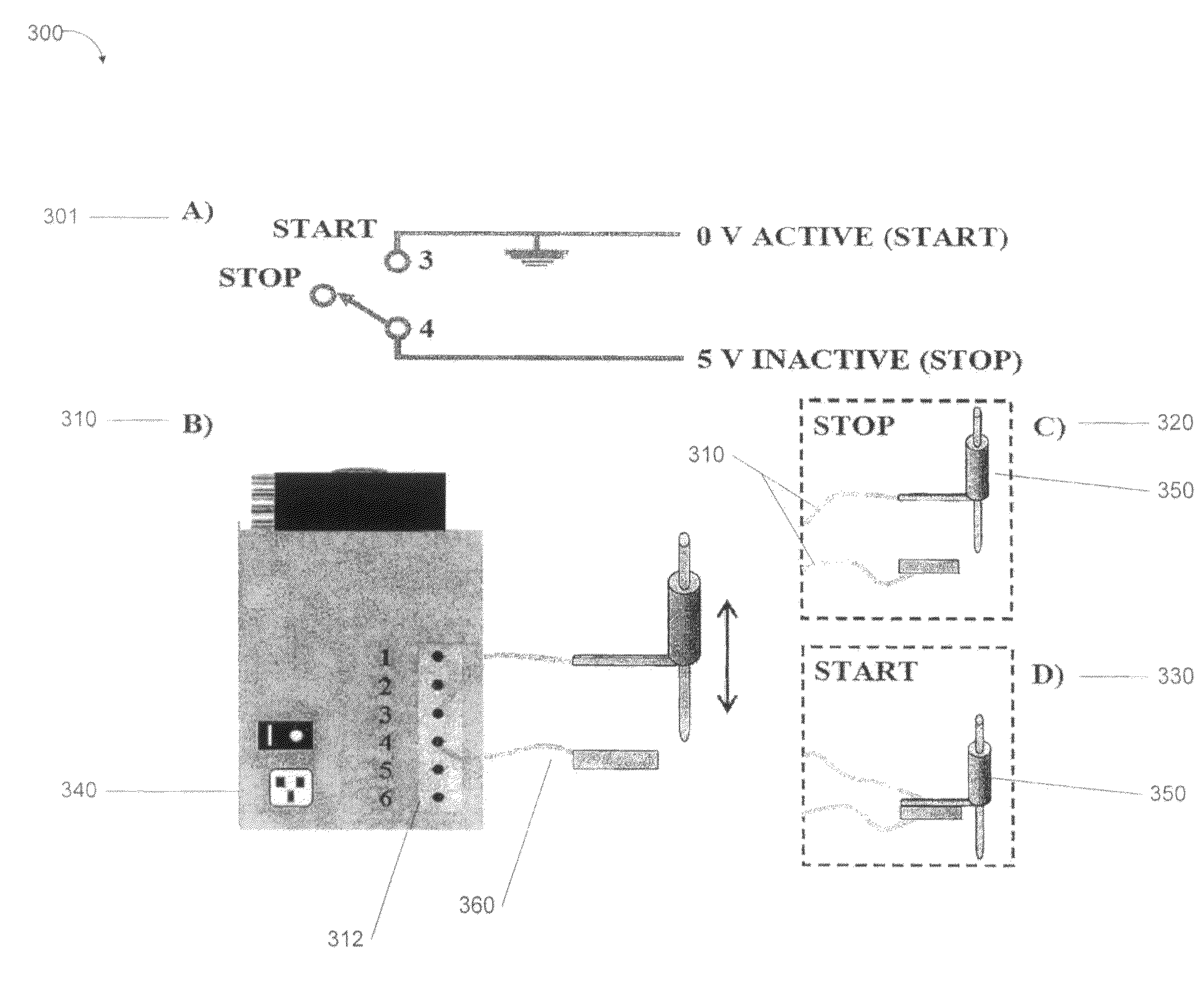
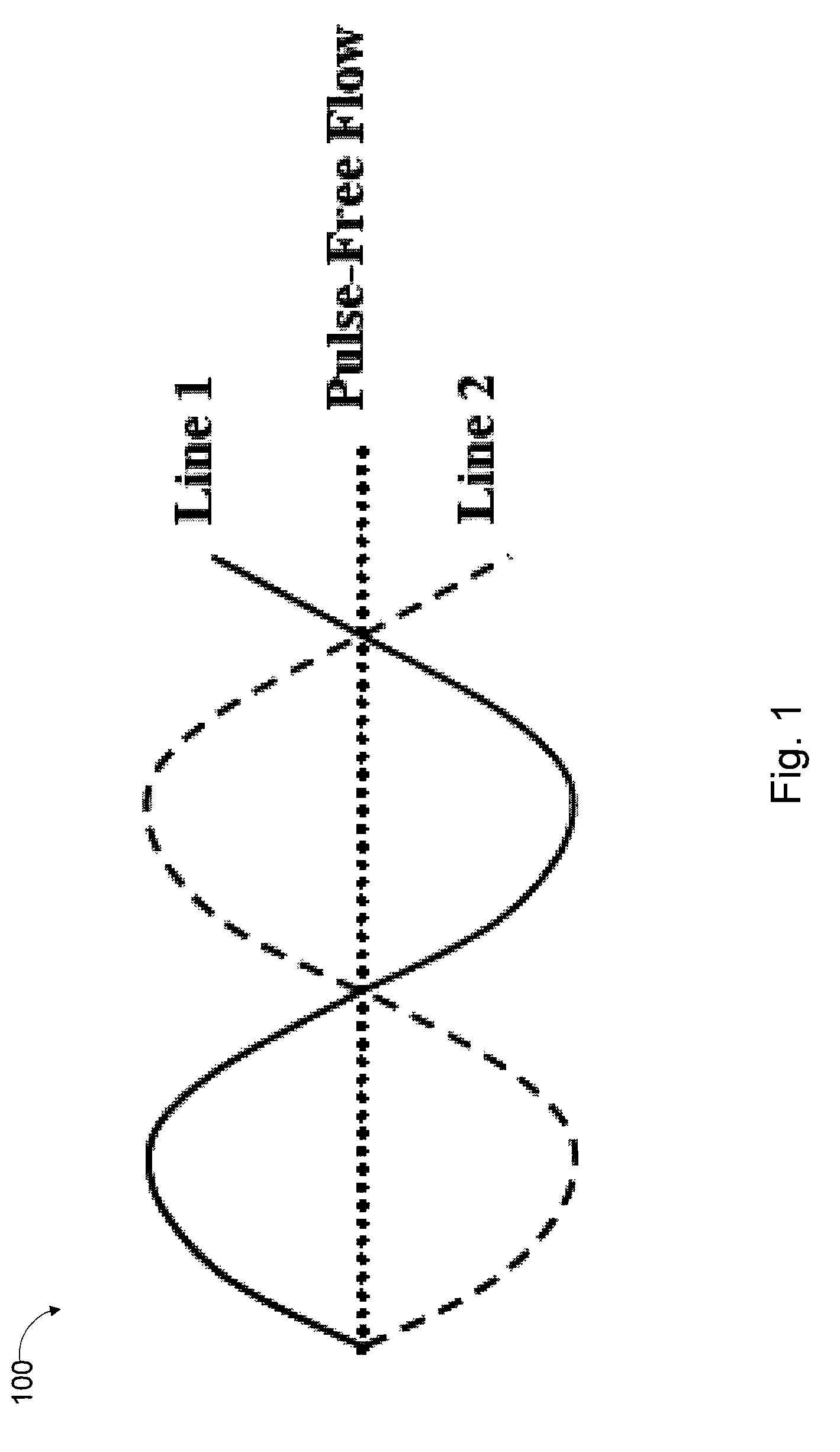
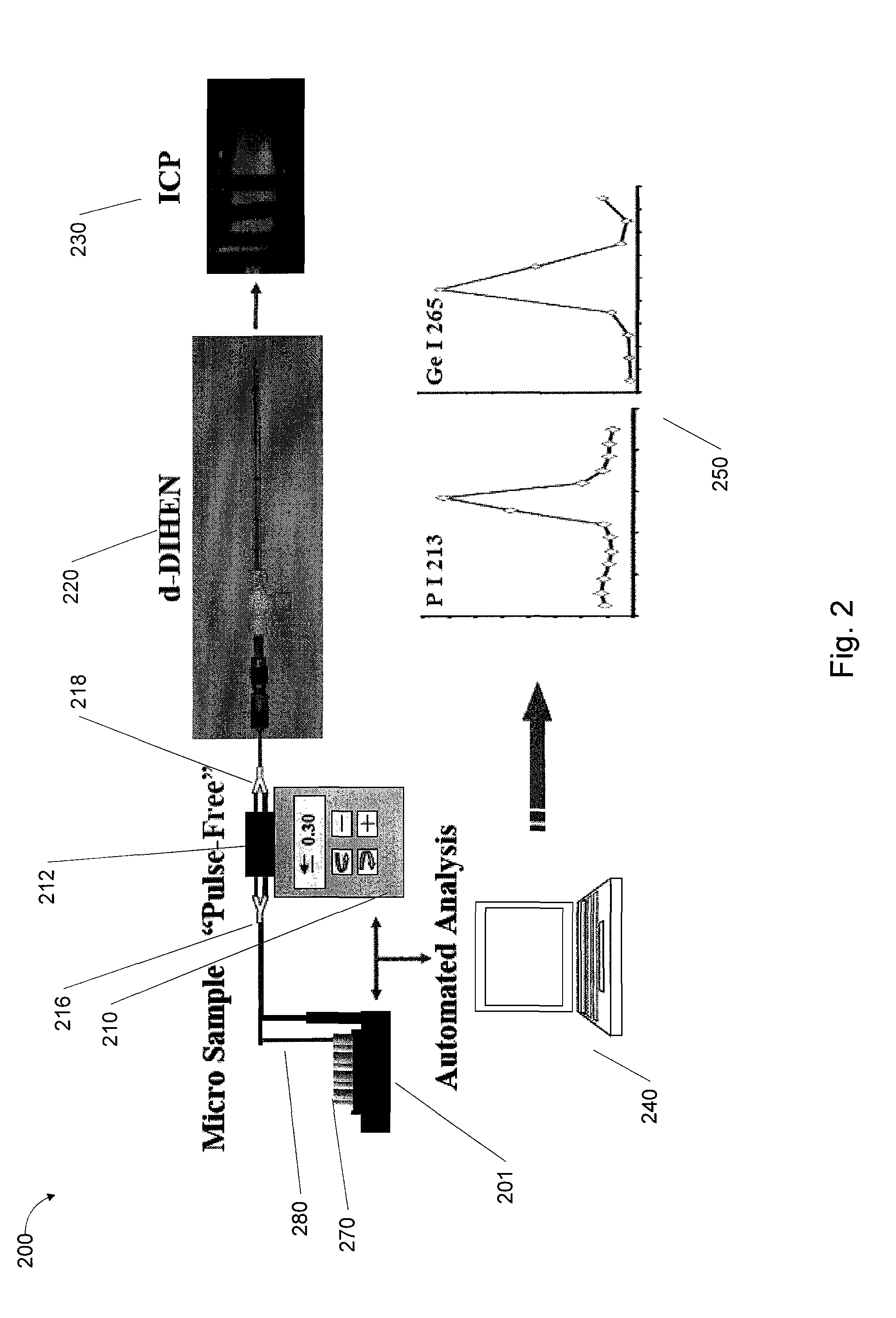
- A demountable direct injection high efficiency nebulizer (d-DIHEN) system is integrated with HP-ICP-OES, enabling pulse-free sample aspiration and automated sampling, reducing sample consumption and increasing sensitivity, allowing for precise phosphorus content measurement in acid-digested nucleotides and DNA.
Interference Mitigation Strategies in Ultra-Trace Analysis
Interference mitigation represents a critical frontier in achieving ultra-trace detection capabilities with ICP-MS technology. The primary challenge in lowering detection limits stems from various interference sources that mask analyte signals. Physical interferences arise from sample matrix effects, causing signal suppression or enhancement. Spectral interferences occur when polyatomic species or isobaric elements overlap with analyte masses, creating false positive signals or elevating background levels.
Modern collision/reaction cell technologies have revolutionized interference management by utilizing kinetic energy discrimination. These systems employ collision gases like helium to reduce polyatomic interferences through energy-dependent collisions, while reaction gases such as hydrogen, ammonia, or oxygen selectively react with interfering species. The selection of appropriate cell gases depends on the specific analyte and interference profile, requiring optimization for each analytical scenario.
Mathematical correction algorithms provide complementary approaches to physical interference reduction. Equations based on natural isotopic abundances can correct for isobaric overlaps, while multivariate statistical methods help distinguish analyte signals from complex interference patterns. Advanced software implementations now automate these corrections, significantly improving analytical accuracy at ultra-trace levels.
Sample preparation strategies represent another critical interference mitigation approach. Matrix separation techniques including chelation, precipitation, and chromatographic methods physically remove interfering components before analysis. Specialized digestion protocols minimize the formation of problematic polyatomic species, while dilution techniques can reduce matrix effects when analyte concentrations permit.
High-resolution mass spectrometry offers the ultimate solution for certain interference challenges. Triple-quadrupole ICP-MS systems provide enhanced selectivity through tandem mass filtering, enabling discrimination between analytes and interferences with identical mass-to-charge ratios. This technology has proven particularly valuable for challenging elements like arsenic, selenium, and chromium in complex matrices.
Emerging technologies continue to expand interference mitigation capabilities. Cold plasma conditions reduce argon-based interferences, while specialized sample introduction systems minimize oxide formation. The integration of machine learning algorithms for automated interference identification and correction represents a promising frontier, potentially enabling adaptive analytical methods that respond to sample-specific interference profiles.
Modern collision/reaction cell technologies have revolutionized interference management by utilizing kinetic energy discrimination. These systems employ collision gases like helium to reduce polyatomic interferences through energy-dependent collisions, while reaction gases such as hydrogen, ammonia, or oxygen selectively react with interfering species. The selection of appropriate cell gases depends on the specific analyte and interference profile, requiring optimization for each analytical scenario.
Mathematical correction algorithms provide complementary approaches to physical interference reduction. Equations based on natural isotopic abundances can correct for isobaric overlaps, while multivariate statistical methods help distinguish analyte signals from complex interference patterns. Advanced software implementations now automate these corrections, significantly improving analytical accuracy at ultra-trace levels.
Sample preparation strategies represent another critical interference mitigation approach. Matrix separation techniques including chelation, precipitation, and chromatographic methods physically remove interfering components before analysis. Specialized digestion protocols minimize the formation of problematic polyatomic species, while dilution techniques can reduce matrix effects when analyte concentrations permit.
High-resolution mass spectrometry offers the ultimate solution for certain interference challenges. Triple-quadrupole ICP-MS systems provide enhanced selectivity through tandem mass filtering, enabling discrimination between analytes and interferences with identical mass-to-charge ratios. This technology has proven particularly valuable for challenging elements like arsenic, selenium, and chromium in complex matrices.
Emerging technologies continue to expand interference mitigation capabilities. Cold plasma conditions reduce argon-based interferences, while specialized sample introduction systems minimize oxide formation. The integration of machine learning algorithms for automated interference identification and correction represents a promising frontier, potentially enabling adaptive analytical methods that respond to sample-specific interference profiles.
Validation and Quality Control for Low-Level Measurements
Validation and quality control procedures are paramount when pushing the boundaries of ICP-MS detection limits. Establishing robust protocols ensures that ultra-trace measurements remain reliable and defensible. The foundation of effective validation begins with comprehensive method validation protocols that specifically address low-level measurement challenges. These protocols must include determination of method detection limits (MDLs) using statistically valid approaches such as the 3σ method based on multiple measurements of low-concentration standards or method blanks.
For day-to-day quality control, laboratories should implement multi-level QC samples that bracket the expected concentration range, with particular emphasis on the lower end of the calibration curve. Regular analysis of certified reference materials (CRMs) that contain analytes at concentrations near the detection limits provides essential verification of measurement accuracy. When suitable CRMs are unavailable, laboratories should consider participating in interlaboratory comparison studies specifically designed for ultra-trace analysis.
Statistical process control charts represent a critical tool for monitoring long-term method performance. Shewhart charts tracking instrument sensitivity, background levels, and recovery of low-level QC samples can identify subtle drift or degradation before it impacts analytical results. Implementation of warning and action limits at 2σ and 3σ, respectively, provides objective criteria for corrective actions.
Blank monitoring deserves special attention in low-level measurements. Establishing separate control charts for method blanks, calibration blanks, and field blanks helps identify contamination sources. Temporal analysis of blank trends can reveal systematic issues related to reagent quality, laboratory environment, or instrument condition. Laboratories should establish maximum acceptable blank values based on method requirements rather than arbitrary thresholds.
Uncertainty estimation becomes increasingly important as measurements approach detection limits. A comprehensive uncertainty budget should account for all relevant factors, including calibration uncertainty, blank variability, and recovery bias. The expanded measurement uncertainty should be clearly reported alongside analytical results to provide data users with appropriate context for decision-making.
Regular proficiency testing specifically targeting low-level analysis serves as an external validation of a laboratory's capabilities. Participation in specialized ultra-trace PT schemes, while challenging to find, provides valuable benchmarking against peer laboratories and helps identify systematic biases that may not be apparent through internal QC procedures.
For day-to-day quality control, laboratories should implement multi-level QC samples that bracket the expected concentration range, with particular emphasis on the lower end of the calibration curve. Regular analysis of certified reference materials (CRMs) that contain analytes at concentrations near the detection limits provides essential verification of measurement accuracy. When suitable CRMs are unavailable, laboratories should consider participating in interlaboratory comparison studies specifically designed for ultra-trace analysis.
Statistical process control charts represent a critical tool for monitoring long-term method performance. Shewhart charts tracking instrument sensitivity, background levels, and recovery of low-level QC samples can identify subtle drift or degradation before it impacts analytical results. Implementation of warning and action limits at 2σ and 3σ, respectively, provides objective criteria for corrective actions.
Blank monitoring deserves special attention in low-level measurements. Establishing separate control charts for method blanks, calibration blanks, and field blanks helps identify contamination sources. Temporal analysis of blank trends can reveal systematic issues related to reagent quality, laboratory environment, or instrument condition. Laboratories should establish maximum acceptable blank values based on method requirements rather than arbitrary thresholds.
Uncertainty estimation becomes increasingly important as measurements approach detection limits. A comprehensive uncertainty budget should account for all relevant factors, including calibration uncertainty, blank variability, and recovery bias. The expanded measurement uncertainty should be clearly reported alongside analytical results to provide data users with appropriate context for decision-making.
Regular proficiency testing specifically targeting low-level analysis serves as an external validation of a laboratory's capabilities. Participation in specialized ultra-trace PT schemes, while challenging to find, provides valuable benchmarking against peer laboratories and helps identify systematic biases that may not be apparent through internal QC procedures.
Unlock deeper insights with PatSnap Eureka Quick Research — get a full tech report to explore trends and direct your research. Try now!
Generate Your Research Report Instantly with AI Agent
Supercharge your innovation with PatSnap Eureka AI Agent Platform!