
Hand vein recognition method based on curve matching
A vein recognition and curve technology, applied in biometrics recognition, character and pattern recognition, instruments, etc., can solve the problems of recognition influence and speed up algorithm matching speed, so as to enhance feature anti-interference ability, speed up algorithm matching speed, and improve inter-class The effect of discriminative ability
Patent Information
- Authority / Receiving Office
- CN · China
- Patent Type
- Applications(China)
- Current Assignee / Owner
- Publication Date
- 2015-12-23
Smart Images
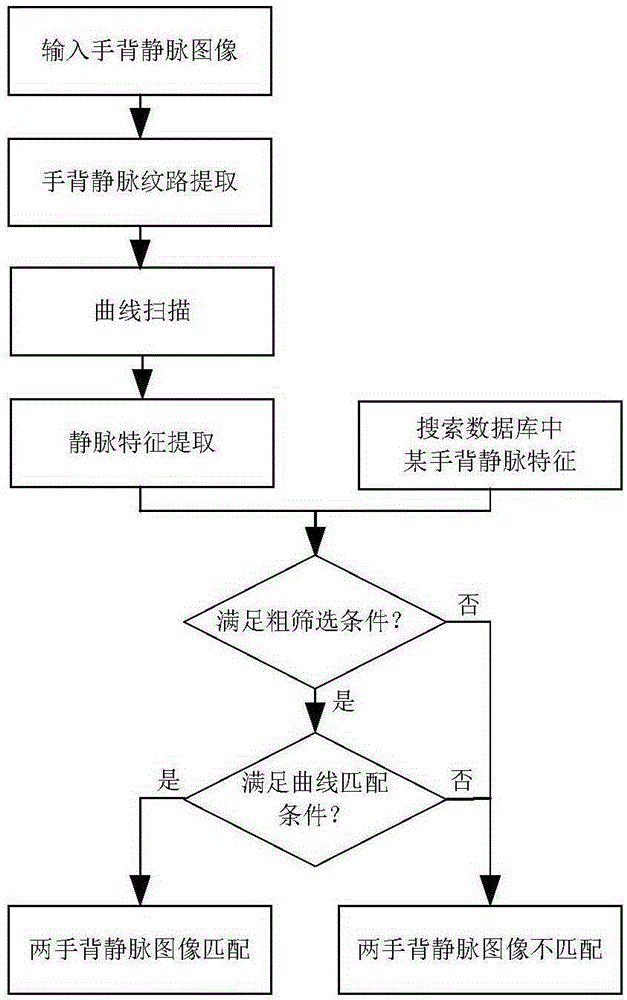
Figure 1 
Figure 2 
Figure 3
Abstract
Description
technical field
[0001] The invention relates to the technical field of security biometric feature recognition, in particular to a method for recognizing veins on the back of a hand. Background technique
[0002] Vein recognition is currently a research hotspot in the field of biometric identification. Its main advantage is that veins are hidden inside the body and are not easy to be copied, stolen or interfered with. It can be widely used in the fields of access control and attendance in banks, offices, shopping malls and other places, and has great theoretical research significance and market application value. Currently, vein recognition mainly includes finger vein recognition, palm vein recognition and hand vein recognition. Compared with finger veins, veins on the back of the hand have richer features, are less affected by rotation changes, and are more significant and robust; compared with palm veins, palm veins are easily disturbed by palm prints, and the acquisition ...
Examples
Embodiment Construction
[0044] The present invention will be further described in detail below in conjunction with specific embodiments and accompanying drawings.
[0045] The flow chart of the present invention is as figure 1 Shown, describe concrete steps of the present invention in detail below in conjunction with flowchart:
[0046] 1. Extraction of vein lines on the back of the hand
[0047] Hand vein texture extraction includes three parts: image segmentation, image filtering and image thinning. Among them, the image segmentation adopts the optimized repeated line tracking method proposed in the literature "Analgorithmforfinger-veinsegmentation based on modified repeated line tracking (ImagingScienceJournal, 2013)"; in the image filtering stage, the opening operation of mathematical morphology is used to filter out the noise, and then the closing operation is used to fill the holes. The window size is set to 7×7 (unit: pixel); the image refinement adopts the hit or miss transformation of math...