

Scalp electroencephalogram (EEG) retrospective epileptic seizure point detection method and system
A technology of EEG signals and epileptic seizures, applied in diagnostic recording/measurement, medical science, complex mathematical operations, etc., can solve problems such as inconvenient analysis, high misjudgment rate, crosstalk between EEG signals, etc., and achieves significant optimization effects, The effect of remarkable effect and good wide adaptability
Patent Information
- Authority / Receiving Office
- CN · China
- Patent Type
- Applications(China)
- Current Assignee / Owner
- Publication Date
- 2016-01-20
- Estimated Expiration
- Not applicable · inactive patent
Smart Images
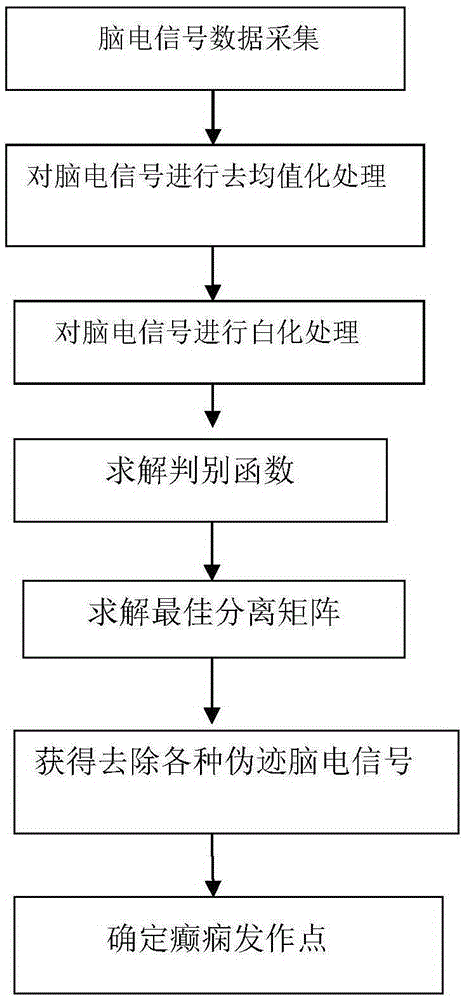
Figure 1 
Figure 2 
Figure 3
Abstract
Description
technical field
[0001] The invention relates to the technical field of scalp electroencephalogram signals, in particular to a method and system for retrospectively detecting epileptic seizure points of scalp electroencephalogram signals. Background technique
[0002] Epilepsy is a disease of nervous system disorder. According to literature reports, the incidence of the disease in the population is about 0.5% to 2%. It is characterized by disorder and brings great inconvenience to the lives of patients. Electroencephalogram (EEG) examination is a common technique for epilepsy diagnosis and focus location in clinical practice at present, and the analysis of epilepsy by EEG is easily accepted by doctors and patients. The time resolution of the EEG signal is high, and it can accurately reflect the time-varying characteristics of the brain at the millisecond level. The 24-hour long-range EEG signal is an important basis for the diagnosis of epilepsy. However, in the face of suc...
Examples
Embodiment Construction
[0044] The present invention will be described in further detail below in conjunction with the accompanying drawings. It is necessary to point out that the following specific embodiments are only used to further illustrate the present invention, and should not be construed as limiting the protection scope of the present invention. SUMMARY OF THE INVENTION Some non-essential improvements and adjustments are made to the present invention.
[0045] like figure 1 As shown, the scalp EEG signal retrospective epileptic seizure point detection method of the present invention comprises the following steps:
[0046] Step 1. Obtain and remove various artifact EEG signals
[0047] Realize fast blind source separation and remove EEG signals through negative entropy of EEG signals and two-stage genetic optimization algorithm
[0048] Various artifacts, especially the influence of ECG noise. The blind source fast separation algorithm can be roughly described as:
[0049] S-->mixing matr...