
Train precise positioning method and system based on rail geometrical characteristic information matching
A technology of information matching and geometric features, applied in navigation calculation tools, navigation through velocity/acceleration measurement, etc., can solve the problems of high cost and difficulty in implementation, and achieve the effect of low construction cost, obvious features and rich varieties.
Patent Information
- Authority / Receiving Office
- CN · China
- Patent Type
- Applications(China)
- Current Assignee / Owner
- Publication Date
- 2017-11-28
Smart Images
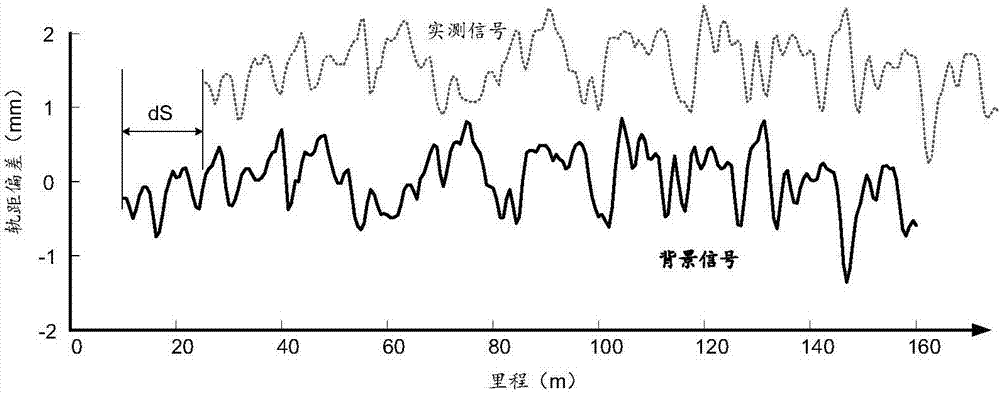
Figure 1 
Figure 2 
Figure 3
Abstract
Description
technical field
[0001] The invention belongs to the field of railway train and locomotive positioning, and relates to a precise train positioning method and system based on track geometric feature information matching. Background technique
[0002] Train positioning is the basis of operation control and on-board state detection. Its accuracy and reliability are important factors for determining the safety protection distance of trains. It is related to the running interval of trains and affects the efficiency and scheduling of rail transit systems. Accurately determining the position of the train is of great significance to promote the research of train operation control system, optimize the operation efficiency of rail transit, and the development of rail transit system, so the precise positioning technology of train has always been paid attention to.
[0003] The positioning of the train is essentially one-dimensional positioning, that is, to determine the milepost where t...
Examples
Embodiment Construction
[0059] The existing map matching methods rely on the characteristic signals such as the three-dimensional coordinates of the orbit or the radius of curvature. The characteristic signal on which the matching in the present invention depends is the measured value of the track geometry state parameter, which is also a significant difference between the present invention and the prior art.
[0060] Since the track cannot be staked out or fine-tuned to be absolutely smooth, there is always a certain amount of track deformation and track irregularity. Even the high-speed rail tracks in operation have small deformations, that is, unevenness. See figure 1 As shown, the fine-tuned track has met the smoothness requirements of the high-speed rail, but the actual gauge still has a deviation of about 2mm, which is also the deviation allowed by the technical specifications. Along the mileage direction, the actual gauge fluctuates around the standard gauge. Although the magnitude of the fl...