
Protective shell receptive for graphics
- Summary
- Abstract
- Description
- Claims
- Application Information
AI Technical Summary
Benefits of technology
Problems solved by technology
Method used
Image

Examples
Example
DETAILED DESCRIPTION OF THE DRAWINGS
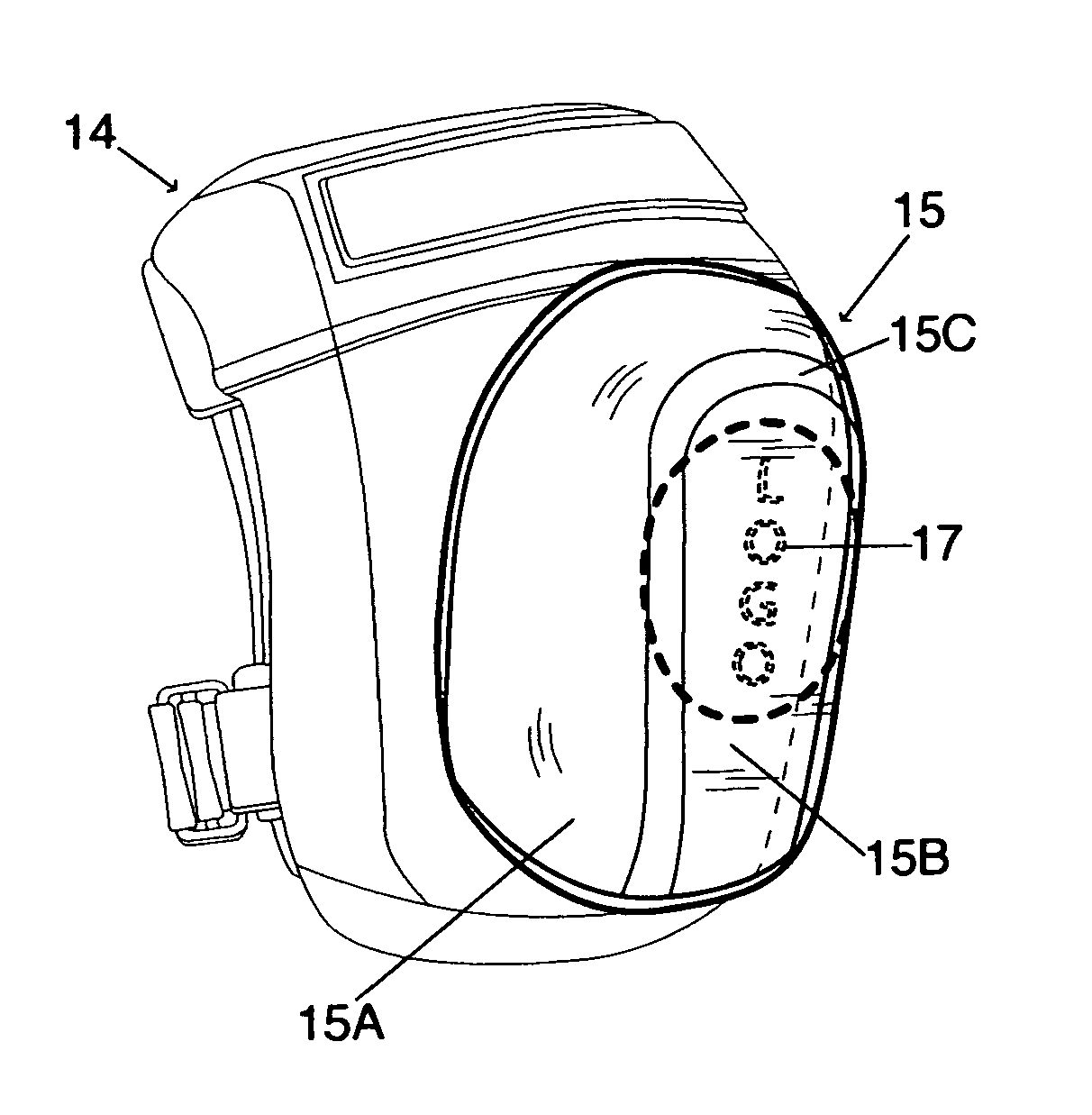
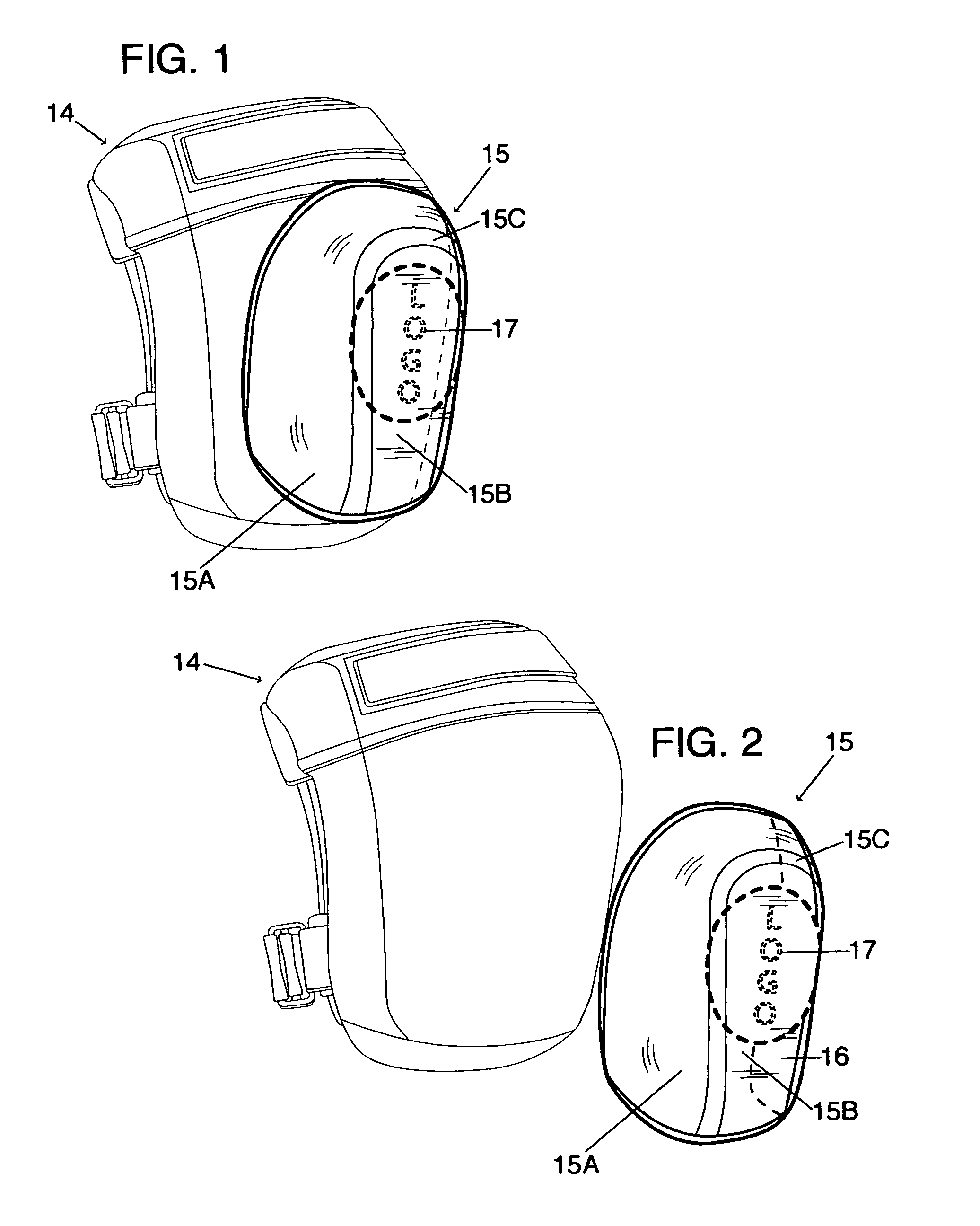
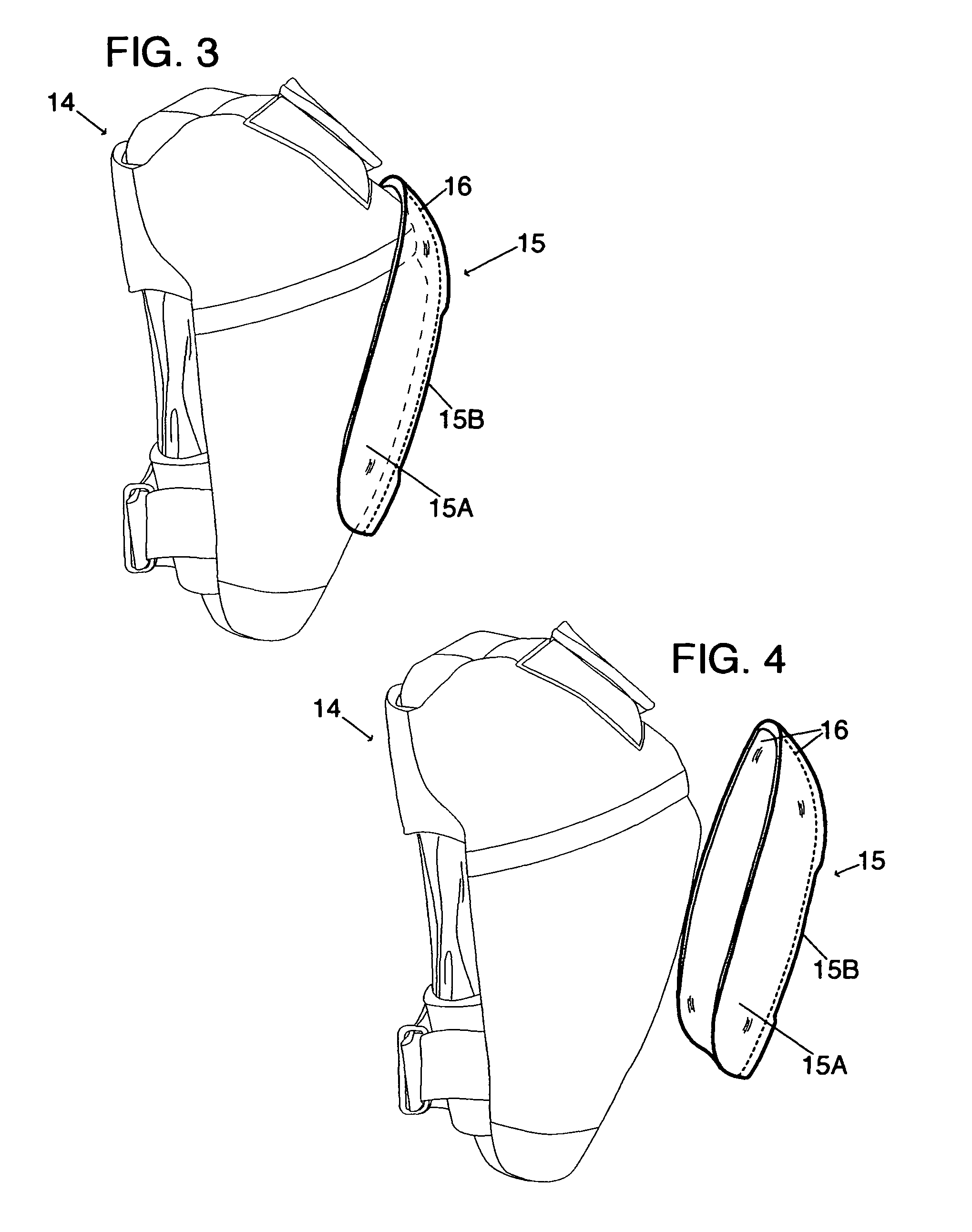
[0026]Referring to FIG. 1-4, a protective knee pad 14 is shown for illustrative purposes.
[0027]Referring to FIG. 1 a protective transparent shell 15 is shown attached to knee pad 14. A thin dashed line is drawn on pad 14 to delineate its periphery outline. Shell 15 is comprised of a convex exterior face 15A, a concave exterior face 15B, a buffer zone transitional area from exterior concave face to exterior convex face 15C, an interior concave face 16 (shown in FIG. 2), and a graphic 17. Shell 15 is transparent with the exception of graphic 17 which is opaque in color. At present, polycarbonate is contemplated for shell 15, but other materials are suitable. In FIGS. 1, 2, 5, and 6, Graphic 17 is drawn with dashed lines to represent its placement on the shell's interior concave face 16 which cannot be drawn in FIG. 1 because shell 15 sits on top of pad 14. Shown in FIG. 2, Interior face 16 lies opposite of: convex exterior face 15A, concave exterior...
PUM
 Login to View More
 Abstract
Description
Claims
Application Information
 Login to View More