
Method for producing high-yield gamma-propalanine and application thereof
A technology of aminobutyric acid and sodium glutamate, which is applied in the fields of medical biology and food engineering, and can solve problems such as hidden safety and sanitation
Patent Information
- Authority / Receiving Office
- CN · China
- Patent Type
- Patents(China)
- Current Assignee / Owner
- Publication Date
- 2012-08-22
- Estimated Expiration
- Not applicable · inactive patent
Smart Images
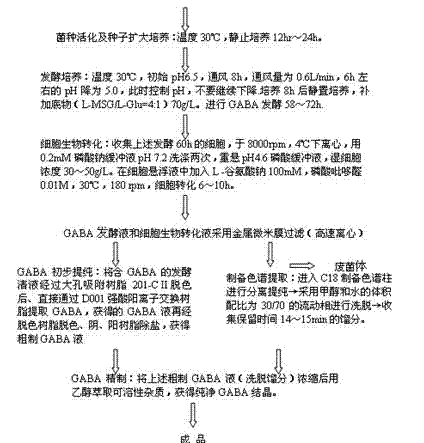
Figure 1 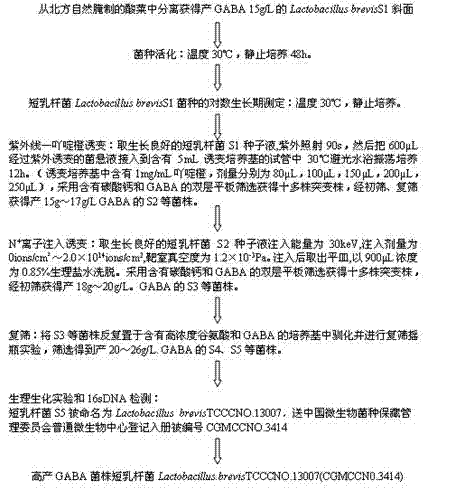
Figure 2 
Figure 3
Abstract
Description
technical field
[0001] The invention belongs to the technical field of medical biology and food engineering, is an organic combination of modern biological and chemical engineering and traditional fermentation engineering technology, and is an improvement on the current production method of gamma-aminobutyric acid (GABA) by biotechnology. More specifically, Lactobacillus brevis isolated and bred from sauerkraut in northern my country Lactobacillus brevis CGMCCNO.3414, through the biotransformation of growing cells and resting cells, efficiently produces the internationally recognized safest API and health food - γ-aminobutyric acid. Background technique
[0002] γ-Aminobutyric acid (GABA), also known as aminobutyric acid, is a natural amino acid that is not a protein component. It exists widely in nature and is an important inhibitory neurotransmitter that has been studied in depth. Metabolic activity has the effects of lowering blood pressure, regulating arrhythmia, impro...
Examples
Embodiment 1
[0060] (2) Ultraviolet-acridine orange mutagenesis: Take the well-grown Lactobacillus brevis S1 seed solution, irradiate with ultraviolet light for 90s, and then transfer 600 μL of the ultraviolet-mutated bacterial suspension into a test tube containing 5 mL of mutagenic medium Incubate in a dark water bath for 12 hours at 30°C with shaking. (The mutagenesis medium contains 1 mg / mL acridine orange, the doses are 80 μL, 100 μL, 150 μL, 200 μL, 250 μL)
[0061] (3) N + Ion implantation mutagenesis: Take the well-grown Lactobacillus brevis seed liquid, dilute it to 100 times with 8% sterile glycerol solution, take 100 μL and evenly spread it on a sterile plate, dry it with sterile wind, take it out for microscopic examination Ion implantation is performed on those cells that overlap. use N + Ions were implanted, the implantation energy was 30keV, and the implantation dose was 0ions / cm 2 ~2.0×10 14 ions / cm 2 , the vacuum degree of the target chamber is 1.2×10 -3 Pa. After...
Embodiment 2
[0071] will activate the Lactobacillus brevis CGM CCN 0 The .3414 strain was inoculated in the seed medium for cultivation, and was transferred to the fermentation medium when the bacterial mass reached the fermentation conditions.
[0072] Seed medium (g / L) and cultivation method: corn saccharification solution 20, peptone 10, yeast extract powder 5, ammonium citrate 2, magnesium sulfate 0.58, manganese sulfate 0.25, sodium acetate 2, potassium dihydrogen phosphate 2. Seed culture conditions: 30 ° C incubator, static culture for 12 hours. According to the inoculation amount of 10-15%, it is inserted into a 5L fermenter.
[0073] Fermentation medium (g / L) and culture method: corn saccharification solution 20, yeast extract powder 20, corn steep liquor 10, sodium acetate 2, potassium phosphate 2, magnesium sulfate 0.4, ammonium sulfate 0.2. The culture temperature of the fermenter was controlled at 30°C and the initial pH was 6.5. Ventilate for 8 hours, the ventilation rat...
Embodiment 3
[0079] Seed medium composition (g / L): peptone 10, yeast extract 10, glucose 20, sodium acetate 5, ammonium citrate 2, MnSO 4˙ h 2 O 0.05, MgSO 4˙ 7H 2 0 0.2, Tween 80 1mL, distilled water 1000 mL, pH control 5.0-6.0. Transfer to the fermentation medium containing 8% L-sodium glutamate at an inoculum size of 10-15%.
[0080] Fermentation medium (g / L): corn steep liquor 10, glucose 22, yeast powder 15, sodium acetate 2, magnesium sulfate 0.2, (NH 4 ) 2 SO 4 0.2, pH6.0. After 16 hours of cultivation, the growth of the bacteria entered the logarithmic phase, and the pH was adjusted to 4.6 and kept at 4.6. After 60 hours of cultivation, the GABA production reached a maximum of 76.52g / L. After culturing the cells for 60 h, the cells were collected, centrifuged for 10 min, 8000 rpm, 4 °C, washed twice with 0.2 mM sodium phosphate buffer pH 7.2, resuspended in pH 4.6 phosphate buffer, and the wet cell concentration was 25 g / L.
[0081]Add 80 mM of L-sodium glutamate and 0.01 M...